Fritz Allen, MD
Visionary Eye Doctors
Review of Uveitis
• A generic term for intraocular inflammation.
• Does not indicate site of inflammation
• Does not indicate the cause:
Autoimmune or Infectious
Uveitis: Definition
How Common is Uveitis?
 10-15% of severe visual handicap in the U.S.
 3rd
leading cause of blindness in the world
 U.S. Incidence 52.4/100,000
 U.S. Prevalence 115.3/100,000
 3 times higher than previous estimate
 Prevalence higher in women (1:1.4)
 Common in older patients
 Gritz and Wong. Ophthalmology 2004
 Worldwide prevalence ~2.4 million
 ~5-10% of cases in children <16 yrs
 Mean age of onset is 37.2 years
 Range 20-50 years
151,200
322,000
2,400,000
U.S. Prevalence WorldwideU.S. Incidence
IUSG Classification of Uveitis
Anterior uveitis
 iris and pars plicata (CB)
Intermediate uveitis
 pars plana and vitreous
Posterior uveitis
 retina + choroid
Panuveitis
“front”
“back”
Cells per high-power field in 1x1 mm slit beam
0 = < 1 cell/hpf
0.5+ = 1 - 5 cells
1+ = 6 - 15
2+ = 16 - 25
3+ = 26 - 50
4+ = > 50
Flare
0 = none
1+ = faint
2+ = moderate,
(iris/lens details clear)
3+ = marked
(iris/lens hazy)
4+ = intense (fibrin or plastic aqueous)
SUN Grading system for AC cell and flare
Number of Cells* Description Grade
0-1 clear 0
2-20 few opacities trace
21-50 scattered opacities 1+
51-100 moderate opacities 2+
101-250 many opacities 3+
>250 dense opacities 4+
*cells are counted using a Hruby, 90 or 78 diopter lens
National Eye Institute Grading System for Vitreous Cell
(No SUN Working Group Consensus)
0 = Clear
0.5+/trace = Trace
1+ = Few opacities,
mild blurring
2+ = Significant
blurring but still
visible
3+ = Optic nerve
visible,
no vessels seen
4+ = Dense opacity
obscures optic
nerve head
National Eye Institute Grading System for Vitreous Haze
(adopted by SUN Working Group)
Developing a Differential Diagnosis
 Is the disease acute or chronic?
 Where is the inflammation located in the eye?
 Unilateral or bilateral?
 Granulomatous or non-granulomatous?
 What are the demographics of the patient?
 Associated symptoms?
 Associated signs on physical exam?
 How did the disease respond to previous therapy?
Anterior Uveitis: ~60% of all uveitis
Idiopathic
HLA-B27 associated
 Inflammatory bowel
disease
 Ankylosing spondylitis
 Reiter’s syndrome
 Psoriatic arthritis
JIA (Juvenile Idiopathic
Arthritis) associated
Behçet’s disease
Fuchs’ heterochromia
Sarcoidosis
Syphilis
Glaucomatocyclitic crisis
Masquerade syndromes
Anterior uveitis
prevalence: 81/100,000 (Gritz et al)
Differential Diagnosis of Stellate Keratic Precipitates:
 Fuchs heterochromia (rubella, herpes, toxoplasmosis)
 Viral
 Toxoplasmosis
Differential Diagnosis of hypopyon:
 HLA-B27 associated
 Behçet’s disease
 Low back pain, ethnicity, GI symptoms,
ulcers, joints
JIA-associated uveitis
 <16 yo,>6 mo disease
 Pauci-articular: 25%
 Type 1=ANA+ young girls
 Type 2=Older boys B27+
 Poly-articular: ~15%
 Systemic onset: 1-5%
Most at risk:
ANA+, RF-, pauci-articular girls
Uveitis develops within 5-7 yrs
No correlation betw joint and eye
Frequently asymptomatic
Uveitis before joint disease poor px
BK/PS/cataract/ON hyperemia/CME common
Complications Treatment
Posterior synechiae
Cataract
 Inflammation-related
 Steroid-induced
Secondary glaucoma
 Steroid response
 Angle closure
Cystoid macular edema
Band keratopathy
 more common in children
Topical corticosteroids
Cycloplegics
Glaucoma gtts
NSAIDs (gtt or PO)
Periocular steroids
Systemic steroids
Systemic
immunosuppression
Anterior Uveitis
Intermediate Uveitis: ~15% of all uveitis
Most common causes:
Sarcoidosis
Pars planitis syndrome (idiopathic)
Multiple sclerosis
Masquerade Syndromes
Infection
 Toxoplasma, Lyme, Toxocara, Syphilis, TB
Intermediate Uveitis
 Vitritis +/- periphlebitis
 Snowballs, snowbanking
(more severe disease process)
 Pars planitis: PP exudates
(HLA-DR15)
 ~15% of patients with pars
planitis will develop MS
 CME is the main vision
threatening complication
Posterior & Panuveitis: 10-15% of all uveitis
Focal choroiditis/retinitis:
Toxocariasis
Tuberculosis
Nocardiosis
Masquerade syndrome
Multifocal Retinitis:
Syphilis
Herpes simplex virus, CMV
Sarcoidosis
Masquerade syndromes
Candidiasis
Meningococcus
Multifocal Choroiditis:
SO
VKH
Sarcoidosis
Serpiginous
Birdshot
Wegener’s, SLE
Histoplasmosis/TB
Masquerade syndrome
PANuveitis:
Syphilis
Sarcoidosis
VKH
Behçet’s disease
Sympathetic Ophthalmia
Infectious endophthalmitis
Posterior (Pan) Uveitis
Inflammation involving retina/choroid
 Optic nerve:
 ON Edema, papillitis, granuloma
 FA features—hot?
 Retinal vasculature:
 Staining, leakage, capillary dropout
 Involves mainly veins vs arteries
 Peripheral vs central
 Chorioretinal lesions:
 Dalen-fuchs nodules
 Size, age of lesion (old atrophic vs new elevated with substance to it)
Sarcoidosis
 Sarcoidosis is a multisystem granulomatous disorder
 Lungs (90-95%), lymph nodes, skin, eyes, CNS
 Typically affects young adults
 More commonly seen in African Americans and Caucasians of Northern
European descent
 In US 8-10x more common in AA
 AA: 35 to 82/100,000 Caucasians: 8 to 11/100,000
 Etiology unknown but believed to be immune mediated:
 Genetic predisposition (familial aggregation, monozygotic twins, HLA-B8,
HLA-DRB1) and environmental factors (environmental allergens and
infectious agents) have been suggested.
 Ocular disease most common extra-pulmonary presentation
 Uveitis occurs in 25-50% of pts
 20-50 yrs, typically bilateral (98%)
Sarcoidosis: Dalen-Fuch’s Nodules
30 yo AAM: Referred for endogenous candida endophthalmitis
Also has recent onset of headache, mood changes, gait abnormalities
Slit-like third ventricle
Enlarged lateral ventricles
Transependymal CSF flow
Diagnosis: Biopsy-Proven Neurosarcoidosis
75 yo WF with recent onset blurry vision
Carried dx of SLE for >20 yrs
CBC: slightly elevated WBC
Neg or wnl: Lyme, RPR, FTA–ABS, PPD
HLA B27 neg, UA & Chem 20 wnl
Diagnostic vitrectomy:
• Nests of macrophages & giant cells
• Small and reactive lymphocytes
• Further work-up: hilar LAD on CT and PET scan
Diagnosis: Presumed Ocular Sarcoidosis
Behçet’s Disease
 Modified Japanese Criteria:
 Major criteria (skin, oral, genital, eye)
 Minor criteria (arthritis, GI, epididymitis, neuropsychiatric
etc)
 Classification
 Complete (4 major), Incomplete (3 major OR ocular
disease+1 major), Suspect (2 major nonocular),
Possible (1 major)
 International Study Group for BD recurrent
oral ulcers is a must (+2 other criteria)
Behçet’s retinitis
VKH: Common in pigmented ethnic groups
•Bilateral panuveitis
•Vitiligo, alopecia, poliosis, (10-60%)
•Dysacusia, tinnitus (75% auditory problems)
•Meningitis (80% have CSF lymphocytic pleocytosis)
•ON edema & hyperemia, Serous RD
•Dalen-Fuchs nodules
•Sunset-glow fundus
•Sigiura sign (perilimbal vitiligo)
•HLA DR4 (esp Japanese), DR1
24 yo Latino male with VKH:
•Sudden onset blurred vision
•Headache
•Tinnitus & hearing loss
One month after presentation
Ten months after presentation
End-stage VKH with diffuse RPE loss and subretinal fibrosis
 Systemic Lupus Erythematosus
 Retinopathy is an important marker of systemic activity esp CNS vasculitis-75%
 Polyarteritis Nodosa (PAN)
 M>F; HBs+, polyneuropathy, Raynaud’s, coronary arteritis
 Untreated: 90% mortality
 Wegener granulomatosis
 Necrotizing granulomatosis of upper & lower resp tract -esp paranasal sinuses
 Glomerulonephritis (85%), peripheral neuropathy
 Untreated: 80% mortality
 Behçet’s Disease
Retinal Vasculitis
52 yo M
Acute onset of blurred
vision & photophobia OS
Non-granulomatous
anterior uveitis OS > OD
Vitritis OS > OD
BRAO and retinitis OD
HIV+ not on HAART
RPR+ 1:2048, Syphilis IgG+
Syphilis-related panuveitis
Responded to IV Penicillin x 4 wks
 Serpiginous choroidopathy
 Relationship w/TB?
 Treated with immunosuppressives
 HLA-B07
 >30%VA <20/200
APMPPE:
Acute posterior multifocal placoid pigment epitheliopathy
•Bitten by a lab animal
•Preceding flu-like symptoms
•Early hypo, late hyper on FA
(White Dot Syndromes)
•Hypofluorescent spots on ICG
•CNS vasculitis
•Benign course
•20% Visual Sequelae
24 yo WM with “flashes of light” and blurry vision that developed overnight
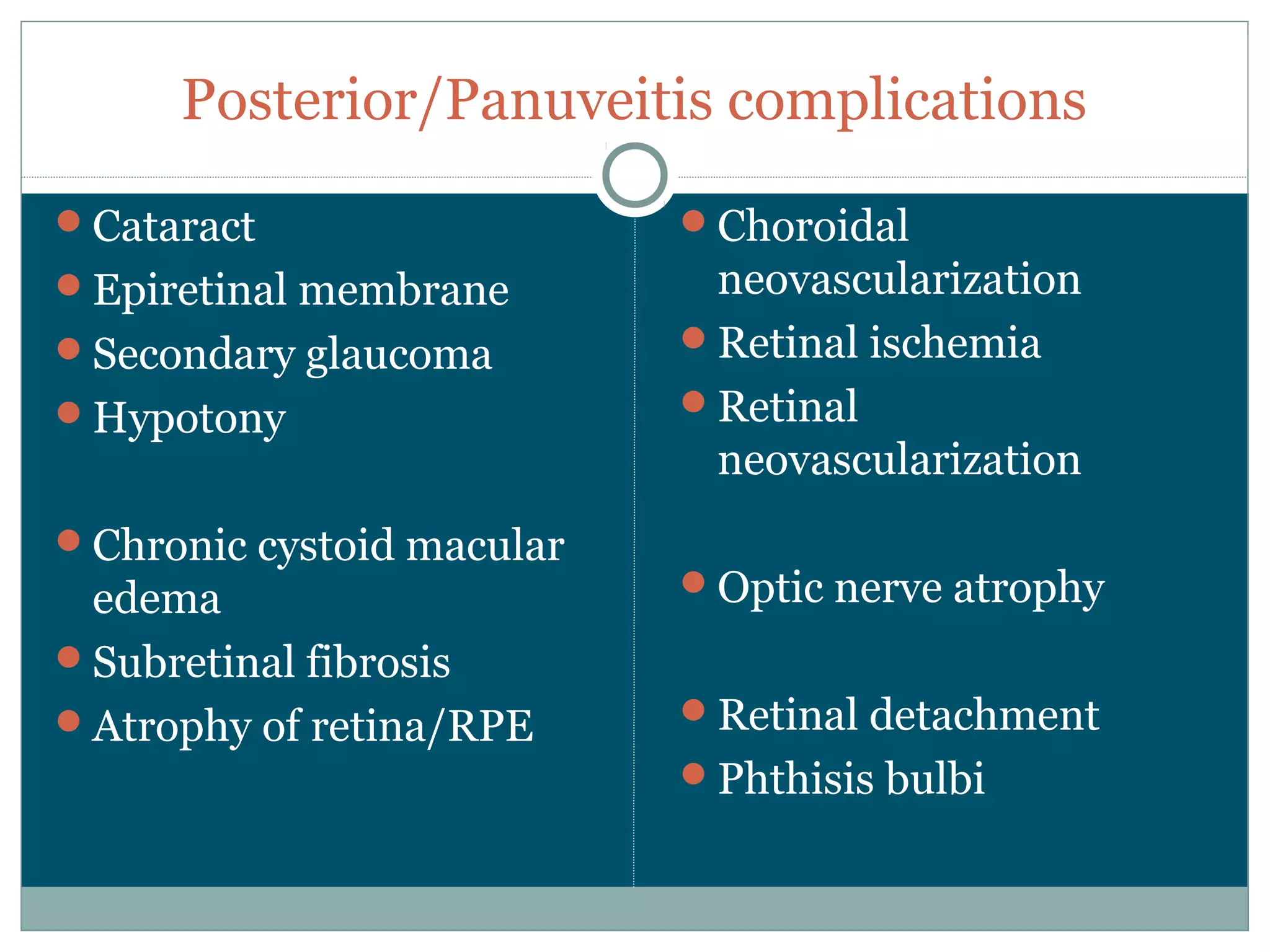
Posterior/Panuveitis complications
Cataract
Epiretinal membrane
Secondary glaucoma
Hypotony
Chronic cystoid macular
edema
Subretinal fibrosis
Atrophy of retina/RPE
Choroidal
neovascularization
Retinal ischemia
Retinal
neovascularization
Optic nerve atrophy
Retinal detachment
Phthisis bulbi
Work-up
 CBC with diff,Chem 20, UA, ESR, CRP
 TB (PPD+anergy panel)+Chest X-ray
 Syphilis (both RPR and Sy IgM, IgG)
 HIV
 Additional:
 ACE, lysozyme, Ca  sarcoidosis
 UA-> TINU, Wegener, SLE
 ANA, anti-DNA, RF, anti-CCP, ENA panel connective tissue disorders
 ANCAs (c-ANCA=PR3; p-ANCA=MPO)  Wegener, PAN
 Hypercoagulability panel (ACA, LAC, Factor V Leiden mut) occlusive vasculitis
 High Resolution Chest CT  TB, sarcoidosis
 PFT/pulm consult  sarcoidosis
 Hearing test VKH, sarcoidosis
 LP MS, VKH, PIOL/CNSL
 HLA panel Birdshot, HLA-B27, Behçet, MS, sarcoid
 Sinus CT  Wegener’s
 Lumbosacral XR/MRIHLAB27 associated uveitides
 Colonoscopy  IBD, Behçet, malignancy work-up
 Anterior chamber and/or vitreous tap for PCR, cultures, cytokines
Despite a million dollar work-up->
40% still idiopathic
Treatment:
Corticosteroids have been the mainstay since 1970s
Neutrophils Inhibit neutrophil migration
neutrophil adherence to vascular
endothelium
bactericidal activity of neutrophils
Local effects on the endothelium
Mononuclear phagocytes Chemotaxis
Clearance of antibody coated particles
Production of Il-1 and TNFα
Lymphocytes Redistribution of T lymphocytes(CD4 > CD8)
Inhibit T lymphocyte activation
proliferation and lymphokine production
Inhibit Ig production by B cells (high dose)
Immunosuppressive Therapy
Antimetabolites:
 Methotrexate (anti-folate), Azathioprine (purine inhibitor),
Mycophenolate Mofetil (pu) (Cellcept), Leflunomide (pyrim inh)
T-cell Inhibitors:
 Cyclosporine, Tacrolimus (cacineurin), Sirolimus(mtor)
Alkylating agents:
 Cyclophosphamide, Chlorambucil
Biologics:
 Anti-TNF( *infliximab, etanercept, adalimumab, golimumab,
certolizumab)
 Anti-IL2R (*daclizumab, basiliximab)
 Anti-IL1 (anakinra)
 Anti-B cell (*Rituximab, Ocralizumab)
million dollar treatment  ?effect on outcome
Summary
Diagnosis: what, where, when, who
Differential: use to guide testing
 Rule out etiologies that must be treated before
immunosuppression (infections!)
Treatment: don’t wait too long to move beyond
corticosteroid treatments (Please refer!)
 If not responding to treatment, consider another diagnosis
Goals: Prevent complications, minimize side effects
of treatment, PRESERVE VISION
Thank you!

Review of Uveitis

  • 1.
    Fritz Allen, MD VisionaryEye Doctors Review of Uveitis
  • 2.
    • A genericterm for intraocular inflammation. • Does not indicate site of inflammation • Does not indicate the cause: Autoimmune or Infectious Uveitis: Definition
  • 3.
    How Common isUveitis?  10-15% of severe visual handicap in the U.S.  3rd leading cause of blindness in the world  U.S. Incidence 52.4/100,000  U.S. Prevalence 115.3/100,000  3 times higher than previous estimate  Prevalence higher in women (1:1.4)  Common in older patients  Gritz and Wong. Ophthalmology 2004  Worldwide prevalence ~2.4 million  ~5-10% of cases in children <16 yrs  Mean age of onset is 37.2 years  Range 20-50 years 151,200 322,000 2,400,000 U.S. Prevalence WorldwideU.S. Incidence
  • 4.
    IUSG Classification ofUveitis Anterior uveitis  iris and pars plicata (CB) Intermediate uveitis  pars plana and vitreous Posterior uveitis  retina + choroid Panuveitis “front” “back”
  • 5.
    Cells per high-powerfield in 1x1 mm slit beam 0 = < 1 cell/hpf 0.5+ = 1 - 5 cells 1+ = 6 - 15 2+ = 16 - 25 3+ = 26 - 50 4+ = > 50 Flare 0 = none 1+ = faint 2+ = moderate, (iris/lens details clear) 3+ = marked (iris/lens hazy) 4+ = intense (fibrin or plastic aqueous) SUN Grading system for AC cell and flare
  • 6.
    Number of Cells*Description Grade 0-1 clear 0 2-20 few opacities trace 21-50 scattered opacities 1+ 51-100 moderate opacities 2+ 101-250 many opacities 3+ >250 dense opacities 4+ *cells are counted using a Hruby, 90 or 78 diopter lens National Eye Institute Grading System for Vitreous Cell (No SUN Working Group Consensus)
  • 7.
    0 = Clear 0.5+/trace= Trace 1+ = Few opacities, mild blurring 2+ = Significant blurring but still visible 3+ = Optic nerve visible, no vessels seen 4+ = Dense opacity obscures optic nerve head National Eye Institute Grading System for Vitreous Haze (adopted by SUN Working Group)
  • 8.
    Developing a DifferentialDiagnosis  Is the disease acute or chronic?  Where is the inflammation located in the eye?  Unilateral or bilateral?  Granulomatous or non-granulomatous?  What are the demographics of the patient?  Associated symptoms?  Associated signs on physical exam?  How did the disease respond to previous therapy?
  • 9.
    Anterior Uveitis: ~60%of all uveitis Idiopathic HLA-B27 associated  Inflammatory bowel disease  Ankylosing spondylitis  Reiter’s syndrome  Psoriatic arthritis JIA (Juvenile Idiopathic Arthritis) associated Behçet’s disease Fuchs’ heterochromia Sarcoidosis Syphilis Glaucomatocyclitic crisis Masquerade syndromes
  • 10.
  • 11.
    Differential Diagnosis ofStellate Keratic Precipitates:  Fuchs heterochromia (rubella, herpes, toxoplasmosis)  Viral  Toxoplasmosis
  • 12.
    Differential Diagnosis ofhypopyon:  HLA-B27 associated  Behçet’s disease  Low back pain, ethnicity, GI symptoms, ulcers, joints
  • 13.
    JIA-associated uveitis  <16yo,>6 mo disease  Pauci-articular: 25%  Type 1=ANA+ young girls  Type 2=Older boys B27+  Poly-articular: ~15%  Systemic onset: 1-5% Most at risk: ANA+, RF-, pauci-articular girls Uveitis develops within 5-7 yrs No correlation betw joint and eye Frequently asymptomatic Uveitis before joint disease poor px BK/PS/cataract/ON hyperemia/CME common
  • 14.
    Complications Treatment Posterior synechiae Cataract Inflammation-related  Steroid-induced Secondary glaucoma  Steroid response  Angle closure Cystoid macular edema Band keratopathy  more common in children Topical corticosteroids Cycloplegics Glaucoma gtts NSAIDs (gtt or PO) Periocular steroids Systemic steroids Systemic immunosuppression Anterior Uveitis
  • 15.
    Intermediate Uveitis: ~15%of all uveitis Most common causes: Sarcoidosis Pars planitis syndrome (idiopathic) Multiple sclerosis Masquerade Syndromes Infection  Toxoplasma, Lyme, Toxocara, Syphilis, TB
  • 16.
    Intermediate Uveitis  Vitritis+/- periphlebitis  Snowballs, snowbanking (more severe disease process)  Pars planitis: PP exudates (HLA-DR15)  ~15% of patients with pars planitis will develop MS  CME is the main vision threatening complication
  • 17.
    Posterior & Panuveitis:10-15% of all uveitis Focal choroiditis/retinitis: Toxocariasis Tuberculosis Nocardiosis Masquerade syndrome Multifocal Retinitis: Syphilis Herpes simplex virus, CMV Sarcoidosis Masquerade syndromes Candidiasis Meningococcus Multifocal Choroiditis: SO VKH Sarcoidosis Serpiginous Birdshot Wegener’s, SLE Histoplasmosis/TB Masquerade syndrome PANuveitis: Syphilis Sarcoidosis VKH Behçet’s disease Sympathetic Ophthalmia Infectious endophthalmitis
  • 18.
    Posterior (Pan) Uveitis Inflammationinvolving retina/choroid  Optic nerve:  ON Edema, papillitis, granuloma  FA features—hot?  Retinal vasculature:  Staining, leakage, capillary dropout  Involves mainly veins vs arteries  Peripheral vs central  Chorioretinal lesions:  Dalen-fuchs nodules  Size, age of lesion (old atrophic vs new elevated with substance to it)
  • 19.
    Sarcoidosis  Sarcoidosis isa multisystem granulomatous disorder  Lungs (90-95%), lymph nodes, skin, eyes, CNS  Typically affects young adults  More commonly seen in African Americans and Caucasians of Northern European descent  In US 8-10x more common in AA  AA: 35 to 82/100,000 Caucasians: 8 to 11/100,000  Etiology unknown but believed to be immune mediated:  Genetic predisposition (familial aggregation, monozygotic twins, HLA-B8, HLA-DRB1) and environmental factors (environmental allergens and infectious agents) have been suggested.  Ocular disease most common extra-pulmonary presentation  Uveitis occurs in 25-50% of pts  20-50 yrs, typically bilateral (98%)
  • 21.
  • 22.
    30 yo AAM:Referred for endogenous candida endophthalmitis Also has recent onset of headache, mood changes, gait abnormalities Slit-like third ventricle Enlarged lateral ventricles Transependymal CSF flow Diagnosis: Biopsy-Proven Neurosarcoidosis
  • 23.
    75 yo WFwith recent onset blurry vision Carried dx of SLE for >20 yrs CBC: slightly elevated WBC Neg or wnl: Lyme, RPR, FTA–ABS, PPD HLA B27 neg, UA & Chem 20 wnl Diagnostic vitrectomy: • Nests of macrophages & giant cells • Small and reactive lymphocytes • Further work-up: hilar LAD on CT and PET scan Diagnosis: Presumed Ocular Sarcoidosis
  • 24.
    Behçet’s Disease  ModifiedJapanese Criteria:  Major criteria (skin, oral, genital, eye)  Minor criteria (arthritis, GI, epididymitis, neuropsychiatric etc)  Classification  Complete (4 major), Incomplete (3 major OR ocular disease+1 major), Suspect (2 major nonocular), Possible (1 major)  International Study Group for BD recurrent oral ulcers is a must (+2 other criteria)
  • 25.
  • 26.
    VKH: Common inpigmented ethnic groups •Bilateral panuveitis •Vitiligo, alopecia, poliosis, (10-60%) •Dysacusia, tinnitus (75% auditory problems) •Meningitis (80% have CSF lymphocytic pleocytosis) •ON edema & hyperemia, Serous RD •Dalen-Fuchs nodules •Sunset-glow fundus •Sigiura sign (perilimbal vitiligo) •HLA DR4 (esp Japanese), DR1
  • 27.
    24 yo Latinomale with VKH: •Sudden onset blurred vision •Headache •Tinnitus & hearing loss One month after presentation Ten months after presentation
  • 28.
    End-stage VKH withdiffuse RPE loss and subretinal fibrosis
  • 29.
     Systemic LupusErythematosus  Retinopathy is an important marker of systemic activity esp CNS vasculitis-75%  Polyarteritis Nodosa (PAN)  M>F; HBs+, polyneuropathy, Raynaud’s, coronary arteritis  Untreated: 90% mortality  Wegener granulomatosis  Necrotizing granulomatosis of upper & lower resp tract -esp paranasal sinuses  Glomerulonephritis (85%), peripheral neuropathy  Untreated: 80% mortality  Behçet’s Disease Retinal Vasculitis
  • 30.
    52 yo M Acuteonset of blurred vision & photophobia OS Non-granulomatous anterior uveitis OS > OD Vitritis OS > OD BRAO and retinitis OD HIV+ not on HAART RPR+ 1:2048, Syphilis IgG+ Syphilis-related panuveitis Responded to IV Penicillin x 4 wks
  • 31.
     Serpiginous choroidopathy Relationship w/TB?  Treated with immunosuppressives  HLA-B07  >30%VA <20/200
  • 32.
    APMPPE: Acute posterior multifocalplacoid pigment epitheliopathy •Bitten by a lab animal •Preceding flu-like symptoms •Early hypo, late hyper on FA (White Dot Syndromes) •Hypofluorescent spots on ICG •CNS vasculitis •Benign course •20% Visual Sequelae 24 yo WM with “flashes of light” and blurry vision that developed overnight
  • 33.
    Posterior/Panuveitis complications Cataract Epiretinal membrane Secondaryglaucoma Hypotony Chronic cystoid macular edema Subretinal fibrosis Atrophy of retina/RPE Choroidal neovascularization Retinal ischemia Retinal neovascularization Optic nerve atrophy Retinal detachment Phthisis bulbi
  • 34.
    Work-up  CBC withdiff,Chem 20, UA, ESR, CRP  TB (PPD+anergy panel)+Chest X-ray  Syphilis (both RPR and Sy IgM, IgG)  HIV  Additional:  ACE, lysozyme, Ca  sarcoidosis  UA-> TINU, Wegener, SLE  ANA, anti-DNA, RF, anti-CCP, ENA panel connective tissue disorders  ANCAs (c-ANCA=PR3; p-ANCA=MPO)  Wegener, PAN  Hypercoagulability panel (ACA, LAC, Factor V Leiden mut) occlusive vasculitis  High Resolution Chest CT  TB, sarcoidosis  PFT/pulm consult  sarcoidosis  Hearing test VKH, sarcoidosis  LP MS, VKH, PIOL/CNSL  HLA panel Birdshot, HLA-B27, Behçet, MS, sarcoid  Sinus CT  Wegener’s  Lumbosacral XR/MRIHLAB27 associated uveitides  Colonoscopy  IBD, Behçet, malignancy work-up  Anterior chamber and/or vitreous tap for PCR, cultures, cytokines Despite a million dollar work-up-> 40% still idiopathic
  • 35.
    Treatment: Corticosteroids have beenthe mainstay since 1970s Neutrophils Inhibit neutrophil migration neutrophil adherence to vascular endothelium bactericidal activity of neutrophils Local effects on the endothelium Mononuclear phagocytes Chemotaxis Clearance of antibody coated particles Production of Il-1 and TNFα Lymphocytes Redistribution of T lymphocytes(CD4 > CD8) Inhibit T lymphocyte activation proliferation and lymphokine production Inhibit Ig production by B cells (high dose)
  • 36.
    Immunosuppressive Therapy Antimetabolites:  Methotrexate(anti-folate), Azathioprine (purine inhibitor), Mycophenolate Mofetil (pu) (Cellcept), Leflunomide (pyrim inh) T-cell Inhibitors:  Cyclosporine, Tacrolimus (cacineurin), Sirolimus(mtor) Alkylating agents:  Cyclophosphamide, Chlorambucil Biologics:  Anti-TNF( *infliximab, etanercept, adalimumab, golimumab, certolizumab)  Anti-IL2R (*daclizumab, basiliximab)  Anti-IL1 (anakinra)  Anti-B cell (*Rituximab, Ocralizumab) million dollar treatment  ?effect on outcome
  • 37.
    Summary Diagnosis: what, where,when, who Differential: use to guide testing  Rule out etiologies that must be treated before immunosuppression (infections!) Treatment: don’t wait too long to move beyond corticosteroid treatments (Please refer!)  If not responding to treatment, consider another diagnosis Goals: Prevent complications, minimize side effects of treatment, PRESERVE VISION
  • 38.

Editor's Notes

  • #17 1% of all MS develop uveitis 25% of cases uveitis precedes MS Up to 15% of pts with parsplanitis will develop MS
  • #21 Mutton fat KP, busacca and koeppe nodules
  • #22 Dalen fuchs nodules Candle wax drippings (tache de bougie)
  • #26 A Katz-behcet retinitis
  • #32 Serpiginous-castro OS active