Uveitis


          W E N D Y    M    S M I T H ,    M D
          S E N I O R    S T A F F    F E L L O W ,   
U V E I T I S    A N D    O C U L A R    I M M U N O L O G Y
        N A T I O N A L    E Y E    I N S T I T U T E
 N A T I O N A L    I N S T I T U T E S    O F    H E A L T H
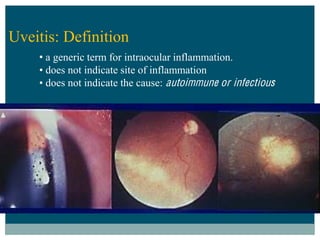
Uveitis: Definition
     a generic term for intraocular inflammation.
     does not indicate site of inflammation
     does not indicate the cause: autoi mmune or infectious
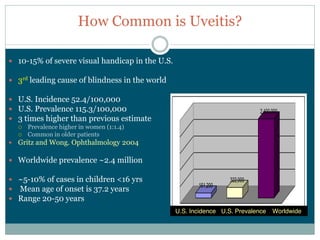
How  Common  is  Uveitis?

10-­15%  of  severe  visual  handicap  in  the  U.S.

3rd leading  cause  of  blindness  in  the  world

U.S.  Incidence  52.4/100,000
U.S.  Prevalence  115.3/100,000                                                    2,400,000
3  times  higher  than  previous  estimate
   Prevalence  higher  in  women  (1:1.4)
   Common  in  older  patients
Gritz  and  Wong.  Ophthalmology  2004

Worldwide  prevalence  ~2.4  million

~5-­10%  of  cases  in  children  <16  yrs                               322,000
                                                              151,200
Mean  age  of  onset  is  37.2  years
Range  20-­50  years
                                                       U.S. Incidence U.S. Prevalence    Worldwide
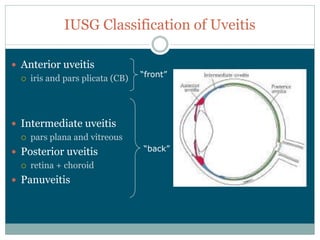
IUSG  Classification  of  Uveitis

Anterior  uveitis
  iris  and  pars  plicata  (CB)


Intermediate  uveitis
  pars  plana  and  vitreous
Posterior  uveitis
  retina  +  choroid
Panuveitis
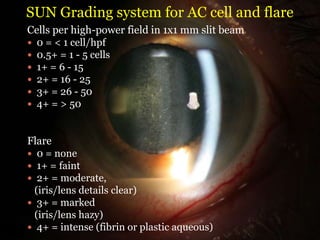
SUN  Grading  system  for  AC  cell  and  flare
Cells  per  high-­power  field  in  1x1  mm  slit  beam
  0  =  <  1  cell/hpf
  0.5+  =  1  -­ 5  cells
  1+  =  6  -­ 15
  2+  =  16  -­ 25
  3+  =  26  -­ 50
  4+  =  >  50


Flare
  0  =  none
  1+  =  faint
  2+  =  moderate,  
 (iris/lens  details  clear)
  3+  =  marked
 (iris/lens  hazy)
  4+  =  intense  (fibrin  or  plastic  aqueous)
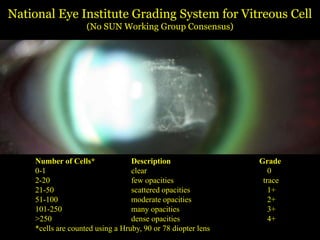
National  Eye  Institute  Grading  System  for  Vitreous  Cell
                        (No  SUN  Working  Group  Consensus)


     Number  of  Cells*                 Description                      Grade
     0-­1                               clear                               0
     2-­20                              few  opacities                    trace
     21-­50                             scattered  opacities                1+
     51-­100                            moderate  opacities                 2+
     101-­250                           many  opacities                     3+
     >250                               dense  opacities                    4+
     *cells  are  counted  using  a  Hruby,  90  or  78  diopter  lens
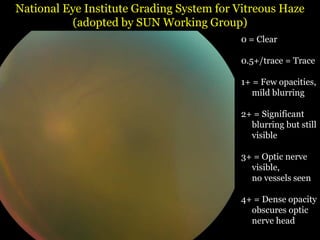
National  Eye  Institute  Grading  System  for  Vitreous  Haze  
           (adopted  by  SUN  Working  Group)
                                                 0  =  Clear

                                                 0.5+/trace  =  Trace

                                                 1+  =  Few  opacities,
                                                    mild  blurring

                                                 2+  =  Significant
                                                   blurring  but  still
                                                   visible

                                                 3+  =  Optic  nerve
                                                   visible,  
                                                   no  vessels  seen

                                                 4+  =  Dense  opacity
                                                   obscures  optic
                                                   nerve  head
Developing  a  Differential  Diagnosis

  Is  the  disease  acute  or  chronic?
  Where  is  the  inflammation  located  in  the  eye?
  Unilateral  or  bilateral?
  Granulomatous  or  non-­granulomatous?

  What  are  the  demographics  of  the  patient?
  Associated  symptoms?
  Associated  signs  on  physical  exam?

  How  did  the  disease  respond  to  previous  therapy?
Anterior  Uveitis:  ~60%  of  all  uveitis

Idiopathic
HLA-­B27  associated
  Inflammatory  bowel          Sarcoidosis
  disease                      Syphilis
  Ankylosing  spondylitis
                               Glaucomatocyclitic  crisis
                               Masquerade  syndromes
  Psoriatic  arthritis
JIA  (Juvenile  Idiopathic  
Arthritis)  associated
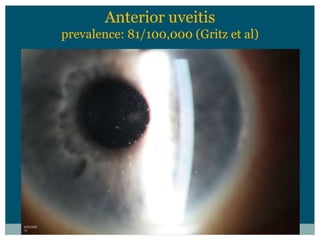
Anterior  uveitis
prevalence:  81/100,000  (Gritz et  al)
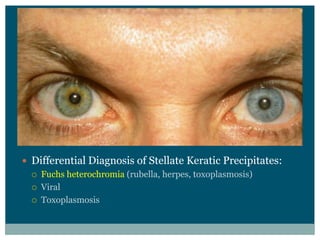
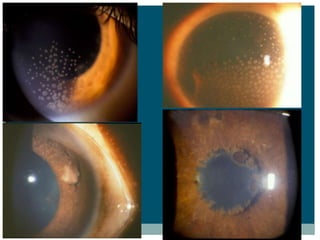
Differential  Diagnosis  of  Stellate  Keratic  Precipitates:
  Fuchs  heterochromia  (rubella,  herpes,  toxoplasmosis)
  Viral
  Toxoplasmosis
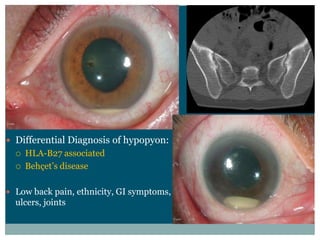
Differential  Diagnosis  of  hypopyon:
  HLA-­B27  associated


Low  back  pain,  ethnicity,  GI  symptoms,  
ulcers,  joints
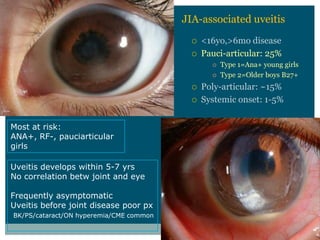
JIA-­associated  uveitis
                                                <16yo,>6mo  disease
                                                Pauci-­articular:  25%
                                                     Type  1=Ana+  young  girls
                                                     Type  2=Older  boys  B27+
                                                Poly-­articular:  ~15%
                                                Systemic  onset:  1-­5%


Most  at  risk:
ANA+,  RF-­,  pauciarticular  
girls

Uveitis  develops  within  5-­7  yrs
No  correlation  betw  joint  and  eye

Frequently  asymptomatic
Uveitis  before  joint  disease  poor  px
BK/PS/cataract/ON  hyperemia/CME  common
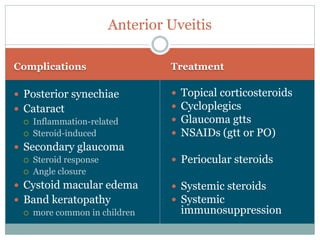
Anterior  Uveitis

Complications                    Treatment

 Posterior  synechiae             Topical  corticosteroids
 Cataract                         Cycloplegics
   Inflammation-­related          Glaucoma  gtts
   Steroid-­induced               NSAIDs  (gtt or  PO)
 Secondary  glaucoma
   Steroid  response              Periocular  steroids
   Angle  closure
 Cystoid  macular  edema          Systemic  steroids
 Band  keratopathy                Systemic  
   more  common  in  children     immunosuppression
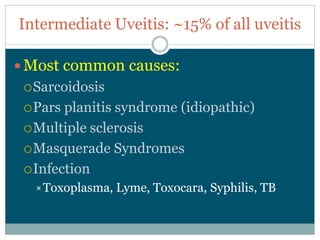
Intermediate  Uveitis:  ~15%  of  all  uveitis

Most  common  causes:
  Sarcoidosis
  Pars  planitis  syndrome  (idiopathic)
  Multiple  sclerosis
  Masquerade  Syndromes
  Infection  
   Toxoplasma,  Lyme,  Toxocara,  Syphilis,  TB
Intermediate  Uveitis

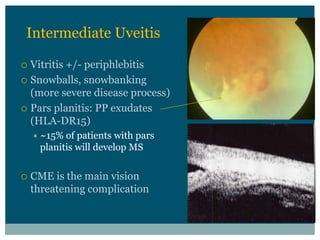
Vitritis  +/-­ periphlebitis
Snowballs,  snowbanking                
(more  severe  disease  process)
Pars  planitis:  PP  exudates            
(HLA-­DR15)
  ~15%  of  patients  with  pars  
  planitis  will  develop  MS

CME  is  the  main  vision  
threatening  complication
Posterior  &  Panuveitis:  10-­15%  of  all  uveitis

Focal  choroiditis/retinitis:     Multifocal  Retinitis:
  Toxocariasis                     Syphilis
                                   Herpes  simplex  virus,  CMV
  Tuberculosis
                                   Sarcoidosis
  Nocardiosis                      Masquerade  syndromes
  Masquerade  syndrome             Candidiasis
                                   Meningococcus
Multifocal  Choroiditis:
 SO                               PANuveitis:
 VKH                                Syphilis
 Sarcoidosis                        Sarcoidosis
 Serpiginous
                                    VKH
 Birdshot
                                             disease  
                                    Sympathetic  Ophthalmia
  Histoplasmosis/TB
                                    Infectious  endophthalmitis
  Masquerade  syndrome
Posterior  (Pan)  Uveitis

Inflammation  involving  retina/choroid

  Optic  nerve:
    ON  Edema,  papillitis,  granuloma
    FA  features hot?

  Retinal  vasculature:
    Staining,  leakage,  capillary  dropout
    Involves  mainly  veins  vs  arteries
    Peripheral  vs  central

  Chorioretinal  lesions:
    Dalen-­fuchs  nodules
    Size,  age  of  lesion  (old  atrophic  vs  new  elevated  with  substance  to  it)
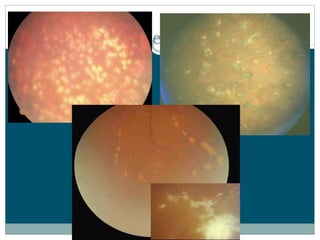
Sarcoidosis

Sarcoidosis  is  a  multisystem  granulomatous  disorder  
  lungs  (90-­95%),  lymph  nodes,  skin,  eyes,  CNS
  Typically  affects  young  adults  
More  commonly  seen  in  African  Americans  and  Caucasians  of  
Northern  European  descent
  In  US  8-­10x  more  common  in  AA  
     AA:  35  to  82/100,000  Caucasians:  8  to  11/100,000
Etiology  unknown  but  believed  to  be  immune  mediated:  
  genetic  predisposition  (familial  aggregation,  monozygotic  twins,  HLAB8,  
  HLADRB1)  and  environmental  factors  (environmental  allergens  and  
  infectious  agents)  have  been  suggested.
Ocular  disease  most  common  extra-­pulmonary  presentation
  Uveitis  occurs  in  25-­50%  of  pts
  20-­50  yrs,  typically  bilateral  (98%)
Sarcoidosis:    Dalen-­
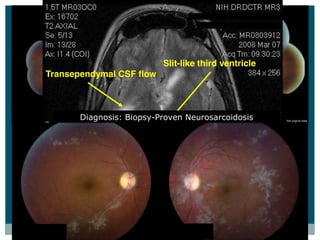
Slit-like third ventricle
      Transependymal CSF flow


               Diagnosis:  Biopsy-­Proven  Neurosarcoidosis


30  yo  AAM:  Referred  for  endogenous  candida  endophthalmitis
Also  has  recent  onset  of  headache,  mood  changes,  gait  abnormalities


                     Enlarged lateral ventricles
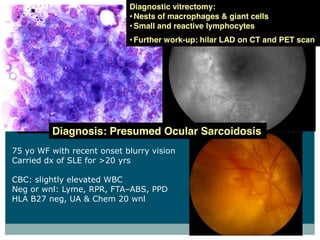
Diagnostic vitrectomy:
                                  Nests of macrophages & giant cells
                                  Small and reactive lymphocytes
                                  Further work-up: hilar LAD on CT and PET scan


           Diagnosis: Presumed Ocular Sarcoidosis
75  yo  WF  with  recent  onset  blurry  vision
Carried  dx  of  SLE  for  >20  yrs

CBC:  slightly  elevated  WBC
Neg  or  wnl:  Lyme,  RPR,  FTA ABS,  PPD  
HLA  B27  neg,  UA  &  Chem  20  wnl
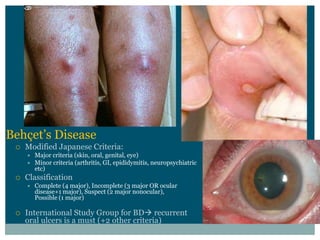
Modified  Japanese  Criteria:
  Major  criteria  (skin,  oral,  genital,  eye)
  Minor  criteria  (arthritis,  GI,  epididymitis,  neuropsychiatric  
  etc)
Classification
  Complete  (4  major),  Incomplete  (3  major  OR  ocular  
  disease+1  major),  Suspect  (2  major  nonocular),                      
  Possible  (1  major)

International  Study  Group  for  BD recurrent  
oral  ulcers  is  a  must  (+2  other  criteria)
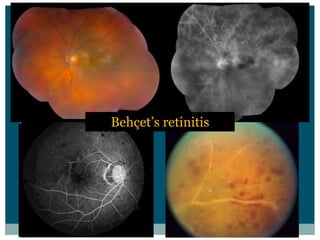
retinitis
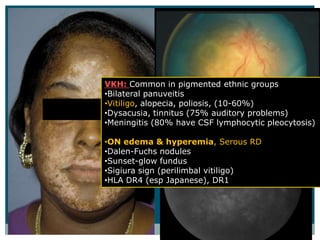
VKH:  Common  in  pigmented  ethnic  groups
Bilateral  panuveitis
Vitiligo,  alopecia,  poliosis,  (10-­60%)
Dysacusia,  tinnitus  (75%  auditory  problems)
Meningitis  (80%  have  CSF  lymphocytic  pleocytosis)

ON  edema  &  hyperemia,  Serous  RD
Dalen-­Fuchs  nodules
Sunset-­glow  fundus
Sigiura  sign  (perilimbal  vitiligo)
HLA  DR4  (esp  Japanese),  DR1
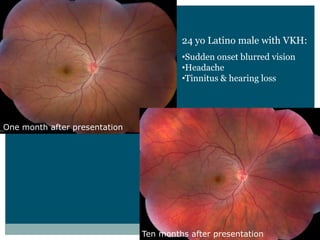
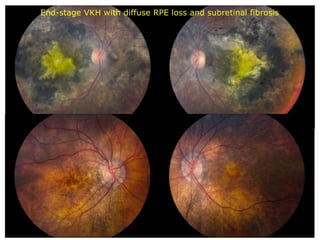
24  yo Latino  male  with  VKH:
                                             Sudden  onset  blurred  vision
                                             Headache
                                             Tinnitus  &  hearing  loss


One  month  after  presentation


                                  Ten  months  after  presentation
End-­stage  VKH  with  diffuse  RPE  loss  and  subretinal  fibrosis
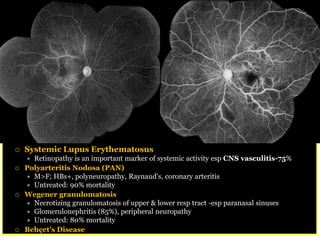
Retinal  Vasculitis


Systemic  Lupus  Erythematosus
  Retinopathy  is  an  important  marker  of  systemic  activity  esp  CNS  vasculitis-­75%
Polyarteritis  Nodosa  (PAN)

 Untreated:  90%  mortality
Wegener  granulomatosis  
 Necrotizing  granulomatosis  of  upper  &  lower  resp  tract  -­esp  paranasal  sinuses
 Glomerulonephritis  (85%),  peripheral  neuropathy  
 Untreated:  80%  mortality
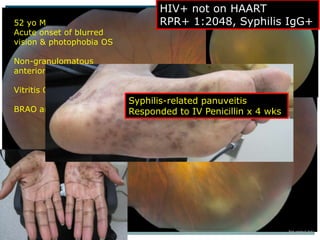
HIV+  not  on  HAART
52  yo  M                              RPR+  1:2048,  Syphilis  IgG+
Acute  onset  of  blurred  
vision  &  photophobia  OS

Non-­granulomatous  
anterior  uveitis  OS  >  OD

Vitritis  OS  >  OD
                               Syphilis-­related  panuveitis
BRAO  and  retinitis  OD       Responded  to  IV  Penicillin  x  4  wks
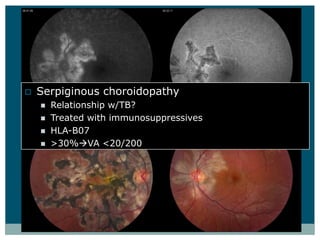
Serpiginous  choroidopathy
  Relationship  w/TB?
  Treated  with  immunosuppressives
  HLA-­B07
  >30% VA  <20/200
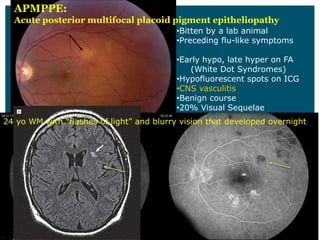
APMPPE:  
Acute  posterior  multifocal  placoid  pigment  epitheliopathy
                                      Bitten  by  a  lab  animal
                                      Preceding  flu-­like  symptoms

                                      Early  hypo,  late  hyper  on  FA
                                        (White  Dot  Syndromes)
                                      Hypofluorescent  spots  on  ICG
                                      CNS  vasculitis
                                      Benign  course
                                      20%  Visual  Sequelae
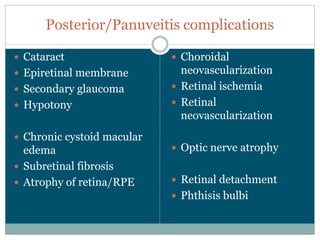
Posterior/Panuveitis  complications

Cataract                      Choroidal  
Epiretinal  membrane          neovascularization
Secondary  glaucoma           Retinal  ischemia
Hypotony                      Retinal  
                              neovascularization
Chronic  cystoid  macular  
edema                         Optic  nerve  atrophy
Subretinal  fibrosis
Atrophy  of  retina/RPE       Retinal  detachment
                              Phthisis  bulbi
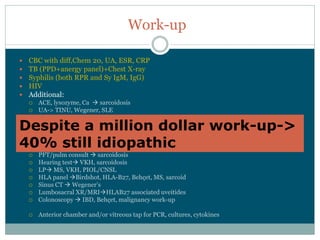
Work-­up

 CBC  with  diff,Chem  20,  UA,  ESR,  CRP
 TB  (PPD+anergy  panel)+Chest  X-­ray
 Syphilis  (both  RPR  and  Sy  IgM,  IgG)
 HIV
 Additional:
    ACE,  lysozyme,  Ca     sarcoidosis
    UA-­>  TINU,  Wegener,  SLE
    ANA,  anti-­DNA,  RF,  anti-­CCP,  ENA  panel connective  tissue  disorders
Despite  a  million  dollar  work-­up-­>  
    ANCAs  (c-­ANCA=PR3;;  p-­ANCA=MPO)   Wegener,  PAN
    Hypercoagulability  panel  (ACA,  LAC,  Factor  V  Leiden  mut)   occlusive  vasculitis

40%  still  idiopathic
  High  Resolution  Chest  CT   TB,  sarcoidosis
    PFT/pulm  consult   sarcoidosis
    Hearing  test VKH,  sarcoidosis
    LP MS,  VKH,  PIOL/CNSL
    HLA  panel   Birdshot,  HLA-­B27,  Behçet,  MS,  sarcoid
    Sinus  CT   W
    Lumbosacral  XR/MRI HLAB27  associated  uveitides
    Colonoscopy   IBD,  Behçet,  malignancy  work-­up

    Anterior  chamber  and/or  vitreous  tap  for  PCR,  cultures,  cytokines
Treatment:
Corticosteroids  have  been  the  mainstay  since  1970s

 Neutrophils               Inhibit neutrophil migration
                            neutrophil adherence to vascular
                           endothelium
                            bactericidal activity of neutrophils
 Local effects on the endothelium
 Mononuclea r phagocytes    Chemotaxis
                            Clearance of antibody coated particles
                            Production of Il-1 and TNF
 L ymphocytes              Redistribution of T lymphocytes(CD4 > CD8)
                           Inhibit T lymphocyte activation
                           proliferation and lymphokine production
                           Inhibit Ig production by B cells (high dose)
Immunosuppressive  Therapy

Antimetabolites:
  Methotrexate  (anti-­folate),  Azathioprine  (purine  inhibitor),  
  Mycophenolate  Mofetil  (pu)  (Cellcept),  Leflunomide  (pyrim  inh)
T-­cell  Inhibitors:
  Cyclosporine,  Tacrolimus  (cacineurin),  Sirolimus(mtor)
Alkylating  agents:
  Cyclophosphamide,  Chlorambucil
Biologics:
  Anti-­TNF(  *infliximab,  etanercept,  adalimumab,  golimumab,  
  certolizumab)
  Anti-­IL2R  (*daclizumab,  basiliximab)
  Anti-­IL1  (anakinra)
  Anti-­B  cell  (*Rituximab,  Ocralizumab)


million  dollar  treatment           ?effect  on  outcome
Summary

Diagnosis:  what,  where,  when,  who
Differential:  use  to  guide  testing  
  rule  out  etiologies  that  must  be  treated  before  
  immunosuppression  (infections!)


corticosteroid  treatments  (Please  refer!)
  If  not  responding  to  treatment,  consider  another  diagnosis
Goals:  Prevent  complications,  minimize  side  effects  
of  treatment,  PRESERVE  VISION
Thank  you!

W smith uveitis compressed 5.22.11 (1)

  • 1.
    Uveitis W E N D Y   M   S M I T H ,   M D S E N I O R   S T A F F   F E L L O W ,   U V E I T I S   A N D   O C U L A R   I M M U N O L O G Y N A T I O N A L   E Y E   I N S T I T U T E N A T I O N A L   I N S T I T U T E S   O F   H E A L T H
  • 2.
    Uveitis: Definition a generic term for intraocular inflammation. does not indicate site of inflammation does not indicate the cause: autoi mmune or infectious
  • 3.
    How  Common  is Uveitis? 10-­15%  of  severe  visual  handicap  in  the  U.S. 3rd leading  cause  of  blindness  in  the  world U.S.  Incidence  52.4/100,000 U.S.  Prevalence  115.3/100,000 2,400,000 3  times  higher  than  previous  estimate Prevalence  higher  in  women  (1:1.4) Common  in  older  patients Gritz  and  Wong.  Ophthalmology  2004 Worldwide  prevalence  ~2.4  million ~5-­10%  of  cases  in  children  <16  yrs 322,000 151,200 Mean  age  of  onset  is  37.2  years Range  20-­50  years U.S. Incidence U.S. Prevalence Worldwide
  • 4.
    IUSG  Classification  of Uveitis Anterior  uveitis iris  and  pars  plicata  (CB) Intermediate  uveitis pars  plana  and  vitreous Posterior  uveitis retina  +  choroid Panuveitis
  • 5.
    SUN  Grading  system for  AC  cell  and  flare Cells  per  high-­power  field  in  1x1  mm  slit  beam 0  =  <  1  cell/hpf 0.5+  =  1  -­ 5  cells 1+  =  6  -­ 15 2+  =  16  -­ 25 3+  =  26  -­ 50 4+  =  >  50 Flare 0  =  none 1+  =  faint 2+  =  moderate,   (iris/lens  details  clear) 3+  =  marked (iris/lens  hazy) 4+  =  intense  (fibrin  or  plastic  aqueous)
  • 6.
    National  Eye  Institute Grading  System  for  Vitreous  Cell (No  SUN  Working  Group  Consensus) Number  of  Cells* Description Grade 0-­1 clear 0 2-­20 few  opacities trace 21-­50 scattered  opacities 1+ 51-­100 moderate  opacities 2+ 101-­250 many  opacities 3+ >250 dense  opacities 4+ *cells  are  counted  using  a  Hruby,  90  or  78  diopter  lens
  • 7.
    National  Eye  Institute Grading  System  for  Vitreous  Haze   (adopted  by  SUN  Working  Group) 0  =  Clear 0.5+/trace  =  Trace 1+  =  Few  opacities, mild  blurring 2+  =  Significant blurring  but  still visible 3+  =  Optic  nerve visible,   no  vessels  seen 4+  =  Dense  opacity obscures  optic nerve  head
  • 8.
    Developing  a  Differential Diagnosis Is  the  disease  acute  or  chronic? Where  is  the  inflammation  located  in  the  eye? Unilateral  or  bilateral? Granulomatous  or  non-­granulomatous? What  are  the  demographics  of  the  patient? Associated  symptoms? Associated  signs  on  physical  exam? How  did  the  disease  respond  to  previous  therapy?
  • 9.
    Anterior  Uveitis:  ~60% of  all  uveitis Idiopathic HLA-­B27  associated Inflammatory  bowel   Sarcoidosis disease Syphilis Ankylosing  spondylitis Glaucomatocyclitic  crisis Masquerade  syndromes Psoriatic  arthritis JIA  (Juvenile  Idiopathic   Arthritis)  associated
  • 10.
  • 11.
    Differential  Diagnosis  of Stellate  Keratic  Precipitates: Fuchs  heterochromia  (rubella,  herpes,  toxoplasmosis) Viral Toxoplasmosis
  • 12.
    Differential  Diagnosis  of hypopyon: HLA-­B27  associated Low  back  pain,  ethnicity,  GI  symptoms,   ulcers,  joints
  • 13.
    JIA-­associated  uveitis <16yo,>6mo  disease Pauci-­articular:  25% Type  1=Ana+  young  girls Type  2=Older  boys  B27+ Poly-­articular:  ~15% Systemic  onset:  1-­5% Most  at  risk: ANA+,  RF-­,  pauciarticular   girls Uveitis  develops  within  5-­7  yrs No  correlation  betw  joint  and  eye Frequently  asymptomatic Uveitis  before  joint  disease  poor  px BK/PS/cataract/ON  hyperemia/CME  common
  • 14.
    Anterior  Uveitis Complications Treatment Posterior  synechiae Topical  corticosteroids Cataract   Cycloplegics Inflammation-­related Glaucoma  gtts Steroid-­induced NSAIDs  (gtt or  PO) Secondary  glaucoma Steroid  response Periocular  steroids Angle  closure Cystoid  macular  edema Systemic  steroids Band  keratopathy Systemic   more  common  in  children immunosuppression
  • 15.
    Intermediate  Uveitis:  ~15% of  all  uveitis Most  common  causes: Sarcoidosis Pars  planitis  syndrome  (idiopathic) Multiple  sclerosis Masquerade  Syndromes Infection   Toxoplasma,  Lyme,  Toxocara,  Syphilis,  TB
  • 16.
    Intermediate  Uveitis Vitritis  +/-­periphlebitis Snowballs,  snowbanking                 (more  severe  disease  process) Pars  planitis:  PP  exudates             (HLA-­DR15) ~15%  of  patients  with  pars   planitis  will  develop  MS CME  is  the  main  vision   threatening  complication
  • 17.
    Posterior  &  Panuveitis: 10-­15%  of  all  uveitis Focal  choroiditis/retinitis:   Multifocal  Retinitis: Toxocariasis Syphilis Herpes  simplex  virus,  CMV Tuberculosis Sarcoidosis Nocardiosis Masquerade  syndromes Masquerade  syndrome Candidiasis Meningococcus Multifocal  Choroiditis: SO PANuveitis: VKH Syphilis Sarcoidosis Sarcoidosis Serpiginous VKH Birdshot disease   Sympathetic  Ophthalmia Histoplasmosis/TB Infectious  endophthalmitis Masquerade  syndrome
  • 18.
    Posterior  (Pan)  Uveitis Inflammation involving  retina/choroid Optic  nerve: ON  Edema,  papillitis,  granuloma FA  features hot? Retinal  vasculature: Staining,  leakage,  capillary  dropout Involves  mainly  veins  vs  arteries Peripheral  vs  central Chorioretinal  lesions: Dalen-­fuchs  nodules Size,  age  of  lesion  (old  atrophic  vs  new  elevated  with  substance  to  it)
  • 19.
    Sarcoidosis Sarcoidosis  is  a multisystem  granulomatous  disorder   lungs  (90-­95%),  lymph  nodes,  skin,  eyes,  CNS Typically  affects  young  adults   More  commonly  seen  in  African  Americans  and  Caucasians  of   Northern  European  descent In  US  8-­10x  more  common  in  AA   AA:  35  to  82/100,000  Caucasians:  8  to  11/100,000 Etiology  unknown  but  believed  to  be  immune  mediated:   genetic  predisposition  (familial  aggregation,  monozygotic  twins,  HLAB8,   HLADRB1)  and  environmental  factors  (environmental  allergens  and   infectious  agents)  have  been  suggested. Ocular  disease  most  common  extra-­pulmonary  presentation Uveitis  occurs  in  25-­50%  of  pts 20-­50  yrs,  typically  bilateral  (98%)
  • 21.
  • 22.
    Slit-like third ventricle Transependymal CSF flow Diagnosis:  Biopsy-­Proven  Neurosarcoidosis 30  yo  AAM:  Referred  for  endogenous  candida  endophthalmitis Also  has  recent  onset  of  headache,  mood  changes,  gait  abnormalities Enlarged lateral ventricles
  • 23.
    Diagnostic vitrectomy: Nests of macrophages & giant cells Small and reactive lymphocytes Further work-up: hilar LAD on CT and PET scan Diagnosis: Presumed Ocular Sarcoidosis 75  yo  WF  with  recent  onset  blurry  vision Carried  dx  of  SLE  for  >20  yrs CBC:  slightly  elevated  WBC Neg  or  wnl:  Lyme,  RPR,  FTA ABS,  PPD   HLA  B27  neg,  UA  &  Chem  20  wnl
  • 24.
    Modified  Japanese  Criteria: Major  criteria  (skin,  oral,  genital,  eye) Minor  criteria  (arthritis,  GI,  epididymitis,  neuropsychiatric   etc) Classification Complete  (4  major),  Incomplete  (3  major  OR  ocular   disease+1  major),  Suspect  (2  major  nonocular),                       Possible  (1  major) International  Study  Group  for  BD recurrent   oral  ulcers  is  a  must  (+2  other  criteria)
  • 25.
  • 26.
    VKH:  Common  in pigmented  ethnic  groups Bilateral  panuveitis Vitiligo,  alopecia,  poliosis,  (10-­60%) Dysacusia,  tinnitus  (75%  auditory  problems) Meningitis  (80%  have  CSF  lymphocytic  pleocytosis) ON  edema  &  hyperemia,  Serous  RD Dalen-­Fuchs  nodules Sunset-­glow  fundus Sigiura  sign  (perilimbal  vitiligo) HLA  DR4  (esp  Japanese),  DR1
  • 27.
    24  yo Latino male  with  VKH: Sudden  onset  blurred  vision Headache Tinnitus  &  hearing  loss One  month  after  presentation Ten  months  after  presentation
  • 28.
    End-­stage  VKH  with diffuse  RPE  loss  and  subretinal  fibrosis
  • 29.
    Retinal  Vasculitis Systemic  Lupus Erythematosus Retinopathy  is  an  important  marker  of  systemic  activity  esp  CNS  vasculitis-­75% Polyarteritis  Nodosa  (PAN) Untreated:  90%  mortality Wegener  granulomatosis   Necrotizing  granulomatosis  of  upper  &  lower  resp  tract  -­esp  paranasal  sinuses Glomerulonephritis  (85%),  peripheral  neuropathy   Untreated:  80%  mortality
  • 30.
    HIV+  not  on HAART 52  yo  M RPR+  1:2048,  Syphilis  IgG+ Acute  onset  of  blurred   vision  &  photophobia  OS Non-­granulomatous   anterior  uveitis  OS  >  OD Vitritis  OS  >  OD Syphilis-­related  panuveitis BRAO  and  retinitis  OD Responded  to  IV  Penicillin  x  4  wks
  • 31.
    Serpiginous  choroidopathy Relationship  w/TB? Treated  with  immunosuppressives HLA-­B07 >30% VA  <20/200
  • 32.
    APMPPE:   Acute  posterior multifocal  placoid  pigment  epitheliopathy Bitten  by  a  lab  animal Preceding  flu-­like  symptoms Early  hypo,  late  hyper  on  FA (White  Dot  Syndromes) Hypofluorescent  spots  on  ICG CNS  vasculitis Benign  course 20%  Visual  Sequelae
  • 33.
    Posterior/Panuveitis  complications Cataract Choroidal   Epiretinal  membrane neovascularization Secondary  glaucoma Retinal  ischemia Hypotony Retinal   neovascularization Chronic  cystoid  macular   edema Optic  nerve  atrophy Subretinal  fibrosis Atrophy  of  retina/RPE Retinal  detachment Phthisis  bulbi
  • 34.
    Work-­up CBC  with diff,Chem  20,  UA,  ESR,  CRP TB  (PPD+anergy  panel)+Chest  X-­ray Syphilis  (both  RPR  and  Sy  IgM,  IgG) HIV Additional: ACE,  lysozyme,  Ca     sarcoidosis UA-­>  TINU,  Wegener,  SLE ANA,  anti-­DNA,  RF,  anti-­CCP,  ENA  panel connective  tissue  disorders Despite  a  million  dollar  work-­up-­>   ANCAs  (c-­ANCA=PR3;;  p-­ANCA=MPO)   Wegener,  PAN Hypercoagulability  panel  (ACA,  LAC,  Factor  V  Leiden  mut)   occlusive  vasculitis 40%  still  idiopathic High  Resolution  Chest  CT   TB,  sarcoidosis PFT/pulm  consult   sarcoidosis Hearing  test VKH,  sarcoidosis LP MS,  VKH,  PIOL/CNSL HLA  panel   Birdshot,  HLA-­B27,  Behçet,  MS,  sarcoid Sinus  CT   W Lumbosacral  XR/MRI HLAB27  associated  uveitides Colonoscopy   IBD,  Behçet,  malignancy  work-­up Anterior  chamber  and/or  vitreous  tap  for  PCR,  cultures,  cytokines
  • 35.
    Treatment: Corticosteroids  have  been the  mainstay  since  1970s Neutrophils Inhibit neutrophil migration neutrophil adherence to vascular endothelium bactericidal activity of neutrophils Local effects on the endothelium Mononuclea r phagocytes Chemotaxis Clearance of antibody coated particles Production of Il-1 and TNF L ymphocytes Redistribution of T lymphocytes(CD4 > CD8) Inhibit T lymphocyte activation proliferation and lymphokine production Inhibit Ig production by B cells (high dose)
  • 36.
    Immunosuppressive  Therapy Antimetabolites: Methotrexate  (anti-­folate),  Azathioprine  (purine  inhibitor),   Mycophenolate  Mofetil  (pu)  (Cellcept),  Leflunomide  (pyrim  inh) T-­cell  Inhibitors: Cyclosporine,  Tacrolimus  (cacineurin),  Sirolimus(mtor) Alkylating  agents: Cyclophosphamide,  Chlorambucil Biologics: Anti-­TNF(  *infliximab,  etanercept,  adalimumab,  golimumab,   certolizumab) Anti-­IL2R  (*daclizumab,  basiliximab) Anti-­IL1  (anakinra) Anti-­B  cell  (*Rituximab,  Ocralizumab) million  dollar  treatment   ?effect  on  outcome
  • 37.
    Summary Diagnosis:  what,  where, when,  who Differential:  use  to  guide  testing   rule  out  etiologies  that  must  be  treated  before   immunosuppression  (infections!) corticosteroid  treatments  (Please  refer!) If  not  responding  to  treatment,  consider  another  diagnosis Goals:  Prevent  complications,  minimize  side  effects   of  treatment,  PRESERVE  VISION
  • 38.