Under the supervision of Dr. Alaa Hashem
Student :
Zahraa Thabit
Nawras Mossa
REVERSE TRANSCRIPTION
SYNTHESIS OF cDNA FROM RNA
1-Technique used in molecular biology to detect RNA
expression by generation of complementary DNA
(cDNA) transcripts from single stranded RNA
2-Transcription: synthesis of RNA from DNA
3-Reverse transcription: transcription of
single stranded RNA into cDNA with the
help of the enzyme Reverse Transcriptase.
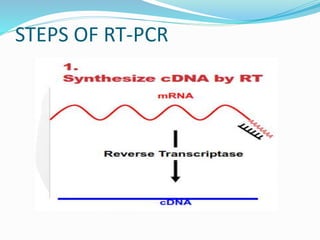
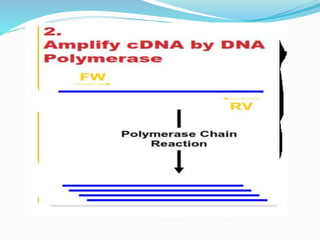
STEPS OF RT-PCR
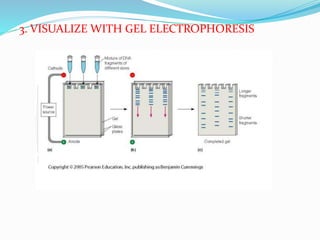
3. VISUALIZE WITH GEL ELECTROPHORESIS
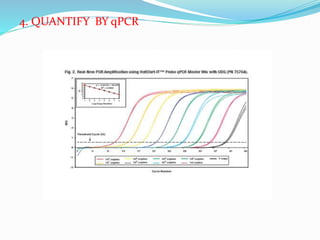
4. QUANTIFY BY qPCR
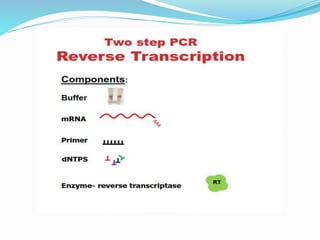
RT Buffer
TrisHCl: for maintaining the pH
MgCl2 (MnCl2), KCl salt: cofactor.
1- the polymerase uses it in the catalytic area to balance
the
negativley charged phosphate groups of RNA template
backbone.
2- stabilizes duplex’s structure because the negative
charges would
otherwise repel one another in the DNA strands
3- forms soluble complex with dNTPs
DTT:
loosen the secondary structure of RNA,
breaks disulfide bonds - reduces thermostability of the
bonds
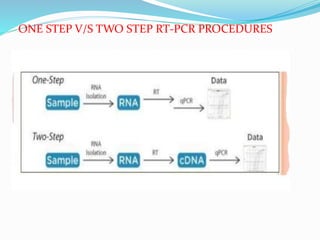
1-One-step RT-PCR
One-step RT-PCR combines first-strand cDNA synthesis
(RT) and subsequent
PCR in a single reaction tube
2- Two-step RT-PCR
Two-step RT-PCR entails two separate reactions,
beginning with first-strand
cDNA synthesis (RT), followed by amplification of a
portion of the resulting
cDNA by PCR in a separate tube.
ONE STEP V/S TWO STEP RT-PCR PROCEDURES
Advantage:
1. Simple
2. Minimize possible contamination
3. Processing of large numbers of samples
4. Useful for detecting multiple genes in a single RNA
sample.
Disadvantage:
1. One-step RT-PCR uses gene-specific primers for
amplification,
limiting the analysis to one gene per RNA sample.
2. Include multiple steps for an extended workflow
3. Increasing the chance of contamination.
تقنيات احيائية.pptx

تقنيات احيائية.pptx

  • 1.
    Under the supervisionof Dr. Alaa Hashem Student : Zahraa Thabit Nawras Mossa
  • 2.
    REVERSE TRANSCRIPTION SYNTHESIS OFcDNA FROM RNA 1-Technique used in molecular biology to detect RNA expression by generation of complementary DNA (cDNA) transcripts from single stranded RNA 2-Transcription: synthesis of RNA from DNA 3-Reverse transcription: transcription of single stranded RNA into cDNA with the help of the enzyme Reverse Transcriptase.
  • 3.
  • 5.
    3. VISUALIZE WITHGEL ELECTROPHORESIS
  • 6.
  • 8.
    RT Buffer TrisHCl: formaintaining the pH MgCl2 (MnCl2), KCl salt: cofactor. 1- the polymerase uses it in the catalytic area to balance the negativley charged phosphate groups of RNA template backbone. 2- stabilizes duplex’s structure because the negative charges would otherwise repel one another in the DNA strands 3- forms soluble complex with dNTPs
  • 9.
    DTT: loosen the secondarystructure of RNA, breaks disulfide bonds - reduces thermostability of the bonds
  • 10.
    1-One-step RT-PCR One-step RT-PCRcombines first-strand cDNA synthesis (RT) and subsequent PCR in a single reaction tube 2- Two-step RT-PCR Two-step RT-PCR entails two separate reactions, beginning with first-strand cDNA synthesis (RT), followed by amplification of a portion of the resulting cDNA by PCR in a separate tube.
  • 11.
    ONE STEP V/STWO STEP RT-PCR PROCEDURES
  • 12.
    Advantage: 1. Simple 2. Minimizepossible contamination 3. Processing of large numbers of samples 4. Useful for detecting multiple genes in a single RNA sample. Disadvantage: 1. One-step RT-PCR uses gene-specific primers for amplification, limiting the analysis to one gene per RNA sample. 2. Include multiple steps for an extended workflow 3. Increasing the chance of contamination.