









By
Amol D Sagulale
Reverse Phase Chromatography
Continued……
By
Amol D Sagulale
Sr. Reseach Associae-II
Macleod Pharmaceuticals, Mumbai
Email: amol.sagulale@gmail.com
Retention in Reverse Phase Chromatography
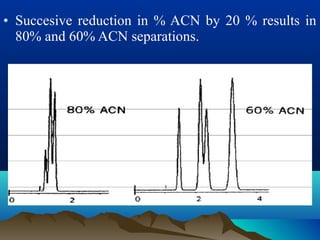
• An analyte is in equilibrium between the two phases
Mobile Phase
Stationary Phase
• The equilibrium constant, K, is termed the partition
coefficient; defined as the molar concentration of
analyte in the stationary phase divided by the molar
concentration of the analyte in the mobile phase.
• Sample molecules partition between polar mobile
phase and non-polar bonded phase.
.
Retention Time
•Time required for the sample to travel from the
injection port through the column to the detector (tR ).
•
•A term called the retention factor, k', is often used to
describe the migration rate of an analyte on a column.
(also called the capacity factor). The retention factor
for analyte A is defined as;
k'A
= t R
- tM
/ tM
•
--
•The time taken for the mobile phase to pass
through the column is called tM.
•Degree of retention is based primarily on the
degree of hydrophobicity of sample and column
packing
•Hydrophilic compounds are less strongly held
and elute first from the coloumn.
•More hydrphobic compounds elute last.
•The retention time can be increased by adding
more water to the mobile phase; thereby making the
affinity of the hydrophobic analyte for the
hydrophobic stationary phase stronger relative to
the now more hydrophilic mobile phase.
•Similarly, the retention time can be decrease by
adding more organic solvent to the eluent.
• The retention of a compound is determined by its
• Polarity and
• Experimental conditions
• Mobile phase
• Column
• Temperature
• These changes in experiment have been well studied
and can lead to a systematic approach to RPC
method development.
- •When an analytes retention factor is less than
one, elution is so fast that accurate determination
of the retention time is very difficult.
•High retention factors (greater than 20) mean that
elution takes a very long time.
• Ideally, the retention factor for an analyte is
between one and ten.
Mobile Phase Effects
• Retention ( compound k values) can be adjusted by
changing mobile phase composition or solvent
strength.
• Retention is less for stronger, less polar mobile
phases.
• Solvent strength depends on both
• Choice of organic solvent
• Its concentration in mobile phase %B
• Where, A = Water
• B = Organic solvent
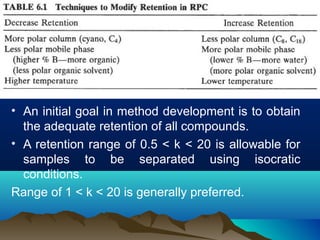
• An initial goal in method development is to obtain
the adequate retention of all compounds.
• A retention range of 0.5 < k < 20 is allowable for
samples to be separated using isocratic
conditions.
Range of 1 < k < 20 is generally preferred.
Choice of % B
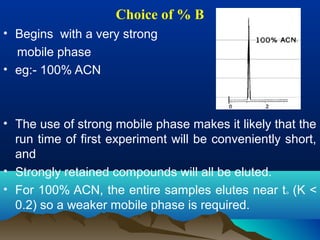
• Begins with a very strong
mobile phase
• eg:- 100% ACN
• The use of strong mobile phase makes it likely that the
run time of first experiment will be conveniently short,
and
• Strongly retained compounds will all be eluted.
• For 100% ACN, the entire samples elutes near to (K <
0.2) so a weaker mobile phase is required.
• Succesive reduction in % ACN by 20 % results in
80% and 60% ACN separations.
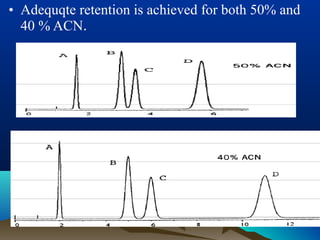
• Adequqte retention is achieved for both 50% and
40 % ACN.
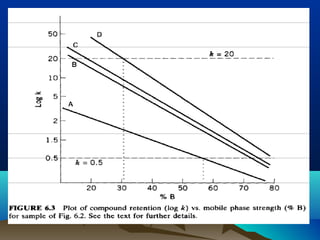
• If the mobile phase is much weaker
• ( < 30%ACN ), the retention for compound D
would be unacceptably long ( k > 20 )
•Value of k increases by a factor of 2 to 3 for a
decrease of 10% B for compounds A to D.
•The value of compound D decreases from 9 to 23 as
the mobile phase is changed from 40 to 30 %
•This rule of three ( three fold increase in k for a
10% B decrease) is useful in quick estimation of best
% B value for acceptable retention of all sample
compounds
•Systematic decrease of % B to investigate sample
retention is
•Simple and
•Convenient
•Way to determine the best mobile phase
composition for a given sample.
•A faster alternative procedure uses gradient
elution.
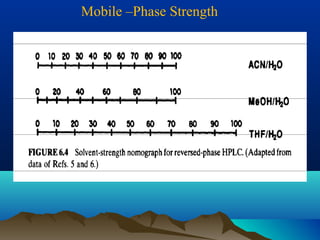
Mobile –Phase Strength
•Mobile phase strength in RPC is depends on both
•% B and
• type of organic solvents
•A vertical line connects % B values for mobile
phases having the same strength ( giving similar
value of k ).
• Various scales are at best approximate for any
particular sample and should be used only as rough
guide (± 5 % B accuracy)
• Literature data suggest that RPC solvent strength
varies as
• water ( weakest ) < methanol < acetonitrile <
ethanol < tetrahydrofuran < propanol < methylene
chloride ( strongest )
• Thus solvent strength increases as solvent polarity
decreases.
• ACN
• Best initial choice of organic solvent for mobile
phase
• UV cut off is190 nm, allowing detection at lower
wavelengths.
• It is less viscous than methanol, thus causing less
fluctuations in pressure.
• Less bubble formation occurs when it is mixed with
water.
• It has also better selectivity for peptides and
proteins.
• MeOH
• THF
• Widely use to control selectivity and separation.
• THF
• Disadvantages :-
• High UV absorbance
• Reactivity with oxygen
• Slower column equilibrium when mobile phase is
changed.
Column & Temperature effects
• RPC separations are usually carried out with silica
based, bonded-phase columns.
• Sample retention depends on 3 characteristics of the
column.
• Its type
• Concentration of bonded phase
• Column surface area
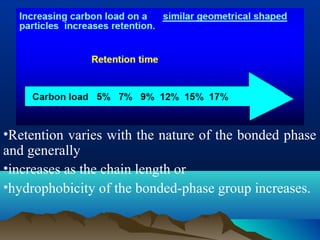
•Retention varies with the nature of the bonded phase
and generally
•increases as the chain length or
•hydrophobicity of the bonded-phase group increases.
• Eg. Retention on a C18 column is usually greater
than on a C8 column.
• RPC retention for non-polar, non-ionic
compounds generally follows the pattern :-
• (weak) unbonded silica << cyano < C1(TMS)
• < C3 < C4 < Phenyl < C8 < C18( strong)
• Polysterene and porous graphitic coloumn are
even more retentive than a C18 column.
• Column strength can be defined in terms of
bonded phase, a cyano coloumn being weak and
a C18 column strong
• Column packing ( 8nm pores) will have a surface
area of about 250 m2/gm of packing.
• Particles with 30nm pores will have a surface
area of about 60m2/gm
• K values for 30nm pore (low surface area)
column will be about one fourth as large as
(60:250) as k values for an 8 nm pore column.
• Therefore, a wide pore ( low surface area ) cyano
coloumn is quite weak and much less retentive
than a narrow pore (high surface area) C18
column.
• A change in column strength can be used to
control sample retention. ( k range )
• But in most cases a change in solvent
• strength (% B) is more effective and convenient.
Exceptions
• Very hydrophobic samples are strongly retained and
in some cases their elution from a strong column
eg:- narrow pore C18 may not be possible.
• In this case, the use of a weaker column eg:- wide
pore cyano may allow the convenient elution of the
sample.
• Similarly very hydrophilic samples may benefit
from the use of a narrow pore, highly retentive C18
or specially graphite carbon column.
Temperature
• An increase in temp by 10 will usually decrease
values of k by 1-2% for non-ionic compounds.
• Thus, a change in temp can be used to control
sample retention (k range) similar to change in
% B.
• This is rarely used in RPC, since it is more
effective to vary solvent strength.
• For very hydrophobic samples, it can be useful to
operate at higher temp with a very strong mobile
phase & weak column.
-
--
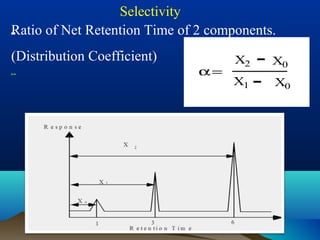
Selectivity
Ratio of Net Retention Time of 2 components.
(Distribution Coefficient) X2 - X0
X1 X0-α=
• We define a quantity called the selectivity factor,
a , which describes the separation of two species
(A and B) on the column;
• a = k 'B / k 'A
• When calculating the selectivity factor, species A
elutes faster than species B.
• The selectivity factor is always greater than
one.
• Adjusting the sample k range is only the first step
in achieving adequate separation.
• Once overall sample retention is acceptable (0.5
< k < 20) it may be necessary to change the band
spacing or selectivity of different bands.
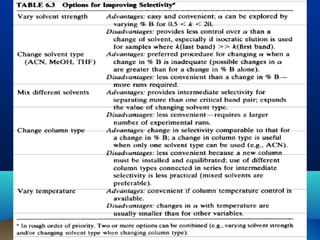
• 3 main variables can be used in RPC to change
selectivity for neutral samples
• Mobile phase
• Coloumn type
• temp
• A change in mobile phase composition is generally
the most effective and convenient and should be
tried first.
• Changes in temp are especially convenient but
provide generally smaller changes in α .
• However small changes in α are adequate for
separating many samples.
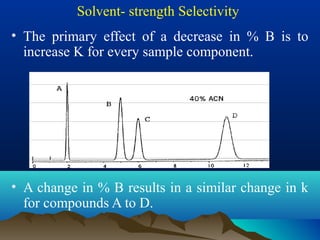
Solvent- strength Selectivity
• The primary effect of a decrease in % B is to
increase K for every sample component.
• A change in % B results in a similar change in k
for compounds A to D.
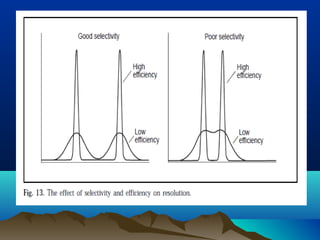
• The selectivity of adjacent peak pairs eg;- comp
B/C does not change as much as % B varied
from 30 to 56%
• but the resolution continues to increase as % B
is decreased.
• In other cases, however, the spacing of adjacent
bands can change markedly as a function of %
B.
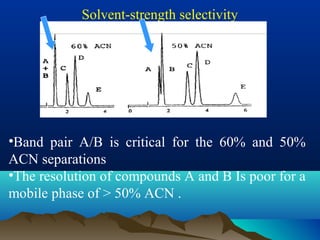
Solvent-strength selectivity
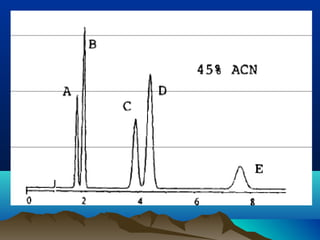
•Band pair A/B is critical for the 60% and 50%
ACN separations
•The resolution of compounds A and B Is poor for a
mobile phase of > 50% ACN .
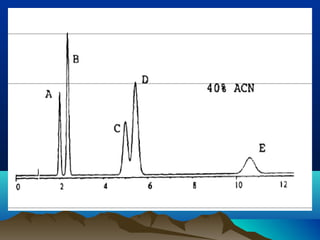
• Since the separation of A & B improves for a
decrease in % ACN, a further decrease in solvent
strength to 40% is expected to give even better
resolution of this band pair.
• However, the separation of band pair C/D becomes
worse as solvent strength decreases, so that at 40%
ACN, compounds C and D become the critical pair
band.
• When the resolution of one band pair increases and
the resolution of another band pair decreases with a
change in %B, the identity of critical band pair is
changed.
• The best sample resolution will then occur for a
%B value where both band pairs have the same
resolution ( where both pairs are critical)
• The best separation is then obtained for an
intermediate solvent strength, 45% ACN
• There is generally some range of % B values that
provide acceptable values of k for all compounds
of a given sample.
• Within this range , a particular mobile phase % B
will provide the best overall sample resolution.
• The selection of an optimum solvent strength % B
can be achieved by systematic trail- and error
experiments.
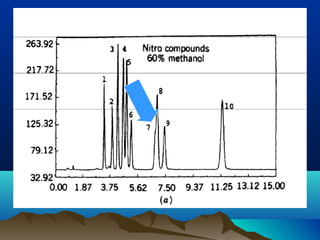
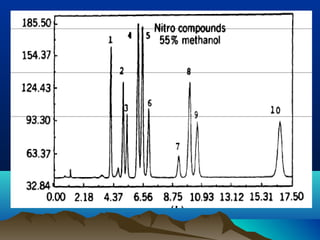
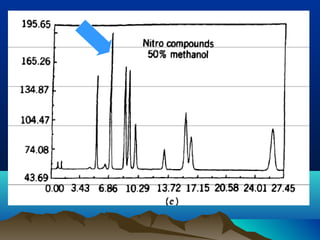
• Many different studies have shown that changing
selectivity by changing solvent strength is often
significant for RPC.
• Advantage
It can be explored while % B is varied for optimum
sample retention.
Thus, little experimental effort is normally required
in adjusting selectivity for adequate resolution.
• The use of solvent strength selectivity is limited
mainly by the retention range of the sample
• The ratio Kz/Ka for the first a and last z bands.
• This ratio can be 40 at most if 0.5<k<20 is
maintained
• Ratio is > 20,the acceptable variation of % B is
small and possible changes in selectivity by
changing % B are also small.
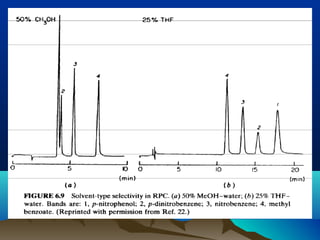
Solvent Type Selectivity
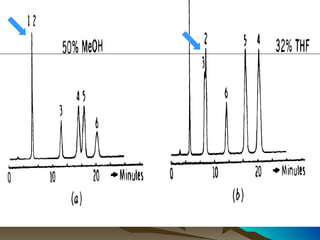
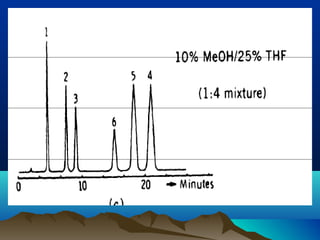
• A change in organic solvent type is often used
• to change peak spacing and
• To improve resolution
• The selection of different RPC solvents for this
purpose has been guided by solvent properties that
are believed to affect
• selectivity
• Acidity
• Basicity
• dipolarity
• According to Snyder , the strength of a mobile phase
is defined by its polarity, thus the ability to dissolve
more polar compounds.
•
• Solvent selectivity, on the other hand, is the ability to
dissolve compounds that have the same polarity, to a
different extent.
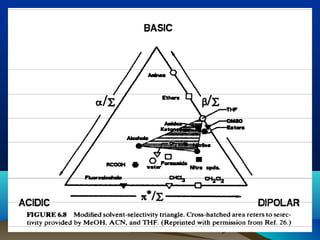
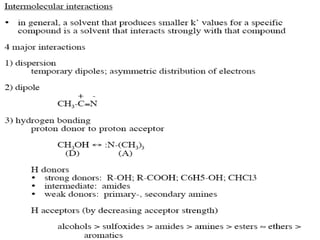
• According to the Snyder solvent triangle, three types
of interaction defines the polarity and thus the solvent
strength:
• proton-donor,
• proton-acceptor,
• and dipole interactions.
• The relative measures of these three types of
interaction defines the selectivity of a solvent.
• Different solvents with the same polarity can
have selective effects on certain solutes
because of their position within the solvent
classification scheme of Snyder.
• Each solvent will show a favorable kind of
interaction with sample solutes that show the
same polarity.
Acidity : hydrogen bond donor towards basic
solute.
Basicity: hydrogen bond acceptor from acidic
solute
Dipolarity: ability of the solvent to interact with a
solute by dipolar and polarization forces.
These are normalized in such a way that their
sum gives 1.0 and therefore are only relative
no.
So called solvatochromic parameters.
• Useful for characterization of the selectivity
properties of solvent.
• It will be best to choose solvent with large
differences in their selectivity properties.
• If these parameters are used for construction, a
solvent selectivity traingle is obtained- which
clearly shows the difference between the
individual solvent with regard to their
properties.
• The key feature of this classification of solvents for
practical method development is that
• Only three solvents should routinely be chosen to
provide the best opportunity for selectivity changes.
• 3 water miscible solvents differ significantly in
their selectivity properties (shaded area)
• Also acceptable in terms of
• UV absorptivity
• Viscosity
• Therefore, these 3 solvents are recommended for
solvent –type selectivity investigations in RPC.
• Changes in selectivity that do not involve
band reversal can still be highly
advantageous.
• Only a slight increase (2 to 5%) in the
selectivity for a critical band (by some
change in experimental conditions) pair may
be necessary to achieve acceptable
resolution.
• Solvents other than ACN, MeOH, and THF have
found occasional use as a means of optimizing
selectivity.
• Dioxane, propanol, DMSO, 2-methoxyethanol
• Useful differences in selectivity are observed for
some samples with these alternative solvents.
• High UV absorbance,
• high columnback pressure
• issues of purity and stability
• Changing solvent type in RPC is usually the
most effective procedure
• to alter selectivity and
• To achieve the separation of multi-component
neutral samples.
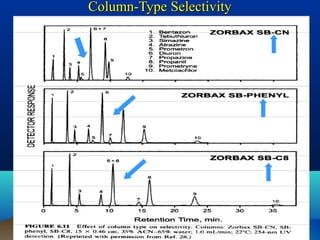
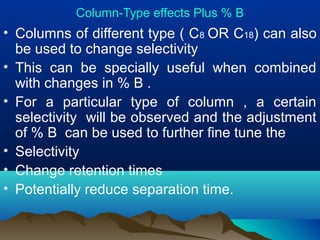
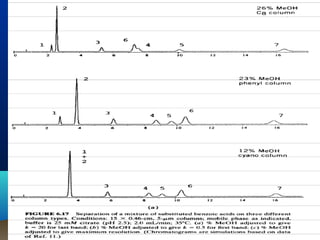
Column-Type SelectivityColumn-Type Selectivity
• Changes in band spacing are evident in each
chromatogram for these 3 different column
types
• Eg. Bands 6 and 7 are better separated on the
phenyl and C8 columns that on the cyano
column.
• Converesly, the bands 5 and 6 are better
separated on cyano column than on C8
column.
• A change in column type can produce useful
changes in selectivity.
• The phenyl column provides the better
separartion of this particular sample for this
particular mobile phase.
• A change in either % B or solvent type is likely
to change selectivity for each column, so it is
possible that the phenyl column is not the only
( or the best ) column for the sample.
• A change in column type can also change
overall sample retention .
• A change of column is usually less useful than
a change in mobile phase type.
• A change in column type for the purpose of
improving selectivity and separation should be
tried after
• The use of solvent-strength or
• Solvent-type selectivity has failed.
• If the column is changed, the mobile phase
must be reoptimized for the new column.
• Other studies have shown that the column
selectivity is quite different for cyano, phenyl,
and either C8 or C18 columns.
• Usually a C8 or C18 column should be tried
first, followed by a cyano, then by a phenyl
column.
• A change in selectivity by changing column
type may also be advantageous if
• Only one organic solvent can be used.
• Eg. Low wavelength UV detection (< 210) may
be required in those cases when only ACN and
water are usable.
• If some or all of the sample components are
unstable or potentially reactive with the mobile
phase, a specific organic solvent may also be
required.
• Band spacing changes in RPC can also be
affected by changing a source of given
column type.
• Eg . A brand X C18 column could be replaced
with a brand Y C18 column of
• same length and
• Column diameter
• Selectivity changes may result in this case
( specially for ionic samples) this approach is
not recommended.
• Selectivity differences of this type can arise for
a no. of different reasons;
• Type of silica used
• Technique
• Type of bonding chemistry
• The presence or absence of endcapping.
• These differences are often difficult to control
from batch to batch of column packing.
• Therefore, less reproducible over time and can
result in RPC methods that are less rugged.
• There is an imp. Exception to the
recommendation not to use the columns from a
different source as a means of changing
selectivity.
• Wide–pore RPC C18 columns –polyfunctional
polymeric silanes
• -appears to provide unique selectivity for PAH
that differ in shape due to intramolecular
crowding.
• It is also possible to characterize differences in
C18 bonding and resulting column selectivity
by means of PAH test mixture.
• Column packings bonded with cyclodextrin are
also used in RPC specially for the separation
of– Enantiomeric isomers.
• Found to be quite effective in separating other
achiral isomers.
Temperature Selectivity
• Values of k typically decreases at higher
temperature for the separation of neutral
compounds.
• However, large changes in selectivity with
temperature are less common with non-ionic
solutes.
• Thus, a change in temperature is in most cases
less effective for non-ionic compounds as a
means of altering selectivity for improved
separation.
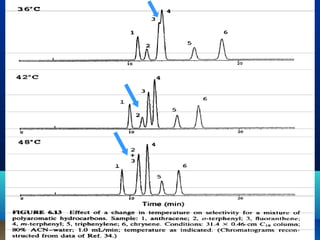
• Compounds 2 and 4- twisted molecules
• Remaining molecules – planar Fused ring
polyaromatics.
• Temp increases-retention of planar
compound decreases more rapidly
• Bands 2 and 4 change their spacing
• Optimum band spacing-temp 42
Optimizing the separation of non-ionic samples in
RPC
• It includes
• Use of solvent type plus % B
• Use of organic solvent mixtures.
• Change in column type plus change in %B
• Combined use of different olvents plus
column types.
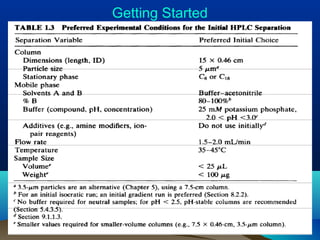
Getting Started
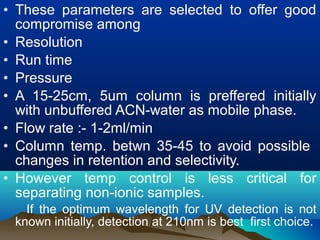
• These parameters are selected to offer good
compromise among
• Resolution
• Run time
• Pressure
• A 15-25cm, 5um column is preffered initially
with unbuffered ACN-water as mobile phase.
• Flow rate :- 1-2ml/min
• Column temp. betwn 35-45 to avoid possible
changes in retention and selectivity.
• However temp control is less critical for
separating non-ionic samples.
If the optimum wavelength for UV detection is not
known initially, detection at 210nm is best first choice.
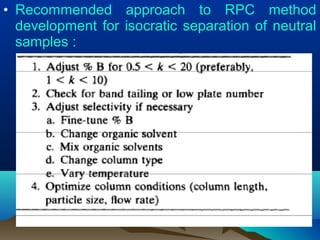
• Recommended approach to RPC method
development for isocratic separation of neutral
samples :
• Samples that are retained too strongly or too
weakly for any value of % B require special
handling .
• In addtion, if tailing bands , low column plate
no. or other peak shape effect are observed,
they should be deal with before proceeding with
further method development.
Optimizing Selectivity
• Once the % ACN for acceptable sample
retention has been established , it may be
necessary to adjust selectivity for improved
separation that is
• Either a shorter run time or
• Better resolution
Solvent-Strength (%B) Effects
• First choice for separating unresolved bands ,
because of ease and simplicity.
• Selectivity effects based on solvent strength will
usually be obvious during the adjustment of %
B for acceptable retention.
• If no value of % ACN provides acceptable
selectivity , further changes in experimental
conditions must be investigated.
• Whenever another means of changing
selectivity is investigated, it is desirable to
reoptimize %B to improve selectivity.
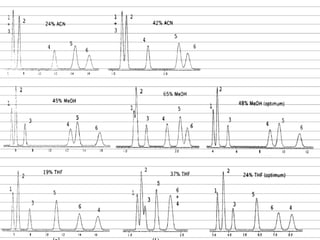
Solvent- Type Effects Plus % B Effects
• For most neutral samples a change in organic
solvent from ACN to MeOH or THF is likely to
result in major changes
• in band spacing and
• Resolution of band pairs that were unresolved.
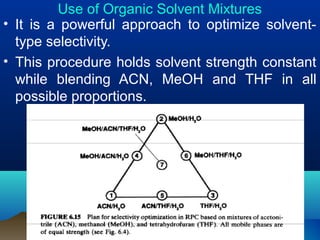
Use of Organic Solvent Mixtures
• It is a powerful approach to optimize solvent-
type selectivity.
• This procedure holds solvent strength constant
while blending ACN, MeOH and THF in all
possible proportions.
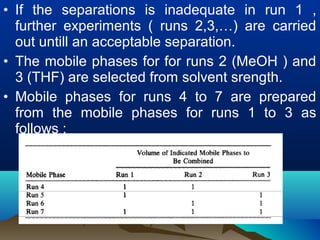
• If the separations is inadequate in run 1 ,
further experiments ( runs 2,3,…) are carried
out untill an acceptable separation.
• The mobile phases for for runs 2 (MeOH ) and
3 (THF) are selected from solvent srength.
• Mobile phases for runs 4 to 7 are prepared
from the mobile phases for runs 1 to 3 as
follows :
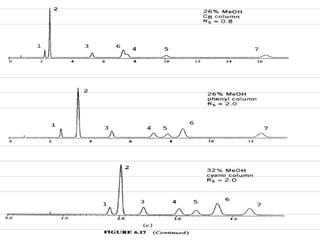
Column-Type effects Plus % B
• Columns of different type ( C8 OR C18) can also
be used to change selectivity
• This can be specially useful when combined
with changes in % B .
• For a particular type of column , a certain
selectivity will be observed and the adjustment
of % B can be used to further fine tune the
• Selectivity
• Change retention times
• Potentially reduce separation time.
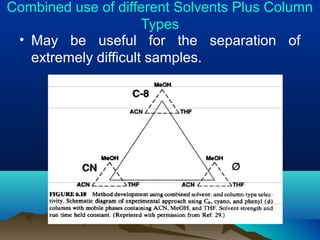
Combined use of different Solvents Plus Column
Types
• May be useful for the separation of
extremely difficult samples.
• Solvent type selectivity is first investigated for
a C8 or C18 column.
• If a satisfactory separation is obtained, no
further improvement in selectivity is
attempted.
• If a separation is inadequate, the approach is
repeated using a cyano column.
• The optimum mobile phase for one column
will differ from that for another column.
• If these experiments are unsuccessful, the
procedure is repeated with a phenyl column.
Non-Aqueous RPC
• It is reserved for very hydrophobic samples that
are retained strongly or not eluted with
100%ACN as a mobile phase.
• eg lipids or synthetic polymers.
• Mobile phase. Mixture of more polar (A) and
less polar (B) organic solvents.
• Often the A solvent will be ACN or MeOH while
the B solvent can be chloroform, acetone,
methylene chloride or mixture of these
solvents.
• Sample retention is controlled by varying % B
and the type of strong solvent B.
• Method development for NARP is similar to
RPC.
• Mixture of ACN (A) and THF (B) as a mobile
phase is a good starting point.
• If a sample is retained too strongly with 100%
THF, less polar (STRONGER) B solvents
• Methylene chloride or
• Chloroform can be tried .
The use of
methylene chloride or
Chloroform restricts UV detection higher than
236 or 250 nm respectively.
Many samples that have been separated by
NARP can be handled conveniently by means
of Normal Phase Chromatography.
Are your peaks
coeluting again?
THANK YOU

Reverse phsase chromatography 2

  • 1.
    By Amol D Sagulale ReversePhase Chromatography Continued…… By Amol D Sagulale Sr. Reseach Associae-II Macleod Pharmaceuticals, Mumbai Email: amol.sagulale@gmail.com
  • 2.
    Retention in ReversePhase Chromatography • An analyte is in equilibrium between the two phases Mobile Phase Stationary Phase • The equilibrium constant, K, is termed the partition coefficient; defined as the molar concentration of analyte in the stationary phase divided by the molar concentration of the analyte in the mobile phase. • Sample molecules partition between polar mobile phase and non-polar bonded phase.
  • 3.
    . Retention Time •Time requiredfor the sample to travel from the injection port through the column to the detector (tR ). • •A term called the retention factor, k', is often used to describe the migration rate of an analyte on a column. (also called the capacity factor). The retention factor for analyte A is defined as; k'A = t R - tM / tM •
  • 4.
    -- •The time takenfor the mobile phase to pass through the column is called tM. •Degree of retention is based primarily on the degree of hydrophobicity of sample and column packing •Hydrophilic compounds are less strongly held and elute first from the coloumn. •More hydrphobic compounds elute last.
  • 5.
    •The retention timecan be increased by adding more water to the mobile phase; thereby making the affinity of the hydrophobic analyte for the hydrophobic stationary phase stronger relative to the now more hydrophilic mobile phase. •Similarly, the retention time can be decrease by adding more organic solvent to the eluent.
  • 6.
    • The retentionof a compound is determined by its • Polarity and • Experimental conditions • Mobile phase • Column • Temperature • These changes in experiment have been well studied and can lead to a systematic approach to RPC method development.
  • 7.
    - •When ananalytes retention factor is less than one, elution is so fast that accurate determination of the retention time is very difficult. •High retention factors (greater than 20) mean that elution takes a very long time. • Ideally, the retention factor for an analyte is between one and ten.
  • 8.
    Mobile Phase Effects •Retention ( compound k values) can be adjusted by changing mobile phase composition or solvent strength. • Retention is less for stronger, less polar mobile phases. • Solvent strength depends on both • Choice of organic solvent • Its concentration in mobile phase %B • Where, A = Water • B = Organic solvent
  • 9.
    • An initialgoal in method development is to obtain the adequate retention of all compounds. • A retention range of 0.5 < k < 20 is allowable for samples to be separated using isocratic conditions. Range of 1 < k < 20 is generally preferred.
  • 10.
    Choice of %B • Begins with a very strong mobile phase • eg:- 100% ACN • The use of strong mobile phase makes it likely that the run time of first experiment will be conveniently short, and • Strongly retained compounds will all be eluted. • For 100% ACN, the entire samples elutes near to (K < 0.2) so a weaker mobile phase is required.
  • 11.
    • Succesive reductionin % ACN by 20 % results in 80% and 60% ACN separations.
  • 12.
    • Adequqte retentionis achieved for both 50% and 40 % ACN.
  • 13.
    • If themobile phase is much weaker • ( < 30%ACN ), the retention for compound D would be unacceptably long ( k > 20 )
  • 15.
    •Value of kincreases by a factor of 2 to 3 for a decrease of 10% B for compounds A to D. •The value of compound D decreases from 9 to 23 as the mobile phase is changed from 40 to 30 % •This rule of three ( three fold increase in k for a 10% B decrease) is useful in quick estimation of best % B value for acceptable retention of all sample compounds
  • 16.
    •Systematic decrease of% B to investigate sample retention is •Simple and •Convenient •Way to determine the best mobile phase composition for a given sample. •A faster alternative procedure uses gradient elution.
  • 17.
  • 18.
    •Mobile phase strengthin RPC is depends on both •% B and • type of organic solvents •A vertical line connects % B values for mobile phases having the same strength ( giving similar value of k ).
  • 19.
    • Various scalesare at best approximate for any particular sample and should be used only as rough guide (± 5 % B accuracy) • Literature data suggest that RPC solvent strength varies as • water ( weakest ) < methanol < acetonitrile < ethanol < tetrahydrofuran < propanol < methylene chloride ( strongest ) • Thus solvent strength increases as solvent polarity decreases.
  • 20.
    • ACN • Bestinitial choice of organic solvent for mobile phase • UV cut off is190 nm, allowing detection at lower wavelengths. • It is less viscous than methanol, thus causing less fluctuations in pressure. • Less bubble formation occurs when it is mixed with water. • It has also better selectivity for peptides and proteins.
  • 21.
    • MeOH • THF •Widely use to control selectivity and separation. • THF • Disadvantages :- • High UV absorbance • Reactivity with oxygen • Slower column equilibrium when mobile phase is changed.
  • 22.
    Column & Temperatureeffects • RPC separations are usually carried out with silica based, bonded-phase columns. • Sample retention depends on 3 characteristics of the column. • Its type • Concentration of bonded phase • Column surface area
  • 23.
    •Retention varies withthe nature of the bonded phase and generally •increases as the chain length or •hydrophobicity of the bonded-phase group increases.
  • 24.
    • Eg. Retentionon a C18 column is usually greater than on a C8 column. • RPC retention for non-polar, non-ionic compounds generally follows the pattern :- • (weak) unbonded silica << cyano < C1(TMS) • < C3 < C4 < Phenyl < C8 < C18( strong) • Polysterene and porous graphitic coloumn are even more retentive than a C18 column.
  • 25.
    • Column strengthcan be defined in terms of bonded phase, a cyano coloumn being weak and a C18 column strong • Column packing ( 8nm pores) will have a surface area of about 250 m2/gm of packing. • Particles with 30nm pores will have a surface area of about 60m2/gm • K values for 30nm pore (low surface area) column will be about one fourth as large as (60:250) as k values for an 8 nm pore column.
  • 26.
    • Therefore, awide pore ( low surface area ) cyano coloumn is quite weak and much less retentive than a narrow pore (high surface area) C18 column. • A change in column strength can be used to control sample retention. ( k range ) • But in most cases a change in solvent • strength (% B) is more effective and convenient.
  • 27.
    Exceptions • Very hydrophobicsamples are strongly retained and in some cases their elution from a strong column eg:- narrow pore C18 may not be possible. • In this case, the use of a weaker column eg:- wide pore cyano may allow the convenient elution of the sample. • Similarly very hydrophilic samples may benefit from the use of a narrow pore, highly retentive C18 or specially graphite carbon column.
  • 28.
    Temperature • An increasein temp by 10 will usually decrease values of k by 1-2% for non-ionic compounds. • Thus, a change in temp can be used to control sample retention (k range) similar to change in % B. • This is rarely used in RPC, since it is more effective to vary solvent strength. • For very hydrophobic samples, it can be useful to operate at higher temp with a very strong mobile phase & weak column.
  • 29.
    - -- Selectivity Ratio of NetRetention Time of 2 components. (Distribution Coefficient) X2 - X0 X1 X0-α=
  • 30.
    • We definea quantity called the selectivity factor, a , which describes the separation of two species (A and B) on the column; • a = k 'B / k 'A • When calculating the selectivity factor, species A elutes faster than species B. • The selectivity factor is always greater than one.
  • 31.
    • Adjusting thesample k range is only the first step in achieving adequate separation. • Once overall sample retention is acceptable (0.5 < k < 20) it may be necessary to change the band spacing or selectivity of different bands. • 3 main variables can be used in RPC to change selectivity for neutral samples • Mobile phase • Coloumn type • temp
  • 32.
    • A changein mobile phase composition is generally the most effective and convenient and should be tried first. • Changes in temp are especially convenient but provide generally smaller changes in α . • However small changes in α are adequate for separating many samples.
  • 33.
    Solvent- strength Selectivity •The primary effect of a decrease in % B is to increase K for every sample component. • A change in % B results in a similar change in k for compounds A to D.
  • 34.
    • The selectivityof adjacent peak pairs eg;- comp B/C does not change as much as % B varied from 30 to 56% • but the resolution continues to increase as % B is decreased. • In other cases, however, the spacing of adjacent bands can change markedly as a function of % B.
  • 36.
    Solvent-strength selectivity •Band pairA/B is critical for the 60% and 50% ACN separations •The resolution of compounds A and B Is poor for a mobile phase of > 50% ACN .
  • 39.
    • Since theseparation of A & B improves for a decrease in % ACN, a further decrease in solvent strength to 40% is expected to give even better resolution of this band pair. • However, the separation of band pair C/D becomes worse as solvent strength decreases, so that at 40% ACN, compounds C and D become the critical pair band.
  • 40.
    • When theresolution of one band pair increases and the resolution of another band pair decreases with a change in %B, the identity of critical band pair is changed. • The best sample resolution will then occur for a %B value where both band pairs have the same resolution ( where both pairs are critical) • The best separation is then obtained for an intermediate solvent strength, 45% ACN
  • 41.
    • There isgenerally some range of % B values that provide acceptable values of k for all compounds of a given sample. • Within this range , a particular mobile phase % B will provide the best overall sample resolution. • The selection of an optimum solvent strength % B can be achieved by systematic trail- and error experiments.
  • 42.
    • Many differentstudies have shown that changing selectivity by changing solvent strength is often significant for RPC. • Advantage It can be explored while % B is varied for optimum sample retention. Thus, little experimental effort is normally required in adjusting selectivity for adequate resolution.
  • 46.
    • The useof solvent strength selectivity is limited mainly by the retention range of the sample • The ratio Kz/Ka for the first a and last z bands. • This ratio can be 40 at most if 0.5<k<20 is maintained • Ratio is > 20,the acceptable variation of % B is small and possible changes in selectivity by changing % B are also small.
  • 47.
    Solvent Type Selectivity •A change in organic solvent type is often used • to change peak spacing and • To improve resolution • The selection of different RPC solvents for this purpose has been guided by solvent properties that are believed to affect • selectivity • Acidity • Basicity • dipolarity
  • 51.
    • According toSnyder , the strength of a mobile phase is defined by its polarity, thus the ability to dissolve more polar compounds. • • Solvent selectivity, on the other hand, is the ability to dissolve compounds that have the same polarity, to a different extent. • According to the Snyder solvent triangle, three types of interaction defines the polarity and thus the solvent strength: • proton-donor, • proton-acceptor, • and dipole interactions. • The relative measures of these three types of interaction defines the selectivity of a solvent.
  • 52.
    • Different solventswith the same polarity can have selective effects on certain solutes because of their position within the solvent classification scheme of Snyder. • Each solvent will show a favorable kind of interaction with sample solutes that show the same polarity.
  • 53.
    Acidity : hydrogenbond donor towards basic solute. Basicity: hydrogen bond acceptor from acidic solute Dipolarity: ability of the solvent to interact with a solute by dipolar and polarization forces. These are normalized in such a way that their sum gives 1.0 and therefore are only relative no. So called solvatochromic parameters.
  • 54.
    • Useful forcharacterization of the selectivity properties of solvent. • It will be best to choose solvent with large differences in their selectivity properties. • If these parameters are used for construction, a solvent selectivity traingle is obtained- which clearly shows the difference between the individual solvent with regard to their properties.
  • 55.
    • The keyfeature of this classification of solvents for practical method development is that • Only three solvents should routinely be chosen to provide the best opportunity for selectivity changes. • 3 water miscible solvents differ significantly in their selectivity properties (shaded area) • Also acceptable in terms of • UV absorptivity • Viscosity • Therefore, these 3 solvents are recommended for solvent –type selectivity investigations in RPC.
  • 57.
    • Changes inselectivity that do not involve band reversal can still be highly advantageous. • Only a slight increase (2 to 5%) in the selectivity for a critical band (by some change in experimental conditions) pair may be necessary to achieve acceptable resolution.
  • 60.
    • Solvents otherthan ACN, MeOH, and THF have found occasional use as a means of optimizing selectivity. • Dioxane, propanol, DMSO, 2-methoxyethanol • Useful differences in selectivity are observed for some samples with these alternative solvents. • High UV absorbance, • high columnback pressure • issues of purity and stability
  • 61.
    • Changing solventtype in RPC is usually the most effective procedure • to alter selectivity and • To achieve the separation of multi-component neutral samples.
  • 62.
  • 63.
    • Changes inband spacing are evident in each chromatogram for these 3 different column types • Eg. Bands 6 and 7 are better separated on the phenyl and C8 columns that on the cyano column. • Converesly, the bands 5 and 6 are better separated on cyano column than on C8 column. • A change in column type can produce useful changes in selectivity.
  • 64.
    • The phenylcolumn provides the better separartion of this particular sample for this particular mobile phase. • A change in either % B or solvent type is likely to change selectivity for each column, so it is possible that the phenyl column is not the only ( or the best ) column for the sample. • A change in column type can also change overall sample retention . • A change of column is usually less useful than a change in mobile phase type.
  • 65.
    • A changein column type for the purpose of improving selectivity and separation should be tried after • The use of solvent-strength or • Solvent-type selectivity has failed. • If the column is changed, the mobile phase must be reoptimized for the new column. • Other studies have shown that the column selectivity is quite different for cyano, phenyl, and either C8 or C18 columns. • Usually a C8 or C18 column should be tried first, followed by a cyano, then by a phenyl column.
  • 66.
    • A changein selectivity by changing column type may also be advantageous if • Only one organic solvent can be used. • Eg. Low wavelength UV detection (< 210) may be required in those cases when only ACN and water are usable. • If some or all of the sample components are unstable or potentially reactive with the mobile phase, a specific organic solvent may also be required.
  • 67.
    • Band spacingchanges in RPC can also be affected by changing a source of given column type. • Eg . A brand X C18 column could be replaced with a brand Y C18 column of • same length and • Column diameter • Selectivity changes may result in this case ( specially for ionic samples) this approach is not recommended.
  • 68.
    • Selectivity differencesof this type can arise for a no. of different reasons; • Type of silica used • Technique • Type of bonding chemistry • The presence or absence of endcapping. • These differences are often difficult to control from batch to batch of column packing. • Therefore, less reproducible over time and can result in RPC methods that are less rugged.
  • 69.
    • There isan imp. Exception to the recommendation not to use the columns from a different source as a means of changing selectivity. • Wide–pore RPC C18 columns –polyfunctional polymeric silanes • -appears to provide unique selectivity for PAH that differ in shape due to intramolecular crowding. • It is also possible to characterize differences in C18 bonding and resulting column selectivity by means of PAH test mixture.
  • 70.
    • Column packingsbonded with cyclodextrin are also used in RPC specially for the separation of– Enantiomeric isomers. • Found to be quite effective in separating other achiral isomers.
  • 71.
    Temperature Selectivity • Valuesof k typically decreases at higher temperature for the separation of neutral compounds. • However, large changes in selectivity with temperature are less common with non-ionic solutes. • Thus, a change in temperature is in most cases less effective for non-ionic compounds as a means of altering selectivity for improved separation.
  • 73.
    • Compounds 2and 4- twisted molecules • Remaining molecules – planar Fused ring polyaromatics. • Temp increases-retention of planar compound decreases more rapidly • Bands 2 and 4 change their spacing • Optimum band spacing-temp 42
  • 74.
    Optimizing the separationof non-ionic samples in RPC • It includes • Use of solvent type plus % B • Use of organic solvent mixtures. • Change in column type plus change in %B • Combined use of different olvents plus column types.
  • 75.
  • 76.
    • These parametersare selected to offer good compromise among • Resolution • Run time • Pressure • A 15-25cm, 5um column is preffered initially with unbuffered ACN-water as mobile phase. • Flow rate :- 1-2ml/min • Column temp. betwn 35-45 to avoid possible changes in retention and selectivity. • However temp control is less critical for separating non-ionic samples. If the optimum wavelength for UV detection is not known initially, detection at 210nm is best first choice.
  • 77.
    • Recommended approachto RPC method development for isocratic separation of neutral samples :
  • 78.
    • Samples thatare retained too strongly or too weakly for any value of % B require special handling . • In addtion, if tailing bands , low column plate no. or other peak shape effect are observed, they should be deal with before proceeding with further method development.
  • 79.
    Optimizing Selectivity • Oncethe % ACN for acceptable sample retention has been established , it may be necessary to adjust selectivity for improved separation that is • Either a shorter run time or • Better resolution
  • 81.
    Solvent-Strength (%B) Effects •First choice for separating unresolved bands , because of ease and simplicity. • Selectivity effects based on solvent strength will usually be obvious during the adjustment of % B for acceptable retention. • If no value of % ACN provides acceptable selectivity , further changes in experimental conditions must be investigated. • Whenever another means of changing selectivity is investigated, it is desirable to reoptimize %B to improve selectivity.
  • 82.
    Solvent- Type EffectsPlus % B Effects • For most neutral samples a change in organic solvent from ACN to MeOH or THF is likely to result in major changes • in band spacing and • Resolution of band pairs that were unresolved.
  • 84.
    Use of OrganicSolvent Mixtures • It is a powerful approach to optimize solvent- type selectivity. • This procedure holds solvent strength constant while blending ACN, MeOH and THF in all possible proportions.
  • 85.
    • If theseparations is inadequate in run 1 , further experiments ( runs 2,3,…) are carried out untill an acceptable separation. • The mobile phases for for runs 2 (MeOH ) and 3 (THF) are selected from solvent srength. • Mobile phases for runs 4 to 7 are prepared from the mobile phases for runs 1 to 3 as follows :
  • 86.
    Column-Type effects Plus% B • Columns of different type ( C8 OR C18) can also be used to change selectivity • This can be specially useful when combined with changes in % B . • For a particular type of column , a certain selectivity will be observed and the adjustment of % B can be used to further fine tune the • Selectivity • Change retention times • Potentially reduce separation time.
  • 89.
    Combined use ofdifferent Solvents Plus Column Types • May be useful for the separation of extremely difficult samples.
  • 90.
    • Solvent typeselectivity is first investigated for a C8 or C18 column. • If a satisfactory separation is obtained, no further improvement in selectivity is attempted. • If a separation is inadequate, the approach is repeated using a cyano column. • The optimum mobile phase for one column will differ from that for another column. • If these experiments are unsuccessful, the procedure is repeated with a phenyl column.
  • 91.
    Non-Aqueous RPC • Itis reserved for very hydrophobic samples that are retained strongly or not eluted with 100%ACN as a mobile phase. • eg lipids or synthetic polymers. • Mobile phase. Mixture of more polar (A) and less polar (B) organic solvents. • Often the A solvent will be ACN or MeOH while the B solvent can be chloroform, acetone, methylene chloride or mixture of these solvents.
  • 92.
    • Sample retentionis controlled by varying % B and the type of strong solvent B. • Method development for NARP is similar to RPC. • Mixture of ACN (A) and THF (B) as a mobile phase is a good starting point. • If a sample is retained too strongly with 100% THF, less polar (STRONGER) B solvents • Methylene chloride or • Chloroform can be tried .
  • 93.
    The use of methylenechloride or Chloroform restricts UV detection higher than 236 or 250 nm respectively. Many samples that have been separated by NARP can be handled conveniently by means of Normal Phase Chromatography.
  • 94.
    Are your peaks coelutingagain? THANK YOU