Counter current
chromatography
Presented by
S. Suma
Under the guidance of
Mrs. Srividya M .pharm
Assistant professor
CONTENTS
INTRODUCTION
PRINCIPLE
PROCEDURE
INSTRUMENTATION
COLUMNS OF CCC
TYPES OF CCC
DROPLET CCC
CENTRIFUGAL PARTITION CHROMATOGRAPHY
CHOICE OF SOLVENTS
APLLICATIONS OF CCC
CONCLUSION
REFERENCES
Introduction
• Counter-current chromatography is a liquid
chromatography that uses two immiscible liquid
phases i.e.., one act as stationary liquid and mobile
liquid phase and no solid support .
• The inventor Yochiro Ito(1978) ,named it after the
counter current partition method .
Definition
• Counter-current chromatography is a method of
distribution of two (or) more substances by repeated
distribution between two immiscible liquid phases
that flow in opposite directions.
Principle Of CCC
• The principle of separation involves the partition of
a solute between two immiscible solvents (mobile
phase and stationary phase).
• The relative proportion of solute passing into each
of the two solvents determined by partition
coefficient.
• Here both phases are liquid. Partition of solute in
two phases is based on differences in capacity factor,
k and distribution coefficient ,kd of the analyte.
PROCEDURE
• The best results are obtained by filtering the sample solution
before introduction into the column.
• The whole ccc is a chromatographic column
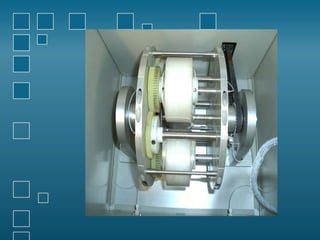
• centrifugal fields imply rotating parts, rotors, gears, spools,
motors and speed regulators.
• Mixing of phases is done so that the analyte can move
between the phases.
• Mobile phase is mixing with then settling from stationary
phase throughout the column.
• Maximum retention of stationary phase is obtained by using
less viscous phase as mobile phase.
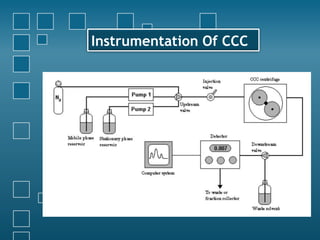
Instrumentation Of CCC
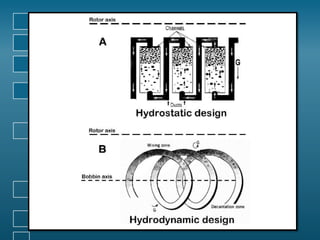
Hydrostatic ccc column
• The very first hydrostatic CCC columns used gravity to
maintain the liquid stationary phase; they were called
droplet CCC (DCCC) columns. They needed very long
elution times (days).Their two main characteristics are:
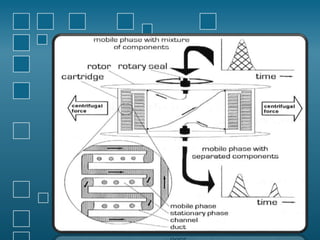
• (1) they have single axis of rotation generating a
constant centrifugal field and (2) they enclose
geometrical volumes ,tubes, channels, or locules that
repeat themselves through connecting tubes forming a
pattern.
• It can be seen that there is quite a significant volume of
connecting ducts which only contain the mobile phase.
Hydrodynamic ccc column
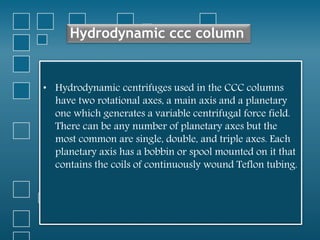
• Hydrodynamic centrifuges used in the CCC columns
have two rotational axes, a main axis and a planetary
one which generates a variable centrifugal force field.
There can be any number of planetary axes but the
most common are single, double, and triple axes. Each
planetary axis has a bobbin or spool mounted on it that
contains the coils of continuously wound Teflon tubing.
Types of ccc
1. Droplet counter current chromatography.
2. Elution Extrusion Counter Current Chromatography
3. Centrifugal Partition Chromatography
4. High Speed Counter Current Chromatography.
Droplet counter current chromatography
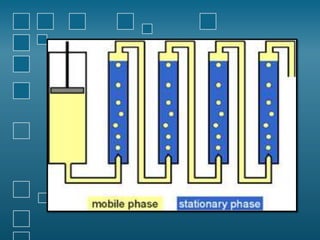
1. It uses only gravity to move the mobile phase through the
stationary phase.
2. In descending mode, droplets of the denser mobile phase and
sample are allowed to fall through a column of the lighter
stationary phase using only gravity.
3. If a less dense mobile phase is used it will rise through the
stationary phase, this is called ascending mode.
4. The eluent from one column is transferred to another; the
more columns that are used, the more theoretical plates can be
achieved.
Centrifugal Partition Chromatography
1. CPC use CENTRIFUGAL FORCE to speed separation and
achieves higher flow rates than DCCC.
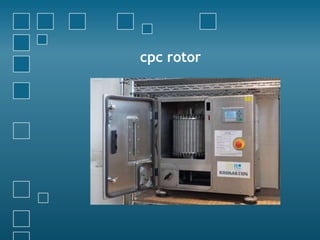
2. The centrifugal partition chromatograph is constituted with
a unique rotor(column). This rotor rotates on its central axis.
3. With less vibrations and noise, the CPC offers a wider
rotation speed range(from 500 to 2000 rpm) .
4. That allows a better decantation and retention for unstable
biphasic system.
cpc rotor
Choice of solvents
• Critical points in selection are
Sample solubility
Partition coefficient
• Chloroform based system (or)
• Ternary phase diagram is used for the
selecting the solvent system
- Foucault suggested three criteria to follow ternary
phase diagrams
-Select the best solvent in which sample can be
completely dissolved,
- Select two solvents (one is less polar another
is more polar), best solvent will partition into the
two other solvents,
- The less polar fraction of the sample will
preferentially go into the less polar phase and the
more polar fraction will preferentially go into the
more polar phase so that average partition
coefficient stay around 1.
Solvent systems
• Biphasic liquid system
-octanol and water
• Tertiary liquid system
-chloroform-methanol-water
• Quaternary liquid system
- hexane-ethyl acetate- acetone-water
Applications
• Droplet counter-current chromatography (DCCC) has
found wide application for preparative separation of
plant constituents and other natural products. It is
particularly indicated for the isolation of polar
compounds.
• New fields of applications include essential oils,
triterpenoids and steroids, plant growth regulators
(gibberellins), antibiotics.
• Different types of centrifuges are used for seperation of
various compounds from plant and different natural
products.
REFERENCE
• www.wikipedia.org/wiki/counter-cureent-chromatography
• http://www.authorstream.com/Presentation/aSGuest111335-
1159749-cntrifugal-partion-chromatography/
• http://www.tandfonline.com/doi/abs/10.1080/1082607070127
7067?journalCode=ljlc20
• http://pubs.acs.org/doi/abs/10.1021/jf00076a020
• http://www.slideshare.net/kalpanaraj/abstrct
• https://en.wikipedia.org/wiki/Droplet_countercurrent_chroma
tography
• https://www.ncbi.nlm.nih.gov/pubmed/7031776
counter current chromatography

counter current chromatography

  • 1.
    Counter current chromatography Presented by S.Suma Under the guidance of Mrs. Srividya M .pharm Assistant professor
  • 2.
    CONTENTS INTRODUCTION PRINCIPLE PROCEDURE INSTRUMENTATION COLUMNS OF CCC TYPESOF CCC DROPLET CCC CENTRIFUGAL PARTITION CHROMATOGRAPHY CHOICE OF SOLVENTS APLLICATIONS OF CCC CONCLUSION REFERENCES
  • 3.
    Introduction • Counter-current chromatographyis a liquid chromatography that uses two immiscible liquid phases i.e.., one act as stationary liquid and mobile liquid phase and no solid support . • The inventor Yochiro Ito(1978) ,named it after the counter current partition method . Definition • Counter-current chromatography is a method of distribution of two (or) more substances by repeated distribution between two immiscible liquid phases that flow in opposite directions.
  • 4.
    Principle Of CCC •The principle of separation involves the partition of a solute between two immiscible solvents (mobile phase and stationary phase). • The relative proportion of solute passing into each of the two solvents determined by partition coefficient. • Here both phases are liquid. Partition of solute in two phases is based on differences in capacity factor, k and distribution coefficient ,kd of the analyte.
  • 5.
    PROCEDURE • The bestresults are obtained by filtering the sample solution before introduction into the column. • The whole ccc is a chromatographic column • centrifugal fields imply rotating parts, rotors, gears, spools, motors and speed regulators. • Mixing of phases is done so that the analyte can move between the phases. • Mobile phase is mixing with then settling from stationary phase throughout the column. • Maximum retention of stationary phase is obtained by using less viscous phase as mobile phase.
  • 6.
  • 8.
    Hydrostatic ccc column •The very first hydrostatic CCC columns used gravity to maintain the liquid stationary phase; they were called droplet CCC (DCCC) columns. They needed very long elution times (days).Their two main characteristics are: • (1) they have single axis of rotation generating a constant centrifugal field and (2) they enclose geometrical volumes ,tubes, channels, or locules that repeat themselves through connecting tubes forming a pattern. • It can be seen that there is quite a significant volume of connecting ducts which only contain the mobile phase.
  • 10.
    Hydrodynamic ccc column •Hydrodynamic centrifuges used in the CCC columns have two rotational axes, a main axis and a planetary one which generates a variable centrifugal force field. There can be any number of planetary axes but the most common are single, double, and triple axes. Each planetary axis has a bobbin or spool mounted on it that contains the coils of continuously wound Teflon tubing.
  • 11.
    Types of ccc 1.Droplet counter current chromatography. 2. Elution Extrusion Counter Current Chromatography 3. Centrifugal Partition Chromatography 4. High Speed Counter Current Chromatography.
  • 12.
    Droplet counter currentchromatography 1. It uses only gravity to move the mobile phase through the stationary phase. 2. In descending mode, droplets of the denser mobile phase and sample are allowed to fall through a column of the lighter stationary phase using only gravity. 3. If a less dense mobile phase is used it will rise through the stationary phase, this is called ascending mode. 4. The eluent from one column is transferred to another; the more columns that are used, the more theoretical plates can be achieved.
  • 14.
    Centrifugal Partition Chromatography 1.CPC use CENTRIFUGAL FORCE to speed separation and achieves higher flow rates than DCCC. 2. The centrifugal partition chromatograph is constituted with a unique rotor(column). This rotor rotates on its central axis. 3. With less vibrations and noise, the CPC offers a wider rotation speed range(from 500 to 2000 rpm) . 4. That allows a better decantation and retention for unstable biphasic system.
  • 15.
  • 17.
    Choice of solvents •Critical points in selection are Sample solubility Partition coefficient • Chloroform based system (or) • Ternary phase diagram is used for the selecting the solvent system
  • 18.
    - Foucault suggestedthree criteria to follow ternary phase diagrams -Select the best solvent in which sample can be completely dissolved, - Select two solvents (one is less polar another is more polar), best solvent will partition into the two other solvents, - The less polar fraction of the sample will preferentially go into the less polar phase and the more polar fraction will preferentially go into the more polar phase so that average partition coefficient stay around 1.
  • 19.
    Solvent systems • Biphasicliquid system -octanol and water • Tertiary liquid system -chloroform-methanol-water • Quaternary liquid system - hexane-ethyl acetate- acetone-water
  • 20.
    Applications • Droplet counter-currentchromatography (DCCC) has found wide application for preparative separation of plant constituents and other natural products. It is particularly indicated for the isolation of polar compounds. • New fields of applications include essential oils, triterpenoids and steroids, plant growth regulators (gibberellins), antibiotics. • Different types of centrifuges are used for seperation of various compounds from plant and different natural products.
  • 21.
    REFERENCE • www.wikipedia.org/wiki/counter-cureent-chromatography • http://www.authorstream.com/Presentation/aSGuest111335- 1159749-cntrifugal-partion-chromatography/ •http://www.tandfonline.com/doi/abs/10.1080/1082607070127 7067?journalCode=ljlc20 • http://pubs.acs.org/doi/abs/10.1021/jf00076a020 • http://www.slideshare.net/kalpanaraj/abstrct • https://en.wikipedia.org/wiki/Droplet_countercurrent_chroma tography • https://www.ncbi.nlm.nih.gov/pubmed/7031776