HIGH PERFORMANCE LIQUID
CHROMATOGRAPHY
PRESENTED BY:
Mr. Ankush P. Jadhav & Miss. Tejashree R. Kedar
M. Pharm (PQA)
Email id: jadhavbrand@gmail.com,
………..tejashrikedar@gmail.com 1
CONTENTS :
1) PRINCIPLE
2) INSTRUMENTATION
2
CHROMATOGRAPHY :
Chromatography is defined as the method of separating a mixture of components
into individual components.
HPLC :
It was originally referred to as High Pressure Liquid Chromatography since high
pressure is applied using a pumping system to the column.
This pressure works by forcing the mobile phase through, at much higher rate
increasing the resolution power.
Due to its high efficiency and performance High Pressure Liquid
Chromatography is referred to as High Performance Liquid Chromatography.
3
ADSORPTION CHROMATOGRAPHY:
The principle of separation is adsorption .
Separation of compounds takes place based on the difference in the affinity of the
compound towards stationary phase as in the normal and reverse phase.
4
5
INSTRUMENTATION OF HPLC
Mobile Phase Reservoirs
De-gassing of solvents
Pump
Sample injection systems
Column
Detector
Recorder
6
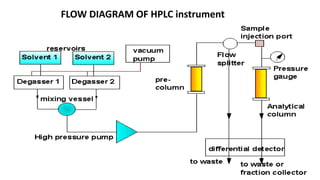
FLOW DIAGRAM OF HPLC instrument
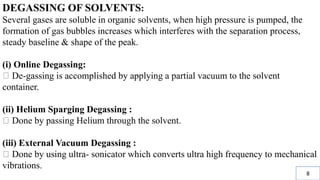
DEGASSING OF SOLVENTS:
Several gases are soluble in organic solvents, when high pressure is pumped, the
formation of gas bubbles increases which interferes with the separation process,
steady baseline & shape of the peak.
(i) Online Degassing:
De-gassing is accomplished by applying a partial vacuum to the solvent
container.
(ii) Helium Sparging Degassing :
Done by passing Helium through the solvent.
(iii) External Vacuum Degassing :
Done by using ultra- sonicator which converts ultra high frequency to mechanical
vibrations.
8
PUMP:
The solvents or mobile phase must be passed through a column at high pressures
smaller the particle size of the stationary phase the greater is the resistance to the flow of
solvents.
Hence high pressure is recommended.
Requirements for pumps:
It should provide uniform flow rate
Pulse free output & all materials in the pump should be chemically resistant to solvents.
9
10
1) DISPLACEMENT PUMPS :
It consists of large syringe like chambers
So it is also called as Syringe Type Pump.
11
2) RECIPROCATING PUMPS:
This pump transmits alternative pressure to the solvent
Advantages:
Have small internal volume
Large solvent capacities & constant flow rates.
Disadvantages:-
Produces a pulsed flow which is damped because
pulses appear as baseline noise on the chromatograph.
12
3) PNEUMATIC PUMPS:
In this pumps, the mobile phase is
driven through the column with the
use of pressure produced from a gas
cylinder.
It has limited capacity of solvent
13
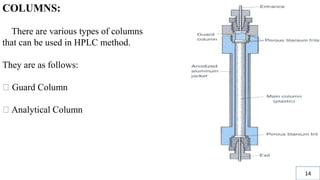
COLUMNS:
There are various types of columns
that can be used in HPLC method.
They are as follows:
Guard Column
Analytical Column
14
1) GUARD COLUMN:
Guard columns are placed anterior to the separating column.
This protects and prolongs the life & usefulness of the separating column.
They are dependable columns designed to filter or remove:-
-particles that clog the separating column
-compounds and ions that could ultimately decreased sensitivity and create false
peaks.
15
2) ANALYTICAL COLUMN:
This is the most important part of HPLC which decides the efficiency of
separation
Length- 5 to 25 cm , Internal Diameter 3 to 5mm.
Particle size of packing material is 3 to 5μm.
16
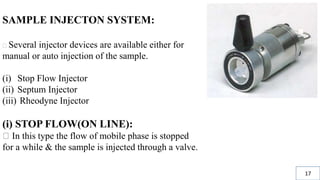
SAMPLE INJECTON SYSTEM:
Several injector devices are available either for
manual or auto injection of the sample.
(i) Stop Flow Injector
(ii) Septum Injector
(iii) Rheodyne Injector
(i) STOP FLOW(ON LINE):
In this type the flow of mobile phase is stopped
for a while & the sample is injected through a valve.
17
(ii) SEPTUM INJECTOR:
These are used for injecting the sample through a rubber septum
This kind of injectors cannot be commonly used , since the septum has to
withstand high pressures.
(iii) RHEODYNE INJECTOR:
It is the most popular injector and is widely used.
This has a fixed volume of loop, for holding sample until its injected into the
column
18
19
DETECTORS:
20
2) FLUORIMETRIC DETECTORS
1) REFRACTIVE INDEX (RI) DETECTOR
3) ULTRAVIOLET / VISIBLE DETECTOR
1) REFRACTIVE INDEX (RI) DETECTOR:
Nearly universal but poor detection limit.
Detection occurs when the light is bent due to samples eluting from the columns
It has low sensitivity & specificity.
21
2) FLUORIMETRIC
DETECTORS:
It is based on the fluorescent
radiation emitted by some
compounds.
The excitation source passes
through the flow cell to a
photodetector while a
monochromator measures the
emission wavelengths.
More sensitive and specific. 22
3) ULTRAVIOLET / VISIBLE DETECTOR :
Advantage:
• Sensitivity is high
• Relative temperature and flow rate change
Disadvantage:
• Only compounds with UV or visible absorption could be detected.
• Dual Wavelength mode
• Wavelength Time Program mode
23
RECORDERS :
Recorders are used to record responses obtained from the detectors after
amplification if necessary.
They record the baseline & all the peaks obtained with respect to time.
24
REFERENCE:
Gurdeep R. Chatwal, Sham K. Anand, Instrumental Method Of Chemical
Analysis, Himalaya Publishing House, 2003, p. 2.624 to 2.638
P.D Sethi, Quantitative Analysis Of Pharmaceutical Preparations .
Douglas A. Skoog, Instrumental Analysis, Brooks/Cole, 2007, p. 897 to 899
Dr. S Ravi Shankar, Textbook Of Pharmaceutical Analysis, Rx Publications, 2005,
p. 18-1 to 18-11
Robert D. Braun, Introduction Instrumental Analysis, Pharma Book Syndicate,
2006, p. 860 to 863
www.google.com 25
THANK YOU…
26

HIGH PERFORMANCE LIQUID CHROMATOGRAPHY

  • 1.
    HIGH PERFORMANCE LIQUID CHROMATOGRAPHY PRESENTEDBY: Mr. Ankush P. Jadhav & Miss. Tejashree R. Kedar M. Pharm (PQA) Email id: jadhavbrand@gmail.com, ………..tejashrikedar@gmail.com 1
  • 2.
    CONTENTS : 1) PRINCIPLE 2)INSTRUMENTATION 2
  • 3.
    CHROMATOGRAPHY : Chromatography isdefined as the method of separating a mixture of components into individual components. HPLC : It was originally referred to as High Pressure Liquid Chromatography since high pressure is applied using a pumping system to the column. This pressure works by forcing the mobile phase through, at much higher rate increasing the resolution power. Due to its high efficiency and performance High Pressure Liquid Chromatography is referred to as High Performance Liquid Chromatography. 3
  • 4.
    ADSORPTION CHROMATOGRAPHY: The principleof separation is adsorption . Separation of compounds takes place based on the difference in the affinity of the compound towards stationary phase as in the normal and reverse phase. 4
  • 5.
  • 6.
    INSTRUMENTATION OF HPLC MobilePhase Reservoirs De-gassing of solvents Pump Sample injection systems Column Detector Recorder 6
  • 7.
    FLOW DIAGRAM OFHPLC instrument
  • 8.
    DEGASSING OF SOLVENTS: Severalgases are soluble in organic solvents, when high pressure is pumped, the formation of gas bubbles increases which interferes with the separation process, steady baseline & shape of the peak. (i) Online Degassing: De-gassing is accomplished by applying a partial vacuum to the solvent container. (ii) Helium Sparging Degassing : Done by passing Helium through the solvent. (iii) External Vacuum Degassing : Done by using ultra- sonicator which converts ultra high frequency to mechanical vibrations. 8
  • 9.
    PUMP: The solvents ormobile phase must be passed through a column at high pressures smaller the particle size of the stationary phase the greater is the resistance to the flow of solvents. Hence high pressure is recommended. Requirements for pumps: It should provide uniform flow rate Pulse free output & all materials in the pump should be chemically resistant to solvents. 9
  • 10.
  • 11.
    1) DISPLACEMENT PUMPS: It consists of large syringe like chambers So it is also called as Syringe Type Pump. 11
  • 12.
    2) RECIPROCATING PUMPS: Thispump transmits alternative pressure to the solvent Advantages: Have small internal volume Large solvent capacities & constant flow rates. Disadvantages:- Produces a pulsed flow which is damped because pulses appear as baseline noise on the chromatograph. 12
  • 13.
    3) PNEUMATIC PUMPS: Inthis pumps, the mobile phase is driven through the column with the use of pressure produced from a gas cylinder. It has limited capacity of solvent 13
  • 14.
    COLUMNS: There are varioustypes of columns that can be used in HPLC method. They are as follows: Guard Column Analytical Column 14
  • 15.
    1) GUARD COLUMN: Guardcolumns are placed anterior to the separating column. This protects and prolongs the life & usefulness of the separating column. They are dependable columns designed to filter or remove:- -particles that clog the separating column -compounds and ions that could ultimately decreased sensitivity and create false peaks. 15
  • 16.
    2) ANALYTICAL COLUMN: Thisis the most important part of HPLC which decides the efficiency of separation Length- 5 to 25 cm , Internal Diameter 3 to 5mm. Particle size of packing material is 3 to 5μm. 16
  • 17.
    SAMPLE INJECTON SYSTEM: Severalinjector devices are available either for manual or auto injection of the sample. (i) Stop Flow Injector (ii) Septum Injector (iii) Rheodyne Injector (i) STOP FLOW(ON LINE): In this type the flow of mobile phase is stopped for a while & the sample is injected through a valve. 17
  • 18.
    (ii) SEPTUM INJECTOR: Theseare used for injecting the sample through a rubber septum This kind of injectors cannot be commonly used , since the septum has to withstand high pressures. (iii) RHEODYNE INJECTOR: It is the most popular injector and is widely used. This has a fixed volume of loop, for holding sample until its injected into the column 18
  • 19.
  • 20.
    DETECTORS: 20 2) FLUORIMETRIC DETECTORS 1)REFRACTIVE INDEX (RI) DETECTOR 3) ULTRAVIOLET / VISIBLE DETECTOR
  • 21.
    1) REFRACTIVE INDEX(RI) DETECTOR: Nearly universal but poor detection limit. Detection occurs when the light is bent due to samples eluting from the columns It has low sensitivity & specificity. 21
  • 22.
    2) FLUORIMETRIC DETECTORS: It isbased on the fluorescent radiation emitted by some compounds. The excitation source passes through the flow cell to a photodetector while a monochromator measures the emission wavelengths. More sensitive and specific. 22
  • 23.
    3) ULTRAVIOLET /VISIBLE DETECTOR : Advantage: • Sensitivity is high • Relative temperature and flow rate change Disadvantage: • Only compounds with UV or visible absorption could be detected. • Dual Wavelength mode • Wavelength Time Program mode 23
  • 24.
    RECORDERS : Recorders areused to record responses obtained from the detectors after amplification if necessary. They record the baseline & all the peaks obtained with respect to time. 24
  • 25.
    REFERENCE: Gurdeep R. Chatwal,Sham K. Anand, Instrumental Method Of Chemical Analysis, Himalaya Publishing House, 2003, p. 2.624 to 2.638 P.D Sethi, Quantitative Analysis Of Pharmaceutical Preparations . Douglas A. Skoog, Instrumental Analysis, Brooks/Cole, 2007, p. 897 to 899 Dr. S Ravi Shankar, Textbook Of Pharmaceutical Analysis, Rx Publications, 2005, p. 18-1 to 18-11 Robert D. Braun, Introduction Instrumental Analysis, Pharma Book Syndicate, 2006, p. 860 to 863 www.google.com 25
  • 26.