Analytical Chemistry-II
BS-V, CH-311
Department of Chemistry, SNS, NUST
By
Dr. Musammir Khan
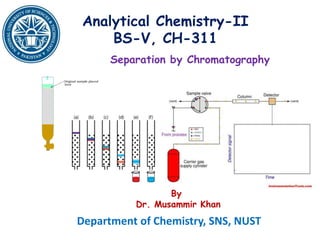
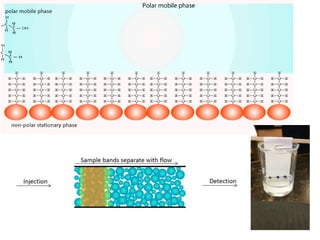
Separation by Chromatography
Separation by chromatography
o In which the components of a mixture are separated based on
differences in the rates (polarity) through the stationary phase
by a gaseous or liquid mobile phase.
o Stationary phase: Phase that is fixed in place either in a
column or on a planar surface.
o Mobile phase: Phase that moves over or through the stationary
phase carrying with it the analyte mixture.
o Classification:
o Column chromatography: Here the stationary phase is held in
a narrow tube, and the mobile phase is forced through the tube
under pressure or by gravity.
o Planar chromatography: Where stationary phase is supported
on a flat plate or in the pores of a paper and mobile phase
moves by capillary action or under the influence of gravity.
3 Categories: Based on mobile phase
I. Gas chromatography (G-C): In which liquid is
bonded/adsorbed to solid stationary surface, while gas eluent
sample partition between gas and this liquid surface.
II. Liquid chromatography (L-C): Several types: a) Liquid-
liquid: In which sample partition between two immiscible
liquids, b) Liquid-solid: Adsorption occur on solid stationary
phase, c) ion exchange: In which ion-exchange occur ionic
resin, d) size exclusion: In which partition or sieving occur
between interstices of polymer solid/matrix, e) Affinity: In
which functional group specific liquid in solid surface cause
partition between two liquids.
III. Supercritical chromatography (SC):
In which supercritical liquid/fluid (at above Tc/Pc: CO2) is used
as mobile phase and organic species bonded to a solid stationary
surface causes the separation of sample between them.
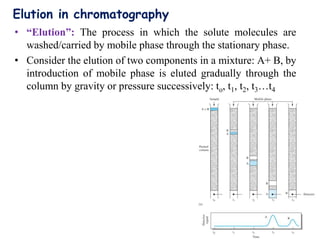
Elution in chromatography
• “Elution”: The process in which the solute molecules are
washed/carried by mobile phase through the stationary phase.
• Consider the elution of two components in a mixture: A+ B, by
introduction of mobile phase is eluted gradually through the
column by gravity or pressure successively: to, t1, t2, t3…t4
Chromatogram
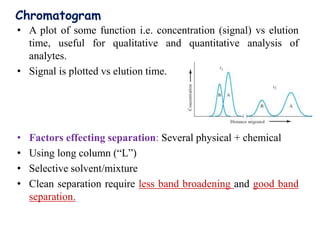
• A plot of some function i.e. concentration (signal) vs elution
time, useful for qualitative and quantitative analysis of
analytes.
• Signal is plotted vs elution time.
• Factors effecting separation: Several physical + chemical
• Using long column (“L”)
• Selective solvent/mixture
• Clean separation require less band broadening and good band
separation.
Migration rates of solute_ Derivation of equation
• The effective chromatographic separation of two solutes A & B
(mixture) depends on the relative rates at which the two species are
eluted.
• Distribution constant (Kc): The ratio of the molar concentration of
solute in the stationary phase to mobile phase i.e.
• A (mobile phase_A (stationary)
• Kc = (aA)S/(aA)M or CS/CM = Ideally constant over a wide range C
• Retention time (tR): The time required for the solute molecules to
reach the detector (R = retained by st. phase).
• Dead/void time tM: The time taken by an un-retained solute specie
to pass through. It provide an average time taken by the mobile
phase.
• This can be achieved by adding an un-retained specie into the
sample if not already present e.g. LHS peak Figure---next page
• LHS peak represent un-retained specie or average time taken by
mobile phase, while peak at RHS represent time taken by sample
through the stationary phase:
tR = tM + tS
• Average linear velocity of solute migration: (L =length of column)
ν = L/tR
• Average linear velocity of mobile phase =
µ = L/tM
Volumetric flow (F=cm3/min)
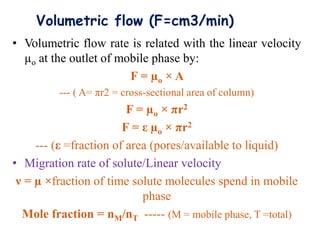
• Volumetric flow rate is related with the linear velocity
µo at the outlet of mobile phase by:
F = µo × A
--- ( A= πr2 = cross-sectional area of column)
F = µo × πr2
F = ε µo × πr2
--- (ε =fraction of area (pores/available to liquid)
• Migration rate of solute/Linear velocity
ν = µ ×fraction of time solute molecules spend in mobile
phase
Mole fraction = nM/nT ----- (M = mobile phase, T =total)
Retention factor kA = Kc VS/ VM
ν = µ × number of moles of solute in mobile
phase/total number of moles of solute
Putting ν = L/tR
& µ = L/tM
L/tR = L/tM × CM × VM/CS × VS +CM × VM
After re-arranging and dividing by CM × VM
tM/tR = 1/CS × VS/CM × VM + 1 ------{Kc = CS/CM }
tR = tM × Kc VS/ VM + tM
tR – tM/ tM= kA
tS/ tM= kA -----------1-5 usually
Retention factor

Lec#2_Separation by Chromatography.ppt

  • 1.
    Analytical Chemistry-II BS-V, CH-311 Departmentof Chemistry, SNS, NUST By Dr. Musammir Khan Separation by Chromatography
  • 2.
    Separation by chromatography oIn which the components of a mixture are separated based on differences in the rates (polarity) through the stationary phase by a gaseous or liquid mobile phase. o Stationary phase: Phase that is fixed in place either in a column or on a planar surface. o Mobile phase: Phase that moves over or through the stationary phase carrying with it the analyte mixture. o Classification: o Column chromatography: Here the stationary phase is held in a narrow tube, and the mobile phase is forced through the tube under pressure or by gravity. o Planar chromatography: Where stationary phase is supported on a flat plate or in the pores of a paper and mobile phase moves by capillary action or under the influence of gravity.
  • 3.
    3 Categories: Basedon mobile phase I. Gas chromatography (G-C): In which liquid is bonded/adsorbed to solid stationary surface, while gas eluent sample partition between gas and this liquid surface. II. Liquid chromatography (L-C): Several types: a) Liquid- liquid: In which sample partition between two immiscible liquids, b) Liquid-solid: Adsorption occur on solid stationary phase, c) ion exchange: In which ion-exchange occur ionic resin, d) size exclusion: In which partition or sieving occur between interstices of polymer solid/matrix, e) Affinity: In which functional group specific liquid in solid surface cause partition between two liquids. III. Supercritical chromatography (SC): In which supercritical liquid/fluid (at above Tc/Pc: CO2) is used as mobile phase and organic species bonded to a solid stationary surface causes the separation of sample between them.
  • 4.
    Elution in chromatography •“Elution”: The process in which the solute molecules are washed/carried by mobile phase through the stationary phase. • Consider the elution of two components in a mixture: A+ B, by introduction of mobile phase is eluted gradually through the column by gravity or pressure successively: to, t1, t2, t3…t4
  • 6.
    Chromatogram • A plotof some function i.e. concentration (signal) vs elution time, useful for qualitative and quantitative analysis of analytes. • Signal is plotted vs elution time. • Factors effecting separation: Several physical + chemical • Using long column (“L”) • Selective solvent/mixture • Clean separation require less band broadening and good band separation.
  • 7.
    Migration rates ofsolute_ Derivation of equation • The effective chromatographic separation of two solutes A & B (mixture) depends on the relative rates at which the two species are eluted. • Distribution constant (Kc): The ratio of the molar concentration of solute in the stationary phase to mobile phase i.e. • A (mobile phase_A (stationary) • Kc = (aA)S/(aA)M or CS/CM = Ideally constant over a wide range C • Retention time (tR): The time required for the solute molecules to reach the detector (R = retained by st. phase). • Dead/void time tM: The time taken by an un-retained solute specie to pass through. It provide an average time taken by the mobile phase. • This can be achieved by adding an un-retained specie into the sample if not already present e.g. LHS peak Figure---next page
  • 8.
    • LHS peakrepresent un-retained specie or average time taken by mobile phase, while peak at RHS represent time taken by sample through the stationary phase: tR = tM + tS • Average linear velocity of solute migration: (L =length of column) ν = L/tR • Average linear velocity of mobile phase = µ = L/tM
  • 9.
    Volumetric flow (F=cm3/min) •Volumetric flow rate is related with the linear velocity µo at the outlet of mobile phase by: F = µo × A --- ( A= πr2 = cross-sectional area of column) F = µo × πr2 F = ε µo × πr2 --- (ε =fraction of area (pores/available to liquid) • Migration rate of solute/Linear velocity ν = µ ×fraction of time solute molecules spend in mobile phase Mole fraction = nM/nT ----- (M = mobile phase, T =total)
  • 10.
    Retention factor kA= Kc VS/ VM ν = µ × number of moles of solute in mobile phase/total number of moles of solute Putting ν = L/tR & µ = L/tM L/tR = L/tM × CM × VM/CS × VS +CM × VM After re-arranging and dividing by CM × VM tM/tR = 1/CS × VS/CM × VM + 1 ------{Kc = CS/CM } tR = tM × Kc VS/ VM + tM tR – tM/ tM= kA tS/ tM= kA -----------1-5 usually
  • 11.