Nucleic Acid
Amplification Testing
DR. G.D.A. SAMARANAYAKA
REGISTRAR IN TRANSFUSION MEDICINE
NATIONAL BLOOD TRANSFUSION SERVICE
Blood Safety
• Both donor and recipient
• Voluntary non remunerated blood donors
• Pre donation information to blood donors
• Donor counselling and examination – donor
declaration form
• TTI testing
• Pathogen inactivation
• Patient blood management
Transfusion transmitted infection testing
• Mandatory screening required by theWHO
• HIV 1 & 2
• Hepatitis B and C
• Malaria
• Syphilis
• Depending on the prevalence – HTLV, WNV, Leishmania etc.
Testing Methodologies
• Microscopical examination – Malaria
• Serological testing
• ELISA,Chemiluminescence (ECi), Rapid testing
• Particle agglutination/Hemagglutination – (TTPA,TPHA,
HIV)
• Antibody detection & Antigen detection
• NAT testing
TTI screening testing done in Sri Lanka
• Hepatitis B surface antigen (HBsAg)
• Hepatitis B core antibody (anti-HBc)
• Hepatitis C virus antibody (anti-HCV)
• HIV-1 and HIV-2 antibody (anti-HIV-1 and anti-HIV-2) + p24 antigen
• Malaria – thick and thin films – microscopic examination
• Treponema pallidum –VDRL /TPPA
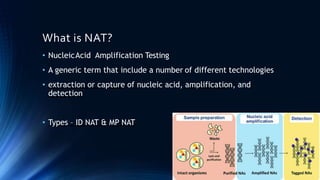
What is NAT?
• NucleicAcid Amplification Testing
• A generic term that include a number of different technologies
• extraction or capture of nucleic acid, amplification, and
detection
• Types – ID NAT & MP NAT
Introduction of NAT – timeline
Window Period
• Period between the initial infection and the time
at which the presence of the virus or bacteria can
first be identified in the blood (by detecting
antibodies, antigens, DNA or RNA).
 Eclipse phase - the very initial phase after
exposure when virus replication is restricted to
tissue sites and there is no detectable viraemia
 Infectious phase - is after eclipse and before
seroconversion
Importance of the window period
• During the window period - pathogen cannot be detected
• Could transmit the infection via transfusion
• Infection of transfusion recipients
HIV
Hepatitis B
Hepatitis C
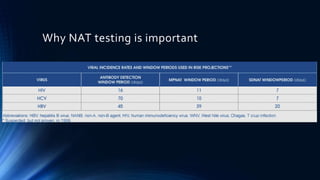
Why NAT testing is important
Residual risk
Major sources of remaining risk are:
1. Window period donation
2. Viral variants not detect by current assays
3. Immunosilent donor
4. Laboratory testing error
NAT implementation in Sri Lanka
• Since 2012
• Started as a pilot project
• Testing performed for 30-40% of the total blood collection
• Using ProcleixTigris system
• Procleix Ultrio Elite Screening assey
• Procleix Ultrio Elite HIV, HCV, and/or HBV DiscriminatoryAssays
Procleix® Ultrio Elite Assay
• 1) Sample preparation/ target capture
• 2) HIV RNA, HCV RNA, and HBV DNA target
amplification byTranscription-Mediated
Amplification (TMA)
• 3) Detection of the amplification products
(amplicon) by the Hybridization Protection
Assay (HPA).
Advantages
• Significant reduction of window period and residual risk
• Improved blood safety
• Rapid implementation of testing for various transfusion transmissible
pathogens –WNV
• Detection of novel pathogens
Disadvantages
• Highly technically demanding
• High costs
• Need of dedicated infrastructure facility, equipment, consumables
and technical expertise
• May not detect some mutated strains
Will NAT replace serological testing?
• NO
• Small percentage of Antibody positive donors have been tested
negative by NAT tests.
• It is possible that an antibody positive and NAT Negative donation
might transmit infection to the recipient.
• Therefore NATTesting will not replace current serology tests in blood
screening
• So far no country has discontinued the serology screening for HBsAg,
Anti HIV and Anti HCV after implementation of NAT screening
ThankYou

Neucleic Acid Amplification Testing

  • 1.
    Nucleic Acid Amplification Testing DR.G.D.A. SAMARANAYAKA REGISTRAR IN TRANSFUSION MEDICINE NATIONAL BLOOD TRANSFUSION SERVICE
  • 2.
    Blood Safety • Bothdonor and recipient • Voluntary non remunerated blood donors • Pre donation information to blood donors • Donor counselling and examination – donor declaration form • TTI testing • Pathogen inactivation • Patient blood management
  • 3.
    Transfusion transmitted infectiontesting • Mandatory screening required by theWHO • HIV 1 & 2 • Hepatitis B and C • Malaria • Syphilis • Depending on the prevalence – HTLV, WNV, Leishmania etc.
  • 4.
    Testing Methodologies • Microscopicalexamination – Malaria • Serological testing • ELISA,Chemiluminescence (ECi), Rapid testing • Particle agglutination/Hemagglutination – (TTPA,TPHA, HIV) • Antibody detection & Antigen detection • NAT testing
  • 5.
    TTI screening testingdone in Sri Lanka • Hepatitis B surface antigen (HBsAg) • Hepatitis B core antibody (anti-HBc) • Hepatitis C virus antibody (anti-HCV) • HIV-1 and HIV-2 antibody (anti-HIV-1 and anti-HIV-2) + p24 antigen • Malaria – thick and thin films – microscopic examination • Treponema pallidum –VDRL /TPPA
  • 6.
    What is NAT? •NucleicAcid Amplification Testing • A generic term that include a number of different technologies • extraction or capture of nucleic acid, amplification, and detection • Types – ID NAT & MP NAT
  • 7.
    Introduction of NAT– timeline
  • 8.
    Window Period • Periodbetween the initial infection and the time at which the presence of the virus or bacteria can first be identified in the blood (by detecting antibodies, antigens, DNA or RNA).  Eclipse phase - the very initial phase after exposure when virus replication is restricted to tissue sites and there is no detectable viraemia  Infectious phase - is after eclipse and before seroconversion
  • 9.
    Importance of thewindow period • During the window period - pathogen cannot be detected • Could transmit the infection via transfusion • Infection of transfusion recipients
  • 10.
  • 11.
  • 12.
  • 13.
    Why NAT testingis important
  • 14.
    Residual risk Major sourcesof remaining risk are: 1. Window period donation 2. Viral variants not detect by current assays 3. Immunosilent donor 4. Laboratory testing error
  • 15.
    NAT implementation inSri Lanka • Since 2012 • Started as a pilot project • Testing performed for 30-40% of the total blood collection • Using ProcleixTigris system • Procleix Ultrio Elite Screening assey • Procleix Ultrio Elite HIV, HCV, and/or HBV DiscriminatoryAssays
  • 16.
    Procleix® Ultrio EliteAssay • 1) Sample preparation/ target capture • 2) HIV RNA, HCV RNA, and HBV DNA target amplification byTranscription-Mediated Amplification (TMA) • 3) Detection of the amplification products (amplicon) by the Hybridization Protection Assay (HPA).
  • 17.
    Advantages • Significant reductionof window period and residual risk • Improved blood safety • Rapid implementation of testing for various transfusion transmissible pathogens –WNV • Detection of novel pathogens
  • 18.
    Disadvantages • Highly technicallydemanding • High costs • Need of dedicated infrastructure facility, equipment, consumables and technical expertise • May not detect some mutated strains
  • 19.
    Will NAT replaceserological testing? • NO • Small percentage of Antibody positive donors have been tested negative by NAT tests. • It is possible that an antibody positive and NAT Negative donation might transmit infection to the recipient. • Therefore NATTesting will not replace current serology tests in blood screening • So far no country has discontinued the serology screening for HBsAg, Anti HIV and Anti HCV after implementation of NAT screening
  • 20.