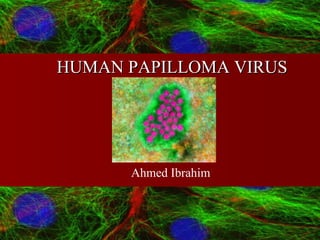
HUMAN PAPILLOMA VIRUS Ahmed Ibrahim
HPV-THE VIRUS HPV-THE INFECTIOUS DISEASE HPV-THE CARCINOGEN HPV/CANCER-THE CURE
HPV-THE INFECTIOUS DISEASE
VIRUSES ds DNA Genome ss DNA Genome ds RNA Genome (+)ss DNA Genome (-)ss DNA Genome RT DNA Genome RT RNA Genome Adenoviridae Papovaviridae Herpesviridae Poxviridae Papilloma Viruses Human Papilloma Viruses 100 serotypes (HPV-16 and HPV 18 highly oncogenic)
1. human warts was first identified as a viral infection in 1907. the first  Papillomavirus  was isolated from rabbits by Richard Shope in 1933 (Rockefeller Foundation).  In spite of this early start, human Papillomaviruses (HPV) remained largely unstudied in the 1970s.  Discovery and History of HPV
skin-to-skin contact with an infected individual  usually from vaginal, oral, or anal sexual contact, and can occur whether or not warts or other symptoms are present (McDermott-Webster, 1999).  3. Vertical transmission (Puranen, 1997).  4. nonsexual routes (Carson, 1997; Keller, et al., 1995; Stevens-Simon, et al., 2000).  Modes of Transmission
Symptoms of HPV lesions of the skin epithelium or the mucosal linings of the anogenital area, oral cavity, and respiratory tract.  2. The most common (and benign) symptomatic presentation of an HPV infection is condylomata acuminata (genital warts). 3. Other visible HPV infections are the plantar warts and the common warts.  4. Asymptomatic/sub clinical HPV infection.  Pap Test Hybrid Capture II HPV
Clinical Manifestation of HPV The incubation period for genital warts is usually between three and six months, but it may last for years after exposure (ASHA, 1998; ASHA 2000).  2. small bumps that appear in the genital area or anus. They may be single or clusters and have a cauliflower-like appearance as they grow larger.  3. Women: Genital warts usually start as In women, genital warts appear on the vulva, in the vagina, on the cervix, or in the anal area.  4. In men, they appear on the foreskin, head or shaft of the penis, and in the anal area, urethra, and scrotum (Cockerell, 1995). 5. mouth or throat of a person who has had sexual contact with an infected person (Koutsky & Kiviat, 1999).
SUPERFICIAL (Flat) WARTS
PLANTAR WARTS
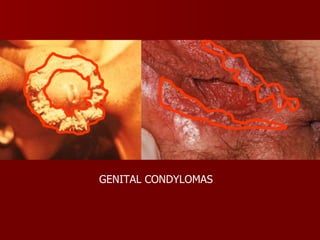
GENITAL CONDYLOMAS
INTERNAL WARTS Also includes Laryngeal warts  (not shown here)
COLORECTAL CONDYLOMAS


15% (Koutsky, 1997) Ages 15-49 75% (Koutsky, 1997) Reproductive Age 20 million annually (Cates, 1999) Morbidity Rate 5.5 million  (Cates, 1999) Currently Infected
 
HPV-THE VIRUS
MORPHOLOGY Papilloma viruses are a group of well over 100 human and animal virus types, classified by their genomes.  Small, non-enveloped icosahedral particles  (52-55nm) 72 capsomers (60 hexameric + 12 pentameric) There are 2 capsid proteins, 1 major (encoded by the L1 gene) and 1 minor
 
TREATMENT: Low Grade Lesions Treatment is not usually necessary (infections regress quickly) 2. Cryotherapy  3. Laser Ablation Therapy 4. LEEP (loop electrical excision behavior)
TREATMENT: High Grade Lesions Necessary to avoid progression to malignancy 2. Cryotherapy  3. Laser Ablation Therapy 4. LEEP (loop electrical excision behavior)
TREATMENT: Genital Warts TOPICAL CHEMODESTRUCTIVE AGENTS   Tri-(or Bi) chloracetic acid (TCA or BCA)  Podophyllum: Is an extract of the May apple plant   2. Self Treatments (topical) Condylox[R]:  purified podophyllotoxin (podophilox).  Imiquimod:  an immune response modifier 3. Adjunctive Treatments (no longer extensively used due to side effects (i.e. efudex, interferon)
Genome Circular, d/s DNA ~8kbp associated with cellular histones to form a chromatin-like substance.  At least 12 different HPV genomes have been sequenced, and the genetic organization of all is similar.
HP Genomic Replication  Link between gene expression and cellular differentiation Vegetative Replication Plasmid Replication
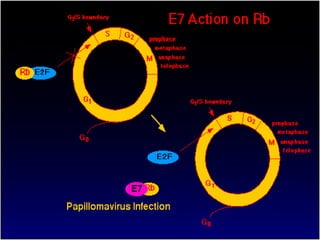
E2 binds to the early promoter and decreases expression of E6/E7; loss of E2 is thus the first stage in transformation.  E6 binds to p53 via a cellular protein ("p100") and targets it for degradation via the ubiquitin pathway.  E7 binds pRB and prevents phosphorylation. This would normally result in apoptosis BUT:  Both E6 and E7 interact with a number of cellular proteins which influence the outcome of infection:  TRANSFORMATION IN HPV
 
Transcription in HPV
HPV: Structural Proteins Minor capsid protein: possible DNA packaging protein.  L2 Major capsid protein: can form virus-like particles.  L1 Function Gene
HPV: Regulatory Proteins binds to pRB/p107.  E7 Binding p53 protein.  E6 Obstruction of growth suppression mechanisms: e.g EGF receptor; activation of mitogenic signalling pathways via transcription factors: c-Jun and c-Fos. Inactivation of p21.  E5 Late Expression: C terminal binds intermediate filament, allowing release of virus-like particles.  E4 Responsible for recognition and binding of origin of replication.  E2 DNA-dependent ATPase, ATP dependent helices: allow unwinding of the viral genome and act as an elongation factor for DNA replication.  E1 Function Gene
L1 protein in COPV
L2 Major Protein
Visualization of E1 protein bound to HPV-11 origin-containing DNA
E2 Protein E2 binds DNA as a dimer and is sequence specific. The overall secondary structure of the dimer consists of an eight-stranded beta-barrel (magenta) and two pairs of alpha-helices (purple).  Also it is a trans-acting transcriptional activator. The protein is capable of activating a conditional enhancer in the viral long control region, or lcr.
E4 Protein Ability to aggregate into cytoplasm and nuclear inclusion granules. Inclusions are most noticeable in cutaneous lesions. E4 expression coincides with the onset of vegetative viral DNA replication and occurs immediately after cells have left the basal layer (higher layers for mucosal types). Involvement in virus maturation or vegetative viral DNA replication possibly by sequestering inhibitory factors  E4 may interfere with normal differentiation in order to create the conditions required for high level virus synthesis. In the upper layers, E4 and L1 are expressed from the same bicistronic message An important role in productive infection seems likely.
HPV-THE CARCINOGEN
93% of all cervical neoplasia cases test are positive for HPV making it the leading the third leading killer among women X-rays HPV-6, 11 Malignant transformation of respiratory papillomas ??? HPV-16, 18, 31, 33 Lower genital tract cancers U.V., genetic? HPV-5, 8 Skin carcinomas Co-factors: Predominant types: Cancer:
SENSOR of DNA DAMAGE Figure 1 Levine (1997) Cell 88:325 p53 increased levels phosphorylation conformational change oligomerization Transcriptional Activation Cell Cycle Arrest p21 mdm2 Repair GADD45 Apoptosis BAX p53
E6-binding protein
Association with p53: E6 protein requires a cellular protein of 100 kDa, termed E6-associated protein (E6-AP).  E6-dependent degradation of p53 occurs through the cellular ubiquitin proteolysis pathway.  Localized to the nuclear matrix and non-nuclear membrane fraction
1  80  150  276  393 P53 Domain Structure Acidic helical Hydrophobic Proline-Rich Conserved Basic Helical Region of high mutation  Trans-activation 15  22, 23 Sequence-specific DNA Binding Oligomerization Nuclear Localization MDM-2 Domains and Interacting Proteins E1B E6
 
 
E7 promotes degradation of Rb family proteins rather than simply inhibiting their function by complex formation.  The relative carcinogenic potency of the various human papillomavirus types is partially explained by the relative avidity of their respective E7 proteins for Rb,  e.g. , the more tightly a given viral E7 binds Rb, the greater the oncogenic potential of the virus  The E7 protein contains two zinc binding motifs which mediate dimerisation of the protein. Mutation in one of the two Zn binding motifs destroys transforming activity, although this mutant is able to associate with Rb protein.  Zinc binding phosphoproteins which are localised in the nucleus.
 
HPV/Cancer-THE CURE
L1 Major Protein: A potential Vaccine (Koutsky LA, 2002) An HPV Virus like particle Trial done using HPV-16 serotype 2392 women 16-23 years of age Vaccine/Placebo given at 0 months, 2 months and 6 months Vaccine shown to have 100% efficiency (none of the recipients got infected) 9 cases in the placebo group developed HPV infection over the course of 17.4 months study period This may be reduce the incidence of HPV related cancers in women.
E2 : Another potential treatment (Webster et al 2000)   E2 suppresses expression of E6 and E7 which are both involved in transformation and degradation of tumor suppressor proteins. E2 studies show that IL-2 targeting E2 proteins help accelerate the rate of infection since E6 and E7 go unchecked Overexpression of E2 might suppress HPV infectious cycle
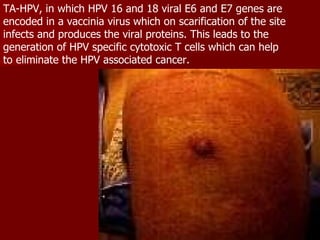
TA-HPV, in which HPV 16 and 18 viral E6 and E7 genes are encoded in a vaccinia virus which on scarification of the site infects and produces the viral proteins. This leads to the generation of HPV specific cytotoxic T cells which can help to eliminate the HPV associated cancer.

Human Papiiloma Virus

  • 1.
    HUMAN PAPILLOMA VIRUSAhmed Ibrahim
  • 2.
    HPV-THE VIRUS HPV-THEINFECTIOUS DISEASE HPV-THE CARCINOGEN HPV/CANCER-THE CURE
  • 3.
  • 4.
    VIRUSES ds DNAGenome ss DNA Genome ds RNA Genome (+)ss DNA Genome (-)ss DNA Genome RT DNA Genome RT RNA Genome Adenoviridae Papovaviridae Herpesviridae Poxviridae Papilloma Viruses Human Papilloma Viruses 100 serotypes (HPV-16 and HPV 18 highly oncogenic)
  • 5.
    1. human wartswas first identified as a viral infection in 1907. the first Papillomavirus was isolated from rabbits by Richard Shope in 1933 (Rockefeller Foundation). In spite of this early start, human Papillomaviruses (HPV) remained largely unstudied in the 1970s. Discovery and History of HPV
  • 6.
    skin-to-skin contact withan infected individual usually from vaginal, oral, or anal sexual contact, and can occur whether or not warts or other symptoms are present (McDermott-Webster, 1999). 3. Vertical transmission (Puranen, 1997). 4. nonsexual routes (Carson, 1997; Keller, et al., 1995; Stevens-Simon, et al., 2000). Modes of Transmission
  • 7.
    Symptoms of HPVlesions of the skin epithelium or the mucosal linings of the anogenital area, oral cavity, and respiratory tract. 2. The most common (and benign) symptomatic presentation of an HPV infection is condylomata acuminata (genital warts). 3. Other visible HPV infections are the plantar warts and the common warts. 4. Asymptomatic/sub clinical HPV infection. Pap Test Hybrid Capture II HPV
  • 8.
    Clinical Manifestation ofHPV The incubation period for genital warts is usually between three and six months, but it may last for years after exposure (ASHA, 1998; ASHA 2000). 2. small bumps that appear in the genital area or anus. They may be single or clusters and have a cauliflower-like appearance as they grow larger. 3. Women: Genital warts usually start as In women, genital warts appear on the vulva, in the vagina, on the cervix, or in the anal area. 4. In men, they appear on the foreskin, head or shaft of the penis, and in the anal area, urethra, and scrotum (Cockerell, 1995). 5. mouth or throat of a person who has had sexual contact with an infected person (Koutsky & Kiviat, 1999).
  • 9.
  • 10.
  • 11.
  • 12.
    INTERNAL WARTS Alsoincludes Laryngeal warts (not shown here)
  • 13.
  • 14.
  • 15.
  • 16.
  • 17.
  • 18.
  • 19.
  • 20.
  • 21.
    15% (Koutsky, 1997)Ages 15-49 75% (Koutsky, 1997) Reproductive Age 20 million annually (Cates, 1999) Morbidity Rate 5.5 million (Cates, 1999) Currently Infected
  • 22.
  • 23.
  • 24.
    MORPHOLOGY Papilloma virusesare a group of well over 100 human and animal virus types, classified by their genomes. Small, non-enveloped icosahedral particles (52-55nm) 72 capsomers (60 hexameric + 12 pentameric) There are 2 capsid proteins, 1 major (encoded by the L1 gene) and 1 minor
  • 25.
  • 26.
    TREATMENT: Low GradeLesions Treatment is not usually necessary (infections regress quickly) 2. Cryotherapy 3. Laser Ablation Therapy 4. LEEP (loop electrical excision behavior)
  • 27.
    TREATMENT: High GradeLesions Necessary to avoid progression to malignancy 2. Cryotherapy 3. Laser Ablation Therapy 4. LEEP (loop electrical excision behavior)
  • 28.
    TREATMENT: Genital WartsTOPICAL CHEMODESTRUCTIVE AGENTS Tri-(or Bi) chloracetic acid (TCA or BCA) Podophyllum: Is an extract of the May apple plant 2. Self Treatments (topical) Condylox[R]: purified podophyllotoxin (podophilox). Imiquimod: an immune response modifier 3. Adjunctive Treatments (no longer extensively used due to side effects (i.e. efudex, interferon)
  • 29.
    Genome Circular, d/sDNA ~8kbp associated with cellular histones to form a chromatin-like substance. At least 12 different HPV genomes have been sequenced, and the genetic organization of all is similar.
  • 30.
    HP Genomic Replication Link between gene expression and cellular differentiation Vegetative Replication Plasmid Replication
  • 31.
    E2 binds tothe early promoter and decreases expression of E6/E7; loss of E2 is thus the first stage in transformation. E6 binds to p53 via a cellular protein ("p100") and targets it for degradation via the ubiquitin pathway. E7 binds pRB and prevents phosphorylation. This would normally result in apoptosis BUT: Both E6 and E7 interact with a number of cellular proteins which influence the outcome of infection: TRANSFORMATION IN HPV
  • 32.
  • 33.
  • 34.
    HPV: Structural ProteinsMinor capsid protein: possible DNA packaging protein. L2 Major capsid protein: can form virus-like particles. L1 Function Gene
  • 35.
    HPV: Regulatory Proteinsbinds to pRB/p107. E7 Binding p53 protein. E6 Obstruction of growth suppression mechanisms: e.g EGF receptor; activation of mitogenic signalling pathways via transcription factors: c-Jun and c-Fos. Inactivation of p21. E5 Late Expression: C terminal binds intermediate filament, allowing release of virus-like particles. E4 Responsible for recognition and binding of origin of replication. E2 DNA-dependent ATPase, ATP dependent helices: allow unwinding of the viral genome and act as an elongation factor for DNA replication. E1 Function Gene
  • 36.
  • 37.
  • 38.
    Visualization of E1protein bound to HPV-11 origin-containing DNA
  • 39.
    E2 Protein E2binds DNA as a dimer and is sequence specific. The overall secondary structure of the dimer consists of an eight-stranded beta-barrel (magenta) and two pairs of alpha-helices (purple). Also it is a trans-acting transcriptional activator. The protein is capable of activating a conditional enhancer in the viral long control region, or lcr.
  • 40.
    E4 Protein Abilityto aggregate into cytoplasm and nuclear inclusion granules. Inclusions are most noticeable in cutaneous lesions. E4 expression coincides with the onset of vegetative viral DNA replication and occurs immediately after cells have left the basal layer (higher layers for mucosal types). Involvement in virus maturation or vegetative viral DNA replication possibly by sequestering inhibitory factors E4 may interfere with normal differentiation in order to create the conditions required for high level virus synthesis. In the upper layers, E4 and L1 are expressed from the same bicistronic message An important role in productive infection seems likely.
  • 41.
  • 42.
    93% of allcervical neoplasia cases test are positive for HPV making it the leading the third leading killer among women X-rays HPV-6, 11 Malignant transformation of respiratory papillomas ??? HPV-16, 18, 31, 33 Lower genital tract cancers U.V., genetic? HPV-5, 8 Skin carcinomas Co-factors: Predominant types: Cancer:
  • 43.
    SENSOR of DNADAMAGE Figure 1 Levine (1997) Cell 88:325 p53 increased levels phosphorylation conformational change oligomerization Transcriptional Activation Cell Cycle Arrest p21 mdm2 Repair GADD45 Apoptosis BAX p53
  • 44.
  • 45.
    Association with p53:E6 protein requires a cellular protein of 100 kDa, termed E6-associated protein (E6-AP). E6-dependent degradation of p53 occurs through the cellular ubiquitin proteolysis pathway. Localized to the nuclear matrix and non-nuclear membrane fraction
  • 46.
    1 80 150 276 393 P53 Domain Structure Acidic helical Hydrophobic Proline-Rich Conserved Basic Helical Region of high mutation Trans-activation 15 22, 23 Sequence-specific DNA Binding Oligomerization Nuclear Localization MDM-2 Domains and Interacting Proteins E1B E6
  • 47.
  • 48.
  • 49.
    E7 promotes degradationof Rb family proteins rather than simply inhibiting their function by complex formation. The relative carcinogenic potency of the various human papillomavirus types is partially explained by the relative avidity of their respective E7 proteins for Rb, e.g. , the more tightly a given viral E7 binds Rb, the greater the oncogenic potential of the virus The E7 protein contains two zinc binding motifs which mediate dimerisation of the protein. Mutation in one of the two Zn binding motifs destroys transforming activity, although this mutant is able to associate with Rb protein. Zinc binding phosphoproteins which are localised in the nucleus.
  • 50.
  • 51.
  • 52.
    L1 Major Protein:A potential Vaccine (Koutsky LA, 2002) An HPV Virus like particle Trial done using HPV-16 serotype 2392 women 16-23 years of age Vaccine/Placebo given at 0 months, 2 months and 6 months Vaccine shown to have 100% efficiency (none of the recipients got infected) 9 cases in the placebo group developed HPV infection over the course of 17.4 months study period This may be reduce the incidence of HPV related cancers in women.
  • 53.
    E2 : Anotherpotential treatment (Webster et al 2000) E2 suppresses expression of E6 and E7 which are both involved in transformation and degradation of tumor suppressor proteins. E2 studies show that IL-2 targeting E2 proteins help accelerate the rate of infection since E6 and E7 go unchecked Overexpression of E2 might suppress HPV infectious cycle
  • 54.
    TA-HPV, in whichHPV 16 and 18 viral E6 and E7 genes are encoded in a vaccinia virus which on scarification of the site infects and produces the viral proteins. This leads to the generation of HPV specific cytotoxic T cells which can help to eliminate the HPV associated cancer.