Cervical cancer screening
Dr. Nisreen Anfinan
Assistant professor ,Obstetric and gynecology
Gynecology Oncology KAAUH
Cervical Cancer: Worldwide Prevalence,
Incidence, and Mortality Estimates
 Cervical cancer is the 2nd most common cancer among
women worldwide
 Estimated 530,000 new cases
 Estimated 274,000 deaths
 More than 85% of the global burden occurs in developing
countries .
Geneva, Switzerland: World Health Organization; 2003
Bosch FX, de Sanjosé S. J Natl Cancer Inst Monogr. 2003
Cervical Cancer in Saudi Arabia
 Incidence of cervical cancer is low in Saudi Arabia
 Rank number 8 between all cancers in female
 Every year, 241women are diagnosed with cervical cancer
and 84 die from the disease.
 Account only 2.4 % of all cases
SCR Report 2012
 Infection with oncogenic HPV types is the most significant
risk factor in cervical cancer etiology.1
 Worldwide , the prevalence of HPV in cervical cancer is
99.7%.
 Specific oncogenic HPV types (16, 18, 31, 33, and 45)
have been detected in 63%–97% of invasive cervical
cancer cases worldwide.
Oncogenic HPV & Cervical Cancer
1. Walboomers JM, Jacobs MV, Manos MM, et al. J Pathol. 1999;189:12–19. 2. Clifford GM, Smith JS, Plummer M, Muñoz N,
Franceschi S. Br J Cancer. 2003;88:63–73.
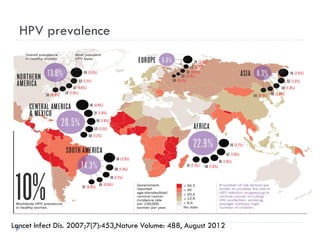
HPV prevalence
Lancet Infect Dis. 2007;7(7):453,Nature Volume: 488, August 2012
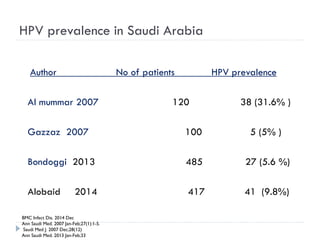
HPV prevalence in Saudi Arabia
Author No of patients HPV prevalence
Al mummar 2007 120 38 (31.6% )
Gazzaz 2007 100 5 (5% )
Bondoggi 2013 485 27 (5.6 %)
Alobaid 2014 417 41 (9.8%)
BMC Infect Dis. 2014 Dec
Ann Saudi Med. 2007 Jan-Feb;27(1):1-5.
Saudi Med J. 2007 Dec;28(12)
Ann Saudi Med. 2013 Jan-Feb;33
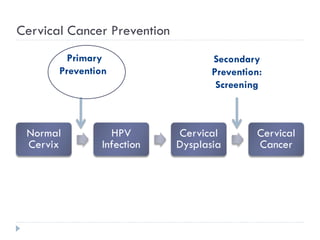
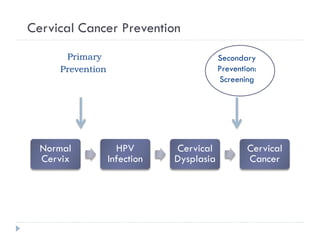
Normal
Cervix
HPV
Infection
Cervical
Dysplasia
Cervical
Cancer
Cervical Cancer Prevention
Primary
Prevention:
Secondary
Prevention:
Screening
Primary prevention
 Reduced Risk Factors
 Vaccination
Normal
Cervix
HPV
Infection
Cervical
Dysplasia
Cervical
Cancer
Cervical Cancer Prevention
Primary
Prevention:
Secondary
Prevention:
Screening
Screening test
 Should be accurate, practical
 Acceptable, highly sensitive (those with disease are most
likely to have a positive test)
 Highly specific (negative test means there is no disease),
and it should have a high
 Predictive value (those with a positive test are most likely
to have disease)
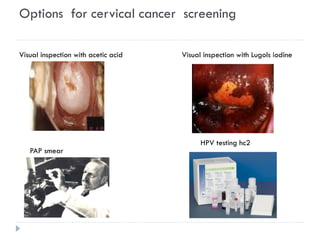
Options for cervical cancer screening
Visual inspection with acetic acid Visual inspection with Lugols iodine
PAP smear
HPV testing hc2
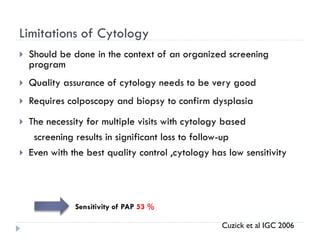
Limitations of Cytology
 Should be done in the context of an organized screening
program
 Quality assurance of cytology needs to be very good
 Requires colposcopy and biopsy to confirm dysplasia
 The necessity for multiple visits with cytology based
screening results in significant loss to follow-up
 Even with the best quality control ,cytology has low sensitivity
Sensitivity of PAP 53 %
Cuzick et al IGC 2006
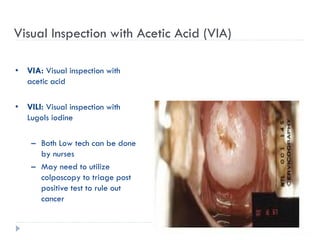
Visual Inspection with Acetic Acid (VIA)
• VIA: Visual inspection with
acetic acid
• VILI: Visual inspection with
Lugols iodine
– Both Low tech can be done
by nurses
– May need to utilize
colposcopy to triage post
positive test to rule out
cancer
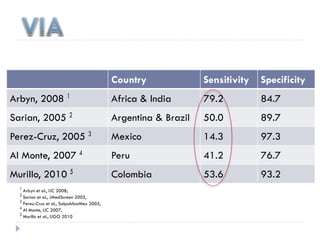
Country Sensitivity Specificity
Arbyn, 2008 Africa & India 79.2 84.7
Sarian, 2005 Argentina & Brazil 50.0 89.7
Perez-Cruz, 2005 Mexico 14.3 97.3
Al Monte, 2007 Peru 41.2 76.7
Murillo, 2010 Colombia 53.6 93.2
Arbyn et al., IJC 2008;
Sarian et al., JMedScreen 2005,
Perez-Cruz et al., SalpublicaMex 2005,
Al Monte, IJC 2007,
Murillo et al., IJGO 2010
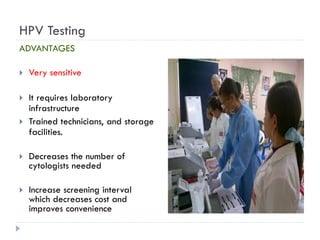
HPV Testing
ADVANTAGES
 Very sensitive
 It requires laboratory
infrastructure
 Trained technicians, and storage
facilities.
 Decreases the number of
cytologists needed
 Increase screening interval
which decreases cost and
improves convenience
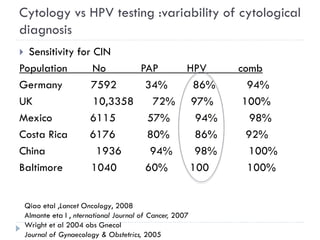
Cytology vs HPV testing :variability of cytological
diagnosis
 Sensitivity for CIN
Population No PAP HPV comb
Germany 7592 34% 86% 94%
UK 10,3358 72% 97% 100%
Mexico 6115 57% 94% 98%
Costa Rica 6176 80% 86% 92%
China 1936 94% 98% 100%
Baltimore 1040 60% 100 100%
Qiao etal ,Lancet Oncology, 2008
Almonte eta l , nternational Journal of Cancer, 2007
Wright et al 2004 obs Gnecol
Journal of Gynaecology & Obstetrics, 2005
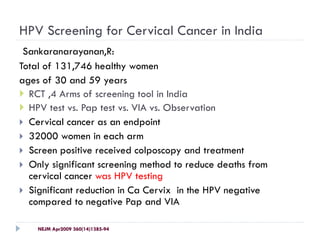
HPV Screening for Cervical Cancer in India
Sankaranarayanan,R:
Total of 131,746 healthy women
ages of 30 and 59 years
 RCT ,4 Arms of screening tool in India
 HPV test vs. Pap test vs. VIA vs. Observation
 Cervical cancer as an endpoint
 32000 women in each arm
 Screen positive received colposcopy and treatment
 Only significant screening method to reduce deaths from
cervical cancer was HPV testing
 Significant reduction in Ca Cervix in the HPV negative
compared to negative Pap and VIA
NEJM Apr2009 360(14)1385-94
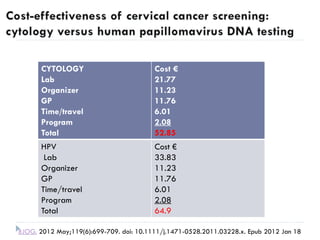
CYTOLOGY
Lab
Organizer
GP
Time/travel
Program
Total
Cost €
21.77
11.23
11.76
6.01
2.08
52.85
HPV
Lab
Organizer
GP
Time/travel
Program
Total
Cost €
33.83
11.23
11.76
6.01
2.08
64.9
BJOG. 2012 May;119(6):699-709. doi: 10.1111/j.1471-0528.2011.03228.x. Epub 2012 Jan 18
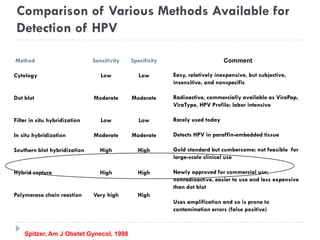
Comparison of Various Methods Available for
Detection of HPV
Spitzer, Am J Obstet Gynecol, 1998
Method
Cytology
Dot blot
Filter in situ hybridization
In situ hybridization
Southern blot hybridization
Hybrid capture
Polymerase chain reaction
Sensitivity
Low
Moderate
Low
Moderate
High
High
Very high
Specificity
Low
Moderate
Low
Moderate
High
High
High
Comment
Easy, relatively inexpensive, but subjective,
insensitive, and nonspecific
Radioactive, commercially available as ViraPap,
ViraType, HPV Profile; labor intensive
Rarely used today
Detects HPV in paraffin-embedded tissue
Gold standard but cumbersome; not feasible for
large-scale clinical use
Newly approved for commercial use;
nonradioactive, easier to use and less expensive
than dot blot
Uses amplification and so is prone to
contamination errors (false positive)
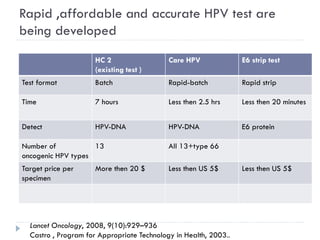
Rapid ,affordable and accurate HPV test are
being developed
HC 2
(existing test )
Care HPV E6 strip test
Test format Batch Rapid-batch Rapid strip
Time 7 hours Less then 2.5 hrs Less then 20 minutes
Detect HPV-DNA HPV-DNA E6 protein
Number of
oncogenic HPV types
13 All 13+type 66
Target price per
specimen
More then 20 $ Less then US 5$ Less then US 5$
Lancet Oncology, 2008, 9(10):929–936
Castro , Program for Appropriate Technology in Health, 2003..
Cervical Screening program in Saudi
Arabia ??
I f we don’t have establish screening program
for cervical cancer in low resources setting
what you will use ??
Visual inspection of ascitic acid (VIA )
or
HPV testing
 Budget for screening efforts is limited
 Difficult access to health care
 No follow up surveillance
Screening test must be very sensitive
Screening scheme ≤ two visits
 Jeddah Cervical Screening program
JCSP
 www.jcsp.sa.com
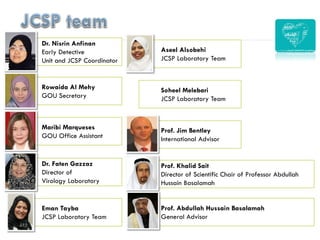
Dr. Nisrin Anfinan
Early Detective
Unit and JCSP Coordinator
Rowaida Al Mehy
GOU Secretary
Maribi Marqueses
GOU Office Assistant
Dr. Faten Gazzaz
Director of
Virology Laboratory
Eman Tayba
JCSP Laboratory Team
Aseel Alsobehi
JCSP Laboratory Team
Soheel Melebari
JCSP Laboratory Team
Prof. Jim Bentley
International Advisor
Prof. Khalid Sait
Director of Scientific Chair of Professor Abdullah
Hussain Basalamah
Prof. Abdullah Hussain Basalamah
General Advisor
 Age 30-65 year.
 Married for three years.
 Saudi & non Saudi.
collecting sampling in our
hospital )
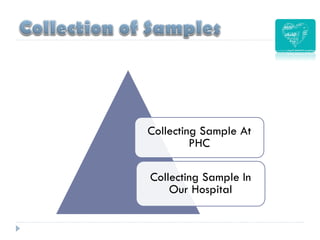
Collecting Sample At
PHC
Collecting Sample In
Our Hospital
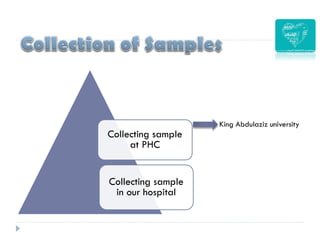
Collecting sample
at PHC
Collecting sample
in our hospital
King Abdulaziz university
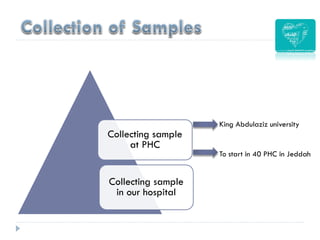
Collecting sample
at PHC
Collecting sample
in our hospital
To start in 40 PHC in Jeddah
King Abdulaziz university
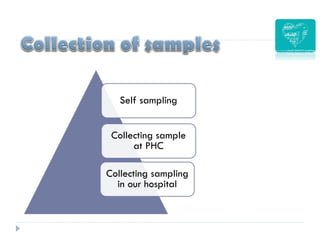
Self sampling
Collecting sample
at PHC
Collecting sampling
in our hospital
 START DATE: January 2012
 Our aim to achieve : 10,000 womens
0
50
100
150
200
250
300
350
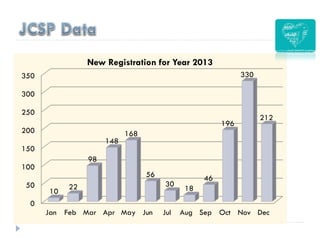
Jan Feb Mar Apr May Jun Jul Aug Sep Oct Nov Dec
10
22
98
148
168
56
30
18
46
196
330
212
New Registration for Year 2013
0
50
100
150
200
250
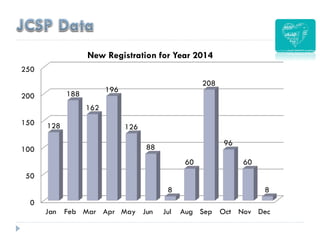
Jan Feb Mar Apr May Jun Jul Aug Sep Oct Nov Dec
128
188
162
196
126
88
8
60
208
96
60
8
New Registration for Year 2014
0
50
100
150
200
250
Jan Feb Mar Apr May Jun Jul Aug Sep Oct Nov Dec
4
14
54
108
154
48
16 14 22
152
218
144
6 8
44 40
14 8 14
4
24
44
112
68
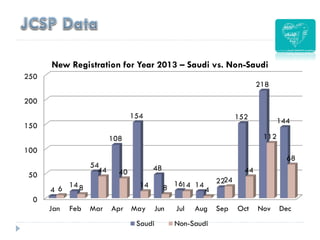
New Registration for Year 2013 – Saudi vs. Non-Saudi
Saudi Non-Saudi
0
20
40
60
80
100
120
140
160
Jan Feb Mar Apr May Jun Jul Aug Sep Oct Nov Dec
98
124
80
156
78
64
2
16
86
66
36
8
30
63
82
40 44
24
6
44
122
30
24
0
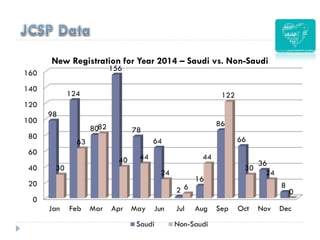
New Registration for Year 2014 – Saudi vs. Non-Saudi
Saudi Non-Saudi
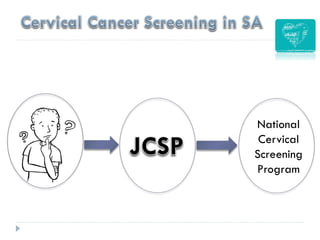
National
Cervical
Screening
Program
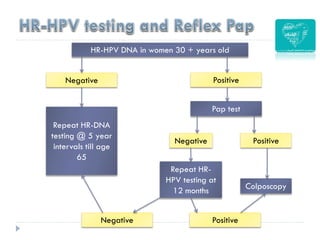
HR-HPV DNA in women 30 + years old
Negative
Negative
Negative
Pap test
Positive
Positive
Colposcopy
Positive
Repeat HR-DNA
testing @ 5 year
intervals till age
65
Repeat HR-
HPV testing at
12 months
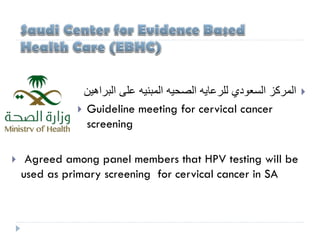
‫اﻟﻣرﻛز‬‫اﻟﺳﻌودي‬‫ﻟﻠرﻋﺎﯾﮫ‬‫اﻟﺻﺣﯾﮫ‬‫اﻟﻣﺑﻧﯾﮫ‬‫ﻋﻠﻰ‬‫اﻟﺑراھﯾن‬
 Guideline meeting for cervical cancer
screening
 Agreed among panel members that HPV testing will be
used as primary screening for cervical cancer in SA
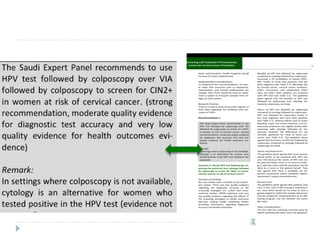
www.moh.gov.sa/Ministry/MediaCenter
The future test for cervical cancer screening
 Dynamic Spectral Imaging System
 DySIS
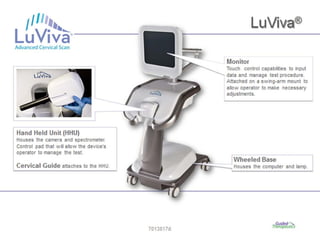
 LuViva Advanced Cervical Scan
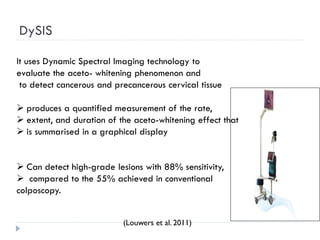
DySIS
It uses Dynamic Spectral Imaging technology to
evaluate the aceto- whitening phenomenon and
to detect cancerous and precancerous cervical tissue
 produces a quantified measurement of the rate,
 extent, and duration of the aceto-whitening effect that
 is summarised in a graphical display
 Can detect high-grade lesions with 88% sensitivity,
 compared to the 55% achieved in conventional
colposcopy.
(Louwers et al. 2011)
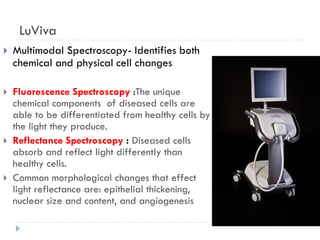
LuViva
 Multimodal Spectroscopy- Identifies both
chemical and physical cell changes
 Fluorescence Spectroscopy :The unique
chemical components of diseased cells are
able to be differentiated from healthy cells by
the light they produce.
 Reflectance Spectroscopy : Diseased cells
absorb and reflect light differently than
healthy cells.
 Common morphological changes that effect
light reflectance are: epithelial thickening,
nuclear size and content, and angiogenesis
Indications of LuViva
LuViva is intended for use after:
•Abnormal cytology
•Positive HPV findings
To triage women aged 16+ for additional evaluation prior
to colposcopy and biopsy.
It may reduce colposcopy by up to 40% thus reducing
overall costs
Multimodal hyperspectroscopy as a triage test for cervical neoplasia: Pivotal clinical trial results Original Research Article -Gynecologic Oncology
Volume1 Issue1 July 2013, Pages 147–151Leo B. Twiggs, Nahida A. Chakhtoura, Daron G. Ferris, Lisa C. Flowers, Marc L. Winter, Daniel R. Sternfeld, Manocher Lashgari, Alexander F. Burnett, Stephen S. Raab,
Edward J. Wilkinson
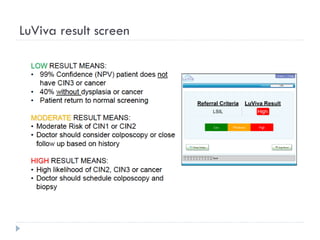
LuViva result screen
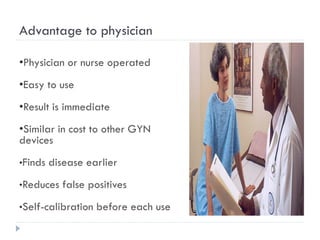
Advantage to physician
•Physician or nurse operated
•Easy to use
•Result is immediate
•Similar in cost to other GYN
devices
•Finds disease earlier
•Reduces false positives
•Self-calibration before each use
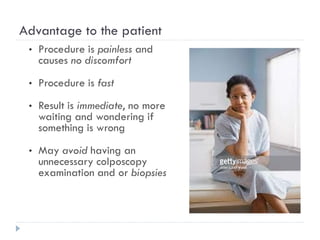
Advantage to the patient
• Procedure is painless and
causes no discomfort
• Procedure is fast
• Result is immediate, no more
waiting and wondering if
something is wrong
• May avoid having an
unnecessary colposcopy
examination and or biopsies
 Pivotal clinical trial 1,607 women enrolled…data
evaluated on 1,330
• Subjects 16 to 84 years old
• Multiple races:
Results :
 cervical spectroscopy (LuViva) detected 36.4% more
cervical intraepithelial neoplasia (CIN2+) than tests
used under current guidelines
 It could reduce unnecessary referrals of women with
normal pathology by as much as 40%
Multimodal hyperspectroscopy as a triage test for cervical neoplasia: Pivotal clinical trial results Original Research Article -Gynecologic Oncology
Volume1 Issue1 July 2013, Pages 147–151Leo B. Twiggs, Nahida A. Chakhtoura, Daron G. Ferris, Lisa C. Flowers, Marc L. Winter, Daniel R. Sternfeld, Manocher Lashgar
i, Alexander F. Burnett, Stephen S. Raab, Edward J. Wilkinson
 Watch "LuViva Advanced Cervical Scan" on
YouTube - LuViva Advanced Cervical Scan:
http://youtu.be/XB-a6URRkY4
Cervical screening , present past crown plaza  final copy

Cervical screening , present past crown plaza final copy

  • 1.
    Cervical cancer screening Dr.Nisreen Anfinan Assistant professor ,Obstetric and gynecology Gynecology Oncology KAAUH
  • 2.
    Cervical Cancer: WorldwidePrevalence, Incidence, and Mortality Estimates  Cervical cancer is the 2nd most common cancer among women worldwide  Estimated 530,000 new cases  Estimated 274,000 deaths  More than 85% of the global burden occurs in developing countries . Geneva, Switzerland: World Health Organization; 2003 Bosch FX, de Sanjosé S. J Natl Cancer Inst Monogr. 2003
  • 3.
    Cervical Cancer inSaudi Arabia  Incidence of cervical cancer is low in Saudi Arabia  Rank number 8 between all cancers in female  Every year, 241women are diagnosed with cervical cancer and 84 die from the disease.  Account only 2.4 % of all cases SCR Report 2012
  • 4.
     Infection withoncogenic HPV types is the most significant risk factor in cervical cancer etiology.1  Worldwide , the prevalence of HPV in cervical cancer is 99.7%.  Specific oncogenic HPV types (16, 18, 31, 33, and 45) have been detected in 63%–97% of invasive cervical cancer cases worldwide. Oncogenic HPV & Cervical Cancer 1. Walboomers JM, Jacobs MV, Manos MM, et al. J Pathol. 1999;189:12–19. 2. Clifford GM, Smith JS, Plummer M, Muñoz N, Franceschi S. Br J Cancer. 2003;88:63–73.
  • 5.
    HPV prevalence Lancet InfectDis. 2007;7(7):453,Nature Volume: 488, August 2012
  • 6.
    HPV prevalence inSaudi Arabia Author No of patients HPV prevalence Al mummar 2007 120 38 (31.6% ) Gazzaz 2007 100 5 (5% ) Bondoggi 2013 485 27 (5.6 %) Alobaid 2014 417 41 (9.8%) BMC Infect Dis. 2014 Dec Ann Saudi Med. 2007 Jan-Feb;27(1):1-5. Saudi Med J. 2007 Dec;28(12) Ann Saudi Med. 2013 Jan-Feb;33
  • 7.
  • 8.
    Primary prevention  ReducedRisk Factors  Vaccination
  • 9.
  • 10.
    Screening test  Shouldbe accurate, practical  Acceptable, highly sensitive (those with disease are most likely to have a positive test)  Highly specific (negative test means there is no disease), and it should have a high  Predictive value (those with a positive test are most likely to have disease)
  • 11.
    Options for cervicalcancer screening Visual inspection with acetic acid Visual inspection with Lugols iodine PAP smear HPV testing hc2
  • 12.
    Limitations of Cytology Should be done in the context of an organized screening program  Quality assurance of cytology needs to be very good  Requires colposcopy and biopsy to confirm dysplasia  The necessity for multiple visits with cytology based screening results in significant loss to follow-up  Even with the best quality control ,cytology has low sensitivity Sensitivity of PAP 53 % Cuzick et al IGC 2006
  • 13.
    Visual Inspection withAcetic Acid (VIA) • VIA: Visual inspection with acetic acid • VILI: Visual inspection with Lugols iodine – Both Low tech can be done by nurses – May need to utilize colposcopy to triage post positive test to rule out cancer
  • 14.
    Country Sensitivity Specificity Arbyn,2008 Africa & India 79.2 84.7 Sarian, 2005 Argentina & Brazil 50.0 89.7 Perez-Cruz, 2005 Mexico 14.3 97.3 Al Monte, 2007 Peru 41.2 76.7 Murillo, 2010 Colombia 53.6 93.2 Arbyn et al., IJC 2008; Sarian et al., JMedScreen 2005, Perez-Cruz et al., SalpublicaMex 2005, Al Monte, IJC 2007, Murillo et al., IJGO 2010
  • 15.
    HPV Testing ADVANTAGES  Verysensitive  It requires laboratory infrastructure  Trained technicians, and storage facilities.  Decreases the number of cytologists needed  Increase screening interval which decreases cost and improves convenience
  • 16.
    Cytology vs HPVtesting :variability of cytological diagnosis  Sensitivity for CIN Population No PAP HPV comb Germany 7592 34% 86% 94% UK 10,3358 72% 97% 100% Mexico 6115 57% 94% 98% Costa Rica 6176 80% 86% 92% China 1936 94% 98% 100% Baltimore 1040 60% 100 100% Qiao etal ,Lancet Oncology, 2008 Almonte eta l , nternational Journal of Cancer, 2007 Wright et al 2004 obs Gnecol Journal of Gynaecology & Obstetrics, 2005
  • 17.
    HPV Screening forCervical Cancer in India Sankaranarayanan,R: Total of 131,746 healthy women ages of 30 and 59 years  RCT ,4 Arms of screening tool in India  HPV test vs. Pap test vs. VIA vs. Observation  Cervical cancer as an endpoint  32000 women in each arm  Screen positive received colposcopy and treatment  Only significant screening method to reduce deaths from cervical cancer was HPV testing  Significant reduction in Ca Cervix in the HPV negative compared to negative Pap and VIA NEJM Apr2009 360(14)1385-94
  • 18.
  • 19.
    Comparison of VariousMethods Available for Detection of HPV Spitzer, Am J Obstet Gynecol, 1998 Method Cytology Dot blot Filter in situ hybridization In situ hybridization Southern blot hybridization Hybrid capture Polymerase chain reaction Sensitivity Low Moderate Low Moderate High High Very high Specificity Low Moderate Low Moderate High High High Comment Easy, relatively inexpensive, but subjective, insensitive, and nonspecific Radioactive, commercially available as ViraPap, ViraType, HPV Profile; labor intensive Rarely used today Detects HPV in paraffin-embedded tissue Gold standard but cumbersome; not feasible for large-scale clinical use Newly approved for commercial use; nonradioactive, easier to use and less expensive than dot blot Uses amplification and so is prone to contamination errors (false positive)
  • 20.
    Rapid ,affordable andaccurate HPV test are being developed HC 2 (existing test ) Care HPV E6 strip test Test format Batch Rapid-batch Rapid strip Time 7 hours Less then 2.5 hrs Less then 20 minutes Detect HPV-DNA HPV-DNA E6 protein Number of oncogenic HPV types 13 All 13+type 66 Target price per specimen More then 20 $ Less then US 5$ Less then US 5$ Lancet Oncology, 2008, 9(10):929–936 Castro , Program for Appropriate Technology in Health, 2003..
  • 21.
    Cervical Screening programin Saudi Arabia ??
  • 22.
    I f wedon’t have establish screening program for cervical cancer in low resources setting what you will use ?? Visual inspection of ascitic acid (VIA ) or HPV testing
  • 23.
     Budget forscreening efforts is limited  Difficult access to health care  No follow up surveillance Screening test must be very sensitive Screening scheme ≤ two visits
  • 24.
     Jeddah CervicalScreening program JCSP  www.jcsp.sa.com
  • 25.
    Dr. Nisrin Anfinan EarlyDetective Unit and JCSP Coordinator Rowaida Al Mehy GOU Secretary Maribi Marqueses GOU Office Assistant Dr. Faten Gazzaz Director of Virology Laboratory Eman Tayba JCSP Laboratory Team Aseel Alsobehi JCSP Laboratory Team Soheel Melebari JCSP Laboratory Team Prof. Jim Bentley International Advisor Prof. Khalid Sait Director of Scientific Chair of Professor Abdullah Hussain Basalamah Prof. Abdullah Hussain Basalamah General Advisor
  • 26.
     Age 30-65year.  Married for three years.  Saudi & non Saudi.
  • 28.
    collecting sampling inour hospital )
  • 29.
  • 30.
    Collecting sample at PHC Collectingsample in our hospital King Abdulaziz university
  • 31.
    Collecting sample at PHC Collectingsample in our hospital To start in 40 PHC in Jeddah King Abdulaziz university
  • 32.
    Self sampling Collecting sample atPHC Collecting sampling in our hospital
  • 33.
     START DATE:January 2012  Our aim to achieve : 10,000 womens
  • 34.
    0 50 100 150 200 250 300 350 Jan Feb MarApr May Jun Jul Aug Sep Oct Nov Dec 10 22 98 148 168 56 30 18 46 196 330 212 New Registration for Year 2013
  • 35.
    0 50 100 150 200 250 Jan Feb MarApr May Jun Jul Aug Sep Oct Nov Dec 128 188 162 196 126 88 8 60 208 96 60 8 New Registration for Year 2014
  • 36.
    0 50 100 150 200 250 Jan Feb MarApr May Jun Jul Aug Sep Oct Nov Dec 4 14 54 108 154 48 16 14 22 152 218 144 6 8 44 40 14 8 14 4 24 44 112 68 New Registration for Year 2013 – Saudi vs. Non-Saudi Saudi Non-Saudi
  • 37.
    0 20 40 60 80 100 120 140 160 Jan Feb MarApr May Jun Jul Aug Sep Oct Nov Dec 98 124 80 156 78 64 2 16 86 66 36 8 30 63 82 40 44 24 6 44 122 30 24 0 New Registration for Year 2014 – Saudi vs. Non-Saudi Saudi Non-Saudi
  • 38.
  • 39.
    HR-HPV DNA inwomen 30 + years old Negative Negative Negative Pap test Positive Positive Colposcopy Positive Repeat HR-DNA testing @ 5 year intervals till age 65 Repeat HR- HPV testing at 12 months
  • 40.
    ‫اﻟﻣرﻛز‬‫اﻟﺳﻌودي‬‫ﻟﻠرﻋﺎﯾﮫ‬‫اﻟﺻﺣﯾﮫ‬‫اﻟﻣﺑﻧﯾﮫ‬‫ﻋﻠﻰ‬‫اﻟﺑراھﯾن‬  Guideline meetingfor cervical cancer screening  Agreed among panel members that HPV testing will be used as primary screening for cervical cancer in SA
  • 41.
  • 43.
    The future testfor cervical cancer screening  Dynamic Spectral Imaging System  DySIS  LuViva Advanced Cervical Scan
  • 44.
    DySIS It uses DynamicSpectral Imaging technology to evaluate the aceto- whitening phenomenon and to detect cancerous and precancerous cervical tissue  produces a quantified measurement of the rate,  extent, and duration of the aceto-whitening effect that  is summarised in a graphical display  Can detect high-grade lesions with 88% sensitivity,  compared to the 55% achieved in conventional colposcopy. (Louwers et al. 2011)
  • 45.
    LuViva  Multimodal Spectroscopy-Identifies both chemical and physical cell changes  Fluorescence Spectroscopy :The unique chemical components of diseased cells are able to be differentiated from healthy cells by the light they produce.  Reflectance Spectroscopy : Diseased cells absorb and reflect light differently than healthy cells.  Common morphological changes that effect light reflectance are: epithelial thickening, nuclear size and content, and angiogenesis
  • 47.
    Indications of LuViva LuVivais intended for use after: •Abnormal cytology •Positive HPV findings To triage women aged 16+ for additional evaluation prior to colposcopy and biopsy. It may reduce colposcopy by up to 40% thus reducing overall costs Multimodal hyperspectroscopy as a triage test for cervical neoplasia: Pivotal clinical trial results Original Research Article -Gynecologic Oncology Volume1 Issue1 July 2013, Pages 147–151Leo B. Twiggs, Nahida A. Chakhtoura, Daron G. Ferris, Lisa C. Flowers, Marc L. Winter, Daniel R. Sternfeld, Manocher Lashgari, Alexander F. Burnett, Stephen S. Raab, Edward J. Wilkinson
  • 48.
  • 49.
    Advantage to physician •Physicianor nurse operated •Easy to use •Result is immediate •Similar in cost to other GYN devices •Finds disease earlier •Reduces false positives •Self-calibration before each use
  • 50.
    Advantage to thepatient • Procedure is painless and causes no discomfort • Procedure is fast • Result is immediate, no more waiting and wondering if something is wrong • May avoid having an unnecessary colposcopy examination and or biopsies
  • 51.
     Pivotal clinicaltrial 1,607 women enrolled…data evaluated on 1,330 • Subjects 16 to 84 years old • Multiple races: Results :  cervical spectroscopy (LuViva) detected 36.4% more cervical intraepithelial neoplasia (CIN2+) than tests used under current guidelines  It could reduce unnecessary referrals of women with normal pathology by as much as 40% Multimodal hyperspectroscopy as a triage test for cervical neoplasia: Pivotal clinical trial results Original Research Article -Gynecologic Oncology Volume1 Issue1 July 2013, Pages 147–151Leo B. Twiggs, Nahida A. Chakhtoura, Daron G. Ferris, Lisa C. Flowers, Marc L. Winter, Daniel R. Sternfeld, Manocher Lashgar i, Alexander F. Burnett, Stephen S. Raab, Edward J. Wilkinson
  • 52.
     Watch "LuVivaAdvanced Cervical Scan" on YouTube - LuViva Advanced Cervical Scan: http://youtu.be/XB-a6URRkY4