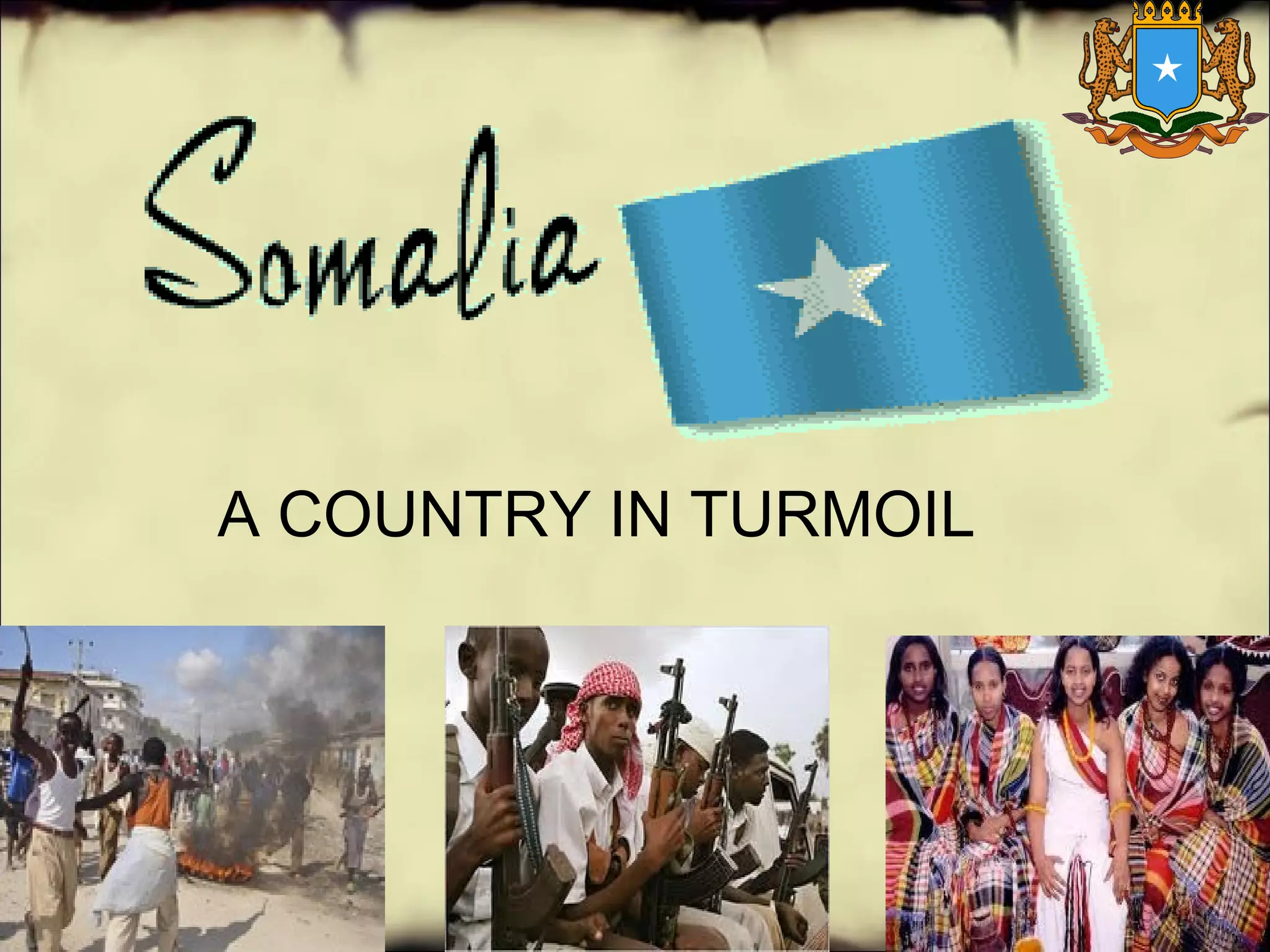
A COUNTRY IN TURMOIL


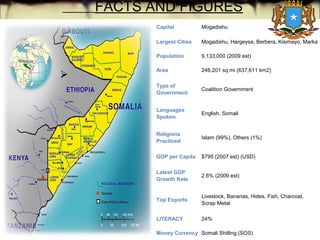
Capital Mogadishu
Largest Cities Mogadishu, Hargeysa, Berbera, Kisimayo, Marka
Population 9,133,000 (2009 est)
Area 246,201 sq mi (637,611 km2)
Type of
Government
Coalition Government
Languages
Spoken
English, Somali
Religions
Practiced
Islam (99%), Others (1%)
GDP per Capita $795 (2007 est) (USD)
Latest GDP
Growth Rate
2.6% (2009 est)
Top Exports
Livestock, Bananas, Hides, Fish, Charcoal,
Scrap Metal
LITERACY 24%
Money Currency Somali Shilling (SOS)
FACTS AND FIGURES
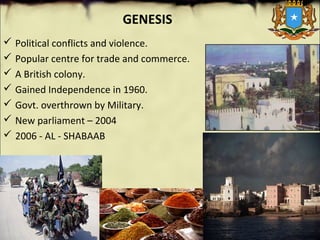
GENESIS
 Political conflicts and violence.
 Popular centre for trade and commerce.
 A British colony.
 Gained Independence in 1960.
 Govt. overthrown by Military.
 New parliament – 2004
 2006 - AL - SHABAAB
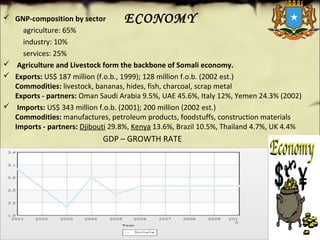
ECONOMY
 
 GNP-composition by sector
agriculture: 65%
           industry: 10%
           services: 25%
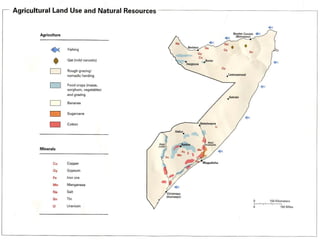
 Agriculture and Livestock form the backbone of Somali economy.
 Exports: US$ 187 million (f.o.b., 1999); 128 million f.o.b. (2002 est.) 
Commodities: livestock, bananas, hides, fish, charcoal, scrap metal
Exports - partners: Oman Saudi Arabia 9.5%, UAE 45.6%, Italy 12%, Yemen 24.3% (2002)
  Imports: US$ 343 million f.o.b. (2001); 200 million (2002 est.)
Commodities: manufactures, petroleum products, foodstuffs, construction materials 
Imports - partners: Djibouti 29.8%, Kenya 13.6%, Brazil 10.5%, Thailand 4.7%, UK 4.4%
                                                       GDP – GROWTH RATE
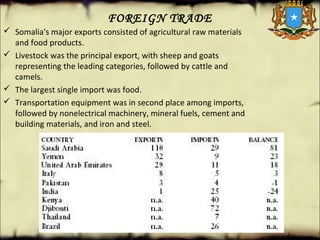
FOREIGN TRADE
 Somalia's major exports consisted of agricultural raw materials 
and food products. 
 Livestock was the principal export, with sheep and goats 
representing the leading categories, followed by cattle and 
camels. 
 The largest single import was food.
 Transportation equipment was in second place among imports, 
followed by nonelectrical machinery, mineral fuels, cement and 
building materials, and iron and steel.
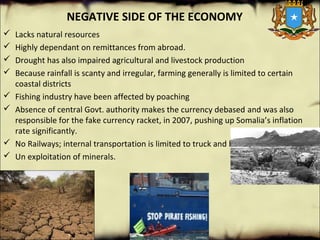
NEGATIVE SIDE OF THE ECONOMY
 Lacks natural resources
 Highly dependant on remittances from abroad.
 Drought has also impaired agricultural and livestock production
 Because rainfall is scanty and irregular, farming generally is limited to certain 
coastal districts
 Fishing industry have been affected by poaching
 Absence of central Govt. authority makes the currency debased and was also 
responsible for the fake currency racket, in 2007, pushing up Somalia’s inflation 
rate significantly.
 No Railways; internal transportation is limited to truck and bus
 Un exploitation of minerals.
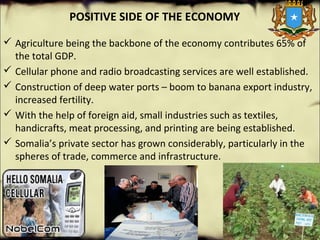
POSITIVE SIDE OF THE ECONOMY
 Agriculture being the backbone of the economy contributes 65% of
the total GDP.
 Cellular phone and radio broadcasting services are well established.
 Construction of deep water ports – boom to banana export industry,
increased fertility.
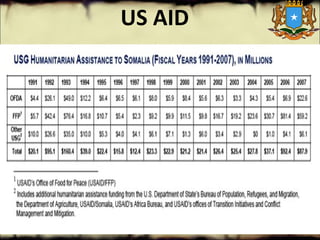
 With the help of foreign aid, small industries such as textiles,
handicrafts, meat processing, and printing are being established.
 Somalia’s private sector has grown considerably, particularly in the
spheres of trade, commerce and infrastructure.
POSITIVE SIDE OF THE ECONOMY
US AID
INFERENCE
BENNETT NATHAN
KAREN BENJAMIN
YESHA KAVAIYA
GOKUL NAIR
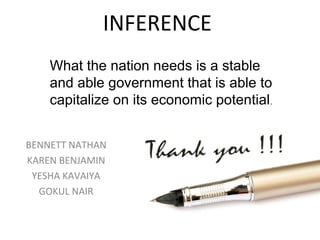
What the nation needs is a stable
and able government that is able to
capitalize on its economic potential.

somalia

  • 1.
    A COUNTRY INTURMOIL
  • 2.
      Capital Mogadishu Largest CitiesMogadishu, Hargeysa, Berbera, Kisimayo, Marka Population 9,133,000 (2009 est) Area 246,201 sq mi (637,611 km2) Type of Government Coalition Government Languages Spoken English, Somali Religions Practiced Islam (99%), Others (1%) GDP per Capita $795 (2007 est) (USD) Latest GDP Growth Rate 2.6% (2009 est) Top Exports Livestock, Bananas, Hides, Fish, Charcoal, Scrap Metal LITERACY 24% Money Currency Somali Shilling (SOS) FACTS AND FIGURES
  • 3.
    GENESIS  Political conflictsand violence.  Popular centre for trade and commerce.  A British colony.  Gained Independence in 1960.  Govt. overthrown by Military.  New parliament – 2004  2006 - AL - SHABAAB
  • 4.
    ECONOMY    GNP-composition bysector agriculture: 65%            industry: 10%            services: 25%  Agriculture and Livestock form the backbone of Somali economy.  Exports: US$ 187 million (f.o.b., 1999); 128 million f.o.b. (2002 est.)  Commodities: livestock, bananas, hides, fish, charcoal, scrap metal Exports - partners: Oman Saudi Arabia 9.5%, UAE 45.6%, Italy 12%, Yemen 24.3% (2002)   Imports: US$ 343 million f.o.b. (2001); 200 million (2002 est.) Commodities: manufactures, petroleum products, foodstuffs, construction materials  Imports - partners: Djibouti 29.8%, Kenya 13.6%, Brazil 10.5%, Thailand 4.7%, UK 4.4%                                                        GDP – GROWTH RATE
  • 5.
    FOREIGN TRADE  Somalia's major exports consisted of agricultural raw materials  and food products.  Livestock was the principal export, with sheep and goats  representing the leading categories, followed by cattle and  camels.   The largest single import was food.  Transportation equipment was in second place among imports,  followed by nonelectrical machinery, mineral fuels, cement and  building materials, and iron and steel.
  • 6.
    NEGATIVE SIDE OFTHE ECONOMY  Lacks natural resources  Highly dependant on remittances from abroad.  Drought has also impaired agricultural and livestock production  Because rainfall is scanty and irregular, farming generally is limited to certain  coastal districts  Fishing industry have been affected by poaching  Absence of central Govt. authority makes the currency debased and was also  responsible for the fake currency racket, in 2007, pushing up Somalia’s inflation  rate significantly.  No Railways; internal transportation is limited to truck and bus  Un exploitation of minerals.
  • 7.
    POSITIVE SIDE OFTHE ECONOMY  Agriculture being the backbone of the economy contributes 65% of the total GDP.  Cellular phone and radio broadcasting services are well established.  Construction of deep water ports – boom to banana export industry, increased fertility.  With the help of foreign aid, small industries such as textiles, handicrafts, meat processing, and printing are being established.  Somalia’s private sector has grown considerably, particularly in the spheres of trade, commerce and infrastructure.
  • 8.
    POSITIVE SIDE OFTHE ECONOMY
  • 9.
  • 10.
    INFERENCE BENNETT NATHAN KAREN BENJAMIN YESHAKAVAIYA GOKUL NAIR What the nation needs is a stable and able government that is able to capitalize on its economic potential.