Quantitative and Qualitative
Results Chapter 4:
Conducting, Interpreting, and Writing
by
Dr. James Lani

Results Chapter and
Threading a Needle
Threading a Needle

Conducting a Results Chapter

Once per sewed button

Do it once in your life

Not an end in itself (it’s to get a
button on to hold something
together)

It’s one part of one project in
one degree, in one part of your
life

You need the right ingredients:
needle, thread, and good eyes.

Software, knowledge, and time.

Right attitude: you don’t quit if
you can’t thread it 3 times.

Right attitude: you never give
up having come this far!

To schedule a consultation call 877-437-8622 or email Info@StatisticsSolutions.com
Today’s Webinar
• Quantitative Results
• Quantitative Results Strategy
• Data cleaning and Screening
• Descriptive statistics
• Conducting common analyses and reporting

findings
• Qualitative Results
• Qualitative Analysis Overview
• Grounded theory: Open, Axial, Selective coding
• Phenomenological: Lived experiences
• Q &A
To schedule a consultation call 877-437-8622 or email Info@StatisticsSolutions.com
Quantitative Results
Quantitative Results Strategy
•

•
•
•
•
•

Select the correct analysis (RQ and level
of measurement)
Clean your data
Describe variables
Conduct the analyses/assess assumptions
Present the findings
Summarize the findings

To schedule a consultation call 877-437-8622 or email Info@StatisticsSolutions.com
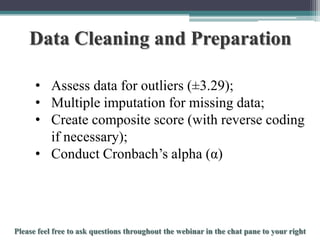
Data Cleaning and Preparation
• Assess data for outliers (±3.29);
• Multiple imputation for missing data;
• Create composite score (with reverse coding
if necessary);
• Conduct Cronbach’s alpha (α)

To schedule a consultation call 877-437-8622 or email Info@StatisticsSolutions.com
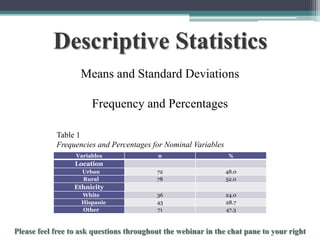
Descriptive Statistics
Means and Standard Deviations
Frequency and Percentages
Table 1
Frequencies and Percentages for Nominal Variables
Variables

n

%

72
78

48.0
52.0

36
43
71

24.0
28.7
47.3

Location
Urban
Rural

Ethnicity
White
Hispanic
Other

To schedule a consultation call 877-437-8622 or email Info@StatisticsSolutions.com
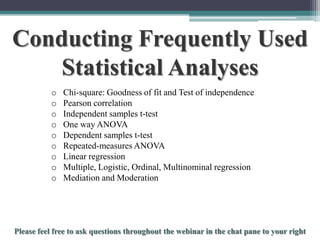
Conducting Frequently Used
Statistical Analyses
o
o
o
o
o
o
o
o
o

Chi-square: Goodness of fit and Test of independence
Pearson correlation
Independent samples t-test
One way ANOVA
Dependent samples t-test
Repeated-measures ANOVA
Linear regression
Multiple, Logistic, Ordinal, Multinominal regression
Mediation and Moderation

To schedule a consultation call 877-437-8622 or email Info@StatisticsSolutions.com
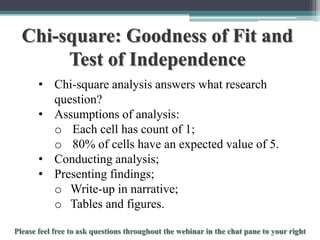
Chi-square: Goodness of Fit and
Test of Independence
• Chi-square analysis answers what research
question?
• Assumptions of analysis:
o Each cell has count of 1;
o 80% of cells have an expected value of 5.
• Conducting analysis;
• Presenting findings;
o Write-up in narrative;
o Tables and figures.
To schedule a consultation call 877-437-8622 or email Info@StatisticsSolutions.com
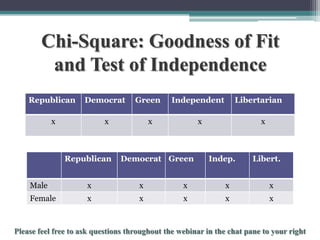
Chi-Square: Goodness of Fit
and Test of Independence
Republican

Democrat

Green

Independent

x

x

x

x

Republican

Democrat Green

Libertarian
x

Indep.

Libert.

Male

x

x

x

x

x

Female

x

x

x

x

x

To schedule a consultation call 877-437-8622 or email Info@StatisticsSolutions.com
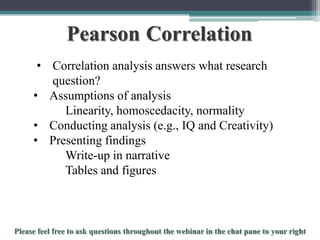
Pearson Correlation
• Correlation analysis answers what research
question?
• Assumptions of analysis
Linearity, homoscedacity, normality
• Conducting analysis (e.g., IQ and Creativity)
• Presenting findings
Write-up in narrative
Tables and figures

To schedule a consultation call 877-437-8622 or email Info@StatisticsSolutions.com
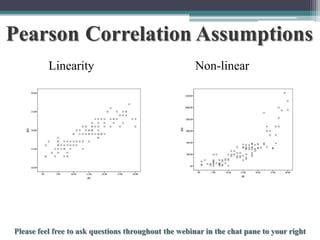
Pearson Correlation Assumptions
Linearity

Non-linear

To schedule a consultation call 877-437-8622 or email Info@StatisticsSolutions.com
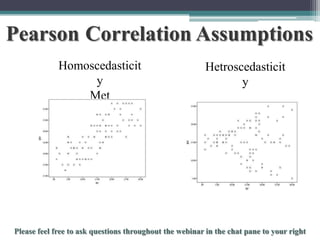
Pearson Correlation Assumptions
Homoscedasticit
y
Met

Hetroscedasticit
y

To schedule a consultation call 877-437-8622 or email Info@StatisticsSolutions.com
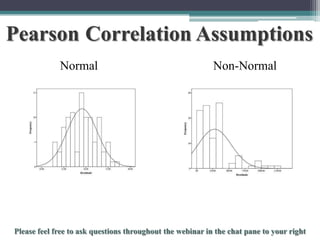
Pearson Correlation Assumptions
Normal

Non-Normal

To schedule a consultation call 877-437-8622 or email Info@StatisticsSolutions.com
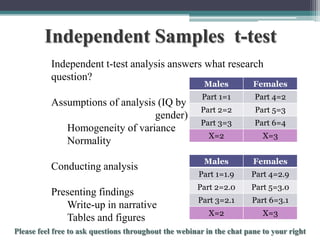
Independent Samples t-test
Independent t-test analysis answers what research
question?
Males

Assumptions of analysis (IQ by
gender)
Homogeneity of variance
Normality
Conducting analysis

Presenting findings
Write-up in narrative
Tables and figures

Females

Part 1=1

Part 4=2

Part 2=2

Part 5=3

Part 3=3

Part 6=4

X=2

X=3

Males

Females

Part 1=1.9

Part 4=2.9

Part 2=2.0

Part 5=3.0

Part 3=2.1

Part 6=3.1

X=2

X=3

To schedule a consultation call 877-437-8622 or email Info@StatisticsSolutions.com
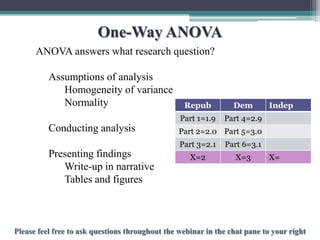
One-Way ANOVA
ANOVA answers what research question?

Assumptions of analysis
Homogeneity of variance
Normality

Dem

Part 1=1.9

Conducting analysis

Repub

Part 4=2.9

Part 2=2.0 Part 5=3.0
Part 3=2.1

Presenting findings
Write-up in narrative
Tables and figures

Indep

Part 6=3.1

X=2

X=3

X=

To schedule a consultation call 877-437-8622 or email Info@StatisticsSolutions.com
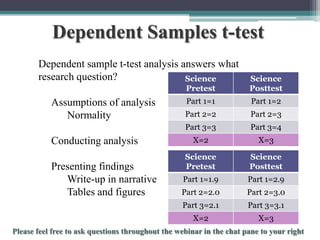
Dependent Samples t-test
Dependent sample t-test analysis answers what
research question?
Science
Pretest
Part 2=2

Part 2=3
Part 3=4

X=2

X=3

Science
Pretest

Science
Posttest

Part 1=1.9

Part 1=2.9

Part 2=2.0

Part 2=3.0
Part 3=3.1

X=2

Presenting findings
Write-up in narrative
Tables and figures

Part 1=2

Part 3=2.1

Conducting analysis

Part 1=1
Part 3=3

Assumptions of analysis
Normality

Science
Posttest

X=3

To schedule a consultation call 877-437-8622 or email Info@StatisticsSolutions.com
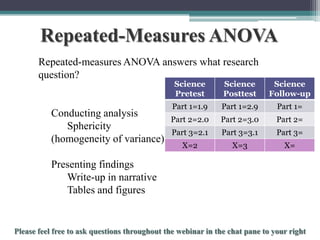
Repeated-Measures ANOVA
Repeated-measures ANOVA answers what research
question?
Science
Pretest

Conducting analysis
Sphericity
(homogeneity of variance)

Science
Posttest

Science
Follow-up

Part 1=1.9

Part 1=2.9

Part 1=

Part 2=2.0

Part 2=3.0

Part 2=

Part 3=2.1

Part 3=3.1

Part 3=

X=2

X=3

X=

Presenting findings
Write-up in narrative
Tables and figures

To schedule a consultation call 877-437-8622 or email Info@StatisticsSolutions.com
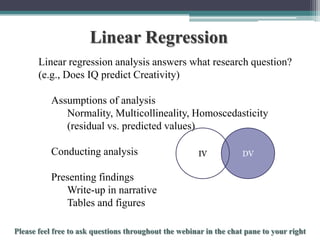
Linear Regression
Linear regression analysis answers what research question?
(e.g., Does IQ predict Creativity)
Assumptions of analysis
Normality, Multicollineality, Homoscedasticity
(residual vs. predicted values)
Conducting analysis

IV

DV

Presenting findings
Write-up in narrative
Tables and figures
To schedule a consultation call 877-437-8622 or email Info@StatisticsSolutions.com
Regressions: Multiple, Logistic,
Ordinal, Multinominal

Its all about the level of measurement
of the DV

To schedule a consultation call 877-437-8622 or email Info@StatisticsSolutions.com
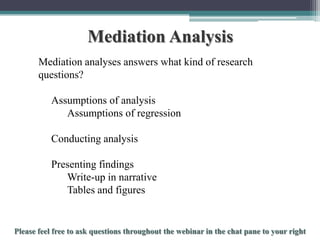
Mediation Analysis
Mediation analyses answers what kind of research
questions?
Assumptions of analysis
Assumptions of regression

Conducting analysis
Presenting findings
Write-up in narrative
Tables and figures

To schedule a consultation call 877-437-8622 or email Info@StatisticsSolutions.com
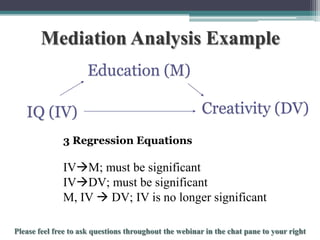
Mediation Analysis Example
Education (M)

IQ (IV)

Creativity (DV)

3 Regression Equations

IVM; must be significant
IVDV; must be significant
M, IV  DV; IV is no longer significant
To schedule a consultation call 877-437-8622 or email Info@StatisticsSolutions.com
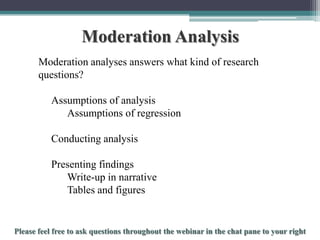
Moderation Analysis
Moderation analyses answers what kind of research
questions?
Assumptions of analysis
Assumptions of regression

Conducting analysis
Presenting findings
Write-up in narrative
Tables and figures

To schedule a consultation call 877-437-8622 or email Info@StatisticsSolutions.com
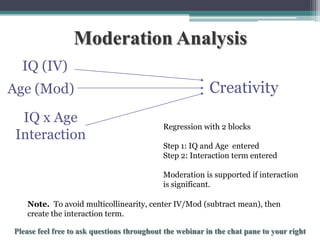
Moderation Analysis
IQ (IV)
Age (Mod)
IQ x Age
Interaction

Creativity
Regression with 2 blocks
Step 1: IQ and Age entered
Step 2: Interaction term entered
Moderation is supported if interaction
is significant.

Note. To avoid multicollinearity, center IV/Mod (subtract mean), then
create the interaction term.

To schedule a consultation call 877-437-8622 or email Info@StatisticsSolutions.com
Qualitative Results
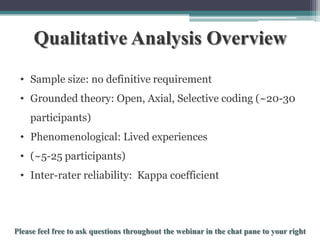
Qualitative Analysis Overview
• Sample size: no definitive requirement
• Grounded theory: Open, Axial, Selective coding (~20-30
participants)

• Phenomenological: Lived experiences
• (~5-25 participants)
• Inter-rater reliability: Kappa coefficient

To schedule a consultation call 877-437-8622 or email Info@StatisticsSolutions.com
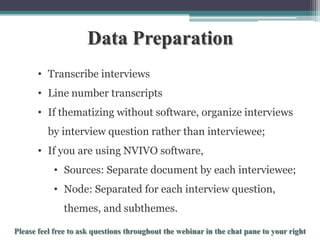
Data Preparation
• Transcribe interviews
• Line number transcripts
• If thematizing without software, organize interviews
by interview question rather than interviewee;
• If you are using NVIVO software,
• Sources: Separate document by each interviewee;
• Node: Separated for each interview question,
themes, and subthemes.
To schedule a consultation call 877-437-8622 or email Info@StatisticsSolutions.com
Grounded Theory Example:
Effectiveness of Block Scheduling
Research Question 1: During the first year of block scheduling, how did
students perceive the effectiveness of the new class schedule?
Interview Question 1. “During the first year of block scheduling, how did you
feel about your class load?”

Open coding revealed two sets of theme related information based on the
level of difficulty and amount of information taught. (1) The majority of
participants cited the level of difficulty associated with block scheduling.
Level of difficulty was related to overall course load and class schedules. (2)
The amount of information taught in the classes was also mentioned by the
students.

To schedule a consultation call 877-437-8622 or email Info@StatisticsSolutions.com
Qualitative Analysis: Grounded
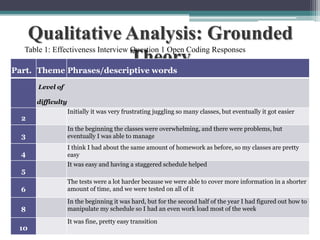
Table 1: Effectiveness Interview Question 1 Open Coding Responses
Theory

Part. Theme Phrases/descriptive words
Level of
difficulty

2

Initially it was very frustrating juggling so many classes, but eventually it got easier

3

In the beginning the classes were overwhelming, and there were problems, but
eventually I was able to manage

4

I think I had about the same amount of homework as before, so my classes are pretty
easy

5

It was easy and having a staggered schedule helped

6

The tests were a lot harder because we were able to cover more information in a shorter
amount of time, and we were tested on all of it

8

In the beginning it was hard, but for the second half of the year I had figured out how to
manipulate my schedule so I had an even work load most of the week

10

It was fine, pretty easy transition
Qualitative Analysis: Grounded
Axial coding for feelings about the class load revealed the following
Theory
thematic relationships (in order from strongest to weakest associations):
Four of the ten (40.0%) specified more information was taught/covered
(e.g., covered chapters a lot faster, not used to learning this much, more
information in a shorter amount of time).
Three of the ten (30.0%) specified the year started out difficult but got
easier (e.g., frustrating but got easier, overwhelming but eventually I could
manage, and hard but eventually I figured it out).
Three of the ten (30%) specified the class load was pretty easy (e.g., classes
are easy, easy transition, and having a staggered schedule made it easier).

To schedule a consultation call 877-437-8622 or email Info@StatisticsSolutions.com
Qualitative Analysis: Grounded
Theory
Selective coding of interview question 1, feelings about the class load,

generated a composite response of block scheduling was easy once an
understanding was gained (e.g., frustrating but got easier, overwhelming
but eventually I could manage, fine, pretty easy transition, and hard but
eventually I figured it out), followed by the theme of more information was
taught (e.g., covered chapters a lot faster, not used to learning this much,
more information in a shorter amount of time).
The researcher selected one participant’s statement that
reflected the axial coding composite with the most congruence.
Participant 3 stated, “In the beginning the classes were overwhelming, and
there were problems, but eventually I was able to manage. Having the block
schedule allows me to have a study period, so even though the tests cover
more information now I can be prepared because I have more time to
study.”
To schedule a consultation call 877-437-8622 or email Info@StatisticsSolutions.com
Qualitative Analysis:
Phenomenological
• Read entire set of transcripts to get a feel
for what is being said;

• Read across each interview question for all
participants, pulling themes out of
passages and then quoting (excerpts)

To schedule a consultation call 877-437-8622 or email Info@StatisticsSolutions.com
Qualitative Analysis: Kappa
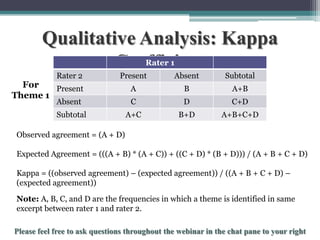
Rater 1
Coefficient
Rater 2

For
Present
Theme 1

Present

Absent

Subtotal

A

B

A+B

C

D

C+D

A+C

B+D

A+B+C+D

Absent

Subtotal

Observed agreement = (A + D)
Expected Agreement = (((A + B) * (A + C)) + ((C + D) * (B + D))) / (A + B + C + D)
Kappa = ((observed agreement) – (expected agreement)) / ((A + B + C + D) –
(expected agreement))
Note: A, B, C, and D are the frequencies in which a theme is identified in same
excerpt between rater 1 and rater 2.

To schedule a consultation call 877-437-8622 or email Info@StatisticsSolutions.com
Qualitative Analysis References
Creswell, J. W. (1998). Qualitative inquiry and research design: Choosing
among five traditions. Thousand Oaks, CA: Sage Publications.
Glaser, B. G. & Strauss, A. L. (1967). The discovery of grounded theory:
Strategies for qualitative research. Piscataway, New Jersey: Transaction.
Morse, J. M. (1994). Designing funded qualitative research. In Denizin, N. K. &
Lincoln, Y. S., Handbook of qualitative research (2nd Ed). Thousand
Oaks, CA: Sage.
Moustakas, C. (1994). Phenomenological research methods. Thousand
Oaks, CA: Sage.
Patton, M. Q. (1990). Qualitative evaluation and research methods (2nd Ed.).
Thousand Oaks, CA: Sage.

To schedule a consultation call 877-437-8622 or email Info@StatisticsSolutions.com
All Yours:
Questions & Answers
Personalized 1-1
Quantitative and
Qualitative Consulting
Email:
Info@StatisticsSolutions.com
877-437-8622
To schedule a consultation call 877-437-8622 or email Info@StatisticsSolutions.com
We’re interested…
Webinar Feedback and
What You’d Like
Please provide feedback on the webinar and tell us what else
you’d like to learn about in upcoming webinars.
Send comments to: James@StatisticsSolutions.com
Thank You
for your Participation
and Attention!
Join us for our next webinar on
Wednesday, January 22nd at
8:30pm ET

Results chapter conducting, interpreting, and writing

  • 1.
    Quantitative and Qualitative ResultsChapter 4: Conducting, Interpreting, and Writing by Dr. James Lani
  • 2.
    Results Chapter and Threadinga Needle Threading a Needle Conducting a Results Chapter Once per sewed button Do it once in your life Not an end in itself (it’s to get a button on to hold something together) It’s one part of one project in one degree, in one part of your life You need the right ingredients: needle, thread, and good eyes. Software, knowledge, and time. Right attitude: you don’t quit if you can’t thread it 3 times. Right attitude: you never give up having come this far! To schedule a consultation call 877-437-8622 or email Info@StatisticsSolutions.com
  • 3.
    Today’s Webinar • QuantitativeResults • Quantitative Results Strategy • Data cleaning and Screening • Descriptive statistics • Conducting common analyses and reporting findings • Qualitative Results • Qualitative Analysis Overview • Grounded theory: Open, Axial, Selective coding • Phenomenological: Lived experiences • Q &A To schedule a consultation call 877-437-8622 or email Info@StatisticsSolutions.com
  • 4.
  • 5.
    Quantitative Results Strategy • • • • • • Selectthe correct analysis (RQ and level of measurement) Clean your data Describe variables Conduct the analyses/assess assumptions Present the findings Summarize the findings To schedule a consultation call 877-437-8622 or email Info@StatisticsSolutions.com
  • 6.
    Data Cleaning andPreparation • Assess data for outliers (±3.29); • Multiple imputation for missing data; • Create composite score (with reverse coding if necessary); • Conduct Cronbach’s alpha (α) To schedule a consultation call 877-437-8622 or email Info@StatisticsSolutions.com
  • 7.
    Descriptive Statistics Means andStandard Deviations Frequency and Percentages Table 1 Frequencies and Percentages for Nominal Variables Variables n % 72 78 48.0 52.0 36 43 71 24.0 28.7 47.3 Location Urban Rural Ethnicity White Hispanic Other To schedule a consultation call 877-437-8622 or email Info@StatisticsSolutions.com
  • 8.
    Conducting Frequently Used StatisticalAnalyses o o o o o o o o o Chi-square: Goodness of fit and Test of independence Pearson correlation Independent samples t-test One way ANOVA Dependent samples t-test Repeated-measures ANOVA Linear regression Multiple, Logistic, Ordinal, Multinominal regression Mediation and Moderation To schedule a consultation call 877-437-8622 or email Info@StatisticsSolutions.com
  • 9.
    Chi-square: Goodness ofFit and Test of Independence • Chi-square analysis answers what research question? • Assumptions of analysis: o Each cell has count of 1; o 80% of cells have an expected value of 5. • Conducting analysis; • Presenting findings; o Write-up in narrative; o Tables and figures. To schedule a consultation call 877-437-8622 or email Info@StatisticsSolutions.com
  • 10.
    Chi-Square: Goodness ofFit and Test of Independence Republican Democrat Green Independent x x x x Republican Democrat Green Libertarian x Indep. Libert. Male x x x x x Female x x x x x To schedule a consultation call 877-437-8622 or email Info@StatisticsSolutions.com
  • 11.
    Pearson Correlation • Correlationanalysis answers what research question? • Assumptions of analysis Linearity, homoscedacity, normality • Conducting analysis (e.g., IQ and Creativity) • Presenting findings Write-up in narrative Tables and figures To schedule a consultation call 877-437-8622 or email Info@StatisticsSolutions.com
  • 12.
    Pearson Correlation Assumptions Linearity Non-linear Toschedule a consultation call 877-437-8622 or email Info@StatisticsSolutions.com
  • 13.
    Pearson Correlation Assumptions Homoscedasticit y Met Hetroscedasticit y Toschedule a consultation call 877-437-8622 or email Info@StatisticsSolutions.com
  • 14.
    Pearson Correlation Assumptions Normal Non-Normal Toschedule a consultation call 877-437-8622 or email Info@StatisticsSolutions.com
  • 15.
    Independent Samples t-test Independentt-test analysis answers what research question? Males Assumptions of analysis (IQ by gender) Homogeneity of variance Normality Conducting analysis Presenting findings Write-up in narrative Tables and figures Females Part 1=1 Part 4=2 Part 2=2 Part 5=3 Part 3=3 Part 6=4 X=2 X=3 Males Females Part 1=1.9 Part 4=2.9 Part 2=2.0 Part 5=3.0 Part 3=2.1 Part 6=3.1 X=2 X=3 To schedule a consultation call 877-437-8622 or email Info@StatisticsSolutions.com
  • 16.
    One-Way ANOVA ANOVA answerswhat research question? Assumptions of analysis Homogeneity of variance Normality Dem Part 1=1.9 Conducting analysis Repub Part 4=2.9 Part 2=2.0 Part 5=3.0 Part 3=2.1 Presenting findings Write-up in narrative Tables and figures Indep Part 6=3.1 X=2 X=3 X= To schedule a consultation call 877-437-8622 or email Info@StatisticsSolutions.com
  • 17.
    Dependent Samples t-test Dependentsample t-test analysis answers what research question? Science Pretest Part 2=2 Part 2=3 Part 3=4 X=2 X=3 Science Pretest Science Posttest Part 1=1.9 Part 1=2.9 Part 2=2.0 Part 2=3.0 Part 3=3.1 X=2 Presenting findings Write-up in narrative Tables and figures Part 1=2 Part 3=2.1 Conducting analysis Part 1=1 Part 3=3 Assumptions of analysis Normality Science Posttest X=3 To schedule a consultation call 877-437-8622 or email Info@StatisticsSolutions.com
  • 18.
    Repeated-Measures ANOVA Repeated-measures ANOVAanswers what research question? Science Pretest Conducting analysis Sphericity (homogeneity of variance) Science Posttest Science Follow-up Part 1=1.9 Part 1=2.9 Part 1= Part 2=2.0 Part 2=3.0 Part 2= Part 3=2.1 Part 3=3.1 Part 3= X=2 X=3 X= Presenting findings Write-up in narrative Tables and figures To schedule a consultation call 877-437-8622 or email Info@StatisticsSolutions.com
  • 19.
    Linear Regression Linear regressionanalysis answers what research question? (e.g., Does IQ predict Creativity) Assumptions of analysis Normality, Multicollineality, Homoscedasticity (residual vs. predicted values) Conducting analysis IV DV Presenting findings Write-up in narrative Tables and figures To schedule a consultation call 877-437-8622 or email Info@StatisticsSolutions.com
  • 20.
    Regressions: Multiple, Logistic, Ordinal,Multinominal Its all about the level of measurement of the DV To schedule a consultation call 877-437-8622 or email Info@StatisticsSolutions.com
  • 21.
    Mediation Analysis Mediation analysesanswers what kind of research questions? Assumptions of analysis Assumptions of regression Conducting analysis Presenting findings Write-up in narrative Tables and figures To schedule a consultation call 877-437-8622 or email Info@StatisticsSolutions.com
  • 22.
    Mediation Analysis Example Education(M) IQ (IV) Creativity (DV) 3 Regression Equations IVM; must be significant IVDV; must be significant M, IV  DV; IV is no longer significant To schedule a consultation call 877-437-8622 or email Info@StatisticsSolutions.com
  • 23.
    Moderation Analysis Moderation analysesanswers what kind of research questions? Assumptions of analysis Assumptions of regression Conducting analysis Presenting findings Write-up in narrative Tables and figures To schedule a consultation call 877-437-8622 or email Info@StatisticsSolutions.com
  • 24.
    Moderation Analysis IQ (IV) Age(Mod) IQ x Age Interaction Creativity Regression with 2 blocks Step 1: IQ and Age entered Step 2: Interaction term entered Moderation is supported if interaction is significant. Note. To avoid multicollinearity, center IV/Mod (subtract mean), then create the interaction term. To schedule a consultation call 877-437-8622 or email Info@StatisticsSolutions.com
  • 25.
  • 26.
    Qualitative Analysis Overview •Sample size: no definitive requirement • Grounded theory: Open, Axial, Selective coding (~20-30 participants) • Phenomenological: Lived experiences • (~5-25 participants) • Inter-rater reliability: Kappa coefficient To schedule a consultation call 877-437-8622 or email Info@StatisticsSolutions.com
  • 27.
    Data Preparation • Transcribeinterviews • Line number transcripts • If thematizing without software, organize interviews by interview question rather than interviewee; • If you are using NVIVO software, • Sources: Separate document by each interviewee; • Node: Separated for each interview question, themes, and subthemes. To schedule a consultation call 877-437-8622 or email Info@StatisticsSolutions.com
  • 28.
    Grounded Theory Example: Effectivenessof Block Scheduling Research Question 1: During the first year of block scheduling, how did students perceive the effectiveness of the new class schedule? Interview Question 1. “During the first year of block scheduling, how did you feel about your class load?” Open coding revealed two sets of theme related information based on the level of difficulty and amount of information taught. (1) The majority of participants cited the level of difficulty associated with block scheduling. Level of difficulty was related to overall course load and class schedules. (2) The amount of information taught in the classes was also mentioned by the students. To schedule a consultation call 877-437-8622 or email Info@StatisticsSolutions.com
  • 29.
    Qualitative Analysis: Grounded Table1: Effectiveness Interview Question 1 Open Coding Responses Theory Part. Theme Phrases/descriptive words Level of difficulty 2 Initially it was very frustrating juggling so many classes, but eventually it got easier 3 In the beginning the classes were overwhelming, and there were problems, but eventually I was able to manage 4 I think I had about the same amount of homework as before, so my classes are pretty easy 5 It was easy and having a staggered schedule helped 6 The tests were a lot harder because we were able to cover more information in a shorter amount of time, and we were tested on all of it 8 In the beginning it was hard, but for the second half of the year I had figured out how to manipulate my schedule so I had an even work load most of the week 10 It was fine, pretty easy transition
  • 30.
    Qualitative Analysis: Grounded Axialcoding for feelings about the class load revealed the following Theory thematic relationships (in order from strongest to weakest associations): Four of the ten (40.0%) specified more information was taught/covered (e.g., covered chapters a lot faster, not used to learning this much, more information in a shorter amount of time). Three of the ten (30.0%) specified the year started out difficult but got easier (e.g., frustrating but got easier, overwhelming but eventually I could manage, and hard but eventually I figured it out). Three of the ten (30%) specified the class load was pretty easy (e.g., classes are easy, easy transition, and having a staggered schedule made it easier). To schedule a consultation call 877-437-8622 or email Info@StatisticsSolutions.com
  • 31.
    Qualitative Analysis: Grounded Theory Selectivecoding of interview question 1, feelings about the class load, generated a composite response of block scheduling was easy once an understanding was gained (e.g., frustrating but got easier, overwhelming but eventually I could manage, fine, pretty easy transition, and hard but eventually I figured it out), followed by the theme of more information was taught (e.g., covered chapters a lot faster, not used to learning this much, more information in a shorter amount of time). The researcher selected one participant’s statement that reflected the axial coding composite with the most congruence. Participant 3 stated, “In the beginning the classes were overwhelming, and there were problems, but eventually I was able to manage. Having the block schedule allows me to have a study period, so even though the tests cover more information now I can be prepared because I have more time to study.” To schedule a consultation call 877-437-8622 or email Info@StatisticsSolutions.com
  • 32.
    Qualitative Analysis: Phenomenological • Readentire set of transcripts to get a feel for what is being said; • Read across each interview question for all participants, pulling themes out of passages and then quoting (excerpts) To schedule a consultation call 877-437-8622 or email Info@StatisticsSolutions.com
  • 33.
    Qualitative Analysis: Kappa Rater1 Coefficient Rater 2 For Present Theme 1 Present Absent Subtotal A B A+B C D C+D A+C B+D A+B+C+D Absent Subtotal Observed agreement = (A + D) Expected Agreement = (((A + B) * (A + C)) + ((C + D) * (B + D))) / (A + B + C + D) Kappa = ((observed agreement) – (expected agreement)) / ((A + B + C + D) – (expected agreement)) Note: A, B, C, and D are the frequencies in which a theme is identified in same excerpt between rater 1 and rater 2. To schedule a consultation call 877-437-8622 or email Info@StatisticsSolutions.com
  • 34.
    Qualitative Analysis References Creswell,J. W. (1998). Qualitative inquiry and research design: Choosing among five traditions. Thousand Oaks, CA: Sage Publications. Glaser, B. G. & Strauss, A. L. (1967). The discovery of grounded theory: Strategies for qualitative research. Piscataway, New Jersey: Transaction. Morse, J. M. (1994). Designing funded qualitative research. In Denizin, N. K. & Lincoln, Y. S., Handbook of qualitative research (2nd Ed). Thousand Oaks, CA: Sage. Moustakas, C. (1994). Phenomenological research methods. Thousand Oaks, CA: Sage. Patton, M. Q. (1990). Qualitative evaluation and research methods (2nd Ed.). Thousand Oaks, CA: Sage. To schedule a consultation call 877-437-8622 or email Info@StatisticsSolutions.com
  • 35.
  • 36.
    Personalized 1-1 Quantitative and QualitativeConsulting Email: Info@StatisticsSolutions.com 877-437-8622 To schedule a consultation call 877-437-8622 or email Info@StatisticsSolutions.com
  • 37.
    We’re interested… Webinar Feedbackand What You’d Like Please provide feedback on the webinar and tell us what else you’d like to learn about in upcoming webinars. Send comments to: James@StatisticsSolutions.com
  • 38.
    Thank You for yourParticipation and Attention! Join us for our next webinar on Wednesday, January 22nd at 8:30pm ET