Why isTheory Important?
Presenter:TomWest
Overview
Introduction
 What is theory?
 Theory and the Research Process
 Theory and Research Questions
 TheTheoretical Framework
 Importance of using relevant theory
 Summary
Introduction
 Theory an important aspect of the dissertation
 Provides a framework for understanding
 Guides research
 Promotes critical thinking
 Has predictive and interpretive capacity
What is theory?
 A set of ideas or concepts that explain a phenomenon
 In studies, theory is presented as a framework to help understand
the relationships between variables
 Data is mute or inert without theory
Need help with your dissertation? Call 727-442-4290
Theory and the
Research
Process
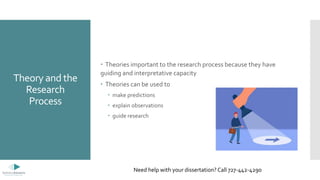
 Theories important to the research process because they have
guiding and interpretative capacity
 Theories can be used to
 make predictions
 explain observations
 guide research
Need help with your dissertation? Call 727-442-4290
Theory and
Research
Questions
 Help define the research question(s) by providing a framework for
the investigation
 Theories can guide the selection of variables to be studied and the
research design.
 Theories undergird the research questions and instruments
Need help with your dissertation? Call 727-442-4290
TheTheoretical
Framework
 Who developed the theory?Year?To
explain what?
 Define the theory, along with any
associated components
 Discuss what researchers have used
the theory for
 Connect to your study
Need help with your dissertation? Call 727-442-4290
Importance of
using relevant
theory
 The theory must be relevant to what you’re studying
 Theories shouldn’t be afterthoughts
 Part of the development of your research problem and research
questions
Need help with your dissertation? Call 727-442-4290
Summary
 Theory is an essential component of a dissertation
 Theory helps to generate hypotheses, guide research, and interpret
data
 Has explanatory and interpretive capacity
 Using relevant theory is crucial to the success of a dissertation
Need help with your dissertation? Call 727-442-4290
Questions?
Need help with your dissertation? Call 727-442-4290
Additional
Support
Statistics Solutions is a full-service dissertation consulting
company providing graduate students timely, editorial
support for their dissertations and scholarly projects
For information about our services, receive a
complementary 30-min consultation available Mon-Fri 9-5
ET
Contact us at info@StatisticsSolutions.com
Phone: 877-437-8622

Why is Theory Important?

  • 1.
  • 2.
    Overview Introduction  What istheory?  Theory and the Research Process  Theory and Research Questions  TheTheoretical Framework  Importance of using relevant theory  Summary
  • 3.
    Introduction  Theory animportant aspect of the dissertation  Provides a framework for understanding  Guides research  Promotes critical thinking  Has predictive and interpretive capacity
  • 4.
    What is theory? A set of ideas or concepts that explain a phenomenon  In studies, theory is presented as a framework to help understand the relationships between variables  Data is mute or inert without theory Need help with your dissertation? Call 727-442-4290
  • 5.
    Theory and the Research Process Theories important to the research process because they have guiding and interpretative capacity  Theories can be used to  make predictions  explain observations  guide research Need help with your dissertation? Call 727-442-4290
  • 6.
    Theory and Research Questions  Helpdefine the research question(s) by providing a framework for the investigation  Theories can guide the selection of variables to be studied and the research design.  Theories undergird the research questions and instruments Need help with your dissertation? Call 727-442-4290
  • 7.
    TheTheoretical Framework  Who developedthe theory?Year?To explain what?  Define the theory, along with any associated components  Discuss what researchers have used the theory for  Connect to your study Need help with your dissertation? Call 727-442-4290
  • 8.
    Importance of using relevant theory The theory must be relevant to what you’re studying  Theories shouldn’t be afterthoughts  Part of the development of your research problem and research questions Need help with your dissertation? Call 727-442-4290
  • 9.
    Summary  Theory isan essential component of a dissertation  Theory helps to generate hypotheses, guide research, and interpret data  Has explanatory and interpretive capacity  Using relevant theory is crucial to the success of a dissertation Need help with your dissertation? Call 727-442-4290
  • 10.
    Questions? Need help withyour dissertation? Call 727-442-4290
  • 11.
    Additional Support Statistics Solutions isa full-service dissertation consulting company providing graduate students timely, editorial support for their dissertations and scholarly projects For information about our services, receive a complementary 30-min consultation available Mon-Fri 9-5 ET Contact us at info@StatisticsSolutions.com Phone: 877-437-8622

Editor's Notes

  • #3 Okay, so the easiest thing to do at first is to go over each comment, so take time to read through each and every comment before you start addressing any feedback because you may find that some of the comments are really similar to each other or changes need to be made throughout. You don't want to be addressing feedback and find that through your edits the comment disappears and then it applies someplace else. So read in its entirety, take notes if necessary. Work on a different coy so you don't lose comments and reach out to your chair with any questions that you may have. Also you want to stay organized. Organization is key when addressing feedback you're going to want to save old drafts of your dissertation just in case you find that something that you deleted previously you need again. So you don't have to reinvent the wheel, you can just pull it out of an old version and maybe edited it to make it apply to the new one.
  • #4 So reaching out with questions, it's okay to ask questions. A lot of students are really hesitant to reach out to their chair with questions, they're afraid they're come off is stupid or anything like that. It's definitely not stupid, just like how easy it is to misinterpret something over email or text message - it's just as easy to misinterpret something that you're receiving feedback in your document. If you have any questions, if you're confused or anything like that just reach your chair, there to help you. You cannot thoroughly answer something if you don't understand it. As I already mentioned, part of your chairs job is to guide you through the editing process. They shouldn't mind if you ask a few questions, just make sure that you have all of your questions together so you can ask them all in one shot, instead of spending a week back and forth emailing or playing phone tag or something like that. If it's something that you feel more comfortable talking about, reach out and see if you can schedule a conference call with them, or something to get them live. You can limit a lot of the back and forth by asking them to elaborate on something right away. Be clear about what you do not understand, don’t just be like “well, I don't get it,” perhaps it would be best if you came in saying “okay, so here you said that this paragraph is unclear. Is it unclear because of the language or do you think I have too many topics going on? Maybe I should spread this out.” Kind of brainstorm a little bit on what the comments might mean before you reach out. Offering some ideas is going to show that you're prepared and that you did put some time in, and that you're not just trying to cut corners by saying “I didn’t get this, explain it to me.” As I said before chairs aren't going to get upset. If they do honestly, that's too bad, it's part of their job. They’re there to help you. So utilize them, you're paying so much money for that.
  • #5 Back to understanding your feedback. I’m going to mention this probably a hundred times tonight because it is really the most important part of being able to effectively and thoroughly address feedback - is understanding it. Once you feel that you do have a solid grasp on the feedback. Address it as thoroughly as possible, even if you get to the point where you're like “oh no, maybe I'm putting too much in.” Well it's a lot better for them to come back and say, “this is great, just cut it back,” or “you only need part of this.” It’s much better for that, then for them to say, “well you didn't address the feedback. I still want to know about this. You didn't include enough details.” Include as many details as possible, think of every possible way that you might need to address feedback and include all of those things. Your chair can look them over and see what they think about it and then you can cut back as necessary. When editing, it's much easier to cut back than it is to add. Don’t force your chair to ask for the same changes multiple times. If you are including everything possible when you're addressing feedback, you're not likely going to get additional feedback saying that you didn't address the original feedback. Make sure that you can put in everything possible, you don't want to leave anything to chance. You don't want to leave them asking any questions or anything like that. You want to provide as much as possible to show that you've done your due diligence and are working to address each and every comment.
  • #6 Pushing back on feedback - this is scary but sometimes very necessary. I hate to say this but sometimes you'll find chairs or committee members, maybe it's the end of the day, maybe they just have a really heavy load going on, and maybe they skimmed over something and then they got to something else that was confusing, so they made a comment that to you seems kind of arbitrary. Or you've been doing a qualitative study and they suggest moving to quantitative. Reaching out to them and talking to them about things, just justify your reasoning and most of the time they're going to agree with you. Occasionally they may not and you may have to change things, but just make sure that you know why you wrote everything. Why it's included and why you've chosen to do things. The way that you have, because if you can push back on something that seems irrelevant it's just going to show that you're more prepared, particularly when it comes time for defense and that's going to make your chair feel a lot more confident about your ability. Also remember it's your dissertation, don't let the feedback drive you into place where either you do not understand or that you feel uncomfortable defending. Perhaps you're doing a study on surviving cancer patients or something like that, and they decide (you know first if you've gotten through URR and they're allowing you to do IRB) and they're allowing you to do that vulnerable population and then someone comes back and says “well maybe you should do the thousands of these people instead,” you know make sure that you're sticking to your gun. Be confident in your study, you are an expert in the field. Sometimes your chair or your reviewer is not, so just embrace your confidence and your expertise. Let your chair know that you’re harnessing that. Sometimes when you have to push off on feedback it's often due to a lack of clarity and the verbiage used in the document or in the feedback. So sometimes you'll find that if you need to push back on something it was more because they made a comment because what you said in the paper, maybe wasn't what you meant, the words didn’t align or you misunderstood the feedback because they weren't clear. Again, goes back to asking questions, it's super important to understand what's expected of you. Keep an open and professional dialogue with your committee. There is absolutely nothing worse than getting super defensive about something and lashing out at your committee, because then you're not going to leave very good taste in their mouth and they're going to remember that the next time that your paper comes across their desk. So if you need to sleep on it before you reach out about something or push back on something. It might be necessary just make sure that you stay calm, cool and collected and professional. Your conversations with your committee will be very fruitful. You'll find that when you need to get things done, very necessary for details to be had or expound upon. These things will happen if you stay open and professional.
  • #7 Incongruent feedback - sometimes this happens. Sometimes you'll find that your chair and committee member, or you're one of your committee members versus another committee member at odds regarding the changes that they think should be done. So the feedback that you're getting will be almost like a rebuttal of them to each other. This is where you need to talk to your chair. Your chair is your advocate they are your first and your last line of defense against the committee. You can talk to your chair, talk about which feedback you think is most fruitful for your particular study. Your chair then needs to deal with the committee. At that point it's not really your place to reach over your committees head to reach out to any of those committee members. Don’t say “hey I see that you don't agree with so-and-so and I agree with you” or anything like that. It’s necessary to go to your chair, make sure you follow the chain of command and they can help you with stuff. So be sure to utilize your chair and their guidance and their resources.
  • #8 Indicating changes - now some chairs have very specific ways that they want you to indicate how you've done your changes and they’ll be very clear about it. They will provide you with a change matrix format or something like that or they'll tell you to use track changes. They will tell you to highlight things, some chairs won’t. They will just give you feedback and leave you in the air. So just make sure that you find some organized way to show that you've done feedback if you don't have clear guidance on how to indicate as much. You can use track changes which sometimes with a little messy and scary to people who aren't familiar with them. Track changes can always be undone, they can be accepted, they can be declined, they can be hidden, they can be exposed. Track changes are very useful. It does take a little bit to get used to them, there are a lot of really wonderful useful Youtube videos on how to use tracked changes. Some chairs are a little more old-fashioned, they just want you to write in regular text and highlight it so they can quickly scan through the documents and stop at the highlighted section, read them, compare them to the comment, and then let you know if they feel like you address it thoroughly or not. Or there is the dreaded change matrix. A change matrix is not hard, it's just really time-consuming and it's most important to be on top of the change matrix while you're making changes because then you can literally just copy and paste the comments from the document and the old text, and the new text, and then write a quick sentence or two on why you made the change or how you make a change. Usually it's something as simple as saying you know changed verbiage for clarity or adjusted sample size to align with whatever, or first line of purpose statement change to align with research question and problem statement. They're usually really easy explanations so don't overthink.
  • #9 Be timely - Think about how long this process takes, think about how long you've been in this process and think about the time that it's going to take for you to address feedback diligently. You know if you just have little nitpicking feedback - maybe they don't like the way you use this one word, or you have to many “that’s” in the document or “these” or “it’s” or something like that. Those are going to be quickly, easy changes that you can turn around in just a day or two. However, if they're asking you to rehash your lit review or to update all your sources because maybe you took a break and everything is too old now. Make sure that you're setting realistic timelines for yourself and that you're setting aside enough time to address the feedback. It takes a long time, think about how long it took you to write each one of these chapters. Sometimes its going to take you just as long to address really in-depth feedback, depending upon how much of a change its going to make to the document. You guys are mostly all working adults with families and jobs and stuff like that, so just be mindful of everything that you have to do and things that you may often need to get done on your paper to address feedback. Set aside the appropriate time talk to your chair about a deadline, when they can expect the document back, so that it holds you to that timeline because it takes you a week to address feedback and then it takes them two weeks to review it and turn it back around to you. You've got three weeks down, that's almost half of the semester so just be mindful of how long it's taking things to happen. You don't want to get stuck you know making those unreasonable decision on a deadline or not being able to make revisions and make one last submission before the end of the semester. So time is money, nobody knows that more than you guys.
  • #10 Be timely - Think about how long this process takes, think about how long you've been in this process and think about the time that it's going to take for you to address feedback diligently. You know if you just have little nitpicking feedback - maybe they don't like the way you use this one word, or you have to many “that’s” in the document or “these” or “it’s” or something like that. Those are going to be quickly, easy changes that you can turn around in just a day or two. However, if they're asking you to rehash your lit review or to update all your sources because maybe you took a break and everything is too old now. Make sure that you're setting realistic timelines for yourself and that you're setting aside enough time to address the feedback. It takes a long time, think about how long it took you to write each one of these chapters. Sometimes its going to take you just as long to address really in-depth feedback, depending upon how much of a change its going to make to the document. You guys are mostly all working adults with families and jobs and stuff like that, so just be mindful of everything that you have to do and things that you may often need to get done on your paper to address feedback. Set aside the appropriate time talk to your chair about a deadline, when they can expect the document back, so that it holds you to that timeline because it takes you a week to address feedback and then it takes them two weeks to review it and turn it back around to you. You've got three weeks down, that's almost half of the semester so just be mindful of how long it's taking things to happen. You don't want to get stuck you know making those unreasonable decision on a deadline or not being able to make revisions and make one last submission before the end of the semester. So time is money, nobody knows that more than you guys.
  • #11 Be timely - Think about how long this process takes, think about how long you've been in this process and think about the time that it's going to take for you to address feedback diligently. You know if you just have little nitpicking feedback - maybe they don't like the way you use this one word, or you have to many “that’s” in the document or “these” or “it’s” or something like that. Those are going to be quickly, easy changes that you can turn around in just a day or two. However, if they're asking you to rehash your lit review or to update all your sources because maybe you took a break and everything is too old now. Make sure that you're setting realistic timelines for yourself and that you're setting aside enough time to address the feedback. It takes a long time, think about how long it took you to write each one of these chapters. Sometimes its going to take you just as long to address really in-depth feedback, depending upon how much of a change its going to make to the document. You guys are mostly all working adults with families and jobs and stuff like that, so just be mindful of everything that you have to do and things that you may often need to get done on your paper to address feedback. Set aside the appropriate time talk to your chair about a deadline, when they can expect the document back, so that it holds you to that timeline because it takes you a week to address feedback and then it takes them two weeks to review it and turn it back around to you. You've got three weeks down, that's almost half of the semester so just be mindful of how long it's taking things to happen. You don't want to get stuck you know making those unreasonable decision on a deadline or not being able to make revisions and make one last submission before the end of the semester. So time is money, nobody knows that more than you guys.