How to Conduct and Interpret Tests
of Differences
Justin D’Souza
Quantitative Specialist
Table of
Contents
Statistics Solutions Services
Conducting t-tests
Intellectus Demo
Summary
Need help with your dissertation? Call 727-442-4290
Services Offered
by Statistics
Solutions
• Topic Development
• Prospectus or Concept Papers
• Introduction Chapter
• Literature Review Chapter (identifying articles)
• Methodology Chapter (Quantitative/Qualitative).
• IRB forms
• Data entry templates
• Survey Monkey upload
• Results Chapter (Quantitative/Qualitative)
• Discussion Chapter
• Powerpoints for Defense
• Journal Publications
 Need help with your dissertation? Call 727-442-4290
Comparisons
Need help with your dissertation? Call 727-442-4290
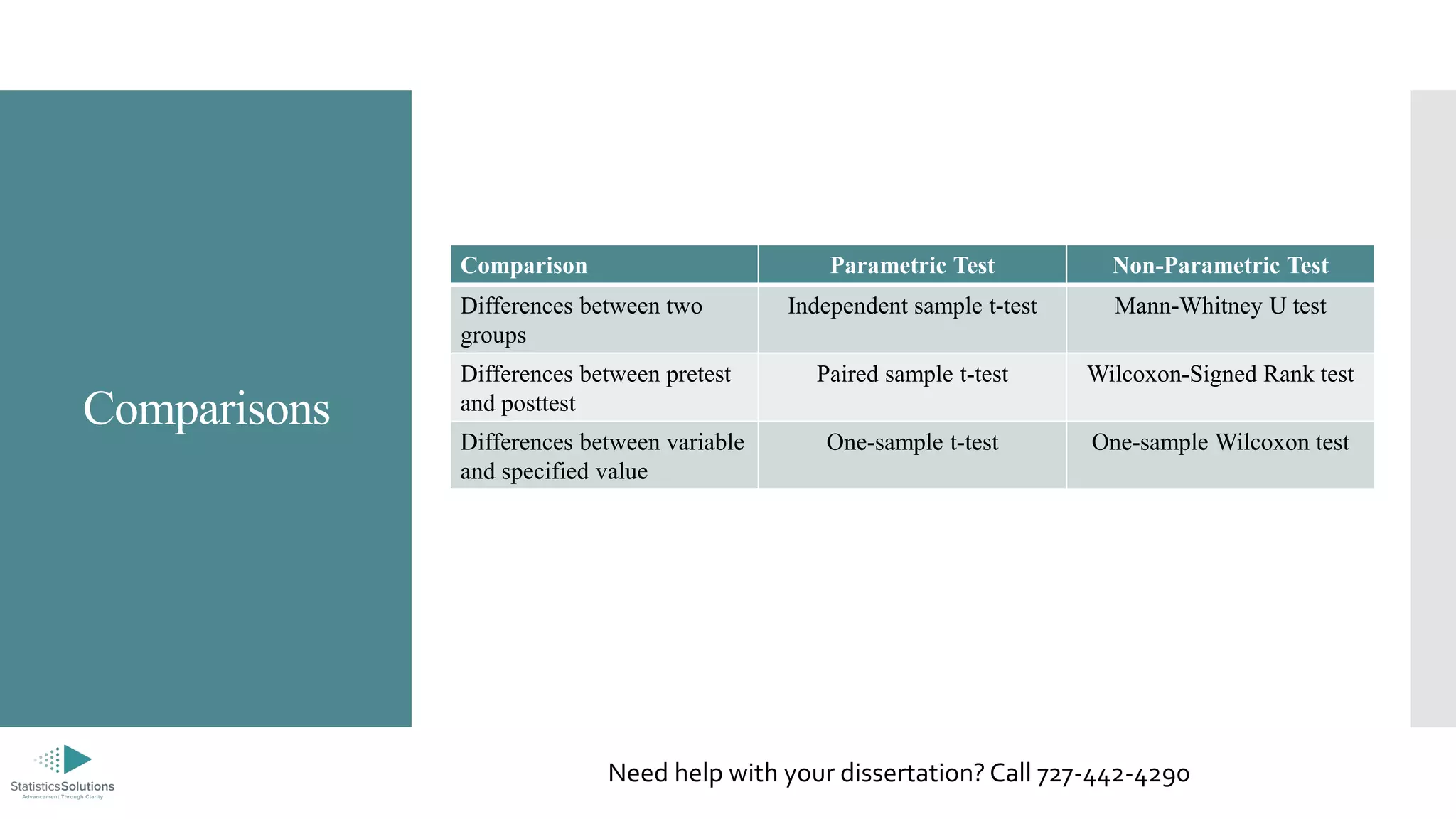
Comparison Parametric Test Non-Parametric Test
Differences between two
groups
Independent sample t-test Mann-Whitney U test
Differences between pretest
and posttest
Paired sample t-test Wilcoxon-Signed Rank test
Differences between variable
and specified value
One-sample t-test One-sample Wilcoxon test
Normality
Assumption
Normality Assumption
 Typically, parametric statistics assume that the data follow a normal (bell-shaped)
distribution.
 There are various ways to check for normality (Shapiro-Wilk test, Kolmogorov-
Smirnov test, skewness/kurtosis, scatterplots/histograms). And if the data do not
follow a normal distribution, non-parametric techniques can potentially be used as
an alternative.
 If you have a large sample size (>50), you can use the central limit theorem to
justify using parametric techniques even if tests normality are not showing a bell-
shaped curve. Howell (2013) states that violations of normality are not problematic
when the sample size for research exceeds 50 cases.
Need help with your dissertation? Call 727-442-4290
Independent Sample t-Test:
Assesses for differences in a
continuous variable between two
independent groups.
Setting Up
Independent
Sample t-test
 Need to have an independent variable that is dichotomous (two groups).
Examples: Gender (male vs female), group in experimental study (treatment vs
control)
 Need to have a continuous dependent variable.
 Check for assumptions of an independent sample t-test.
 https://statistics.laerd.com/spss-tutorials/independent-t-test-using-spss-
statistics.php
 If assumptions are not supported, run a Mann-Whitney U test.
Need help with your dissertation? Call 727-442-4290
Paired (Dependent) Sample t-Test:
Assesses for differences in a matched
continuous variable between two
points in time.
Setting Up Paired
Sample t-test
 Need to have one matched dependent variable that is measured two
times.
 Check for assumptions of a paired sample t-test:
 https://statistics.laerd.com/spss-tutorials/dependent-t-test-using-
spss-statistics.php
 If assumptions are not supported, run a Wilcoxon-Signed Rank
test.
Need help with your dissertation? Call 727-442-4290
One-Sample t-Test:
Assesses for differences between a
continuous variable and a specified
value.
Summary
 Identify independent grouping variables and dependent variables.
 Is goal to test for differences between groups, test for differences over time?
 Use statistical software (Intellectus Statistics, SPSS, Stata, etc.) to analyze your data
and present interpretations.
Need help with your dissertation? Call 727-442-4290
Additional
Support
Statistics Solutions is a full-service dissertation consulting
company providing graduate students timely, editorial
support for their dissertations and scholarly projects
For information about our services, receive a
complementary 30-min consultation available Mon-Fri 9-5
ET
Contact us at info@statisticssolutions.com
Phone: 727-442-4290

How to Conduct and Interpret T-Tests

  • 1.
    How to Conductand Interpret Tests of Differences Justin D’Souza Quantitative Specialist
  • 2.
    Table of Contents Statistics SolutionsServices Conducting t-tests Intellectus Demo Summary Need help with your dissertation? Call 727-442-4290
  • 3.
    Services Offered by Statistics Solutions •Topic Development • Prospectus or Concept Papers • Introduction Chapter • Literature Review Chapter (identifying articles) • Methodology Chapter (Quantitative/Qualitative). • IRB forms • Data entry templates • Survey Monkey upload • Results Chapter (Quantitative/Qualitative) • Discussion Chapter • Powerpoints for Defense • Journal Publications  Need help with your dissertation? Call 727-442-4290
  • 4.
    Comparisons Need help withyour dissertation? Call 727-442-4290 Comparison Parametric Test Non-Parametric Test Differences between two groups Independent sample t-test Mann-Whitney U test Differences between pretest and posttest Paired sample t-test Wilcoxon-Signed Rank test Differences between variable and specified value One-sample t-test One-sample Wilcoxon test
  • 5.
    Normality Assumption Normality Assumption  Typically,parametric statistics assume that the data follow a normal (bell-shaped) distribution.  There are various ways to check for normality (Shapiro-Wilk test, Kolmogorov- Smirnov test, skewness/kurtosis, scatterplots/histograms). And if the data do not follow a normal distribution, non-parametric techniques can potentially be used as an alternative.  If you have a large sample size (>50), you can use the central limit theorem to justify using parametric techniques even if tests normality are not showing a bell- shaped curve. Howell (2013) states that violations of normality are not problematic when the sample size for research exceeds 50 cases. Need help with your dissertation? Call 727-442-4290
  • 6.
    Independent Sample t-Test: Assessesfor differences in a continuous variable between two independent groups.
  • 7.
    Setting Up Independent Sample t-test Need to have an independent variable that is dichotomous (two groups). Examples: Gender (male vs female), group in experimental study (treatment vs control)  Need to have a continuous dependent variable.  Check for assumptions of an independent sample t-test.  https://statistics.laerd.com/spss-tutorials/independent-t-test-using-spss- statistics.php  If assumptions are not supported, run a Mann-Whitney U test. Need help with your dissertation? Call 727-442-4290
  • 8.
    Paired (Dependent) Samplet-Test: Assesses for differences in a matched continuous variable between two points in time.
  • 9.
    Setting Up Paired Samplet-test  Need to have one matched dependent variable that is measured two times.  Check for assumptions of a paired sample t-test:  https://statistics.laerd.com/spss-tutorials/dependent-t-test-using- spss-statistics.php  If assumptions are not supported, run a Wilcoxon-Signed Rank test. Need help with your dissertation? Call 727-442-4290
  • 10.
    One-Sample t-Test: Assesses fordifferences between a continuous variable and a specified value.
  • 11.
    Summary  Identify independentgrouping variables and dependent variables.  Is goal to test for differences between groups, test for differences over time?  Use statistical software (Intellectus Statistics, SPSS, Stata, etc.) to analyze your data and present interpretations. Need help with your dissertation? Call 727-442-4290
  • 12.
    Additional Support Statistics Solutions isa full-service dissertation consulting company providing graduate students timely, editorial support for their dissertations and scholarly projects For information about our services, receive a complementary 30-min consultation available Mon-Fri 9-5 ET Contact us at info@statisticssolutions.com Phone: 727-442-4290