OBJECTIVES
• Define patient safety.
• Understand the development
of patient safety structure.
• Identify culture of safety.
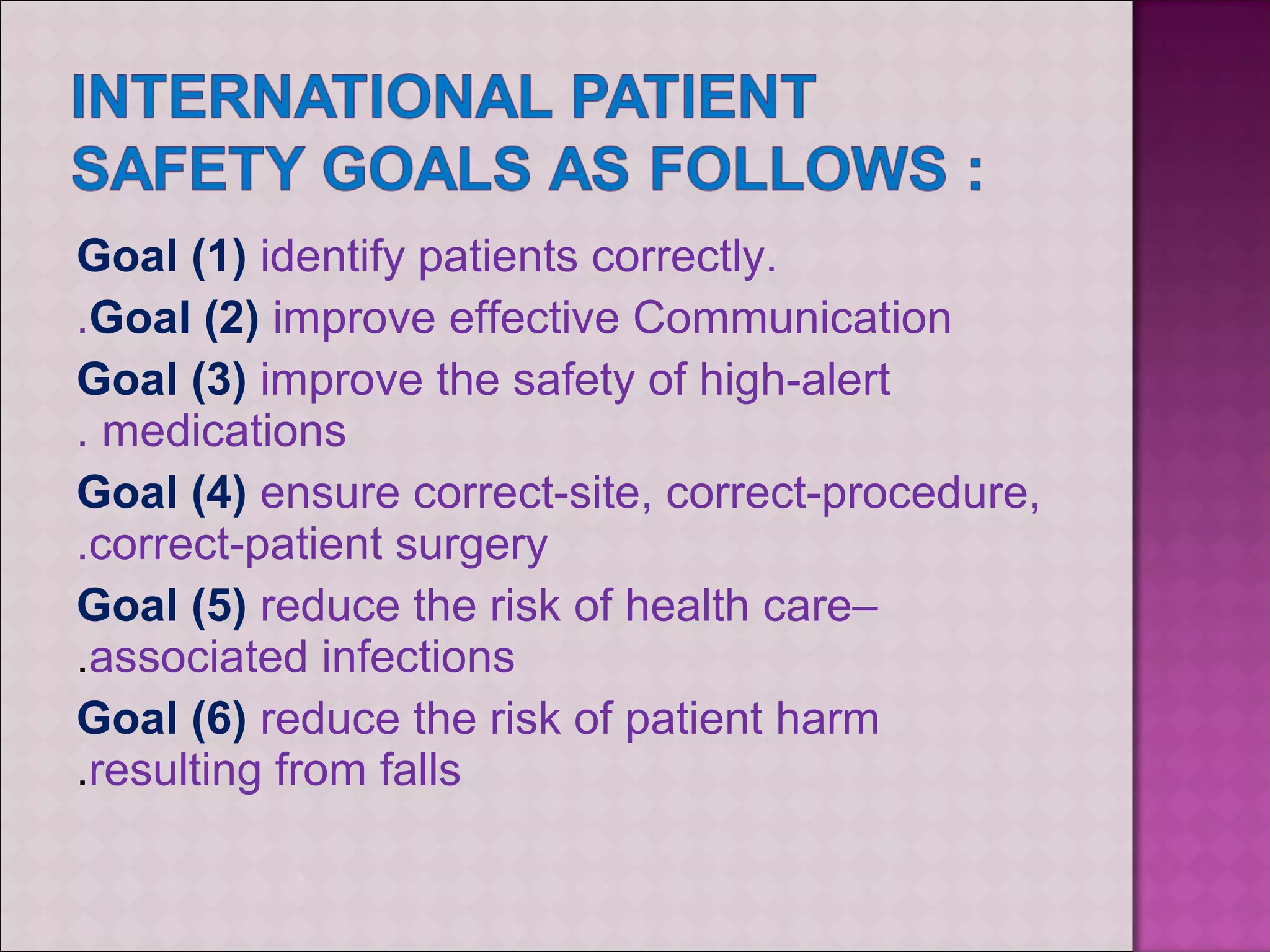
• List the 6 international goals.
• Understand leadership
focus.
• Understand Psychological
safety.
• List the library connection.
Medical errors have become a leading causes of
death, killing more people each year than AIDS or
Airplane crashes.
These medical errors can be classified into
five categories:
1-Poor communication.
2-Poor decision making.
3-Poor patient monitoring.
4-Poor patient identification.
5-Poor patient tracking.
Meeting the Joint
Commission on
accreditation of
healthcare Organization
(JCAHO) patient safety
goals is the current trend
in enhancing patient
safety.
Goal (1) identify patients correctly.
Goal (2) improve effective Communication.
Goal (3) improve the safety of high-alert
medications.
Goal (4) ensure correct-site, correct-procedure,
correct-patient surgery.
Goal (5) reduce the risk of health care–
associated infections.
Goal (6) reduce the risk of patient harm
resulting from falls.
.Freedom from accidental
injury ,ensuring the
establishment of
operational systems and
processes that minimize the
likelihood of errors so they
won’t occur:
A SAFETY CULTURE
WORKSHOP
Is an atmosphere of mutual trust in
which all staff?
Members can talk freely about
safety problems and how to
solve them ---without fear of
blame or punishment.
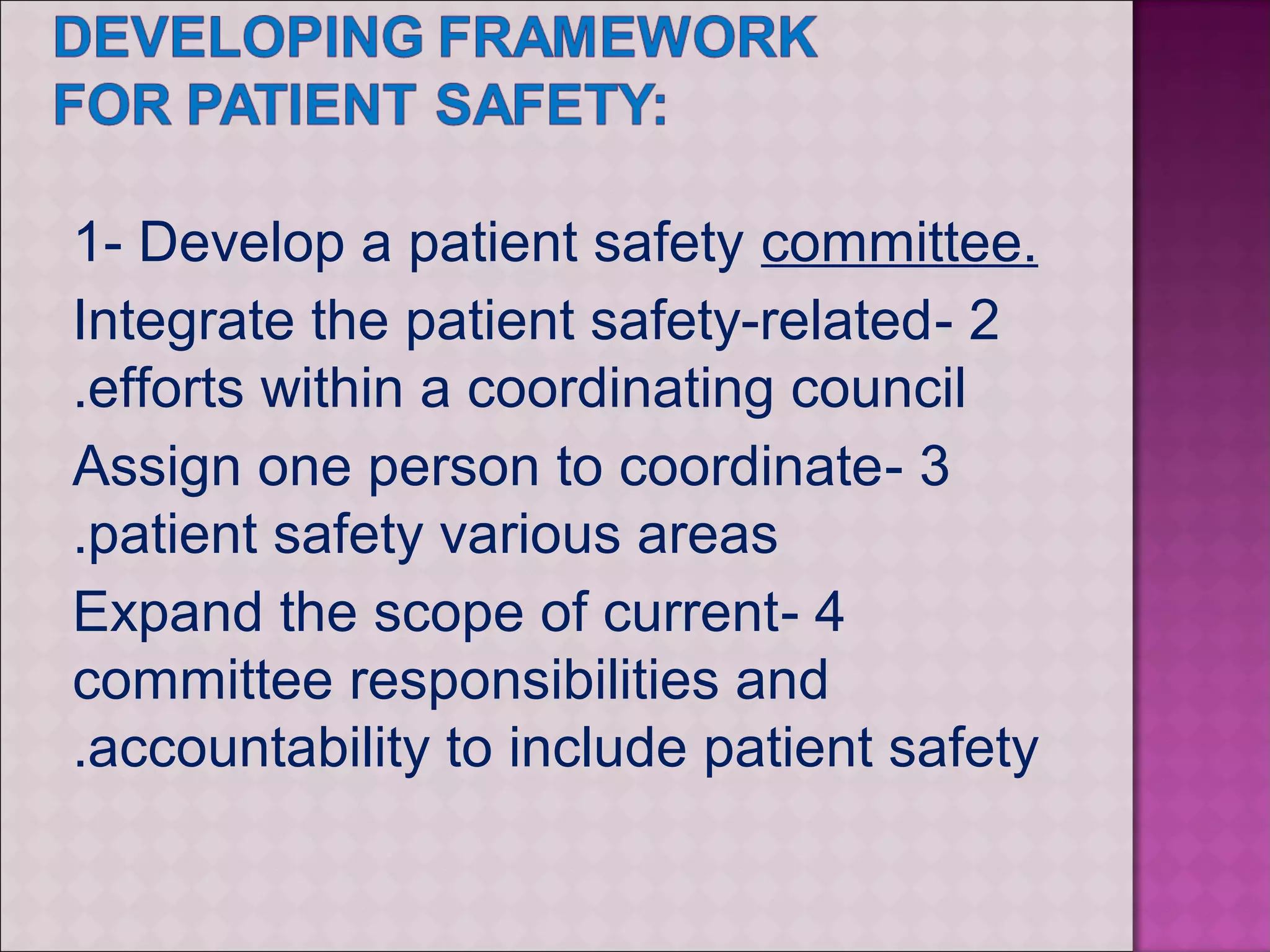
1- Develop a patient safety committee.
2-Integrate the patient safety-related
efforts within a coordinating council.
3-Assign one person to coordinate
patient safety various areas.
4-Expand the scope of current
committee responsibilities and
accountability to include patient safety.
1- Not knowing the plan.
2-Communication issues.
3-Surprises.
4-Missing information.
5-Lack of resources.
6-Failure to plan, recognize and
rescue others?
1-Support teamwork and respect others.
2-Educate staff.
3-Engage physicians.
4-Share lessons learned.
5-Encourage use of communicating.
6-Assign 1 (one) or 2 (two) clinical staff members.
7-Take a proactive approach to error.
8-Study and learn from near misses.
9-Search for information about how to do things safely.
10-Provide team training to a culture of safety.
11-Encourage patient and family involvement in the care
process.
12-Share information about safety with others.
Psychological safety is a belief that
one will not be punished or
humiliated for speaking up with
ideas, questions, concerns, or
mistakes.
A shared sense of psychological
safety is a critical input to an
effective learning system.
A patient safety committee is a
multidisciplinary team that takes
a proactive approach to patient
safety; It provides coordination
and oversight to advance an
organizations safety program
and implement safety-related
policies and procedures.
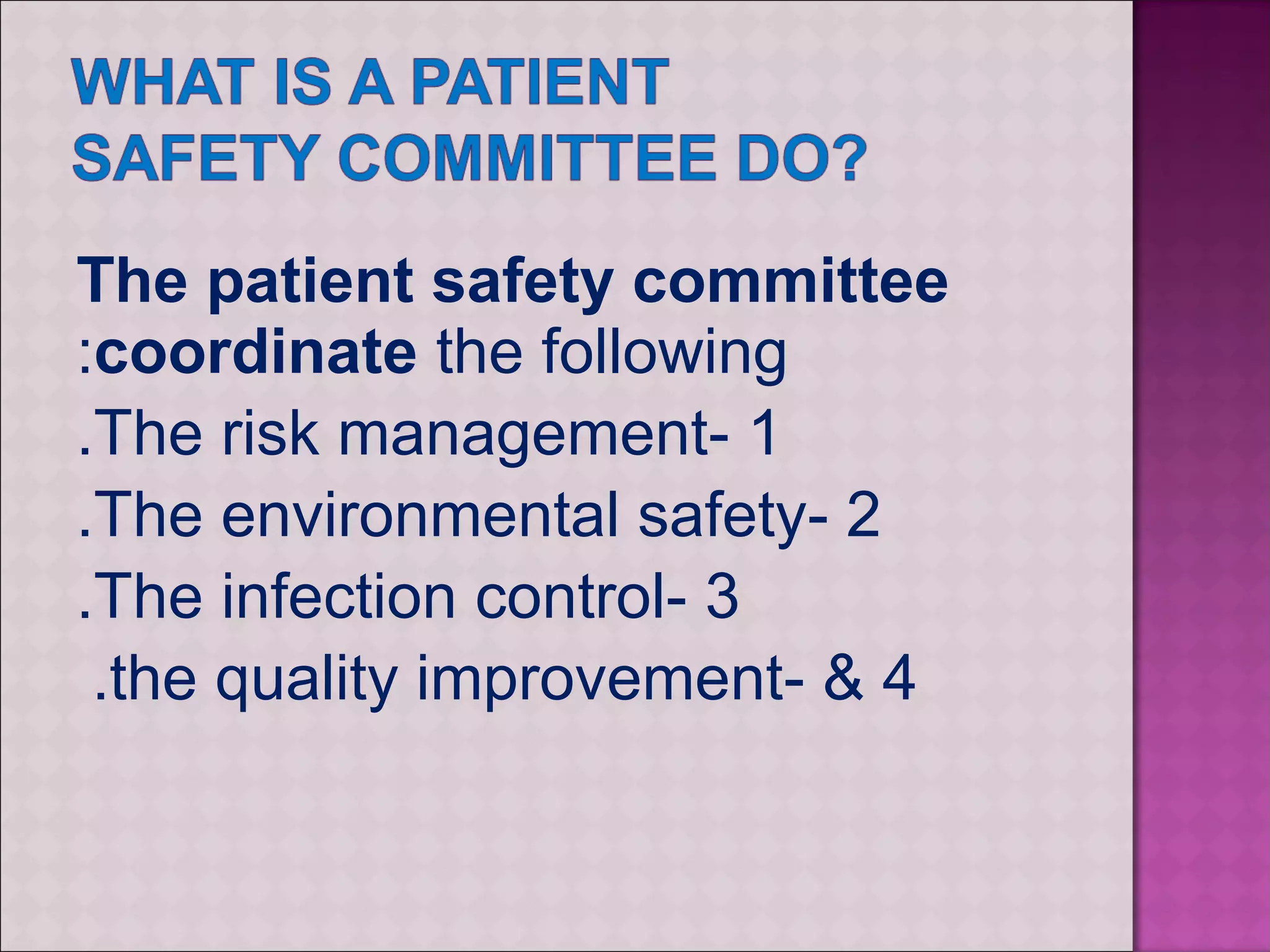
The patient safety committee
coordinate the following:
1-The risk management.
2-The environmental safety.
3-The infection control.
4- &the quality improvement.
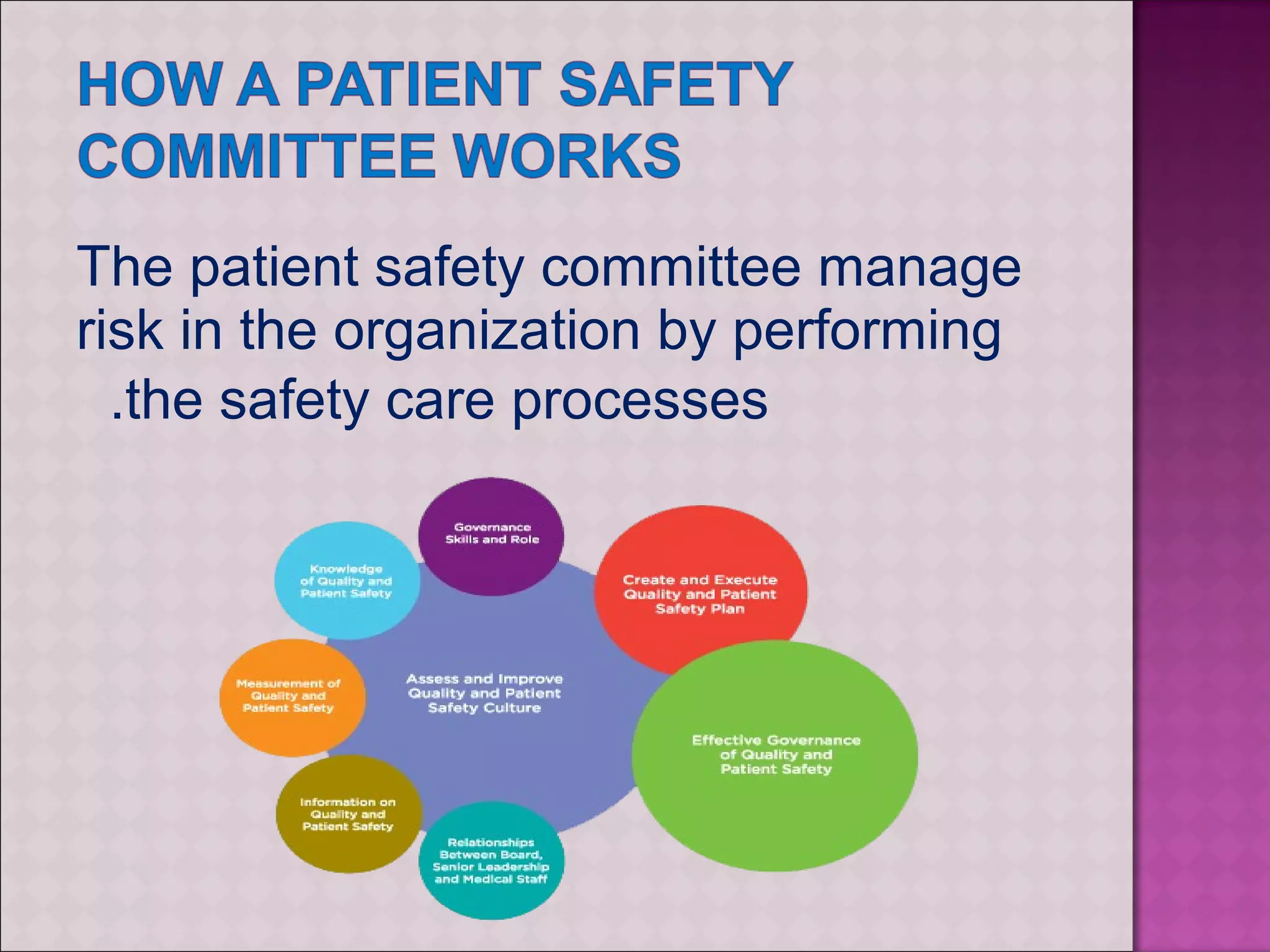
The patient safety committee manage
risk in the organization by performing
the safety care processes.
1-Should standardize the
definitions and categorize
medical errors.
2-Establish or enhance an error,
near miss reporting mechanism.
3-Identify data collection plan,
reporting structure, as well as
performing scheduling.
Patient safety plan
Standardized
&categorize
medical errors
Identify data
collection plan&
reporting
structure
Establish an error-
near miss reporting
mechanism
The leadership is to build an
environment that recognize the
importance of safety.
1-Create & maintain a culture of
safety.
2-Encourage decision making.
3-Implement patient safety program
throughout the organization.
4-Ensure that the processes are
designed well, using available
information from internal or external
sources about potential risks to
patient and successful practices
Reactive:
Investigate significant patient incidents
(sentinel events).
Proactive:
Monitor patient safety and redesign
high-risk processes to prevent a
sentinel event from occurring.
An inpatient received 2 (two) unit of the
incorrect type of blood at the time. The
patient’s blood was drawn for a type/cross
match, the sample was mislabeled with
another patient's name. The transfusion
was given to the patient whose name
appeared on the type/cross match lab
report, not the patient whose blood was in
the lab specimen vial.
Poorly designed system for
labeling laboratory specimen.
If this problem continuing
uncorrected, for sure it could
caused anther incidence that
lead to a blind end.
1- Gather the facts.
2- Choose team.
3- Determine sequence of
events.
4- Identify contributing factors.
5- Select root causes.
6-Develop corrective actions.
7- &Follow-up plan.
LIBRARY CONNECTIONS &
ADVOCACY
How is Your Library
Involved in Patient Safety
)or how will it be(?
With literature searches in Training,
Education & in the telling stories;
participation creating & sharing
information through alert services;
supporting & institutional resources
& needs. Creating & Sharing
Information for patient education on
the website information pages:
In Summary:
All library roles eventually
supporting patient’s safety.
1- Staffs are not washing their hands will.
2-Staff does not changing their gloves between
patients.
3-Staff does not wearing the appropriate PPE.
4-Given the patients wrong medication.
5-Given the wrong dialyzer.
6-Staff does not performing safe procedure.
(catheter care(
7-Staff unskilled in annulations.
8-Staff does not performing appropriate patient
assessments.
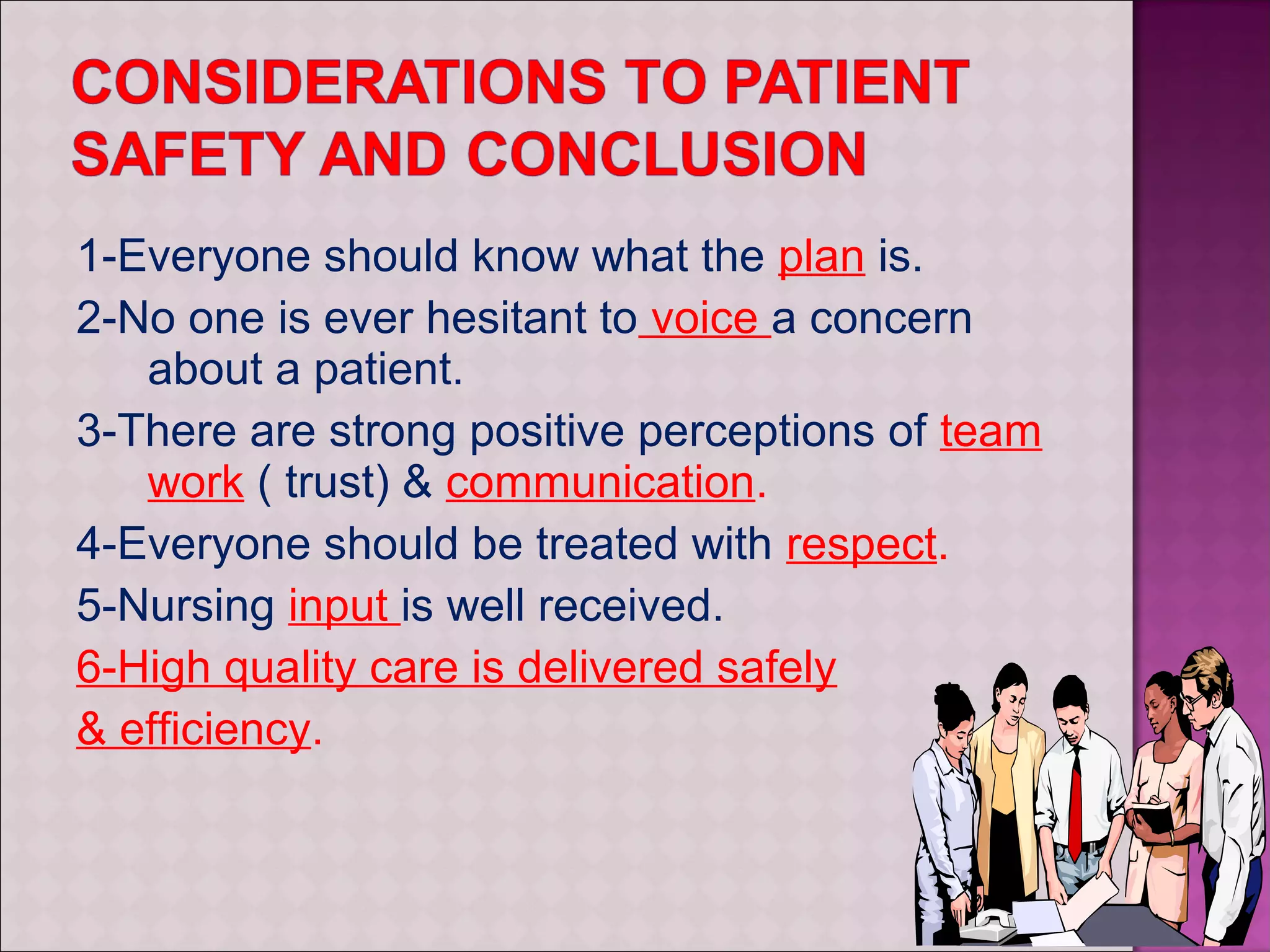
1-Everyone should know what the plan is.
2-No one is ever hesitant to voice a concern
about a patient.
3-There are strong positive perceptions of team
work ( trust( & communication.
4-Everyone should be treated with respect.
5-Nursing input is well received.
6-High quality care is delivered safely
& efficiency.
QUESTIONS
(?)
( LOVE YOU SWEETIE (SON) FARIS )

Power point patient saftey final 2010

  • 2.
    OBJECTIVES • Define patientsafety. • Understand the development of patient safety structure. • Identify culture of safety. • List the 6 international goals. • Understand leadership focus. • Understand Psychological safety. • List the library connection.
  • 3.
    Medical errors havebecome a leading causes of death, killing more people each year than AIDS or Airplane crashes. These medical errors can be classified into five categories: 1-Poor communication. 2-Poor decision making. 3-Poor patient monitoring. 4-Poor patient identification. 5-Poor patient tracking.
  • 4.
    Meeting the Joint Commissionon accreditation of healthcare Organization (JCAHO) patient safety goals is the current trend in enhancing patient safety.
  • 5.
    Goal (1) identifypatients correctly. Goal (2) improve effective Communication. Goal (3) improve the safety of high-alert medications. Goal (4) ensure correct-site, correct-procedure, correct-patient surgery. Goal (5) reduce the risk of health care– associated infections. Goal (6) reduce the risk of patient harm resulting from falls.
  • 6.
    .Freedom from accidental injury,ensuring the establishment of operational systems and processes that minimize the likelihood of errors so they won’t occur:
  • 7.
  • 8.
    Is an atmosphereof mutual trust in which all staff? Members can talk freely about safety problems and how to solve them ---without fear of blame or punishment.
  • 9.
    1- Develop apatient safety committee. 2-Integrate the patient safety-related efforts within a coordinating council. 3-Assign one person to coordinate patient safety various areas. 4-Expand the scope of current committee responsibilities and accountability to include patient safety.
  • 10.
    1- Not knowingthe plan. 2-Communication issues. 3-Surprises. 4-Missing information. 5-Lack of resources. 6-Failure to plan, recognize and rescue others?
  • 11.
    1-Support teamwork andrespect others. 2-Educate staff. 3-Engage physicians. 4-Share lessons learned. 5-Encourage use of communicating. 6-Assign 1 (one) or 2 (two) clinical staff members. 7-Take a proactive approach to error. 8-Study and learn from near misses. 9-Search for information about how to do things safely. 10-Provide team training to a culture of safety. 11-Encourage patient and family involvement in the care process. 12-Share information about safety with others.
  • 12.
    Psychological safety isa belief that one will not be punished or humiliated for speaking up with ideas, questions, concerns, or mistakes. A shared sense of psychological safety is a critical input to an effective learning system.
  • 13.
    A patient safetycommittee is a multidisciplinary team that takes a proactive approach to patient safety; It provides coordination and oversight to advance an organizations safety program and implement safety-related policies and procedures.
  • 14.
    The patient safetycommittee coordinate the following: 1-The risk management. 2-The environmental safety. 3-The infection control. 4- &the quality improvement.
  • 15.
    The patient safetycommittee manage risk in the organization by performing the safety care processes.
  • 16.
    1-Should standardize the definitionsand categorize medical errors. 2-Establish or enhance an error, near miss reporting mechanism. 3-Identify data collection plan, reporting structure, as well as performing scheduling.
  • 17.
    Patient safety plan Standardized &categorize medicalerrors Identify data collection plan& reporting structure Establish an error- near miss reporting mechanism
  • 18.
    The leadership isto build an environment that recognize the importance of safety.
  • 19.
    1-Create & maintaina culture of safety. 2-Encourage decision making. 3-Implement patient safety program throughout the organization. 4-Ensure that the processes are designed well, using available information from internal or external sources about potential risks to patient and successful practices
  • 20.
    Reactive: Investigate significant patientincidents (sentinel events). Proactive: Monitor patient safety and redesign high-risk processes to prevent a sentinel event from occurring.
  • 21.
    An inpatient received2 (two) unit of the incorrect type of blood at the time. The patient’s blood was drawn for a type/cross match, the sample was mislabeled with another patient's name. The transfusion was given to the patient whose name appeared on the type/cross match lab report, not the patient whose blood was in the lab specimen vial.
  • 22.
    Poorly designed systemfor labeling laboratory specimen. If this problem continuing uncorrected, for sure it could caused anther incidence that lead to a blind end.
  • 23.
    1- Gather thefacts. 2- Choose team. 3- Determine sequence of events. 4- Identify contributing factors. 5- Select root causes. 6-Develop corrective actions. 7- &Follow-up plan.
  • 24.
    LIBRARY CONNECTIONS & ADVOCACY Howis Your Library Involved in Patient Safety )or how will it be(?
  • 25.
    With literature searchesin Training, Education & in the telling stories; participation creating & sharing information through alert services; supporting & institutional resources & needs. Creating & Sharing Information for patient education on the website information pages:
  • 26.
    In Summary: All libraryroles eventually supporting patient’s safety.
  • 27.
    1- Staffs arenot washing their hands will. 2-Staff does not changing their gloves between patients. 3-Staff does not wearing the appropriate PPE. 4-Given the patients wrong medication. 5-Given the wrong dialyzer. 6-Staff does not performing safe procedure. (catheter care( 7-Staff unskilled in annulations. 8-Staff does not performing appropriate patient assessments.
  • 28.
    1-Everyone should knowwhat the plan is. 2-No one is ever hesitant to voice a concern about a patient. 3-There are strong positive perceptions of team work ( trust( & communication. 4-Everyone should be treated with respect. 5-Nursing input is well received. 6-High quality care is delivered safely & efficiency.
  • 31.
  • 32.
    ( LOVE YOUSWEETIE (SON) FARIS )

Editor's Notes

  • #7 Freedom from unintended health care errors / injuries due to medical management..
  • #9 without fear of blame or punishment — essential to improving patient safety in any organization
  • #10 1- that monitors all safety efforts ------initiative in various areas
  • #11 Having everyone in the same movie ----------------- not having what you need when you need it
  • #12 Regardless of their position ------------ a culture of safety should not only provide safty to patient but should also include staff, visitors, and all individuals interacting with the organization
  • #15 Depending on the safety culture, resources, and issues facing an organization
  • #16 it accomplishes this by generating and implementing a patient safety plan, overseeing initiatives, prioritizing recommendations, and deploying adequate resources.
  • #17 Reports to the governing board should include results and recommendations in a coordinated fashion.
  • #19 Organization leaders should choose relatively simple projects to ease the committee into its work; early wins help to build trust between staff and administrators and enhance the group's ability to tackle larger, more complex issues.
  • #20 Measure and assess leadership contr
  • #21 prevention Reactive = reaction assess and evaluate proactive = to
  • #26 Stat for Emergency Room Nursing Education Department Monthly Infection Control Reports Drug Use and Clinical Adverse Events Patient/Family Questions Specifics Adverse Events Research Studies
  • #29 Educate staff to recognize that a culture of safety should not only provide safety to patient but should also include staff, visitors, and all individuals interacting with the organization. Engage physicians in the effort, to ensure ongoing involvement and buy-in to the culture of safety
  • #33 THANK YOU