ISBAR
COMMUNICATION
Kathy Trezise NE
https://www.youtube.com/watch?v=3LfJj_p
nQZ8&feature=player_embedded
http://thehappyhospitalist.blogspot.com/20
10/11/xtranormal-medical-videos-
multiple.html
Learning objectives
• Understand why effective verbal and written
communication are an important part of clinical
care
• Understand what ISBAR stands for
• Understand how ISBAR can be used
• Be able to apply ISBAR
• Understand how to use a tool for communicating
patient deterioration to others
Why is effective communication
important?
• Getting the right response when calling for help
• Clear documentation such as actions taken and
targets for treatment
• Allows continuity of care
Situation
Good communication is recognised as essential to
quality and patient safety and is well evidenced
as decreasing communication related errors.
C&CDHB ISBAR Handover /
Communication Guideline
• “The purpose of this guideline is to provide a
consistent communication method using the
ISBAR tool for use in verbal exchanges between
staff for requests for assistance, patient
transfers, shift handovers and in deteriorating
patient situations. The aim is to ensure patient
safety through effective and efficient
communication.”
Background
ISBAR has been adapted from SBAR, a tool
developed by the US Navy to improve
communication.
Specific to C&CDHB, a third of complaints have
communication issues at their core and a
number of reportable events are also related to
poor handovers and communication.
Assessment
• Our assessment is that ISBAR is a supportive
and structured tool which enables all health
professionals and support staff to communicate
using a consistent method.
Recommendation/Request
• It is recommended that all clinical and support
staff at C&CDHB (who have involvement in
patient care) become familiar with ISBAR and
utilise this communication method as a tool to
assist in verbal and written communication.
Training - So what is ISBAR?
• Introduction/Identify
• Situation
• Background
• Assessment
• Request / Recommendation
ISBAR In Our Communication
• Introduction/Identify
▫ Who, what and where you are and why are you calling also is this
a good time to talk?
• Situation
▫ What is happening now. “The situation is….”
• Background
▫ What led to the situation. “By way of background…”
• Assessment
▫ What you consider the problem is. “My assessment is” or “I
assess….”
• Request/Recommend
▫ What should we do to correct the problem. “I recommend…..”
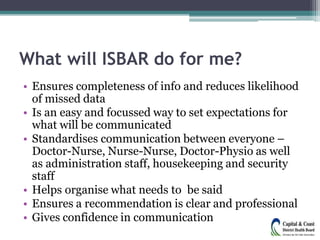
What will ISBAR do for me?
• Ensures completeness of info and reduces likelihood
of missed data
• Is an easy and focussed way to set expectations for
what will be communicated
• Standardises communication between everyone –
Doctor-Nurse, Nurse-Nurse, Doctor-Physio as well
as administration staff, housekeeping and security
staff
• Helps organise what needs to be said
• Ensures a recommendation is clear and professional
• Gives confidence in communication
The ISBAR format can be used in all
forms of communication:
Clinical Handover
Referrals
Reports (Ward etc)
Protocols, memos and emails
Personal interactions
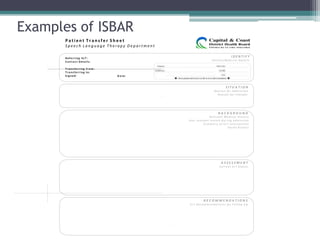
Examples of ISBAR
I D E N T I F Y
Pa tie n t/Re fe r r e r De ta ils
P a t i e n t T r a n s f e r S h e e t
S p e e c h L a n g u a g e T h e r a p y D e p a r t m e n t
S I T U A T I O N
R e a s o n for a d m i s s i o n
R e a s o n for transfer
R E C O M M E N D A T I O N S
S L T R e c o m m e n d a t i o n s for F o l l o w U p
B A C K G R O U N D
R e l e v a n t M e d i c a l H isto r y
A n y r e le va n t e v e n t s d u r i n g a d m i s s i o n
S u m m a r y o f S L T I n te r ve n tio n
Socia l H isto r y
A S S E S S M E N T
Cu r r e n t S L T Sta tu s
Referring S LT :
C o n t a c t Details:
T ra ns ferring f r o m :
T ra ns ferring to:
S ig ned: D a te:
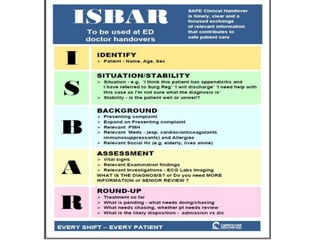
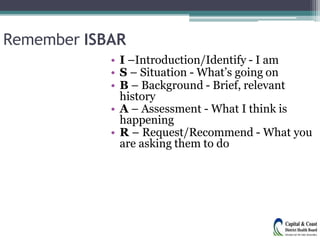
Remember ISBAR
• I –Introduction/Identify - I am
• S – Situation - What’s going on
• B – Background - Brief, relevant
history
• A – Assessment - What I think is
happening
• R – Request/Recommend - What you
are asking them to do
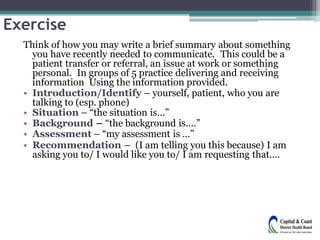
Exercise
Think of how you may write a brief summary about something
you have recently needed to communicate. This could be a
patient transfer or referral, an issue at work or something
personal. In groups of 5 practice delivering and receiving
information Using the information provided.
• Introduction/Identify – yourself, patient, who you are
talking to (esp. phone)
• Situation – “the situation is…”
• Background – “the background is….”
• Assessment – “my assessment is …”
• Recommendation – (I am telling you this because) I am
asking you to/ I would like you to/ I am requesting that….

ISBAR Presentation (1) (1).pptx

  • 1.
  • 2.
  • 3.
  • 4.
    Learning objectives • Understandwhy effective verbal and written communication are an important part of clinical care • Understand what ISBAR stands for • Understand how ISBAR can be used • Be able to apply ISBAR • Understand how to use a tool for communicating patient deterioration to others
  • 5.
    Why is effectivecommunication important? • Getting the right response when calling for help • Clear documentation such as actions taken and targets for treatment • Allows continuity of care
  • 6.
    Situation Good communication isrecognised as essential to quality and patient safety and is well evidenced as decreasing communication related errors.
  • 7.
    C&CDHB ISBAR Handover/ Communication Guideline • “The purpose of this guideline is to provide a consistent communication method using the ISBAR tool for use in verbal exchanges between staff for requests for assistance, patient transfers, shift handovers and in deteriorating patient situations. The aim is to ensure patient safety through effective and efficient communication.”
  • 8.
    Background ISBAR has beenadapted from SBAR, a tool developed by the US Navy to improve communication. Specific to C&CDHB, a third of complaints have communication issues at their core and a number of reportable events are also related to poor handovers and communication.
  • 9.
    Assessment • Our assessmentis that ISBAR is a supportive and structured tool which enables all health professionals and support staff to communicate using a consistent method.
  • 10.
    Recommendation/Request • It isrecommended that all clinical and support staff at C&CDHB (who have involvement in patient care) become familiar with ISBAR and utilise this communication method as a tool to assist in verbal and written communication.
  • 11.
    Training - Sowhat is ISBAR? • Introduction/Identify • Situation • Background • Assessment • Request / Recommendation
  • 12.
    ISBAR In OurCommunication • Introduction/Identify ▫ Who, what and where you are and why are you calling also is this a good time to talk? • Situation ▫ What is happening now. “The situation is….” • Background ▫ What led to the situation. “By way of background…” • Assessment ▫ What you consider the problem is. “My assessment is” or “I assess….” • Request/Recommend ▫ What should we do to correct the problem. “I recommend…..”
  • 15.
    What will ISBARdo for me? • Ensures completeness of info and reduces likelihood of missed data • Is an easy and focussed way to set expectations for what will be communicated • Standardises communication between everyone – Doctor-Nurse, Nurse-Nurse, Doctor-Physio as well as administration staff, housekeeping and security staff • Helps organise what needs to be said • Ensures a recommendation is clear and professional • Gives confidence in communication
  • 16.
    The ISBAR formatcan be used in all forms of communication: Clinical Handover Referrals Reports (Ward etc) Protocols, memos and emails Personal interactions
  • 17.
    Examples of ISBAR ID E N T I F Y Pa tie n t/Re fe r r e r De ta ils P a t i e n t T r a n s f e r S h e e t S p e e c h L a n g u a g e T h e r a p y D e p a r t m e n t S I T U A T I O N R e a s o n for a d m i s s i o n R e a s o n for transfer R E C O M M E N D A T I O N S S L T R e c o m m e n d a t i o n s for F o l l o w U p B A C K G R O U N D R e l e v a n t M e d i c a l H isto r y A n y r e le va n t e v e n t s d u r i n g a d m i s s i o n S u m m a r y o f S L T I n te r ve n tio n Socia l H isto r y A S S E S S M E N T Cu r r e n t S L T Sta tu s Referring S LT : C o n t a c t Details: T ra ns ferring f r o m : T ra ns ferring to: S ig ned: D a te:
  • 19.
    Remember ISBAR • I–Introduction/Identify - I am • S – Situation - What’s going on • B – Background - Brief, relevant history • A – Assessment - What I think is happening • R – Request/Recommend - What you are asking them to do
  • 20.
    Exercise Think of howyou may write a brief summary about something you have recently needed to communicate. This could be a patient transfer or referral, an issue at work or something personal. In groups of 5 practice delivering and receiving information Using the information provided. • Introduction/Identify – yourself, patient, who you are talking to (esp. phone) • Situation – “the situation is…” • Background – “the background is….” • Assessment – “my assessment is …” • Recommendation – (I am telling you this because) I am asking you to/ I would like you to/ I am requesting that….