BALANCED DIET
BALANCED DIET
A balanced diet is the one which contains various groups of
food stuffs such as energy yielding, body building and
protective foods in the correct proportion and also make
provision for extra nutrients to withstand short duration of
leanness.
BUDGETING OF FOOD
Balanced Diet at High Cost
Balanced diet with high cost can include liberal amounts of
costly foods such as mile, fish, fruits, meat, egg and moderate
amounts of cereals and pulses.
Balanced Diet with Moderate Cost
Balanced diet with moderate cost includes moderate amounts of
cereals, pulses, nuts and green leafy vegetables.
Balanced Diet with Low Cost
Balanced diets of low cost will include large amounts of cereals,
pulses and vegetables but small amounts of milk, eggs, fish and
meat.
Goals of balanced diet
● The requirements of protein should be met which amounts
to 15-20% of daily energy needs.
● Fat should be limited to 20-30% daily energy needs.
● Carbohydrates rich in natural fibre stored constitute the
remaining food energy
How to buy money friendly food?
● Buying the staple food, dals and pulses in bulk, when the prices
are competitive just after the harvest.
● Buying milk and milk products from government daily outlets.
● Buying fruits and vegetables from main markets at competitive
rates.
● Buying seasonal vegetables and fruits.
● Buy sugar, jaggery in bulk from wholesale dealers.
● Buy oils from whole sale depots in bulk.
● Make butter and ghee at home.
● Buy spices in bulk and prepare the spices mix at home
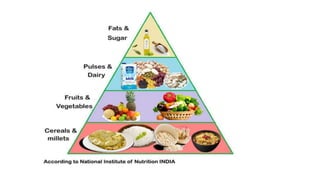
FOOD GROUPS
Foods are classified into different groups based on their nutritive
value. These groups are:
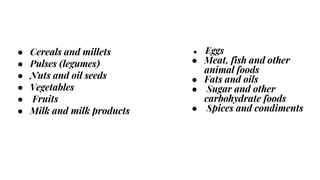
● Cereals and millets
● Pulses (legumes)
● Nuts and oil seeds
● Vegetables
● Fruits
● Milk and milk products
● Eggs
● Meat, fish and other
animal foods
● Fats and oils
● Sugar and other
carbohydrate foods
● Spices and condiments
NUTRITIVE VALUE OF
FOODS
Cereals and Millets
● Cereals contain 6-12% of protein and vitamin thiamine, niacin,
pantothenic acid and vitamin B6.
● They also contain minerals like phosphorus and iron.
● Cereals are poor in calcium except ragi which is a rich source
of calcium (poor mans milk).
● cereals are deficient in vitamin A, D, B12 and C
Pulses (Legumes)
● Pulses are rich in proteins (20-24%)
● They are also good sources of Vitamin B and minerals but
deficient in Vitamin A, D, B12 and C.
● They are palatable and tasty.
● Pulses contain anti-digestive factor trypsin inhibitor which gets
destroyed during cooking.
● Germination of pulses increases their vitamin content.
● Combination of cereals and pulses provide enough protein of
high biological value.
Nuts and Oil Seeds
● Nuts and oil seeds are also rich sources of proteins (20-40%)
some are rich in calcium e.g., Sesame seeds.
● Richest in protein is soyabean.
● They are also good sources of fats, B complex vitamins, Vitamin
E and minerals like phosphorus and iron.
● They are ideal foods for supplying high calories in a palatable
form and are used in milk substitutes for infants.
Vegetables
● Vegetables include green leafy vegetables, roots and tubers and
other vegetables.
● Green leafy vegetables are rich in carotene (provitamin A),
riboflavin, folic acid, vitamin C and calcium. Because of their
cellulose content (cellulose is not digested in man) they form the
bulk of faecal matter and avoid constipation.
● Roots and tubers like potatoes, sweet potato, tapioca and carrots
are good sources of carbohydrates and poor sources proteins.
They can act as partial substitutes for cereals. Excess
consumption may cause protein calorie malnutrition.
● Yellow pumpkin is a rich source of carotene.
Fruits
● Many fruits like amla (Indian gooseberry) guava and citrous
fruits are rich in vitamin C.
● Apple, grapes and banana are poor sources of Vitamin C.
● Banana is rich in potassium and is the cheapest and most
extensively used fruit in India.
● Mango and papaya are good sources of carotene
Milk and Milk Products
● Milk is rich in protein, carbohydrates, fat, vitamin and
minerals like calcium.
● It is deficient only in iron and vitamin C and D.
● Milk proteins are first class proteins containing all the
essential amino acids and therefore have high biological value.
● Milk is used as a complete food for infants and as supplement
in the diets of children and adults.
Eggs
● Eggs of hen or duck contain protein of high biological
value(13%).
● It is a rich source of vitamin A and B complex vitamins and a
fair source of vitamin D but does not contain vitamin C.
● Egg yolk contains saturated fatty acids which increase
cholesterol level
● Eggs are digested and digested completely and therefore form
ideal nutritive food for acutely ill and convalescent patients
and in the diseases of the colon
Meat, Fish and other Animal Food
● Meat is rich in protein which contains all essential amino acids
and high biological value.
● It does not contain Vitamin A, D or C but is a fair source of
vitamin B.
● High meat diet is indicated in protein malnutrition, anaemias and
nephrosis.
● Liver is rich in protein (18-20%) Vitamin A and B complex
especially B12.
● Fish contains 18-20% of protein of high biological value.
● It is fair source of vitamin B.
● Fat fishes are rich in vitamin A and D.
● Large fishes are rich in phosphorus and small fishes in calcium
Fats and Oils
● Butter, ghee and vanaspati are good sources of vitamin A
● Common vegetable oils do not contain vitamin A.
● Many fats and oils are good sources of vitamin E.
● They are used for taste, as sources of energy and for providing
the required quantity of essential fatty acids.
Sugar and other Carbohydrates
● Cane sugar, jaggery, glucose, honey and custard powder
are used as a source of energy.
● Honey and jaggery also contain small quantities of
vitamins.
Condiments and Spices
● The essential oils present in them improve flavour and
enhances the taste of food.
● They stimulate appetite.
● They irritate the intestine and help excretion of bowels in
constipated persons.
FUNCTIONAL
CLASSIFICATIO
N OF FOOD
Functionally foods are divided into:
1. Energy yielding foods
2. Body building foods
3. Protective foods
NUTRITIONAL
ASSESSMENT
The aim of nutritional assessment of a community is to know
the magnitude and geographic distribution of malnutrition as
a public problem, to analyse the factors responsible for it and
to effectively plan to control and eradicate them to maintain
good nutrition.
The methods employed include:
1. Clinical examination
2. Anthropometric examination
3. Laboratory and biochemical examination
4. Dietary examination
5. The study of vital statistics
6. Assessment of ecological factors.
HOSPITAL DIET
Hospital diets suitable for feeding are:
a. Clear fluid diets
b. Full fluid diets
c. Soft diets
CLEAR FLUID DIETS
● Clear fluids are prescribed for patients with marked
intolerance.
● Clear fluid diets are meant to provide very few calories and
make up the water loss in the body. Clear fluid diets include:
a. Tender coconut water
b. Clear fruit juices
c. Glucose water
d. Albumin water
e. Clear vegetable or meat soup
f. Whey water
FULL FLUID DIET
● This diet bridges the gap between clear fluid and soft diet.
● These consist of inclusion of eggs, milk, cereal, porridges, conjees
or gruels, vegetable, chicken or mutton soup, fruit milk shakes
etc.
● This diet will meet the minimum requirement of all protein
calories, vitamins and minerals.
SOFT DIET
● This bridges the gap between acute illness and
convalescence.
● It is used in acute infection following surgery and for
patients unable to chew.
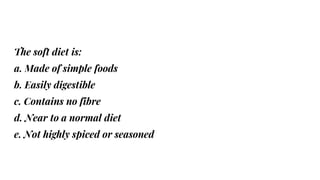
The soft diet is:
a. Made of simple foods
b. Easily digestible
c. Contains no fibre
d. Near to a normal diet
e. Not highly spiced or seasoned
NUTRITION IN
PREGNANCY
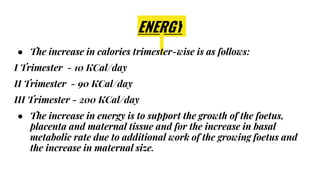
ENERGY
● The increase in calories trimester-wise is as follows:
I Trimester - 10 KCal/day
II Trimester - 90 KCal/day
III Trimester - 200 KCal/day
● The increase in energy is to support the growth of the foetus,
placenta and maternal tissue and for the increase in basal
metabolic rate due to additional work of the growing foetus and
the increase in maternal size.
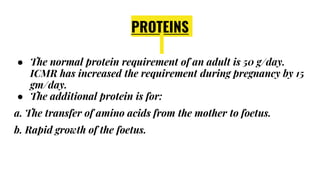
PROTEINS
● The normal protein requirement of an adult is 50 g/day.
ICMR has increased the requirement during pregnancy by 15
gm/day.
● The additional protein is for:
a. The transfer of amino acids from the mother to foetus.
b. Rapid growth of the foetus.
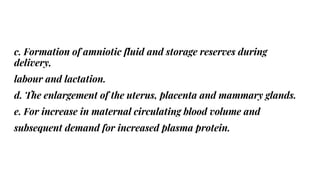
c. Formation of amniotic fluid and storage reserves during
delivery,
labour and lactation.
d. The enlargement of the uterus, placenta and mammary glands.
e. For increase in maternal circulating blood volume and
subsequent demand for increased plasma protein.
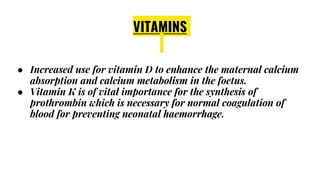
VITAMINS
● Increased use for vitamin D to enhance the maternal calcium
absorption and calcium metabolism in the foetus.
● Vitamin K is of vital importance for the synthesis of
prothrombin which is necessary for normal coagulation of
blood for preventing neonatal haemorrhage.
● The water soluble vitamins B complex and vitamin C must
be supplied in adequate amounts.
● There is an increased requirement of folic acid for
promoting foetal growth and to prevent macrocytic
anaemia during pregnancy.
● Deficiency of iron puts additional stress on folate
metabolism.
MINERALS
● An increased intake of calcium by mother is very essential not
only for the calcification of foetal bones but also protection of
calcium reserves of the mother to meet the large demands during
lactation.
● Use of vitamin D and calcium supplements reduce muscular
cramps during pregnancy.
IRON
a). Iron is necessary for the growth of foetus and placenta.
b). It is necessary for the promotion of haemoglobin as there is
40- 50% increase in the maternal blood volume.
c). To replace the maternal iron losses.
d). To achieve high levels of haemoglobin in the infants which is
stored in the liver for 3-6 months. Iron must be transfused to
uterus of the mother during gestation.
FATS
Fats must be provided according to the normal
requirements
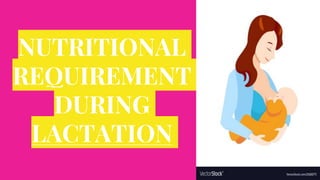
NUTRITIONAL
REQUIREMENT
DURING
LACTATION
CALORIES
● Mother requires total amount of about 13000 Kcal during
lactation period of 6 months.
● Mother needs additional 700-750 Kcal daily to convert food
energy into milk.
PROTEIN
● Daily milk produced is about 850-1000 ml during lactation.
● Human milk contains about 1% protein and thus there is daily
excretion of 8-10 gm of protein.
● Therefore, lactating woman should take about 20-25 gm of extra
protein daily
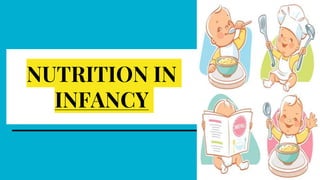
NUTRITION IN
INFANCY
ENERGY
● The energy requirements of infants are much higher.
● Infants require 120 Kcal/kg body weight.
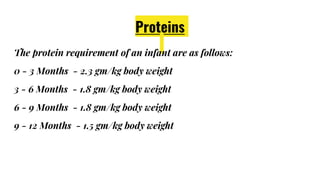
Proteins
The protein requirement of an infant are as follows:
0 - 3 Months - 2.3 gm/kg body weight
3 - 6 Months - 1.8 gm/kg body weight
6 - 9 Months - 1.8 gm/kg body weight
9 - 12 Months - 1.5 gm/kg body weight
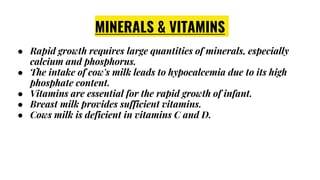
MINERALS & VITAMINS
● Rapid growth requires large quantities of minerals, especially
calcium and phosphorus.
● The intake of cow's milk leads to hypocalcemia due to its high
phosphate content.
● Vitamins are essential for the rapid growth of infant.
● Breast milk provides sufficient vitamins.
● Cows milk is deficient in vitamins C and D.
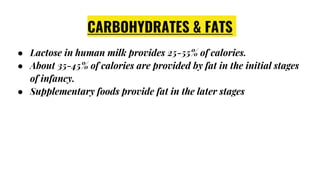
CARBOHYDRATES & FATS
● Lactose in human milk provides 25-55% of calories.
● About 35-45% of calories are provided by fat in the initial stages
of infancy.
● Supplementary foods provide fat in the later stages
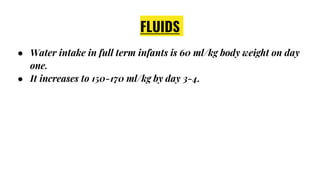
FLUIDS
● Water intake in full term infants is 60 ml/kg body weight on day
one.
● It increases to 150-170 ml/kg by day 3-4.
BREAST FEEDING
● Infants start feeding by first few hours of birth.
● Early feeding helps to maintain normal metabolism and growth,
promotes maternal infant bonding and decreases risk of
hypoglycaemia, hyperkalaemia, dehydration, fever and
hyperbilirubinemia.
Advantages of Breastfeeding
1. Infant derives the sense of security and belongingness by the
comfort of being held in the arms during the process of breastfeeding.
There is an unbreakable bond created between the two.
2. It is economical to breastfeed the infant as it is naturally available
food which is clean and hygienic.
3. Breastfeeding helps in birth control. The hormone prolactin
which stimulates milk production also decreases the
synthesis of various hormones. It is a cost effective method of
contraception. By breastfeeding the uterus comes back to
normal size and would stop bleeding by the secretion of
oxytocin. It also helps to reduce weight in mothers.
4. Risk of breast cancer is higher in women who have not
breastfed their babies.
5. There is proper development of jaws and teeth and they are
not crowded as the infant must suckle hard to extract milk.
6. Reduced likelihood of child being allergic to milk as human
milk proteins do not cause allergies.
7. There is less danger of the feed being contaminated which
could lead to gastrointestinal problems. Mortality rates are
lower among breastfed infants.
8. Human milk contains bacterial and viral antibodies
including high concentration of secretory IgA which provide
local gastrointestinal immunity.
9. It is available at correct temperature and needs no time for
preparation.
10. It is convenient to feed the baby when it is in the mother's arms.
11. It protects the babies from obesity.
12. There is rapid maturation of the gastrointestinal tract due to
the presence of growth factors and certain hormones.
13. The fats and proteins present are more easily digestible and
there is less chance of child developing gastric and intestinal
distress.
14. Milk has other anti-infective proteins due to the presence of
microphages, complement, lysozyme and lactoferrin. All these
provide protection against diarrhoea and respiratory infections.
15. The breast milk also provides many biochemical advantages
like prevention of neonatal hypoglycaemia.
Conditions When Mothers are Advised not to Breastfeed
● Septicaemia
● Nephritis
● Active tuberculosis
● Typhoid fever
● Malaria
● Renal failure
● Grade IV cardiac failure
● Severe neurosis
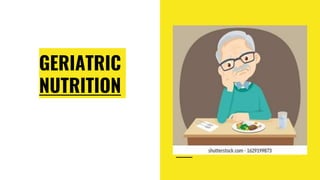
GERIATRIC
NUTRITION
NATUROPATHIC MEDICINE
● Naturopathy is a system of healing science stimulating the
body’s inherent power to regain health with the help of five
great elements of nature — Earth, Water, Air, Fire and Ether.
● Naturopathy is a call to “Return to Nature” and to resort to
simple way of living in harmony with the self, society and
environment.
The whole practice of Nature cure is based on the following
three principles:
• Accumulation of morbid matter
• Abnormal composition of blood and lymph
• Lowered vitality
PRINCIPLES OF NATUROPATHY
1 . All diseases, their cause and their treatment are one.
2 . The basic cause of disease is not bacteria. Bacteria develops
after the accumulation of morbid matter when a favourable
atmosphere for their growth develops in body. Basic cause is
morbid matter and not the bacteria.
3 . Acute diseases are our friends and not enemies. Chronic diseases
are the outcome of wrong treatment and suppression of the acute
diseases.
4 . Nature is the greatest healer. Body has the capacity to prevent
itself from diseases and regain health if unhealthy.
5. In Naturopathy, patient is treated and not the disease.
6. In Naturopathy, diagnosis is easily possible. Ostentation is not
required. Long waiting for diagnosis is not required for treatment.
7 . Patients suffering from chronic ailments are also treated
successfully in comparatively less time in Naturopathy.
8. After emerging suppressed diseases can be cured by
Naturopathy.
9. Nature Cure treats physical, mental, social (moral) and
spiritual. All four aspects at the same time.
10. Nature Cure treats body as a whole instead of giving
treatment to each organ separately.
11. Naturopathy does not use medicines. According to
Naturopathy ‘Food is Medicine.
12 . According to GandhiJi ‘Rama Nama is the best Natural
Treatment”, means doing prayer according to one's spiritual
faith is an important part of treatment.
The Methods Applied for Cure in Naturopathy
1 . Water therapy: Water is the most ancient of all the remedial
agents. It is employed in different forms in treatment and
produces several types of physiological effects depending
upon temperature and duration. Hydrotherapy is employed
in almost all types of disease conditions.
2. Air therapy: Fresh air is essential for good health. Air
therapy is employed in different pressures and temperatures
in variety of disease conditions.
3. Fire therapy: Existence of all the creatures and forms
depends upon “Agni” (Fire). In Nature Cure Treatment,
different temperatures are employed through different
heating techniques to produce different specific effects.
4. Space therapy: Congestion causes disease. Fasting is the best
therapy to relieve congestion of body and mind.
5. Mud therapy: Mud absorbs, dissolves and eliminates the
toxins and rejuvenates the body. It is employed in treatment
of various diseases like constipation, skin diseases etc.
6. Food therapy: Most of the disease are amenable to food
therapy. As you eat so will you be physically as well as
mentally. Your food is your medicine. These are the main
slogans of Nature Cure.
7. Massage therapy: Massage is generally employed for tonic,
stimulant and sedative effects. It is an effective substitute for
exercise.
8. Acupressure: There are different points on hands, feet and
body which are associated with different organs. By
applying pressure on these selected points, related organs
can be influenced for getting rid of their ailments.
9. Magnetotherapy: Magnets influence health. South and
North poles of different powers and shapes are employed in
treatment. By applying directly on different parts of the
body or through charged up water or oil
10. Chronotherapy: Sun rays have seven colours—violet,
indigo, blue, green, yellow, orange and red. These colours
are employed through irradiation of body or by
administering charged water, oil and pills for treatment.
Balanced diet.pptx

Balanced diet.pptx

  • 1.
  • 2.
    BALANCED DIET A balanceddiet is the one which contains various groups of food stuffs such as energy yielding, body building and protective foods in the correct proportion and also make provision for extra nutrients to withstand short duration of leanness.
  • 3.
  • 4.
    Balanced Diet atHigh Cost Balanced diet with high cost can include liberal amounts of costly foods such as mile, fish, fruits, meat, egg and moderate amounts of cereals and pulses. Balanced Diet with Moderate Cost Balanced diet with moderate cost includes moderate amounts of cereals, pulses, nuts and green leafy vegetables. Balanced Diet with Low Cost Balanced diets of low cost will include large amounts of cereals, pulses and vegetables but small amounts of milk, eggs, fish and meat.
  • 5.
    Goals of balanceddiet ● The requirements of protein should be met which amounts to 15-20% of daily energy needs. ● Fat should be limited to 20-30% daily energy needs. ● Carbohydrates rich in natural fibre stored constitute the remaining food energy
  • 6.
    How to buymoney friendly food? ● Buying the staple food, dals and pulses in bulk, when the prices are competitive just after the harvest. ● Buying milk and milk products from government daily outlets. ● Buying fruits and vegetables from main markets at competitive rates. ● Buying seasonal vegetables and fruits. ● Buy sugar, jaggery in bulk from wholesale dealers. ● Buy oils from whole sale depots in bulk. ● Make butter and ghee at home. ● Buy spices in bulk and prepare the spices mix at home
  • 7.
    FOOD GROUPS Foods areclassified into different groups based on their nutritive value. These groups are:
  • 8.
    ● Cereals andmillets ● Pulses (legumes) ● Nuts and oil seeds ● Vegetables ● Fruits ● Milk and milk products ● Eggs ● Meat, fish and other animal foods ● Fats and oils ● Sugar and other carbohydrate foods ● Spices and condiments
  • 10.
  • 11.
    Cereals and Millets ●Cereals contain 6-12% of protein and vitamin thiamine, niacin, pantothenic acid and vitamin B6. ● They also contain minerals like phosphorus and iron. ● Cereals are poor in calcium except ragi which is a rich source of calcium (poor mans milk). ● cereals are deficient in vitamin A, D, B12 and C
  • 12.
    Pulses (Legumes) ● Pulsesare rich in proteins (20-24%) ● They are also good sources of Vitamin B and minerals but deficient in Vitamin A, D, B12 and C. ● They are palatable and tasty. ● Pulses contain anti-digestive factor trypsin inhibitor which gets destroyed during cooking. ● Germination of pulses increases their vitamin content. ● Combination of cereals and pulses provide enough protein of high biological value.
  • 13.
    Nuts and OilSeeds ● Nuts and oil seeds are also rich sources of proteins (20-40%) some are rich in calcium e.g., Sesame seeds. ● Richest in protein is soyabean. ● They are also good sources of fats, B complex vitamins, Vitamin E and minerals like phosphorus and iron. ● They are ideal foods for supplying high calories in a palatable form and are used in milk substitutes for infants.
  • 14.
    Vegetables ● Vegetables includegreen leafy vegetables, roots and tubers and other vegetables. ● Green leafy vegetables are rich in carotene (provitamin A), riboflavin, folic acid, vitamin C and calcium. Because of their cellulose content (cellulose is not digested in man) they form the bulk of faecal matter and avoid constipation. ● Roots and tubers like potatoes, sweet potato, tapioca and carrots are good sources of carbohydrates and poor sources proteins. They can act as partial substitutes for cereals. Excess consumption may cause protein calorie malnutrition. ● Yellow pumpkin is a rich source of carotene.
  • 15.
    Fruits ● Many fruitslike amla (Indian gooseberry) guava and citrous fruits are rich in vitamin C. ● Apple, grapes and banana are poor sources of Vitamin C. ● Banana is rich in potassium and is the cheapest and most extensively used fruit in India. ● Mango and papaya are good sources of carotene
  • 16.
    Milk and MilkProducts ● Milk is rich in protein, carbohydrates, fat, vitamin and minerals like calcium. ● It is deficient only in iron and vitamin C and D. ● Milk proteins are first class proteins containing all the essential amino acids and therefore have high biological value. ● Milk is used as a complete food for infants and as supplement in the diets of children and adults.
  • 17.
    Eggs ● Eggs ofhen or duck contain protein of high biological value(13%). ● It is a rich source of vitamin A and B complex vitamins and a fair source of vitamin D but does not contain vitamin C. ● Egg yolk contains saturated fatty acids which increase cholesterol level ● Eggs are digested and digested completely and therefore form ideal nutritive food for acutely ill and convalescent patients and in the diseases of the colon
  • 18.
    Meat, Fish andother Animal Food ● Meat is rich in protein which contains all essential amino acids and high biological value. ● It does not contain Vitamin A, D or C but is a fair source of vitamin B. ● High meat diet is indicated in protein malnutrition, anaemias and nephrosis. ● Liver is rich in protein (18-20%) Vitamin A and B complex especially B12. ● Fish contains 18-20% of protein of high biological value. ● It is fair source of vitamin B. ● Fat fishes are rich in vitamin A and D. ● Large fishes are rich in phosphorus and small fishes in calcium
  • 19.
    Fats and Oils ●Butter, ghee and vanaspati are good sources of vitamin A ● Common vegetable oils do not contain vitamin A. ● Many fats and oils are good sources of vitamin E. ● They are used for taste, as sources of energy and for providing the required quantity of essential fatty acids.
  • 20.
    Sugar and otherCarbohydrates ● Cane sugar, jaggery, glucose, honey and custard powder are used as a source of energy. ● Honey and jaggery also contain small quantities of vitamins.
  • 21.
    Condiments and Spices ●The essential oils present in them improve flavour and enhances the taste of food. ● They stimulate appetite. ● They irritate the intestine and help excretion of bowels in constipated persons.
  • 22.
  • 23.
    Functionally foods aredivided into: 1. Energy yielding foods 2. Body building foods 3. Protective foods
  • 24.
  • 25.
    The aim ofnutritional assessment of a community is to know the magnitude and geographic distribution of malnutrition as a public problem, to analyse the factors responsible for it and to effectively plan to control and eradicate them to maintain good nutrition.
  • 26.
    The methods employedinclude: 1. Clinical examination 2. Anthropometric examination 3. Laboratory and biochemical examination 4. Dietary examination 5. The study of vital statistics 6. Assessment of ecological factors.
  • 27.
  • 28.
    Hospital diets suitablefor feeding are: a. Clear fluid diets b. Full fluid diets c. Soft diets
  • 29.
    CLEAR FLUID DIETS ●Clear fluids are prescribed for patients with marked intolerance. ● Clear fluid diets are meant to provide very few calories and make up the water loss in the body. Clear fluid diets include: a. Tender coconut water b. Clear fruit juices c. Glucose water d. Albumin water e. Clear vegetable or meat soup f. Whey water
  • 30.
    FULL FLUID DIET ●This diet bridges the gap between clear fluid and soft diet. ● These consist of inclusion of eggs, milk, cereal, porridges, conjees or gruels, vegetable, chicken or mutton soup, fruit milk shakes etc. ● This diet will meet the minimum requirement of all protein calories, vitamins and minerals.
  • 31.
    SOFT DIET ● Thisbridges the gap between acute illness and convalescence. ● It is used in acute infection following surgery and for patients unable to chew.
  • 32.
    The soft dietis: a. Made of simple foods b. Easily digestible c. Contains no fibre d. Near to a normal diet e. Not highly spiced or seasoned
  • 33.
  • 34.
    ENERGY ● The increasein calories trimester-wise is as follows: I Trimester - 10 KCal/day II Trimester - 90 KCal/day III Trimester - 200 KCal/day ● The increase in energy is to support the growth of the foetus, placenta and maternal tissue and for the increase in basal metabolic rate due to additional work of the growing foetus and the increase in maternal size.
  • 35.
    PROTEINS ● The normalprotein requirement of an adult is 50 g/day. ICMR has increased the requirement during pregnancy by 15 gm/day. ● The additional protein is for: a. The transfer of amino acids from the mother to foetus. b. Rapid growth of the foetus.
  • 36.
    c. Formation ofamniotic fluid and storage reserves during delivery, labour and lactation. d. The enlargement of the uterus, placenta and mammary glands. e. For increase in maternal circulating blood volume and subsequent demand for increased plasma protein.
  • 37.
    VITAMINS ● Increased usefor vitamin D to enhance the maternal calcium absorption and calcium metabolism in the foetus. ● Vitamin K is of vital importance for the synthesis of prothrombin which is necessary for normal coagulation of blood for preventing neonatal haemorrhage.
  • 38.
    ● The watersoluble vitamins B complex and vitamin C must be supplied in adequate amounts. ● There is an increased requirement of folic acid for promoting foetal growth and to prevent macrocytic anaemia during pregnancy. ● Deficiency of iron puts additional stress on folate metabolism.
  • 39.
    MINERALS ● An increasedintake of calcium by mother is very essential not only for the calcification of foetal bones but also protection of calcium reserves of the mother to meet the large demands during lactation. ● Use of vitamin D and calcium supplements reduce muscular cramps during pregnancy.
  • 40.
    IRON a). Iron isnecessary for the growth of foetus and placenta. b). It is necessary for the promotion of haemoglobin as there is 40- 50% increase in the maternal blood volume. c). To replace the maternal iron losses. d). To achieve high levels of haemoglobin in the infants which is stored in the liver for 3-6 months. Iron must be transfused to uterus of the mother during gestation.
  • 41.
    FATS Fats must beprovided according to the normal requirements
  • 42.
  • 43.
    CALORIES ● Mother requirestotal amount of about 13000 Kcal during lactation period of 6 months. ● Mother needs additional 700-750 Kcal daily to convert food energy into milk.
  • 44.
    PROTEIN ● Daily milkproduced is about 850-1000 ml during lactation. ● Human milk contains about 1% protein and thus there is daily excretion of 8-10 gm of protein. ● Therefore, lactating woman should take about 20-25 gm of extra protein daily
  • 45.
  • 46.
    ENERGY ● The energyrequirements of infants are much higher. ● Infants require 120 Kcal/kg body weight.
  • 47.
    Proteins The protein requirementof an infant are as follows: 0 - 3 Months - 2.3 gm/kg body weight 3 - 6 Months - 1.8 gm/kg body weight 6 - 9 Months - 1.8 gm/kg body weight 9 - 12 Months - 1.5 gm/kg body weight
  • 48.
    MINERALS & VITAMINS ●Rapid growth requires large quantities of minerals, especially calcium and phosphorus. ● The intake of cow's milk leads to hypocalcemia due to its high phosphate content. ● Vitamins are essential for the rapid growth of infant. ● Breast milk provides sufficient vitamins. ● Cows milk is deficient in vitamins C and D.
  • 49.
    CARBOHYDRATES & FATS ●Lactose in human milk provides 25-55% of calories. ● About 35-45% of calories are provided by fat in the initial stages of infancy. ● Supplementary foods provide fat in the later stages
  • 50.
    FLUIDS ● Water intakein full term infants is 60 ml/kg body weight on day one. ● It increases to 150-170 ml/kg by day 3-4.
  • 51.
    BREAST FEEDING ● Infantsstart feeding by first few hours of birth. ● Early feeding helps to maintain normal metabolism and growth, promotes maternal infant bonding and decreases risk of hypoglycaemia, hyperkalaemia, dehydration, fever and hyperbilirubinemia.
  • 52.
    Advantages of Breastfeeding 1.Infant derives the sense of security and belongingness by the comfort of being held in the arms during the process of breastfeeding. There is an unbreakable bond created between the two. 2. It is economical to breastfeed the infant as it is naturally available food which is clean and hygienic.
  • 53.
    3. Breastfeeding helpsin birth control. The hormone prolactin which stimulates milk production also decreases the synthesis of various hormones. It is a cost effective method of contraception. By breastfeeding the uterus comes back to normal size and would stop bleeding by the secretion of oxytocin. It also helps to reduce weight in mothers.
  • 54.
    4. Risk ofbreast cancer is higher in women who have not breastfed their babies. 5. There is proper development of jaws and teeth and they are not crowded as the infant must suckle hard to extract milk. 6. Reduced likelihood of child being allergic to milk as human milk proteins do not cause allergies. 7. There is less danger of the feed being contaminated which could lead to gastrointestinal problems. Mortality rates are lower among breastfed infants.
  • 55.
    8. Human milkcontains bacterial and viral antibodies including high concentration of secretory IgA which provide local gastrointestinal immunity. 9. It is available at correct temperature and needs no time for preparation. 10. It is convenient to feed the baby when it is in the mother's arms. 11. It protects the babies from obesity. 12. There is rapid maturation of the gastrointestinal tract due to the presence of growth factors and certain hormones.
  • 56.
    13. The fatsand proteins present are more easily digestible and there is less chance of child developing gastric and intestinal distress. 14. Milk has other anti-infective proteins due to the presence of microphages, complement, lysozyme and lactoferrin. All these provide protection against diarrhoea and respiratory infections. 15. The breast milk also provides many biochemical advantages like prevention of neonatal hypoglycaemia.
  • 57.
    Conditions When Mothersare Advised not to Breastfeed ● Septicaemia ● Nephritis ● Active tuberculosis ● Typhoid fever ● Malaria ● Renal failure ● Grade IV cardiac failure ● Severe neurosis
  • 58.
  • 59.
  • 60.
    ● Naturopathy isa system of healing science stimulating the body’s inherent power to regain health with the help of five great elements of nature — Earth, Water, Air, Fire and Ether. ● Naturopathy is a call to “Return to Nature” and to resort to simple way of living in harmony with the self, society and environment.
  • 61.
    The whole practiceof Nature cure is based on the following three principles: • Accumulation of morbid matter • Abnormal composition of blood and lymph • Lowered vitality
  • 62.
    PRINCIPLES OF NATUROPATHY 1. All diseases, their cause and their treatment are one. 2 . The basic cause of disease is not bacteria. Bacteria develops after the accumulation of morbid matter when a favourable atmosphere for their growth develops in body. Basic cause is morbid matter and not the bacteria.
  • 63.
    3 . Acutediseases are our friends and not enemies. Chronic diseases are the outcome of wrong treatment and suppression of the acute diseases. 4 . Nature is the greatest healer. Body has the capacity to prevent itself from diseases and regain health if unhealthy. 5. In Naturopathy, patient is treated and not the disease. 6. In Naturopathy, diagnosis is easily possible. Ostentation is not required. Long waiting for diagnosis is not required for treatment.
  • 64.
    7 . Patientssuffering from chronic ailments are also treated successfully in comparatively less time in Naturopathy. 8. After emerging suppressed diseases can be cured by Naturopathy. 9. Nature Cure treats physical, mental, social (moral) and spiritual. All four aspects at the same time. 10. Nature Cure treats body as a whole instead of giving treatment to each organ separately.
  • 65.
    11. Naturopathy doesnot use medicines. According to Naturopathy ‘Food is Medicine. 12 . According to GandhiJi ‘Rama Nama is the best Natural Treatment”, means doing prayer according to one's spiritual faith is an important part of treatment.
  • 66.
    The Methods Appliedfor Cure in Naturopathy 1 . Water therapy: Water is the most ancient of all the remedial agents. It is employed in different forms in treatment and produces several types of physiological effects depending upon temperature and duration. Hydrotherapy is employed in almost all types of disease conditions.
  • 67.
    2. Air therapy:Fresh air is essential for good health. Air therapy is employed in different pressures and temperatures in variety of disease conditions. 3. Fire therapy: Existence of all the creatures and forms depends upon “Agni” (Fire). In Nature Cure Treatment, different temperatures are employed through different heating techniques to produce different specific effects.
  • 68.
    4. Space therapy:Congestion causes disease. Fasting is the best therapy to relieve congestion of body and mind. 5. Mud therapy: Mud absorbs, dissolves and eliminates the toxins and rejuvenates the body. It is employed in treatment of various diseases like constipation, skin diseases etc. 6. Food therapy: Most of the disease are amenable to food therapy. As you eat so will you be physically as well as mentally. Your food is your medicine. These are the main slogans of Nature Cure.
  • 69.
    7. Massage therapy:Massage is generally employed for tonic, stimulant and sedative effects. It is an effective substitute for exercise. 8. Acupressure: There are different points on hands, feet and body which are associated with different organs. By applying pressure on these selected points, related organs can be influenced for getting rid of their ailments.
  • 70.
    9. Magnetotherapy: Magnetsinfluence health. South and North poles of different powers and shapes are employed in treatment. By applying directly on different parts of the body or through charged up water or oil 10. Chronotherapy: Sun rays have seven colours—violet, indigo, blue, green, yellow, orange and red. These colours are employed through irradiation of body or by administering charged water, oil and pills for treatment.