Authors:
 Muhammad Hussaan (M.Phil. Botany + PhD Scholar)
 Arifa Feroz (MSc Botany + M. Phil Scholor)
 Aniqa Rasheed
C4 Plant:
 The plant whose first product of photosynthesis
is 4 carbon compound is called C4 plant.
Why plant use C4 mechanism ?
 Some plants which live in drought, at high
temperature and nitrogen and co2 limitation
environment. They use c4 mechanism.
 Because C4 plant fix more co2 as compare to
the C3 plant due to having kranz anatomy.
 C4 plant lose 277 molecules of water to fix per
molecules of co2 as compared to c3 use 833
molecules of water approximately at 30 c.
 They also avoid photorespiration process.
Why plant use C4 mechanism
?
 C4 enzyme fix carbon more efficiently as
compared to c3 plant who fix also oxygen
during carbon fixation process.
 Fixation of oxygen start the process of
photorespiration instead of carboxylation of
substrate, substrate oxidized and as a result
loss and start the process of
photorespiration.
 This process occur due to dual activity of
rubissco present in c3 plant such as
oxygenase and carboxylase activity.
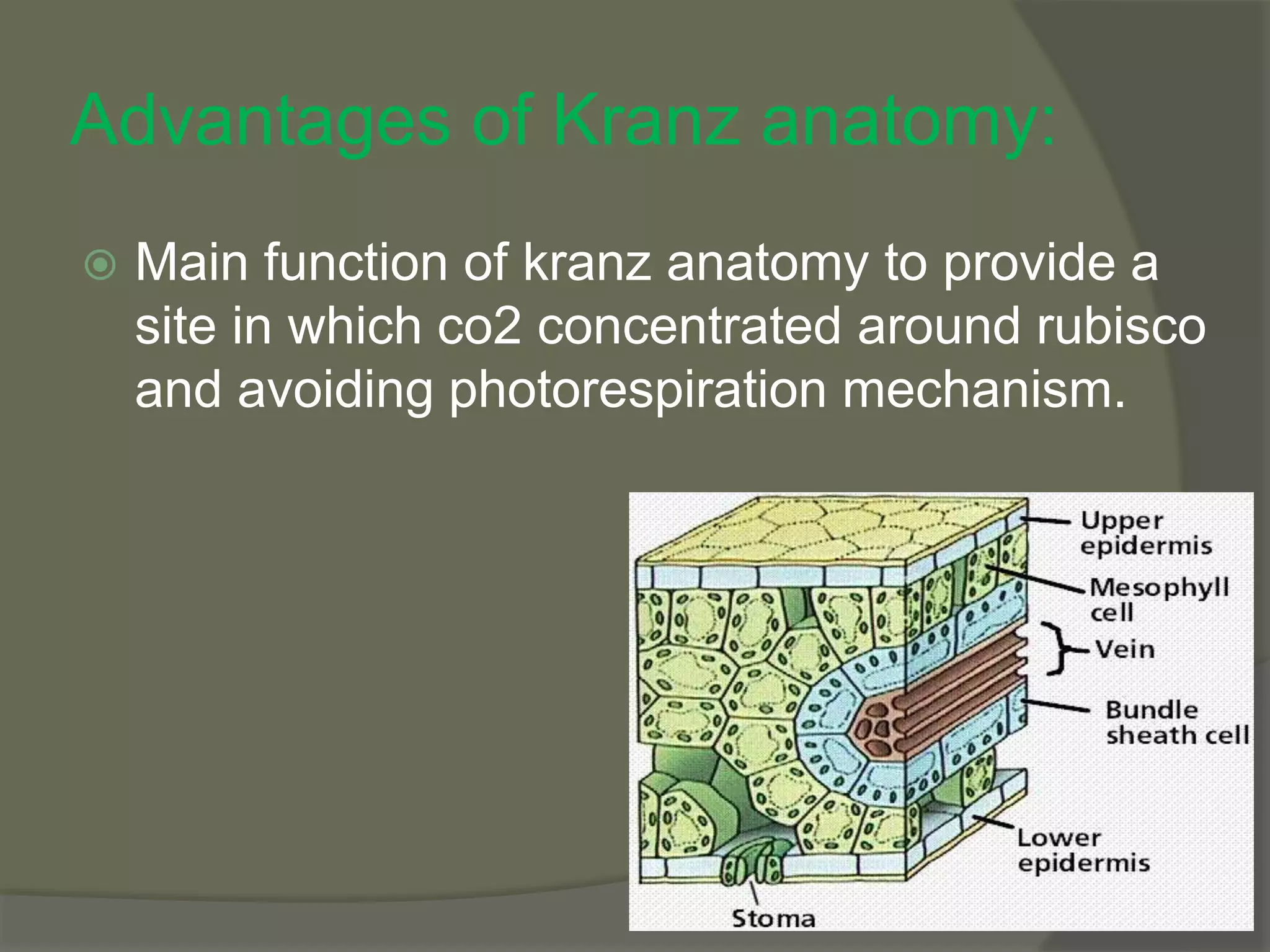
Kranz anatomy:
 Their vascular bundles are surrounded by two
rings of cells
 Inner ring
contain bundle sheat cells (bundle sheat cells
contain starch rich chloroplast lacking grana.
 Outer ring contain
Mesophyll cells
Advantages of Kranz anatomy:
 Main function of kranz anatomy to provide a
site in which co2 concentrated around rubisco
and avoiding photorespiration mechanism.
Mechanism:
First step:
 Conversion of (PEP) into oxaloacetic acid
 In this step co2 react with phosphoenol pyruvic
acid to form oxaloacetic acid.
 This reaction take place in the presence of
enzyme phosphoenol pyruvate corboxylase.
Mechanism:
2ND Step:
Conversion of OAA into Malate:
 Oxaloacetic acid is converted into malate.
 This reaction is catalyzed by malate
dehydrogenase.
Mechanism:
3rd step:
 Conversion of malate into pyruvic acid:
 Malate is transported into bundle sheat cell. In
bundle sheat cell it is converted into pyruvic
acid by releasing Co2.
Mechanism:
4th step:
 Conversion of pyruvic acid into PEP:
 Pyruvic acid react with ATP and regenerate
phosphoenol pyruvate.
 This reaction take place in the presence of
pyruvate orthophosphate dikinase.
C4 mechanism
C4 mechanism:
C4 Plants
 Maize
 Sugarcane
 Millet
 Sorghum
 Grass species

C4 photosynthesis

  • 1.
    Authors:  Muhammad Hussaan(M.Phil. Botany + PhD Scholar)  Arifa Feroz (MSc Botany + M. Phil Scholor)  Aniqa Rasheed
  • 2.
    C4 Plant:  Theplant whose first product of photosynthesis is 4 carbon compound is called C4 plant.
  • 3.
    Why plant useC4 mechanism ?  Some plants which live in drought, at high temperature and nitrogen and co2 limitation environment. They use c4 mechanism.  Because C4 plant fix more co2 as compare to the C3 plant due to having kranz anatomy.  C4 plant lose 277 molecules of water to fix per molecules of co2 as compared to c3 use 833 molecules of water approximately at 30 c.  They also avoid photorespiration process.
  • 4.
    Why plant useC4 mechanism ?  C4 enzyme fix carbon more efficiently as compared to c3 plant who fix also oxygen during carbon fixation process.  Fixation of oxygen start the process of photorespiration instead of carboxylation of substrate, substrate oxidized and as a result loss and start the process of photorespiration.  This process occur due to dual activity of rubissco present in c3 plant such as oxygenase and carboxylase activity.
  • 5.
    Kranz anatomy:  Theirvascular bundles are surrounded by two rings of cells  Inner ring contain bundle sheat cells (bundle sheat cells contain starch rich chloroplast lacking grana.  Outer ring contain Mesophyll cells
  • 6.
    Advantages of Kranzanatomy:  Main function of kranz anatomy to provide a site in which co2 concentrated around rubisco and avoiding photorespiration mechanism.
  • 7.
    Mechanism: First step:  Conversionof (PEP) into oxaloacetic acid  In this step co2 react with phosphoenol pyruvic acid to form oxaloacetic acid.  This reaction take place in the presence of enzyme phosphoenol pyruvate corboxylase.
  • 8.
    Mechanism: 2ND Step: Conversion ofOAA into Malate:  Oxaloacetic acid is converted into malate.  This reaction is catalyzed by malate dehydrogenase.
  • 9.
    Mechanism: 3rd step:  Conversionof malate into pyruvic acid:  Malate is transported into bundle sheat cell. In bundle sheat cell it is converted into pyruvic acid by releasing Co2.
  • 10.
    Mechanism: 4th step:  Conversionof pyruvic acid into PEP:  Pyruvic acid react with ATP and regenerate phosphoenol pyruvate.  This reaction take place in the presence of pyruvate orthophosphate dikinase.
  • 11.
  • 12.
  • 13.
    C4 Plants  Maize Sugarcane  Millet  Sorghum  Grass species