IHM Network – Resolving Conflict Session Joyce Brown  Balkello Consulting  www.balkelloconsulting.co.uk , balkello@btinternet.com
Workplace Conflict “ A condition between or among workers whose jobs are interdependent, who feel angry, who perceive the other(s) as being at fault, and who act in ways that cause a business problem” (Dana, D. 2001)
Potential Positive Effects of Conflict Better ideas produced People forced to search for new approaches Long standing problems brought to the surface and resolved Clarification of individual views Stimulation of interest and creativity
Potential Negative Effects of Conflict Some people feel defeated and demeaned The distance between people is increased A climate of mistrust and suspicion is developed Individuals and groups concentrate on their own narrow interests Resistance is developed rather than teamwork Increase in employee turnover
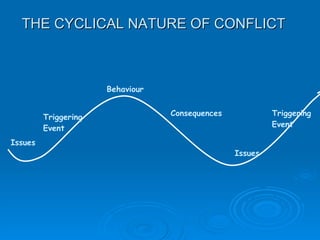
Issues Triggering Event Behaviour Consequences Issues Triggering Event THE CYCLICAL NATURE OF CONFLICT
Conflict Control Strategies Avoidance Alteration Feedback Help with consequences
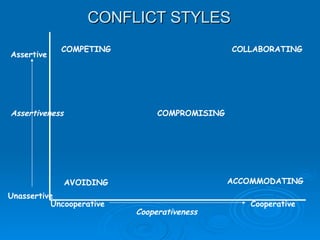
CONFLICT STYLES Cooperativeness Uncooperative Cooperative Assertive Unassertive Assertiveness AVOIDING ACCOMMODATING COMPROMISING COMPETING COLLABORATING
Competing When quick, decisive action is vital On important issues where unpopular courses of action need implementing On issues vital to company welfare To protect yourself against people who will take advantage
Collaborating To find an integrative solution when both sets of concerns are too important to be compromised When your objective is to learn To merge insights  To gain commitment To work through hard feelings
Compromising When goals are moderately important When opponents are strongly committed to mutually exclusive goals To achieve temporary settlements to complex issues To arrive at expedient solutions under time pressure As a back-up mode
Avoiding When an issue is trivial, of only passing importance When you perceive no chance of satisfying your concerns When potential damage outweighs benefits To let people cool down To gather more information When others can resolve conflict
Accommodating When you realise you are wrong When the issue is more important to the other person To build up social credits When continued competition would only damage your cause To allow staff to experiment and learn from own mistakes
A Particular Approach To Conflict ‘ If I had an argument with a player we would sit down for 20 minutes and decide I was right’ Brian Clough, former football manager
7 Steps To Effective Conflict Resolution Explain the situation the way you see it Describe how it’s affecting performance Ask for the other viewpoint to be explained Agree on the problem Explore and discuss possible solutions Agree on what each person will do to solve the problem Set a date for follow-up
Conflict Analysis Questions Objectively review the situation: Who does this conflict affect and how? What do you want from it? What does the other party want from it? How important is this issue to you? Why? How important do you think this issue is to the other party? Why?
Conflict Analysis Questions What is at stake? How serious is this conflict? Is it healthy for the organisation? What barriers previously prevented the conflict from being brought out into the open? What is your past experience with the other party? Is there a pattern of conflict? What are the triggering events, underlying issues, behaviour patterns?
Conflict Analysis Questions What is the other party’s preferred conflict style? What desirable outcomes might result from this conflict? What undesirable outcomes might result from this conflict? List at least three alternative courses of action and the probable consequences of each
Aggressive Behaviour Standing up for your own rights, but doing so in such a way that you violate the rights of other people Ignoring or dismissing the needs, wants, opinions, feelings or beliefs of others Expressing your own needs, wants or opinions ( which may be honest or dishonest) in inappropriate ways
Based On Beliefs That: Your own needs, wants and opinions are more important than other people’s You have rights but other people do not You have something to contribute; others have little or nothing to contribute The aim of aggression is to win, if necessary at the expense of others
Non Assertive Behaviour Failing to stand up for your rights or doing so in such a way that others can easily disregard them Expressing your needs, want opinions, feelings and beliefs in apologetic, diffident or self-effacing ways Failing to express honestly your needs, wants, opinions, feelings and beliefs
Based On Beliefs That: The other person’s needs and wants are more important than your own The other person has rights but you do not You have little or nothing to contribute; the other person has a great deal to contribute The aim of non-assertion is to avoid conflict and to please others
Assertive Behaviour Standing up for your own rights in such a way that you do not violate another person’s rights Expressing your needs, wants, opinions, feelings and beliefs in direct, honest and appropriate ways
Based On Beliefs That: You have needs to be met – so do others You have rights- so do others You have something to contribute – so do others The aim of assertive behaviour is to satisfy the needs and wants of both parties involved in the situation
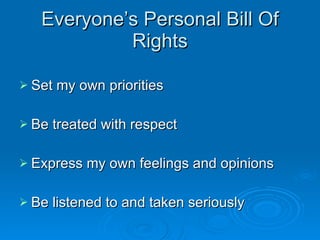
Everyone’s Personal Bill Of Rights Set my own priorities Be treated with respect Express my own feelings and opinions Be listened to and taken seriously
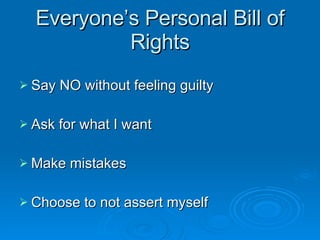
Everyone’s Personal Bill of Rights Say NO without feeling guilty Ask for what I want Make mistakes Choose to not assert myself
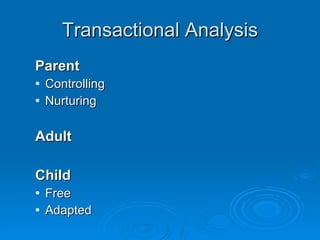
Transactional Analysis   Parent Controlling Nurturing Adult Child Free Adapted

Resolving Conflict

  • 1.
    IHM Network –Resolving Conflict Session Joyce Brown Balkello Consulting www.balkelloconsulting.co.uk , balkello@btinternet.com
  • 2.
    Workplace Conflict “A condition between or among workers whose jobs are interdependent, who feel angry, who perceive the other(s) as being at fault, and who act in ways that cause a business problem” (Dana, D. 2001)
  • 3.
    Potential Positive Effectsof Conflict Better ideas produced People forced to search for new approaches Long standing problems brought to the surface and resolved Clarification of individual views Stimulation of interest and creativity
  • 4.
    Potential Negative Effectsof Conflict Some people feel defeated and demeaned The distance between people is increased A climate of mistrust and suspicion is developed Individuals and groups concentrate on their own narrow interests Resistance is developed rather than teamwork Increase in employee turnover
  • 5.
    Issues Triggering EventBehaviour Consequences Issues Triggering Event THE CYCLICAL NATURE OF CONFLICT
  • 6.
    Conflict Control StrategiesAvoidance Alteration Feedback Help with consequences
  • 7.
    CONFLICT STYLES CooperativenessUncooperative Cooperative Assertive Unassertive Assertiveness AVOIDING ACCOMMODATING COMPROMISING COMPETING COLLABORATING
  • 8.
    Competing When quick,decisive action is vital On important issues where unpopular courses of action need implementing On issues vital to company welfare To protect yourself against people who will take advantage
  • 9.
    Collaborating To findan integrative solution when both sets of concerns are too important to be compromised When your objective is to learn To merge insights To gain commitment To work through hard feelings
  • 10.
    Compromising When goalsare moderately important When opponents are strongly committed to mutually exclusive goals To achieve temporary settlements to complex issues To arrive at expedient solutions under time pressure As a back-up mode
  • 11.
    Avoiding When anissue is trivial, of only passing importance When you perceive no chance of satisfying your concerns When potential damage outweighs benefits To let people cool down To gather more information When others can resolve conflict
  • 12.
    Accommodating When yourealise you are wrong When the issue is more important to the other person To build up social credits When continued competition would only damage your cause To allow staff to experiment and learn from own mistakes
  • 13.
    A Particular ApproachTo Conflict ‘ If I had an argument with a player we would sit down for 20 minutes and decide I was right’ Brian Clough, former football manager
  • 14.
    7 Steps ToEffective Conflict Resolution Explain the situation the way you see it Describe how it’s affecting performance Ask for the other viewpoint to be explained Agree on the problem Explore and discuss possible solutions Agree on what each person will do to solve the problem Set a date for follow-up
  • 15.
    Conflict Analysis QuestionsObjectively review the situation: Who does this conflict affect and how? What do you want from it? What does the other party want from it? How important is this issue to you? Why? How important do you think this issue is to the other party? Why?
  • 16.
    Conflict Analysis QuestionsWhat is at stake? How serious is this conflict? Is it healthy for the organisation? What barriers previously prevented the conflict from being brought out into the open? What is your past experience with the other party? Is there a pattern of conflict? What are the triggering events, underlying issues, behaviour patterns?
  • 17.
    Conflict Analysis QuestionsWhat is the other party’s preferred conflict style? What desirable outcomes might result from this conflict? What undesirable outcomes might result from this conflict? List at least three alternative courses of action and the probable consequences of each
  • 18.
    Aggressive Behaviour Standingup for your own rights, but doing so in such a way that you violate the rights of other people Ignoring or dismissing the needs, wants, opinions, feelings or beliefs of others Expressing your own needs, wants or opinions ( which may be honest or dishonest) in inappropriate ways
  • 19.
    Based On BeliefsThat: Your own needs, wants and opinions are more important than other people’s You have rights but other people do not You have something to contribute; others have little or nothing to contribute The aim of aggression is to win, if necessary at the expense of others
  • 20.
    Non Assertive BehaviourFailing to stand up for your rights or doing so in such a way that others can easily disregard them Expressing your needs, want opinions, feelings and beliefs in apologetic, diffident or self-effacing ways Failing to express honestly your needs, wants, opinions, feelings and beliefs
  • 21.
    Based On BeliefsThat: The other person’s needs and wants are more important than your own The other person has rights but you do not You have little or nothing to contribute; the other person has a great deal to contribute The aim of non-assertion is to avoid conflict and to please others
  • 22.
    Assertive Behaviour Standingup for your own rights in such a way that you do not violate another person’s rights Expressing your needs, wants, opinions, feelings and beliefs in direct, honest and appropriate ways
  • 23.
    Based On BeliefsThat: You have needs to be met – so do others You have rights- so do others You have something to contribute – so do others The aim of assertive behaviour is to satisfy the needs and wants of both parties involved in the situation
  • 24.
    Everyone’s Personal BillOf Rights Set my own priorities Be treated with respect Express my own feelings and opinions Be listened to and taken seriously
  • 25.
    Everyone’s Personal Billof Rights Say NO without feeling guilty Ask for what I want Make mistakes Choose to not assert myself
  • 26.
    Transactional Analysis Parent Controlling Nurturing Adult Child Free Adapted