Conflict Management By: Ohireime Ojeomogha [OJ] and Jessica England
Conflict Exercise Split into groups of five people. Spend three minutes trying to resolve the conflict. Each group member should choose a personality response/role. [person named in scenario, conflict resolution manager, confrontational and opinionated, complainer, non-responder, disagree with everything, etc]
Conflict Exercise Scenario 1: Company AXY – dating relationship. Scenario 2: Personal coach – hostile environment. Scenario 3: Diversity training gone wrong.
Conflict Conflict is neither a necessary evil nor a signal of defeat. It is simply a reality. Wherever there are people there is conflict. The real issue is not to avoid it, but learn how to manage it. Conflict: When two or more people attempt to occupy the same space at the same time: physically, emotionally, or intellectually.
Initial Reaction Fight  Freeze  Flight
Understanding Options ∙ ∙ ∙ ∙ ∙ ∙ ∙ ∙ ∙ Connect all the dots without lifting your pen.
∙ ∙ ∙ ∙ ∙ ∙ ∙ ∙ ∙ One option includes going outside of the box.
What do you see? Two faces or a vase?
Water cannot flow up hill…
Young woman or old lady? Creepy clown face or ladies in an arch way?
 
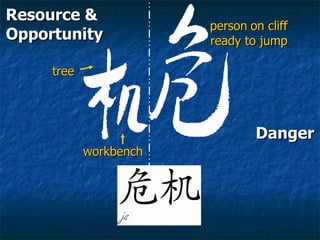
workbench person   on cliff ready to jump tree Resource & Opportunity Danger
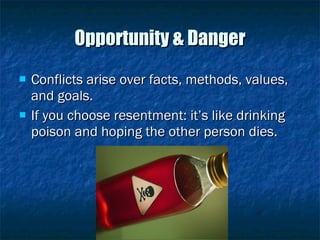
Opportunity & Danger Conflicts arise over facts, methods, values, and goals. If you choose resentment: it’s like drinking poison and hoping the other person dies.
How we  CHOOSE  to  Respond to Conflict Avoidance Accommodation Competition Compromise Collaboration
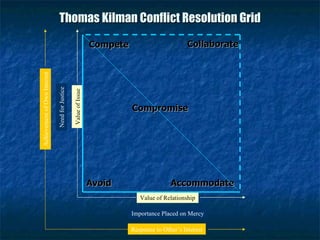
Thomas Kilman Conflict Resolution Grid Value of Relationship Importance Placed on Mercy Response to Other’s Interest Value of Issue Need for Justice Achievement of Own Interest Avoid Accommodate Compromise Compete Collaborate
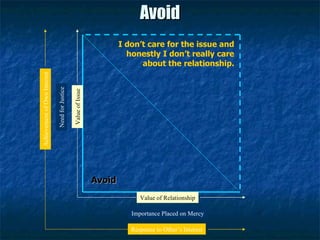
Avoid I don’t care for the issue and honestly I don’t really care about the relationship. Value of Relationship Importance Placed on Mercy Response to Other’s Interest Value of Issue Need for Justice Achievement of Own Interest Avoid
Accommodate Value of Relationship Importance Placed on Mercy Response to Other’s Interest Value of Issue Need for Justice Achievement of Own Interest Preserve the relationship at ALL costs. Accommodate
Compete Value of Relationship Importance Placed on Mercy Response to Other’s Interest Value of Issue Need for Justice Achievement of Own Interest Compete Win / lose situation:  How do I get  MY  way?
Compromise Value of Relationship Importance Placed on Mercy Response to Other’s Interest Value of Issue Need for Justice Achievement of Own Interest Compromise Tolerance  is key!
Collaborate Value of Relationship Importance Placed on Mercy Response to Other’s Interest Value of Issue Need for Justice Achievement of Own Interest Collaborate Seek to preserve both the relationship and the value of the issue at hand. *this requires skill in managing conflict. **not all issues are worth going “to the mat.”
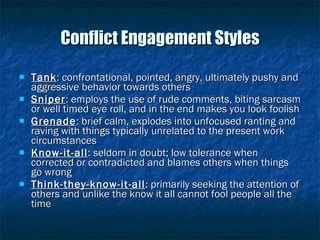
Conflict Engagement Styles Tank : confrontational, pointed, angry, ultimately pushy and aggressive behavior towards others Sniper : employs the use of rude comments, biting sarcasm or well timed eye roll, and in the end makes you look foolish Grenade : brief calm, explodes into unfocused ranting and  raving with things typically unrelated to the present work circumstances Know-it-all : seldom in doubt; low tolerance when corrected or contradicted and blames others when things go wrong Think-they-know-it-all : primarily seeking the attention of others and unlike the know it all cannot fool people all the time
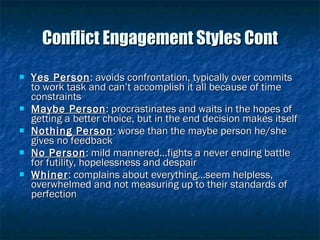
Conflict Engagement Styles Cont Yes Person : avoids confrontation, typically over commits to work task and can’t accomplish it all because of time constraints Maybe Person : procrastinates and waits in the hopes of getting a better choice, but in the end decision makes itself Nothing Person : worse than the maybe person he/she gives no feedback No Person : mild mannered…fights a never ending battle for futility, hopelessness and despair Whiner : complains about everything…seem helpless, overwhelmed and not measuring up to their standards of perfection
Lens of Understanding The Dr.’s Rick Understanding helps you communicate effectively, prevent future conflict, and resolve current conflicts. Look for the motive behind the behavior.
Assertiveness & Focus Normal Zone People Focus Task Focus Aggressive Passive
Motives Normal Zone Get It Right Get It Done Get  Appreciated Get Along People Focus Task Focus Aggressive Passive
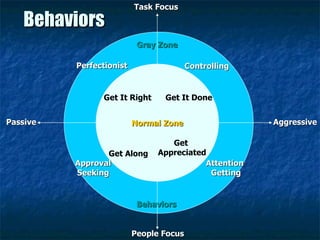
Normal Zone Get It Right Get It Done Get  Appreciated Get Along People Focus Task Focus Aggressive Passive Controlling Attention  Getting Approval Seeking Perfectionist Gray Zone Behaviors Behaviors
Normal   Zone Get It Right Get It Done Get  Appreciated Get Along People Focus Task Focus Aggressive Passive Controlling Attention Getting Approval Seeking Perfectionist Gray Zone Behaviors TANK SNIPER KNOW- IT-ALL GRENADE SNIPER THINK-THEY- KNOW-IT-ALL MAYBE Person YES Person NOTHING Person NOTHING Person NO Person WHINER
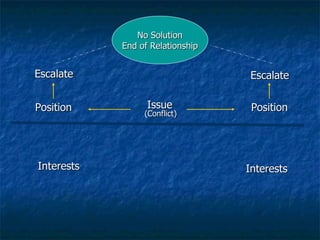
Position Position Issue Conflict When people differ they usually identify an  issue  over which they differ and take a  position  on it.
Choose Your Path
Position-based  Conflict Management One or both sides can walk away, perhaps  avoiding  the conflict. One or both sides can  accommodate , thereby eliminating the conflict. One or both sides can  compete , which escalates the conflict. One or both sides can  compromise  their position, perhaps tempering the conflict. Both sides can give the dispute to someone else for a decision which will decide the matter but which may not resolve the conflict.
Escalate Escalate Position Position Issue (Conflict) Interests Interests No Solution End of Relationship
Go Below the Line The focus of positional-based conflict management is  the issue / my view on it. In a collaborative, consensual process, the key is to bring interests into the discussion… to  GO   BELOW   THE   LINE ! Moving from  position  to  interests  gives the freedom to  explore solutions .
Escalate Escalate Position Position Issue (Conflict) Interests Interests Maintain Relationship Conflict Resolved No Solution End of Relationship
Interest-based  Conflict Management The focus moves from the  issue  to the  solution. Allows potential for: Developing better, more satisfying agreements. Creating greater commitment to an agreement. Strengthening the parties’ relationships. Creating greater organizational effectiveness.
The Shift ISSUE PROBLEM
Action Plan Listen to understand: blend, backtrack, clarify, summarize, confirm. Speak to be understood: tone, intent, tact, truth, ready to listen. Reach a deeper understanding by identifying  positive intent  and  highly valued criteria . P.E.:  Project  and  expect  the  best  of others.
 

Conflict Management

  • 1.
    Conflict Management By:Ohireime Ojeomogha [OJ] and Jessica England
  • 2.
    Conflict Exercise Splitinto groups of five people. Spend three minutes trying to resolve the conflict. Each group member should choose a personality response/role. [person named in scenario, conflict resolution manager, confrontational and opinionated, complainer, non-responder, disagree with everything, etc]
  • 3.
    Conflict Exercise Scenario1: Company AXY – dating relationship. Scenario 2: Personal coach – hostile environment. Scenario 3: Diversity training gone wrong.
  • 4.
    Conflict Conflict isneither a necessary evil nor a signal of defeat. It is simply a reality. Wherever there are people there is conflict. The real issue is not to avoid it, but learn how to manage it. Conflict: When two or more people attempt to occupy the same space at the same time: physically, emotionally, or intellectually.
  • 5.
    Initial Reaction Fight Freeze Flight
  • 6.
    Understanding Options ∙∙ ∙ ∙ ∙ ∙ ∙ ∙ ∙ Connect all the dots without lifting your pen.
  • 7.
    ∙ ∙ ∙∙ ∙ ∙ ∙ ∙ ∙ One option includes going outside of the box.
  • 8.
    What do yousee? Two faces or a vase?
  • 9.
  • 10.
    Young woman orold lady? Creepy clown face or ladies in an arch way?
  • 11.
  • 12.
    workbench person on cliff ready to jump tree Resource & Opportunity Danger
  • 13.
    Opportunity & DangerConflicts arise over facts, methods, values, and goals. If you choose resentment: it’s like drinking poison and hoping the other person dies.
  • 14.
    How we CHOOSE to Respond to Conflict Avoidance Accommodation Competition Compromise Collaboration
  • 15.
    Thomas Kilman ConflictResolution Grid Value of Relationship Importance Placed on Mercy Response to Other’s Interest Value of Issue Need for Justice Achievement of Own Interest Avoid Accommodate Compromise Compete Collaborate
  • 16.
    Avoid I don’tcare for the issue and honestly I don’t really care about the relationship. Value of Relationship Importance Placed on Mercy Response to Other’s Interest Value of Issue Need for Justice Achievement of Own Interest Avoid
  • 17.
    Accommodate Value ofRelationship Importance Placed on Mercy Response to Other’s Interest Value of Issue Need for Justice Achievement of Own Interest Preserve the relationship at ALL costs. Accommodate
  • 18.
    Compete Value ofRelationship Importance Placed on Mercy Response to Other’s Interest Value of Issue Need for Justice Achievement of Own Interest Compete Win / lose situation: How do I get MY way?
  • 19.
    Compromise Value ofRelationship Importance Placed on Mercy Response to Other’s Interest Value of Issue Need for Justice Achievement of Own Interest Compromise Tolerance is key!
  • 20.
    Collaborate Value ofRelationship Importance Placed on Mercy Response to Other’s Interest Value of Issue Need for Justice Achievement of Own Interest Collaborate Seek to preserve both the relationship and the value of the issue at hand. *this requires skill in managing conflict. **not all issues are worth going “to the mat.”
  • 21.
    Conflict Engagement StylesTank : confrontational, pointed, angry, ultimately pushy and aggressive behavior towards others Sniper : employs the use of rude comments, biting sarcasm or well timed eye roll, and in the end makes you look foolish Grenade : brief calm, explodes into unfocused ranting and raving with things typically unrelated to the present work circumstances Know-it-all : seldom in doubt; low tolerance when corrected or contradicted and blames others when things go wrong Think-they-know-it-all : primarily seeking the attention of others and unlike the know it all cannot fool people all the time
  • 22.
    Conflict Engagement StylesCont Yes Person : avoids confrontation, typically over commits to work task and can’t accomplish it all because of time constraints Maybe Person : procrastinates and waits in the hopes of getting a better choice, but in the end decision makes itself Nothing Person : worse than the maybe person he/she gives no feedback No Person : mild mannered…fights a never ending battle for futility, hopelessness and despair Whiner : complains about everything…seem helpless, overwhelmed and not measuring up to their standards of perfection
  • 23.
    Lens of UnderstandingThe Dr.’s Rick Understanding helps you communicate effectively, prevent future conflict, and resolve current conflicts. Look for the motive behind the behavior.
  • 24.
    Assertiveness & FocusNormal Zone People Focus Task Focus Aggressive Passive
  • 25.
    Motives Normal ZoneGet It Right Get It Done Get Appreciated Get Along People Focus Task Focus Aggressive Passive
  • 26.
    Normal Zone GetIt Right Get It Done Get Appreciated Get Along People Focus Task Focus Aggressive Passive Controlling Attention Getting Approval Seeking Perfectionist Gray Zone Behaviors Behaviors
  • 27.
    Normal Zone Get It Right Get It Done Get Appreciated Get Along People Focus Task Focus Aggressive Passive Controlling Attention Getting Approval Seeking Perfectionist Gray Zone Behaviors TANK SNIPER KNOW- IT-ALL GRENADE SNIPER THINK-THEY- KNOW-IT-ALL MAYBE Person YES Person NOTHING Person NOTHING Person NO Person WHINER
  • 28.
    Position Position IssueConflict When people differ they usually identify an issue over which they differ and take a position on it.
  • 29.
  • 30.
    Position-based ConflictManagement One or both sides can walk away, perhaps avoiding the conflict. One or both sides can accommodate , thereby eliminating the conflict. One or both sides can compete , which escalates the conflict. One or both sides can compromise their position, perhaps tempering the conflict. Both sides can give the dispute to someone else for a decision which will decide the matter but which may not resolve the conflict.
  • 31.
    Escalate Escalate PositionPosition Issue (Conflict) Interests Interests No Solution End of Relationship
  • 32.
    Go Below theLine The focus of positional-based conflict management is the issue / my view on it. In a collaborative, consensual process, the key is to bring interests into the discussion… to GO BELOW THE LINE ! Moving from position to interests gives the freedom to explore solutions .
  • 33.
    Escalate Escalate PositionPosition Issue (Conflict) Interests Interests Maintain Relationship Conflict Resolved No Solution End of Relationship
  • 34.
    Interest-based ConflictManagement The focus moves from the issue to the solution. Allows potential for: Developing better, more satisfying agreements. Creating greater commitment to an agreement. Strengthening the parties’ relationships. Creating greater organizational effectiveness.
  • 35.
  • 36.
    Action Plan Listento understand: blend, backtrack, clarify, summarize, confirm. Speak to be understood: tone, intent, tact, truth, ready to listen. Reach a deeper understanding by identifying positive intent and highly valued criteria . P.E.: Project and expect the best of others.
  • 37.