
Dr. R. Sasipriya
Assistant Professor in Physical Science
V.O.C. College of Education
Thoothukudi
RESEARCH PROPOSAL
WRITING
What is Research Proposal?
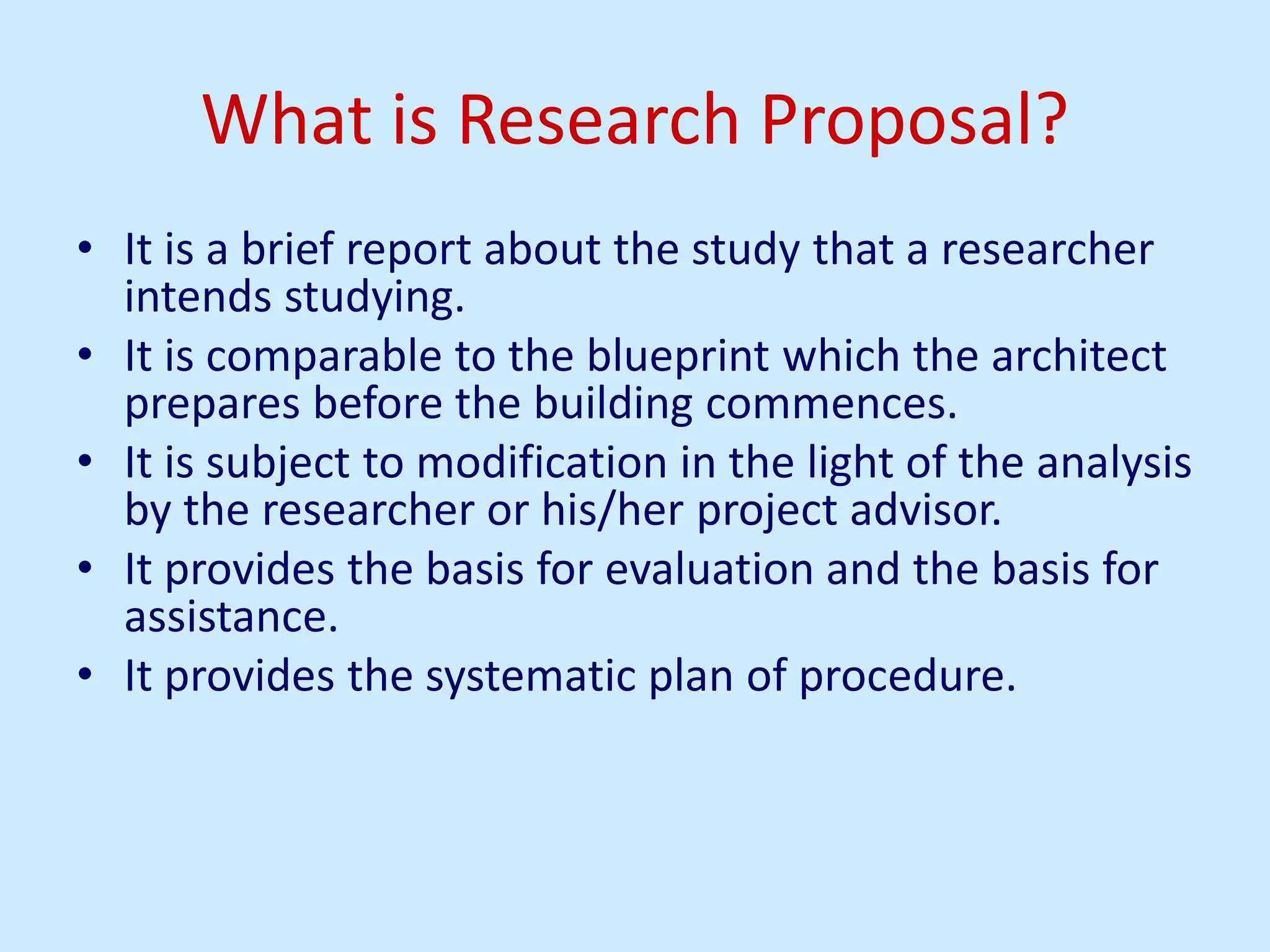
• It is a brief report about the study that a researcher
intends studying.
• It is comparable to the blueprint which the architect
prepares before the building commences.
• It is subject to modification in the light of the analysis
by the researcher or his/her project advisor.
• It provides the basis for evaluation and the basis for
assistance.
• It provides the systematic plan of procedure.
Proposal, Synopsis & Report
Proposal Synopsis Report
Prepared before the
research.
Prepared after the
collection &
analysis of data
Prepared after the
collection & analysis
of data
Plan of work Document in Brief Document in an
elaborate form
Only suggestive. So,
can be altered
Pre-final form.
Caption, chapter can
be altered.
Final form. Cannot
be altered.
‘Seven Part Proposal’ suggested by Best & Kahn
1. The Statement of the Problem
2. The Significance of the Problem
3. Definitions, Assumptions, Limitations and Delimitations
4. Review of Related Literature
5. The Hypotheses
6. Methods
7. Time Schedule
‘Format of Proposal’ we could follow
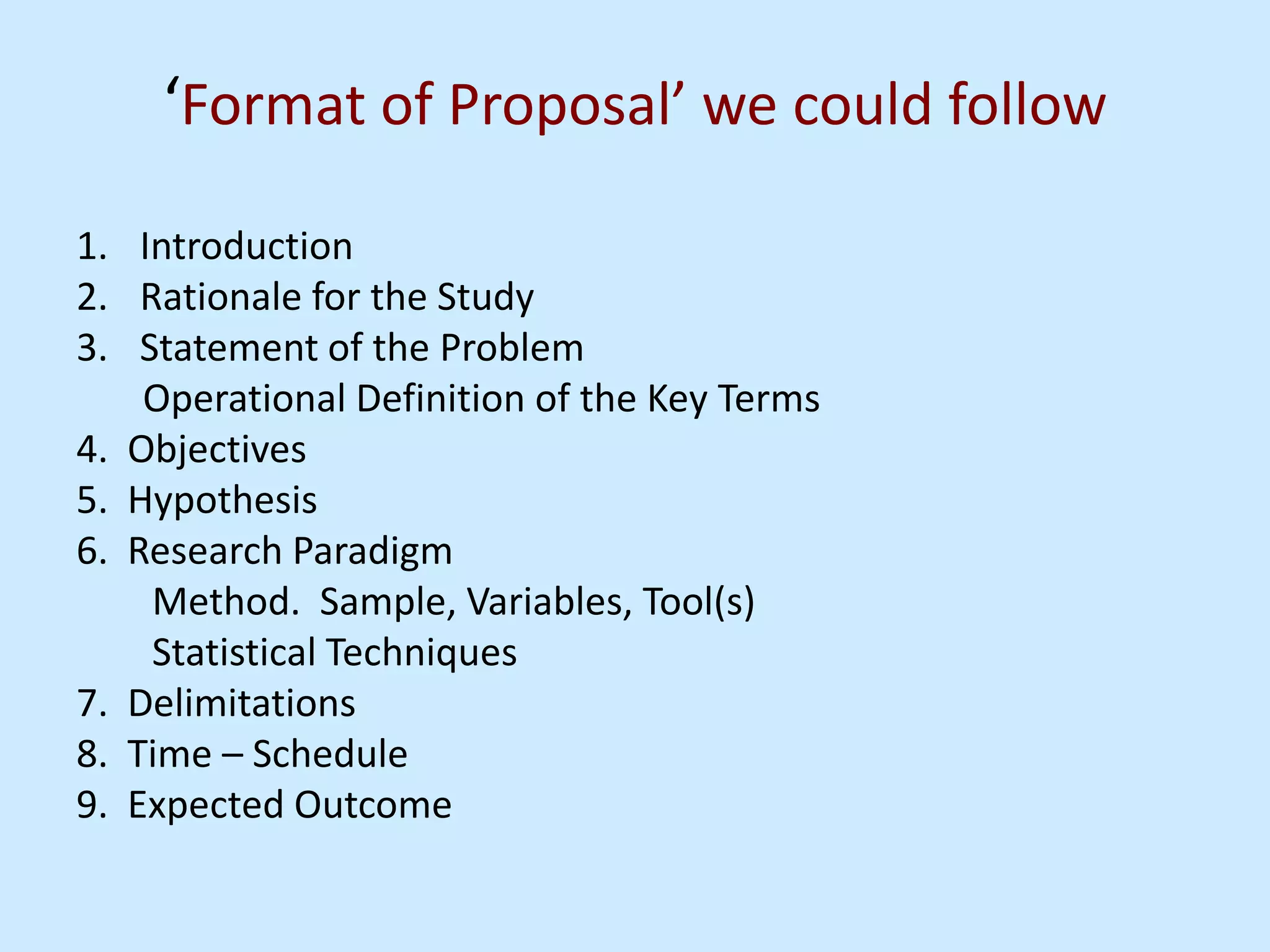
1. Introduction
2. Rationale for the Study
3. Statement of the Problem
Operational Definition of the Key Terms
4. Objectives
5. Hypothesis
6. Research Paradigm
Method. Sample, Variables, Tool(s)
Statistical Techniques
7. Delimitations
8. Time – Schedule
9. Expected Outcome
1.Introduction
• General proclamation about education
• Starting with catchy sentence
• Ending with linking the present study
• About half-a-page
2. Rationale for the Study
• Discusses the need for the study
• Talks about the utility of the study
• Justifies the selection of the area
• Defends the topic selected
• Reviews related studies
• Explains with statistical data
• Runs about one and half pages
3. Statement of the Problem
• Doesn’t reproduce the title as it is
• Explains the problem briefly
• Explains the key terms
• Defines them operationally
• Mentions the dictionary meaning
• Occupies about a page
4. Objectives
• Given in operational term
• Clearly and unambiguously mentioned
• Can be divided into General and Specific
Objectives
• Should not be given with any pre-
conceived opinions.
• Should be more than five in numbers (Kerela
University – for M.Ed.)
5.Hypotheses
• Not given in some proposals
• Should be scientific
• At par with objectives
• Preferably Research Hypotheses
6.Research Paradigm
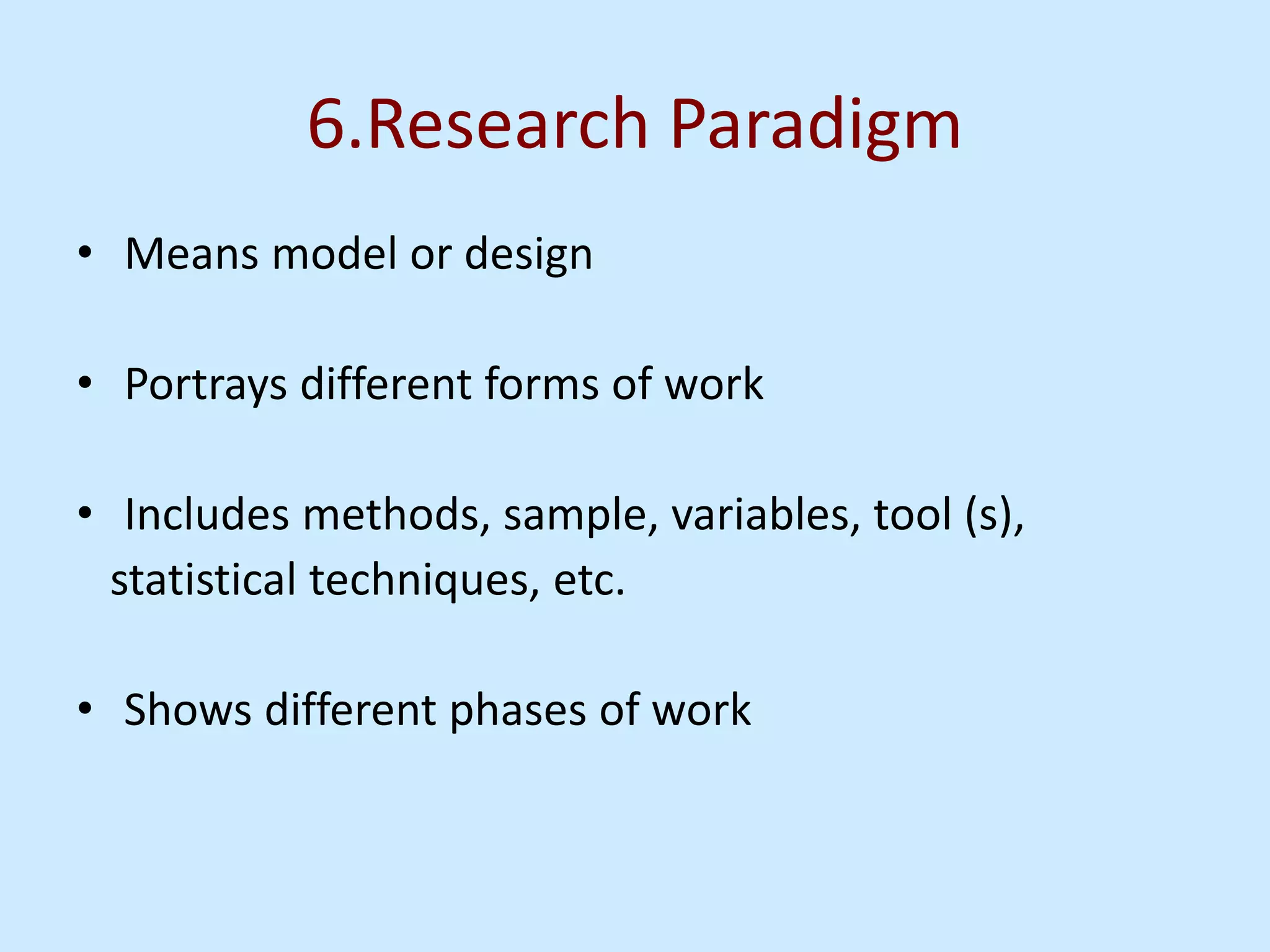
• Means model or design
• Portrays different forms of work
• Includes methods, sample, variables, tool (s),
statistical techniques, etc.
• Shows different phases of work
Method
• Fix the method
• If possible, justify the selection
• Discuss the phase
METHOD
Survey method is adopted in this study. Since the present study
aims at to find out the present status of the problem, the survey
method has been adopted.
Phase - I Phase – II Phase – III Phase - IV
   
Selection of Title Finalizing Sample,
tools, variables and
statistical techniques
Data
Analysis
Typing
thesis
   
Review of related
literature
Development of
Tools
Interpretation of
results
Submission
  
Framing of
Objectives
Standardization of
Tools
Preparation of
Thesis

Formulating
Hypotheses
Collection of Data
Sample
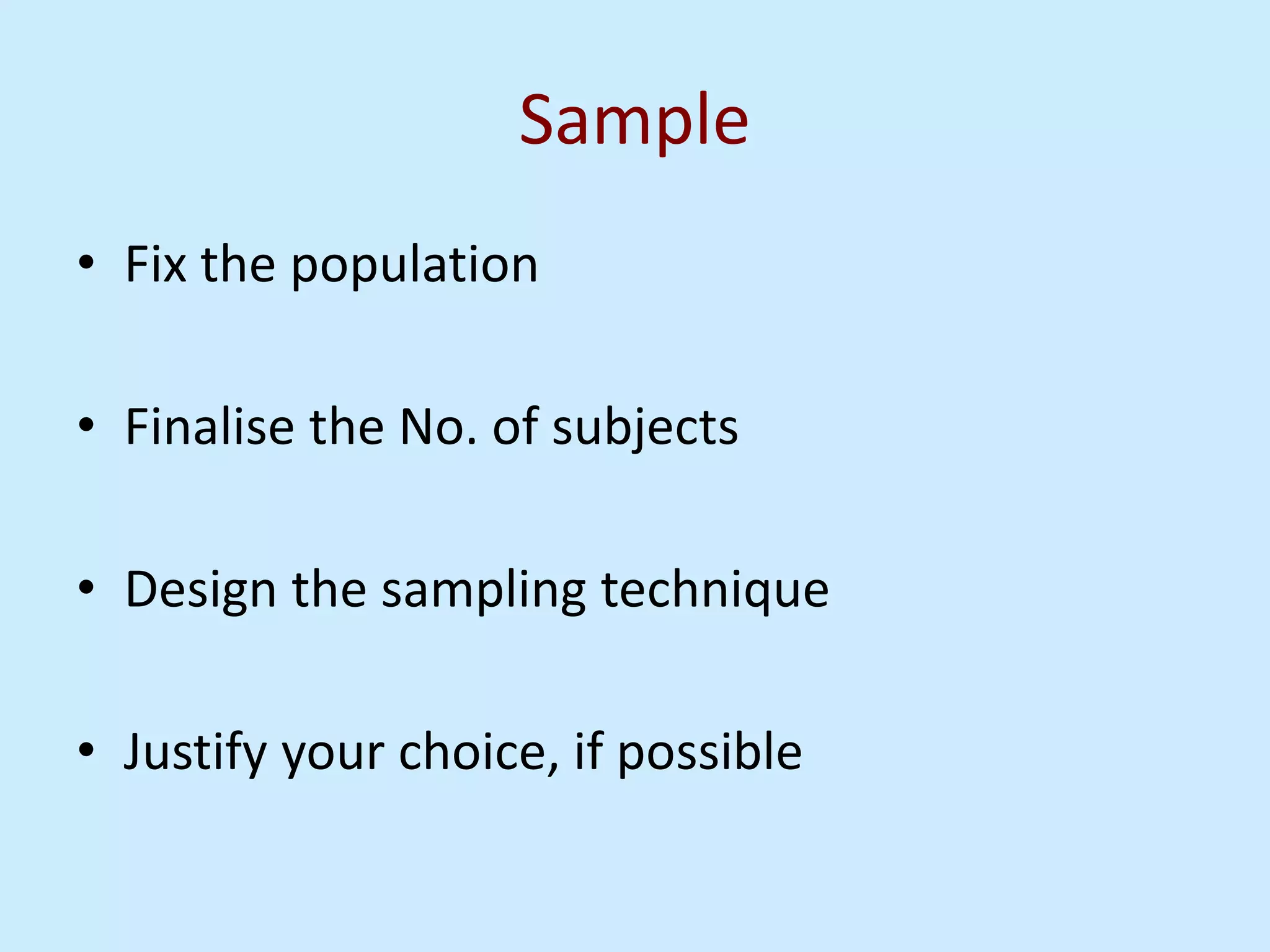
• Fix the population
• Finalise the No. of subjects
• Design the sampling technique
• Justify your choice, if possible
 Prospective Teachers in general form the
population of the study. From among them
300 B.Ed., Student teachers will be
selected as the sample.
 Since the researches has to be observe all
the subject, the number of sample is
restricted to 300.
 The Random sampling technique will be
adopted.
POPULATIONANDSAMPLE
Variables
• Understand different types of variables
• Classify the variables you intend to select
• Mention them
• ‘Background Variables’ is the phrase used
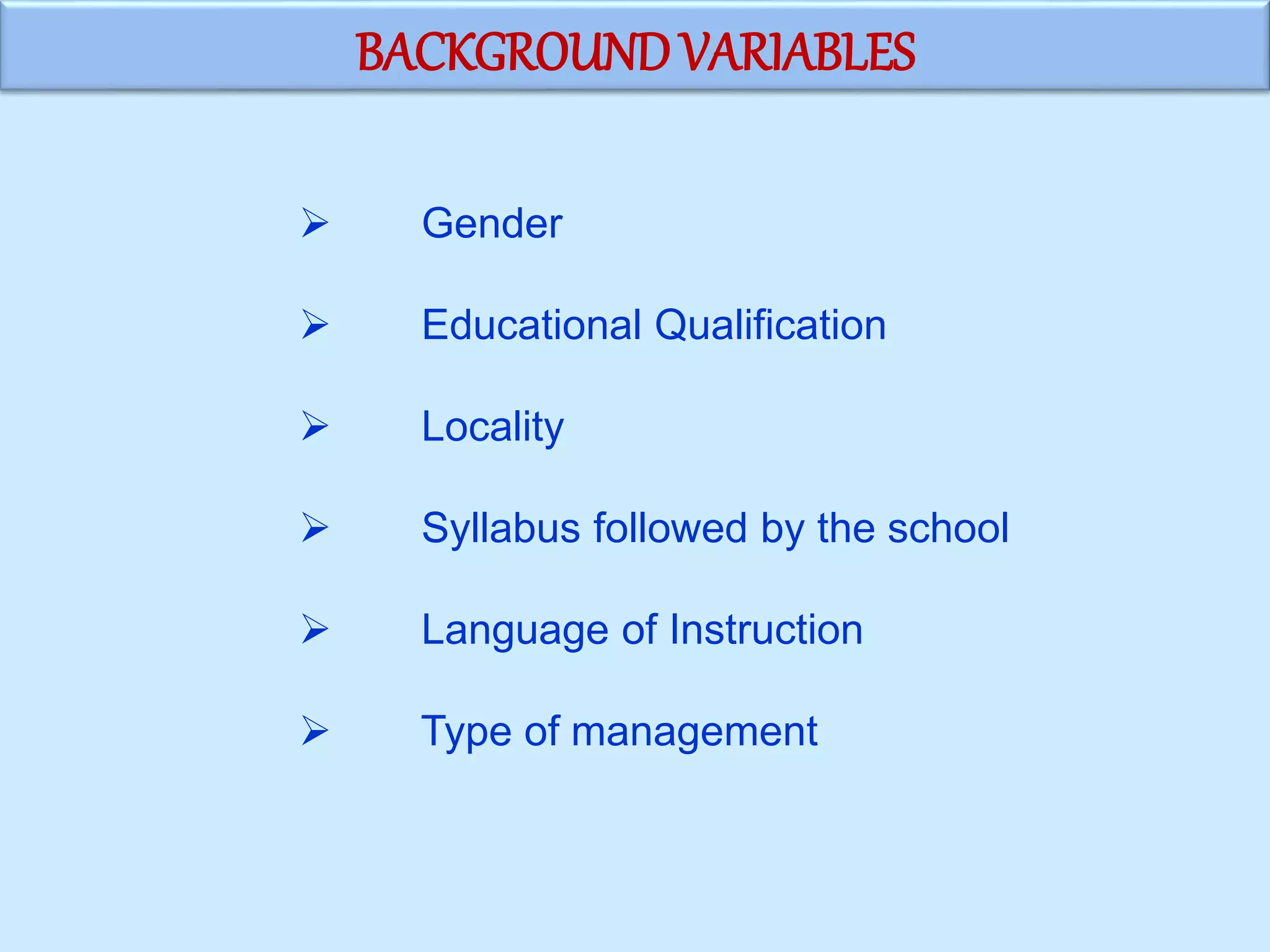
BACKGROUNDVARIABLES
 Gender
 Educational Qualification
 Locality
 Syllabus followed by the school
 Language of Instruction
 Type of management
Tool (s)
• Select the tool (s)
• Mention whether it is self-made or already
standardised
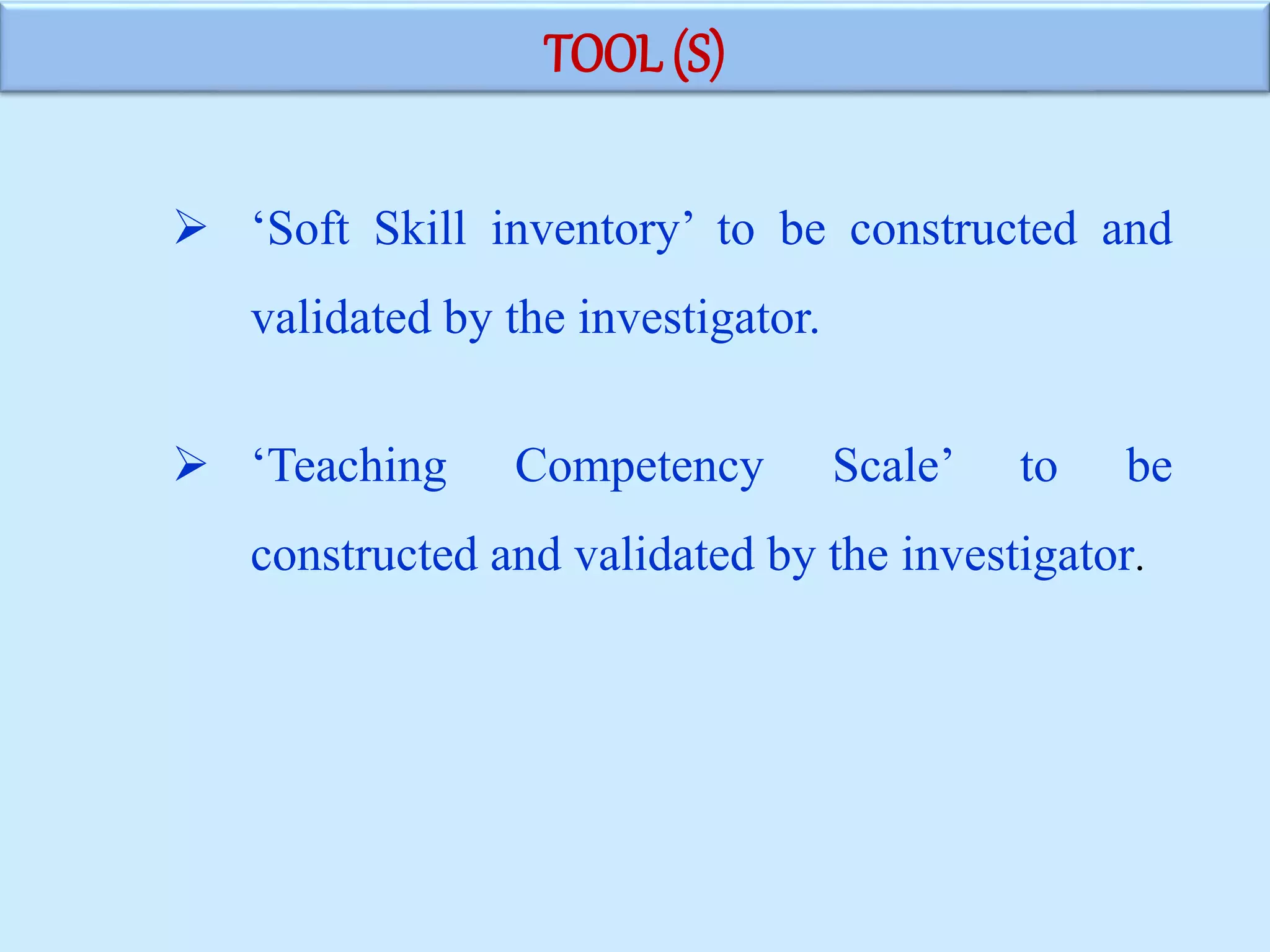
TOOL (S)
 ‘Soft Skill inventory’ to be constructed and
validated by the investigator.
 ‘Teaching Competency Scale’ to be
constructed and validated by the investigator.
Statistical Technique
• Have thorough knowledge of statistics
• Discuss with experts
• Finalise the statistical technique you intend to
apply
STATISTICAL TECHNIQUES
 Percentage Analysis
 t - test
 F - test
 Correlation
7.Delimitations
• Understand the difference between limitations and delimitations.
•
Limitations are the conditions beyond researcher’s control. It may place
the restrictions on the conclusions of the study and their applications.
Delimitations are the boundaries of the study and conclusions are not to
be extended beyond this sample.
• Delimitations only may better be given.
• They should be mentioned taking title for an account.
DELIMITATIONS
 The Sample is restricted to 300 Student
teachers doing B.Ed.
 Only the limited variables will be taken
for this study.
 Only the selected dimensions of teaching
competency and softskill will be included
in the tools.
8.Time-Schedule
• Take available times
• Analyse the nature of every work and the time
required to complete it
• Plan your work accordingly
• Apply the principles of flexibility
• Adhere to it
Time Schedule
Finalising the Research Design - 2 months
Review of Related Literature - 4 months
Development of the Tools - 6 months
Data Collection - 8 months
Data Analysis - 6 months
Report Preparation - 6 months
Typing - 4 months
TOTAL - 36 months
9.Expected Outcome
• Discusses the utility value of the work
• Can be given either in paragraph or one by
one
• It is more important, when the proposal is
sent for funding agency.
Expected Outcome
The findings of this study will enable the
trainees
• to improve his/her teaching competency
• to develop his/her soft skill.
• to bring innovations in the method of teaching .
• to become the mathematics teachers with multi-
facet personality.
Format of Proposal’ we could follow
1. Introduction
2. Rationale for the Study
3. Statement of the Problem
Operational Definition of the Key Terms
4. Objectives
5. Hypothesis
6. Research Paradigm
Method. Sample, Variables, Tool(s)
Statistical Techniques
7. Delimitations
8. Time – Schedule
9. Expected Outcome
Parting Thought
• A worthwhile research project is likely to
result from a well-designed proposal
• This device also serves as a stimulus, helping
the researcher to move systematically toward
the goal of a completed project.
‘Plan the work and work the plan’
Research.Proposal

Research.Proposal

  • 1.
    Dr. R. Sasipriya AssistantProfessor in Physical Science V.O.C. College of Education Thoothukudi RESEARCH PROPOSAL WRITING
  • 2.
    What is ResearchProposal? • It is a brief report about the study that a researcher intends studying. • It is comparable to the blueprint which the architect prepares before the building commences. • It is subject to modification in the light of the analysis by the researcher or his/her project advisor. • It provides the basis for evaluation and the basis for assistance. • It provides the systematic plan of procedure.
  • 3.
    Proposal, Synopsis &Report Proposal Synopsis Report Prepared before the research. Prepared after the collection & analysis of data Prepared after the collection & analysis of data Plan of work Document in Brief Document in an elaborate form Only suggestive. So, can be altered Pre-final form. Caption, chapter can be altered. Final form. Cannot be altered.
  • 4.
    ‘Seven Part Proposal’suggested by Best & Kahn 1. The Statement of the Problem 2. The Significance of the Problem 3. Definitions, Assumptions, Limitations and Delimitations 4. Review of Related Literature 5. The Hypotheses 6. Methods 7. Time Schedule
  • 5.
    ‘Format of Proposal’we could follow 1. Introduction 2. Rationale for the Study 3. Statement of the Problem Operational Definition of the Key Terms 4. Objectives 5. Hypothesis 6. Research Paradigm Method. Sample, Variables, Tool(s) Statistical Techniques 7. Delimitations 8. Time – Schedule 9. Expected Outcome
  • 6.
    1.Introduction • General proclamationabout education • Starting with catchy sentence • Ending with linking the present study • About half-a-page
  • 7.
    2. Rationale forthe Study • Discusses the need for the study • Talks about the utility of the study • Justifies the selection of the area • Defends the topic selected • Reviews related studies • Explains with statistical data • Runs about one and half pages
  • 8.
    3. Statement ofthe Problem • Doesn’t reproduce the title as it is • Explains the problem briefly • Explains the key terms • Defines them operationally • Mentions the dictionary meaning • Occupies about a page
  • 9.
    4. Objectives • Givenin operational term • Clearly and unambiguously mentioned • Can be divided into General and Specific Objectives • Should not be given with any pre- conceived opinions. • Should be more than five in numbers (Kerela University – for M.Ed.)
  • 10.
    5.Hypotheses • Not givenin some proposals • Should be scientific • At par with objectives • Preferably Research Hypotheses
  • 11.
    6.Research Paradigm • Meansmodel or design • Portrays different forms of work • Includes methods, sample, variables, tool (s), statistical techniques, etc. • Shows different phases of work
  • 12.
    Method • Fix themethod • If possible, justify the selection • Discuss the phase
  • 13.
    METHOD Survey method isadopted in this study. Since the present study aims at to find out the present status of the problem, the survey method has been adopted. Phase - I Phase – II Phase – III Phase - IV     Selection of Title Finalizing Sample, tools, variables and statistical techniques Data Analysis Typing thesis     Review of related literature Development of Tools Interpretation of results Submission    Framing of Objectives Standardization of Tools Preparation of Thesis  Formulating Hypotheses Collection of Data
  • 14.
    Sample • Fix thepopulation • Finalise the No. of subjects • Design the sampling technique • Justify your choice, if possible
  • 15.
     Prospective Teachersin general form the population of the study. From among them 300 B.Ed., Student teachers will be selected as the sample.  Since the researches has to be observe all the subject, the number of sample is restricted to 300.  The Random sampling technique will be adopted. POPULATIONANDSAMPLE
  • 16.
    Variables • Understand differenttypes of variables • Classify the variables you intend to select • Mention them • ‘Background Variables’ is the phrase used
  • 17.
    BACKGROUNDVARIABLES  Gender  EducationalQualification  Locality  Syllabus followed by the school  Language of Instruction  Type of management
  • 18.
    Tool (s) • Selectthe tool (s) • Mention whether it is self-made or already standardised
  • 19.
    TOOL (S)  ‘SoftSkill inventory’ to be constructed and validated by the investigator.  ‘Teaching Competency Scale’ to be constructed and validated by the investigator.
  • 20.
    Statistical Technique • Havethorough knowledge of statistics • Discuss with experts • Finalise the statistical technique you intend to apply
  • 21.
    STATISTICAL TECHNIQUES  PercentageAnalysis  t - test  F - test  Correlation
  • 22.
    7.Delimitations • Understand thedifference between limitations and delimitations. • Limitations are the conditions beyond researcher’s control. It may place the restrictions on the conclusions of the study and their applications. Delimitations are the boundaries of the study and conclusions are not to be extended beyond this sample. • Delimitations only may better be given. • They should be mentioned taking title for an account.
  • 23.
    DELIMITATIONS  The Sampleis restricted to 300 Student teachers doing B.Ed.  Only the limited variables will be taken for this study.  Only the selected dimensions of teaching competency and softskill will be included in the tools.
  • 24.
    8.Time-Schedule • Take availabletimes • Analyse the nature of every work and the time required to complete it • Plan your work accordingly • Apply the principles of flexibility • Adhere to it
  • 25.
    Time Schedule Finalising theResearch Design - 2 months Review of Related Literature - 4 months Development of the Tools - 6 months Data Collection - 8 months Data Analysis - 6 months Report Preparation - 6 months Typing - 4 months TOTAL - 36 months
  • 26.
    9.Expected Outcome • Discussesthe utility value of the work • Can be given either in paragraph or one by one • It is more important, when the proposal is sent for funding agency.
  • 27.
    Expected Outcome The findingsof this study will enable the trainees • to improve his/her teaching competency • to develop his/her soft skill. • to bring innovations in the method of teaching . • to become the mathematics teachers with multi- facet personality.
  • 28.
    Format of Proposal’we could follow 1. Introduction 2. Rationale for the Study 3. Statement of the Problem Operational Definition of the Key Terms 4. Objectives 5. Hypothesis 6. Research Paradigm Method. Sample, Variables, Tool(s) Statistical Techniques 7. Delimitations 8. Time – Schedule 9. Expected Outcome
  • 29.
    Parting Thought • Aworthwhile research project is likely to result from a well-designed proposal • This device also serves as a stimulus, helping the researcher to move systematically toward the goal of a completed project. ‘Plan the work and work the plan’