Research Proposal
Development
Definition
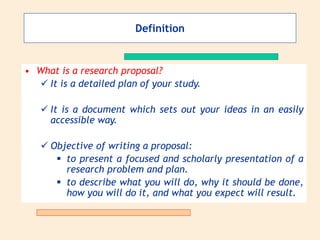
• What is a research proposal?
 It is a detailed plan of your study.
 It is a document which sets out your ideas in an easily
accessible way.
 Objective of writing a proposal:
 to present a focused and scholarly presentation of a
research problem and plan.
 to describe what you will do, why it should be done,
how you will do it, and what you expect will result.
Overview of a Research Proposal
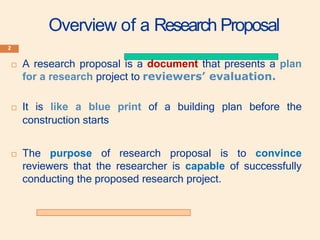
 A research proposal is a document that presents a plan
for a research project to reviewers’ evaluation.
 It is like a blue print of a building plan before the
construction starts
 The purpose of research proposal is to convince
reviewers that the researcher is capable of successfully
conducting the proposed research project.
2
Overview of a Research Proposal
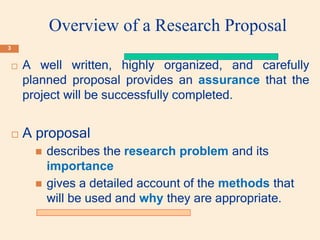
 A well written, highly organized, and carefully
planned proposal provides an assurance that the
project will be successfully completed.
 A proposal
 describes the research problem and its
importance
 gives a detailed account of the methods that
will be used and why they are appropriate.
3
OverviewofaResearchProposal,…
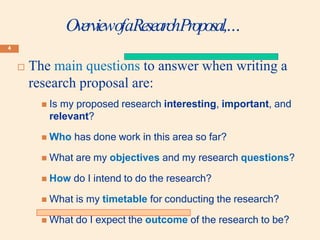
 The main questions to answer when writing a
research proposal are:
 Is my proposed research interesting, important, and
relevant?
 Who has done work in this area so far?
 What are my objectives and my research questions?
 How do I intend to do the research?
 What is my timetable for conducting the research?
 What do I expect the outcome of the research to be?
4
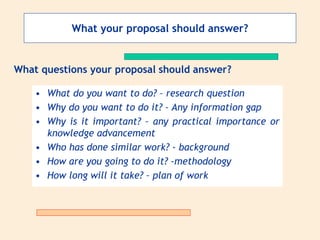
What your proposal should answer?
• What do you want to do? – research question
• Why do you want to do it? – Any information gap
• Why is it important? – any practical importance or
knowledge advancement
• Who has done similar work? - background
• How are you going to do it? -methodology
• How long will it take? – plan of work
What questions your proposal should answer?
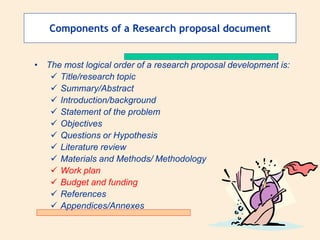
Components of a Research proposal document
• The most logical order of a research proposal development is:
 Title/research topic
 Summary/Abstract
 Introduction/background
 Statement of the problem
 Objectives
 Questions or Hypothesis
 Literature review
 Materials and Methods/ Methodology
 Work plan
 Budget and funding
 References
 Appendices/Annexes
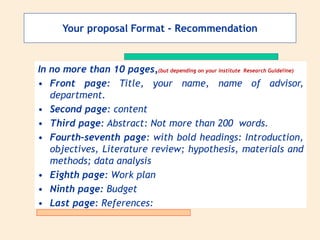
In no more than 10 pages,(but depending on your institute Research Guideline)
• Front page: Title, your name, name of advisor,
department.
• Second page: content
• Third page: Abstract: Not more than 200 words.
• Fourth–seventh page: with bold headings: Introduction,
objectives, Literature review; hypothesis, materials and
methods; data analysis
• Eighth page: Work plan
• Ninth page: Budget
• Last page: References:
Your proposal Format - Recommendation
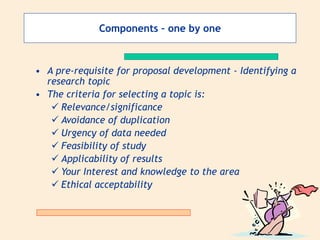
Components – one by one
• A pre-requisite for proposal development - Identifying a
research topic
• The criteria for selecting a topic is:
 Relevance/significance
 Avoidance of duplication
 Urgency of data needed
 Feasibility of study
 Applicability of results
 Your Interest and knowledge to the area
 Ethical acceptability
What your topic should be?
• Title /Topic – the fewest possible words that adequately
describe the contents of the study. (not more than 12 words)
 It is a label; not a sentence It should be as brief as possible
 It shouldn’t contain any abbreviations
 It appears on the title page and on top of the abstract
Note: The title page has no page number and is not counted.
E.g.
• Quality assessment of low cost houses in Addis Ababa
• Effect of web-site technology on distance education class attendance
• Influence of Hollow Concrete Block Infill Wall on Lateral Stiffness of Buildings
• Assessment of the engineering properties of soils in Holleta Town
• Determinants of Project Success in Construction Industries
Wilkinson (1991) suggests
Eliminate unnecessary words
An Approach to ….
A Study of ….
Use a single title or a double title
Sample Title Page
7
School of Civil Engineering
Department of Building Construction
Determinants of Project Success in Construction Industries
Your Name
A Research Proposal Submitted to Course Instructor: Semere Yilma
(PhD. Candidate)
The Presented in Partial Fulfillment of the requirements for Research
Methods
Addis Ababa, Ethiopia
June 2016
Components of a Research proposal
• Summary/Abstract – a one page brief summary of the
thesis proposal.
 It show that your work fits with the topic
 It show what a contribution your work will make.
 It should specify the research question and how it is
going to be answered.
 Do not put any information not stated in the main
text.
 Never contain references, figures and tables.
 It comes first but written last.
 It contains the:
 Objective of the study
 Research problem
 Methodology
 Major findings (Result)
 Major recommendation or Implications
Contents of a Research Proposal,…
Introduction
 The introduction part of a research proposal
should have the following sections:
 Background
 Problem statement
 Research objectives (general and specific)
 Research question/hypotheses
 Significance of the study
 Scope of the study
 Definition of Terms (Operational Definitions of Terms)
 Organization of the study
 Note:
🞑 This part will later on serve as the „Chapter One‟ of the
thesis
🞑 It should be rewritten in past tense wherever necessary.
9
Components of a Research proposal
• Introduction/Background – background information of
the research proposal.
 It establishes a framework for the research show
what a contribution your work will make.
 It should motivate the reader to read the whole
paper
 Should site the most recent and relevant works, and
should explain why work is required.
Cont….
 The background section sets out the direction the researcher
intends to take.
 Introducing the topic entails putting the study into context and
broadly touching on some considered key issues.
🞑 One may begin with offering a broad context for study, and quickly
come to the point with a narrow focus.
🞑 Place the study within the larger context of existing scholarly
literature while reaching out to a specific audience.
 Pick on issues that lead you to the research problem or
question by identifying various dimensions in which problem
manifests itself.
11
Cont….
• Statement of the problem – the general issue that leads
to a need for the study.
 It answer the question ‘Why does this research be
conducted?’
 The foundation for everything to follow in the
proposal.
Cont….
 The research problem refers to a situation whereby there
is observable negative or positive developments of
which there is a knowledge gap.
 The researcher needs to be focused, and must single
out and clearly state the problem. Is the problem:
 Capable of being investigated or evaluated empirically
through collection and analysis of relevant data?
 Brief and clear?
 Researchable by lending itself to appropriate sources of data or
information capable of providing solutions to the
problems identified?
 Fitting itself well to established theories or concepts?
 The research problem refers to a situation whereby there
is observable negative or positive developments of
which there is a knowledge gap.
 The researcher needs to be focused, and must single
out and clearly state the problem. Is the problem:
 Capable of being investigated or evaluated empirically
through collection and analysis of relevant data?
 Brief and clear?
 Researchable by lending itself to appropriate sources of data or
information capable of providing solutions to the
problems identified?
 Fitting itself well to established theories or concepts?
12
Cont….
 The following guiding questions could be
helpful:
a) Who is affected and how?
b) What is missing and where?
c) What went wrong and to what extent?
d) What are the notable effects, where, and for
whom?
e) Is the problem self-expressive or does it generate
other problems?
13
Objective of the study
• Objective of the study – aim which the enquirer seeks to bring
about as a result of completing the research.
 Objectives should be simple, specific, stated in advance,
stated using action verbs
 Objectives can be classified into:
 General objective – showing what exactly to be studied,
and states the desired outcomes from the study.
 Specific objectives – shows in greater detail the specific
aims of the research project.
To study the impact of the use of web site technology on
distance education class attendance in a community college
Example:
The general objective of this research is to explore the determinants of
project success in construction industries.
Specific Research Objectives
 These must be linked to the main objective in a logical way.
 When put together, the specific objectives, which must be set in
SMART
formation, must lead to the accomplishment of the main objective of the
study.
 Example: They have to be attached with the possible
determinants of project success.
 The specific objectives of this study is to explore:
 What project related factors affect project success:.
 Project Procedures
 Project Management Actions
 Human-related factors
 External environment
16
Research Questions/Hypotheses
 The decision to formulate either research questions
or hypotheses will depend on the research approach
you have chosen.
 It is generally the understanding that research can
either be qualitative, quantitative, or mixed.
 The general rule is to formulate research questions for
qualitative studies and research hypothesis for
quantitative studies.
 Deciding to whether to use research questions or
hypothesis depends on the factors such as:
 The purpose of the study,
 Nature of the research design and methodology, and
 Nature of the audience
17
Research Question:
🞑 A research question poses a relationship between two
or more variables but phrases that relationship as a
question.
🞑 The questions should be derived from the main research
problem.
🞑 The research questions should render themselves to
clear and
precise answers.
🞑 They should be such that they demand data collection
and
analysis.
18
Research Hypotheses
🞑 A hypothesis is a tentative conjectural statement of
a relationship between or among variables .
 It is a sort of intellectual (informed) guess.
🞑 It represents a declarative statement based on a
hunch or
suspicion based on extended observation by the
researcher.
🞑 The statement should be tested through research
and must,
finally, be either accepted or rejected.
🞑 It must be statistically testable and related to
observable
phenomenon.
19
Significance of the Study
 The researcher should demonstrate why the
research he/she plans to conduct is worthwhile –
Why the study is significant?
 What benefits are seen when deciding to go through the
pains of research?
 What will it contribute to the existing research literature?
 What implications your findings may have?
 Why do it now?
🞑 State:
 The benefits to be derived from research
 Indicate who is likely to benefit (beneficiaries of the outcome
of the research)
 How this is likely to happen.
20
Scope (Delimitation) of the Study
 This refers to the contextual and conceptual
boundaries of the study which may include:
 The key concerns of study
 The extent it tries to resolve the problem
 Population (who are included and why)
 The time horizon covered in the study
 How deep and wide the researcher plans to
address the problem
 How the study will be narrowed in scope
 This is controlled by the researcher
 Putting a fence around the research problem
21
Limitation of the Study
 When it comes at the beginning (Introduction)
 Factors that will affect the study
 How you plan to overcome the challenges
 When it comes after findings
 What your research lacks
 The limitations it has or what you haven’t addressed
 Limitations are not usually controlled by the researcher
22
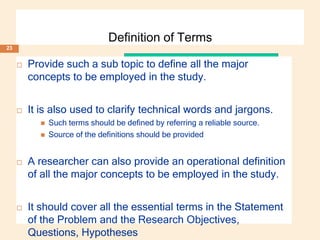
Definition of Terms
 Provide such a sub topic to define all the major
concepts to be employed in the study.
 It is also used to clarify technical words and jargons.
 Such terms should be defined by referring a reliable source.
 Source of the definitions should be provided
 A researcher can also provide an operational definition
of all the major concepts to be employed in the study.
 It should cover all the essential terms in the Statement
of the Problem and the Research Objectives,
Questions, Hypotheses
23
Literature review
• Literature review – a description of the literature very
relevant to your study.
 Gives an overview of what has been said, who the key
authors in the area are, what are the prevailing
theories and hypothesis, etc.
 Relevant materials could be from books, journal
articles, theses and dissertations, government
reports, etc.
Note:
• Be very careful to check your sources when
doing your literature review.
• Many trade magazines are not peer reviewed.
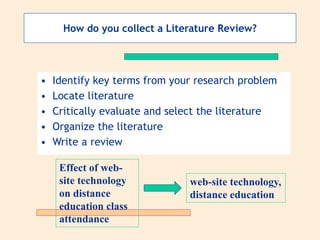
• Identify key terms from your research problem
• Locate literature
• Critically evaluate and select the literature
• Organize the literature
• Write a review
How do you collect a Literature Review?
Effect of web-
site technology
on distance
education class
attendance
web-site technology,
distance education
Cont…….
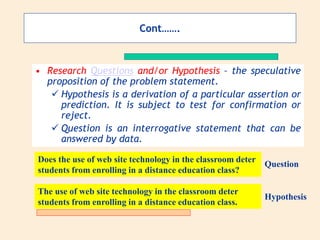
• Research Questions and/or Hypothesis – the speculative
proposition of the problem statement.
 Hypothesis is a derivation of a particular assertion or
prediction. It is subject to test for confirmation or
reject.
 Question is an interrogative statement that can be
answered by data.
Does the use of web site technology in the classroom deter
students from enrolling in a distance education class?
The use of web site technology in the classroom deter
students from enrolling in a distance education class.
Hypothesis
Question
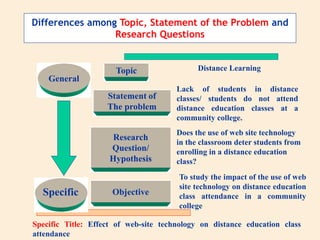
Differences among Topic, Statement of the Problem and
Research Questions
General
Specific
Topic
Statement of
The problem
Research
Question/
Hypothesis
Distance Learning
Lack of students in distance
classes/ students do not attend
distance education classes at a
community college.
Does the use of web site technology
in the classroom deter students from
enrolling in a distance education
class?
Objective
To study the impact of the use of web
site technology on distance education
class attendance in a community
college
Specific Title: Effect of web-site technology on distance education class
attendance
Cont….
• Materials and Methods/Methodology - a detail
description of the materials, activities and the methodological
steps you will take to achieve your objectives.
• Depending upon the type of study, it includes:
 Description of study area, study design and study
participants
 Sampling technique and sample size used
 Methods of data collection
 Method (s) of data analysis, etc.
Cont…
• Study design:
Depending upon the type of study, it could be:
 Observational studies – the researchers stand apart from
events taking place in the study
 Experimental/intervention studies – the investigator tests
the effect of an intervention on the events taking place in
the study.
Cont………
• Work plan – a schedule that summarizes the different
components of a research proposal and how they will be
implemented. Here,
 Different phase/components of the study should be stated
 Describe the activities in each phase.
 Indicate time frame to accomplish the various aspects of
the study.
 Could be presented in table, chart (Gantt chart) or graph.
Cont….
• Budget and funding – the cost of conducting research.
 Budget items need to be explicitly stated with
justification
 Costs are typically:
 Direct costs – personnel, consumable supplies,
equipments, travel, publication, etc.
 Indirect costs – overhead and administrative costs.
Cont…
• References – citation of all the information that you
obtain as a support for conducting your research.
 Be careful, the style of writing list of references
varies from one discipline to another.
Cont….
• Appendices/annexes – additional information provided
for the reader. These include, for example,
 Dummy tables
 Biographical data
 Questionnaire, forms, etc.
Before start writing…answer the following questions.
• Do I have the clear research question?
• Have I read broadly and deeply in that area?
• Have I discussed the topic with peers?
• Have I enough time and fund to start?
• Do I feel support from faculty and friends?
What you should do for Proposal Writing?
In proposal writing, be prepared:
• To make mistakes and to learn.
• To write and rewrite many times.
• To spend many hours looking for information.
• To have your writing criticized.
• To feel confuse and hopeless some times.
What you should do for Proposal Writing?
• Make it simple
– Avoid showy language, unnecessary jargon, and double
speak by cutting down every unnecessary word.
• Read your work loud
– A sentence that is difficult to say will be difficult to
read.
– Each sentence must follow logically from the before:
chain of ideas.
– Every sentence must contain one idea only.
• Contemporary
• contemplete
Tips for successful proposal writing
• Revise , revise, revise.
– Check spelling and grammar.
– Each sentence must follow logically from the before:
chain of ideas.
– Every sentence must contain one idea only.
• Put an end to it
– The faster you finish the proposal and submit it the
less time you have wasted thinking about writing it.
– Give sufficient time but be on time for submission
Tips for successful proposal writing
Thank you
• Select a Topic that you interested
• Review three to Five scientific papers
• Read three published scientific papers (of varying
quality) and write a short report for each of them.
• Individual work.
• NOTE: successful completion of this assignment is
mandatory in order to be allowed to do the rest of
the assignments.
Group Assignment 1
Literature Review
• Identify any researchable topic in your field
of specialization
• Develop Research Proposal
Group Project

Research Method Proposal Development in Eng.

  • 1.
  • 2.
    Definition • What isa research proposal?  It is a detailed plan of your study.  It is a document which sets out your ideas in an easily accessible way.  Objective of writing a proposal:  to present a focused and scholarly presentation of a research problem and plan.  to describe what you will do, why it should be done, how you will do it, and what you expect will result.
  • 3.
    Overview of aResearch Proposal  A research proposal is a document that presents a plan for a research project to reviewers’ evaluation.  It is like a blue print of a building plan before the construction starts  The purpose of research proposal is to convince reviewers that the researcher is capable of successfully conducting the proposed research project. 2
  • 4.
    Overview of aResearch Proposal  A well written, highly organized, and carefully planned proposal provides an assurance that the project will be successfully completed.  A proposal  describes the research problem and its importance  gives a detailed account of the methods that will be used and why they are appropriate. 3
  • 5.
    OverviewofaResearchProposal,…  The mainquestions to answer when writing a research proposal are:  Is my proposed research interesting, important, and relevant?  Who has done work in this area so far?  What are my objectives and my research questions?  How do I intend to do the research?  What is my timetable for conducting the research?  What do I expect the outcome of the research to be? 4
  • 6.
    What your proposalshould answer? • What do you want to do? – research question • Why do you want to do it? – Any information gap • Why is it important? – any practical importance or knowledge advancement • Who has done similar work? - background • How are you going to do it? -methodology • How long will it take? – plan of work What questions your proposal should answer?
  • 7.
    Components of aResearch proposal document • The most logical order of a research proposal development is:  Title/research topic  Summary/Abstract  Introduction/background  Statement of the problem  Objectives  Questions or Hypothesis  Literature review  Materials and Methods/ Methodology  Work plan  Budget and funding  References  Appendices/Annexes
  • 8.
    In no morethan 10 pages,(but depending on your institute Research Guideline) • Front page: Title, your name, name of advisor, department. • Second page: content • Third page: Abstract: Not more than 200 words. • Fourth–seventh page: with bold headings: Introduction, objectives, Literature review; hypothesis, materials and methods; data analysis • Eighth page: Work plan • Ninth page: Budget • Last page: References: Your proposal Format - Recommendation
  • 9.
    Components – oneby one • A pre-requisite for proposal development - Identifying a research topic • The criteria for selecting a topic is:  Relevance/significance  Avoidance of duplication  Urgency of data needed  Feasibility of study  Applicability of results  Your Interest and knowledge to the area  Ethical acceptability
  • 10.
    What your topicshould be? • Title /Topic – the fewest possible words that adequately describe the contents of the study. (not more than 12 words)  It is a label; not a sentence It should be as brief as possible  It shouldn’t contain any abbreviations  It appears on the title page and on top of the abstract Note: The title page has no page number and is not counted. E.g. • Quality assessment of low cost houses in Addis Ababa • Effect of web-site technology on distance education class attendance • Influence of Hollow Concrete Block Infill Wall on Lateral Stiffness of Buildings • Assessment of the engineering properties of soils in Holleta Town • Determinants of Project Success in Construction Industries Wilkinson (1991) suggests Eliminate unnecessary words An Approach to …. A Study of …. Use a single title or a double title
  • 11.
    Sample Title Page 7 Schoolof Civil Engineering Department of Building Construction Determinants of Project Success in Construction Industries Your Name A Research Proposal Submitted to Course Instructor: Semere Yilma (PhD. Candidate) The Presented in Partial Fulfillment of the requirements for Research Methods Addis Ababa, Ethiopia June 2016
  • 12.
    Components of aResearch proposal • Summary/Abstract – a one page brief summary of the thesis proposal.  It show that your work fits with the topic  It show what a contribution your work will make.  It should specify the research question and how it is going to be answered.  Do not put any information not stated in the main text.  Never contain references, figures and tables.  It comes first but written last.  It contains the:  Objective of the study  Research problem  Methodology  Major findings (Result)  Major recommendation or Implications
  • 13.
    Contents of aResearch Proposal,… Introduction  The introduction part of a research proposal should have the following sections:  Background  Problem statement  Research objectives (general and specific)  Research question/hypotheses  Significance of the study  Scope of the study  Definition of Terms (Operational Definitions of Terms)  Organization of the study  Note: 🞑 This part will later on serve as the „Chapter One‟ of the thesis 🞑 It should be rewritten in past tense wherever necessary. 9
  • 14.
    Components of aResearch proposal • Introduction/Background – background information of the research proposal.  It establishes a framework for the research show what a contribution your work will make.  It should motivate the reader to read the whole paper  Should site the most recent and relevant works, and should explain why work is required.
  • 15.
    Cont….  The backgroundsection sets out the direction the researcher intends to take.  Introducing the topic entails putting the study into context and broadly touching on some considered key issues. 🞑 One may begin with offering a broad context for study, and quickly come to the point with a narrow focus. 🞑 Place the study within the larger context of existing scholarly literature while reaching out to a specific audience.  Pick on issues that lead you to the research problem or question by identifying various dimensions in which problem manifests itself. 11
  • 16.
    Cont…. • Statement ofthe problem – the general issue that leads to a need for the study.  It answer the question ‘Why does this research be conducted?’  The foundation for everything to follow in the proposal.
  • 17.
    Cont….  The researchproblem refers to a situation whereby there is observable negative or positive developments of which there is a knowledge gap.  The researcher needs to be focused, and must single out and clearly state the problem. Is the problem:  Capable of being investigated or evaluated empirically through collection and analysis of relevant data?  Brief and clear?  Researchable by lending itself to appropriate sources of data or information capable of providing solutions to the problems identified?  Fitting itself well to established theories or concepts?  The research problem refers to a situation whereby there is observable negative or positive developments of which there is a knowledge gap.  The researcher needs to be focused, and must single out and clearly state the problem. Is the problem:  Capable of being investigated or evaluated empirically through collection and analysis of relevant data?  Brief and clear?  Researchable by lending itself to appropriate sources of data or information capable of providing solutions to the problems identified?  Fitting itself well to established theories or concepts? 12
  • 18.
    Cont….  The followingguiding questions could be helpful: a) Who is affected and how? b) What is missing and where? c) What went wrong and to what extent? d) What are the notable effects, where, and for whom? e) Is the problem self-expressive or does it generate other problems? 13
  • 19.
    Objective of thestudy • Objective of the study – aim which the enquirer seeks to bring about as a result of completing the research.  Objectives should be simple, specific, stated in advance, stated using action verbs  Objectives can be classified into:  General objective – showing what exactly to be studied, and states the desired outcomes from the study.  Specific objectives – shows in greater detail the specific aims of the research project. To study the impact of the use of web site technology on distance education class attendance in a community college Example: The general objective of this research is to explore the determinants of project success in construction industries.
  • 20.
    Specific Research Objectives These must be linked to the main objective in a logical way.  When put together, the specific objectives, which must be set in SMART formation, must lead to the accomplishment of the main objective of the study.  Example: They have to be attached with the possible determinants of project success.  The specific objectives of this study is to explore:  What project related factors affect project success:.  Project Procedures  Project Management Actions  Human-related factors  External environment 16
  • 21.
    Research Questions/Hypotheses  Thedecision to formulate either research questions or hypotheses will depend on the research approach you have chosen.  It is generally the understanding that research can either be qualitative, quantitative, or mixed.  The general rule is to formulate research questions for qualitative studies and research hypothesis for quantitative studies.  Deciding to whether to use research questions or hypothesis depends on the factors such as:  The purpose of the study,  Nature of the research design and methodology, and  Nature of the audience 17
  • 22.
    Research Question: 🞑 Aresearch question poses a relationship between two or more variables but phrases that relationship as a question. 🞑 The questions should be derived from the main research problem. 🞑 The research questions should render themselves to clear and precise answers. 🞑 They should be such that they demand data collection and analysis. 18
  • 23.
    Research Hypotheses 🞑 Ahypothesis is a tentative conjectural statement of a relationship between or among variables .  It is a sort of intellectual (informed) guess. 🞑 It represents a declarative statement based on a hunch or suspicion based on extended observation by the researcher. 🞑 The statement should be tested through research and must, finally, be either accepted or rejected. 🞑 It must be statistically testable and related to observable phenomenon. 19
  • 24.
    Significance of theStudy  The researcher should demonstrate why the research he/she plans to conduct is worthwhile – Why the study is significant?  What benefits are seen when deciding to go through the pains of research?  What will it contribute to the existing research literature?  What implications your findings may have?  Why do it now? 🞑 State:  The benefits to be derived from research  Indicate who is likely to benefit (beneficiaries of the outcome of the research)  How this is likely to happen. 20
  • 25.
    Scope (Delimitation) ofthe Study  This refers to the contextual and conceptual boundaries of the study which may include:  The key concerns of study  The extent it tries to resolve the problem  Population (who are included and why)  The time horizon covered in the study  How deep and wide the researcher plans to address the problem  How the study will be narrowed in scope  This is controlled by the researcher  Putting a fence around the research problem 21
  • 26.
    Limitation of theStudy  When it comes at the beginning (Introduction)  Factors that will affect the study  How you plan to overcome the challenges  When it comes after findings  What your research lacks  The limitations it has or what you haven’t addressed  Limitations are not usually controlled by the researcher 22
  • 27.
    Definition of Terms Provide such a sub topic to define all the major concepts to be employed in the study.  It is also used to clarify technical words and jargons.  Such terms should be defined by referring a reliable source.  Source of the definitions should be provided  A researcher can also provide an operational definition of all the major concepts to be employed in the study.  It should cover all the essential terms in the Statement of the Problem and the Research Objectives, Questions, Hypotheses 23
  • 28.
    Literature review • Literaturereview – a description of the literature very relevant to your study.  Gives an overview of what has been said, who the key authors in the area are, what are the prevailing theories and hypothesis, etc.  Relevant materials could be from books, journal articles, theses and dissertations, government reports, etc. Note: • Be very careful to check your sources when doing your literature review. • Many trade magazines are not peer reviewed.
  • 29.
    • Identify keyterms from your research problem • Locate literature • Critically evaluate and select the literature • Organize the literature • Write a review How do you collect a Literature Review? Effect of web- site technology on distance education class attendance web-site technology, distance education
  • 30.
    Cont……. • Research Questionsand/or Hypothesis – the speculative proposition of the problem statement.  Hypothesis is a derivation of a particular assertion or prediction. It is subject to test for confirmation or reject.  Question is an interrogative statement that can be answered by data. Does the use of web site technology in the classroom deter students from enrolling in a distance education class? The use of web site technology in the classroom deter students from enrolling in a distance education class. Hypothesis Question
  • 31.
    Differences among Topic,Statement of the Problem and Research Questions General Specific Topic Statement of The problem Research Question/ Hypothesis Distance Learning Lack of students in distance classes/ students do not attend distance education classes at a community college. Does the use of web site technology in the classroom deter students from enrolling in a distance education class? Objective To study the impact of the use of web site technology on distance education class attendance in a community college Specific Title: Effect of web-site technology on distance education class attendance
  • 32.
    Cont…. • Materials andMethods/Methodology - a detail description of the materials, activities and the methodological steps you will take to achieve your objectives. • Depending upon the type of study, it includes:  Description of study area, study design and study participants  Sampling technique and sample size used  Methods of data collection  Method (s) of data analysis, etc.
  • 33.
    Cont… • Study design: Dependingupon the type of study, it could be:  Observational studies – the researchers stand apart from events taking place in the study  Experimental/intervention studies – the investigator tests the effect of an intervention on the events taking place in the study.
  • 34.
    Cont……… • Work plan– a schedule that summarizes the different components of a research proposal and how they will be implemented. Here,  Different phase/components of the study should be stated  Describe the activities in each phase.  Indicate time frame to accomplish the various aspects of the study.  Could be presented in table, chart (Gantt chart) or graph.
  • 35.
    Cont…. • Budget andfunding – the cost of conducting research.  Budget items need to be explicitly stated with justification  Costs are typically:  Direct costs – personnel, consumable supplies, equipments, travel, publication, etc.  Indirect costs – overhead and administrative costs.
  • 36.
    Cont… • References –citation of all the information that you obtain as a support for conducting your research.  Be careful, the style of writing list of references varies from one discipline to another.
  • 37.
    Cont…. • Appendices/annexes –additional information provided for the reader. These include, for example,  Dummy tables  Biographical data  Questionnaire, forms, etc.
  • 38.
    Before start writing…answerthe following questions. • Do I have the clear research question? • Have I read broadly and deeply in that area? • Have I discussed the topic with peers? • Have I enough time and fund to start? • Do I feel support from faculty and friends? What you should do for Proposal Writing?
  • 39.
    In proposal writing,be prepared: • To make mistakes and to learn. • To write and rewrite many times. • To spend many hours looking for information. • To have your writing criticized. • To feel confuse and hopeless some times. What you should do for Proposal Writing?
  • 40.
    • Make itsimple – Avoid showy language, unnecessary jargon, and double speak by cutting down every unnecessary word. • Read your work loud – A sentence that is difficult to say will be difficult to read. – Each sentence must follow logically from the before: chain of ideas. – Every sentence must contain one idea only. • Contemporary • contemplete Tips for successful proposal writing
  • 41.
    • Revise ,revise, revise. – Check spelling and grammar. – Each sentence must follow logically from the before: chain of ideas. – Every sentence must contain one idea only. • Put an end to it – The faster you finish the proposal and submit it the less time you have wasted thinking about writing it. – Give sufficient time but be on time for submission Tips for successful proposal writing
  • 42.
  • 43.
    • Select aTopic that you interested • Review three to Five scientific papers • Read three published scientific papers (of varying quality) and write a short report for each of them. • Individual work. • NOTE: successful completion of this assignment is mandatory in order to be allowed to do the rest of the assignments. Group Assignment 1 Literature Review
  • 44.
    • Identify anyresearchable topic in your field of specialization • Develop Research Proposal Group Project