RESEARCH
VARIABLES AND
THEIR USES
WHAT IS A VARIABLE?
it comes from the root
word "vary" which
means to undergo
changes or to differ
from
VARIABLE
•refers to the changing
qualities or
characteristics of
persons or things
MINUTE TO WIN IT
• List down as
many
variables
that you can
think of
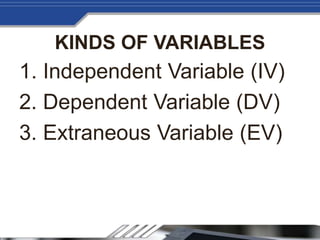
KINDS OF VARIABLES
1. Independent Variable (IV)
2. Dependent Variable (DV)
3. Extraneous Variable (EV)
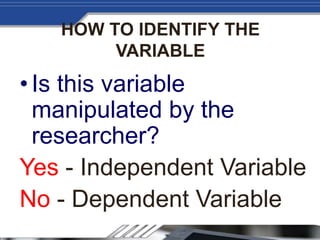
HOW TO IDENTIFY THE
VARIABLE
•Is this variable
manipulated by the
researcher?
Yes - Independent Variable
No - Dependent Variable
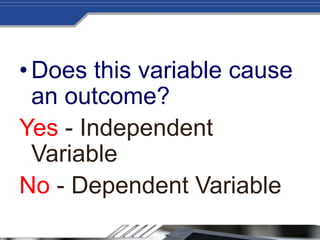
•Does this variable cause
an outcome?
Yes - Independent
Variable
No - Dependent Variable
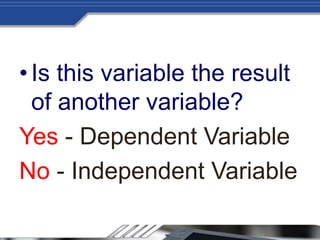
•Is this variable the result
of another variable?
Yes - Dependent Variable
No - Independent Variable
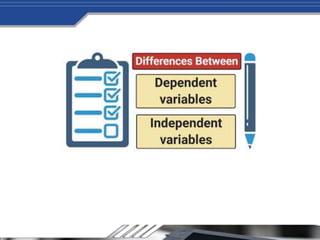
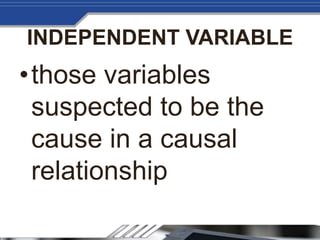
INDEPENDENT VARIABLE
•those variables
suspected to be the
cause in a causal
relationship
DEPENDENT VARIABLES
•those that are
influenced by the
independent
variables
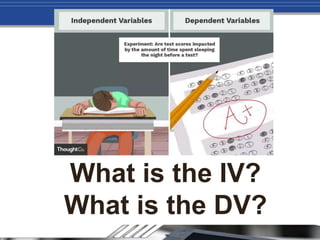
What is the IV?
What is the DV?
EXTRANEOUS VARIABLE
•any extra factor that
may influence the
outcome of the
experiment though it
is not the focus
Examples:
• aspects of the environment
(room temperature, noise
level, light level)
• participant characteristics
• test operator or experimenter
behavior during the test
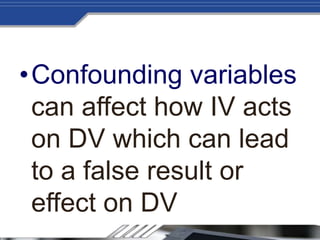
•Confounding variables
can affect how IV acts
on DV which can lead
to a false result or
effect on DV
ASSESSMENT
•Identify the independent
variable (IV), dependent
variable (DV), and
extraneous variable (EV)
in the following:
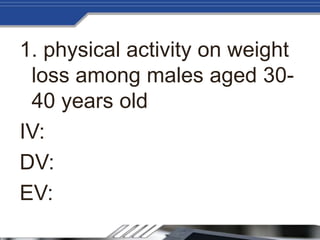
1. physical activity on weight
loss among males aged 30-
40 years old
IV:
DV:
EV:
2. relationship of income to
educational level of workers
in the sugar company
IV:
DV:
EV:
3. amount of time spent
studying and test score of
senior high school students
IV:
DV:
EV:
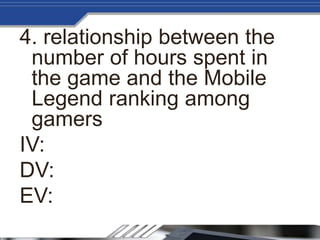
4. relationship between the
number of hours spent in
the game and the Mobile
Legend ranking among
gamers
IV:
DV:
EV:
5. A study conducted to
investigate the effect of
stress on the mental
health of students
DV:
IV:
EV:
RESEARCH VARIABLES AND THEIR USES.ppt

RESEARCH VARIABLES AND THEIR USES.ppt