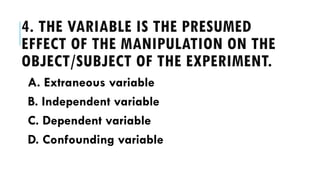
4. THE VARIABLEIS THE PRESUMED
EFFECT OF THE MANIPULATION ON THE
OBJECT/SUBJECT OF THE EXPERIMENT.
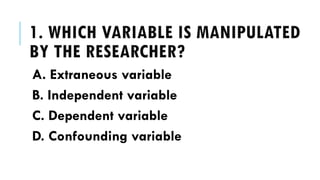
A. Extraneous variable
B. Independent variable
C. Dependent variable
D. Confounding variable
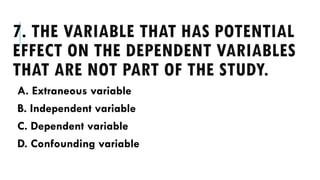
7. THE VARIABLETHAT HAS POTENTIAL
EFFECT ON THE DEPENDENT VARIABLES
THAT ARE NOT PART OF THE STUDY.
A. Extraneous variable
B. Independent variable
C. Dependent variable
D. Confounding variable
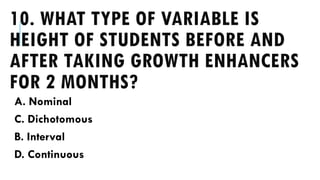
10. WHAT TYPEOF VARIABLE IS
HEIGHT OF STUDENTS BEFORE AND
AFTER TAKING GROWTH ENHANCERS
FOR 2 MONTHS?
A. Nominal
C. Dichotomous
B. Interval
D. Continuous
For instance, duringthe
quarantine period, your
mother planted tomato
seedlings in pots.
25.
Now common understanding
fromscience tells you that
several factors are affecting the
growth of tomatoes:
sunlight, water, kind of soil, and
nutrients in soil.
26.
HOW FAST THETOMATO SEEDLINGS
WILL GROW AND BEAR FRUITS WILL
DEPEND ON THESE FACTORS.
The growth of tomatoes and the
number of fruits produced are
examples of the Dependent
Variables.
27.
The amount ofsunlight, water,
and nutrients in the soil are
the Independent Variables.
28.
If there isan existing relationship
between the independent and
dependent variables, then the value
of the dependent variable varies in
response to the manipulation done
on the independent variable.
29.
The independent variableis
also identified as the
presumed cause while the
dependent variable is the
presumed effect.
30.
In an experimentalquantitative
design, the independent
variable is pre-defined and
manipulated by the researcher
while the dependent variable
is observed and measured.
31.
For descriptive, correlational,and
ex post facto quantitative research
designs, independent and
dependent variables simply do not
apply.
32.
It is importantto note other factors that
may influence the outcome (dependent
variable) not manipulated or pre-
defined by the researcher.
These factors are called Extraneous
Variables.
33.
In our exampleabove, the presence of
pests and environmental stressors (e.g.
pets, extreme weather) are the
extraneous variables.
34.
Since extraneous variablesmay affect
the result of the experiment, it is crucial
for the researcher to identify them prior
to conducting the experiment and control
them in such a way that they do not
threaten the internal validity (i.e.
accurate conclusion) of the result.
When the researcherfails to
control the extraneous variable
that it caused considerable effect
to the outcome, the extraneous
variable becomes a Confounding
Variable.
37.
For example, ifthe tomato had been infested by
pests (confounding variable) then you cannot
conclude that manipulations in sunlight, water, and
soil nutrients (independent variable) are the only
contributing factors for the stunted growth and
poor yield (dependent variable) of the plant or is
it the result of both the independent variables
and the confounding variable.
39.
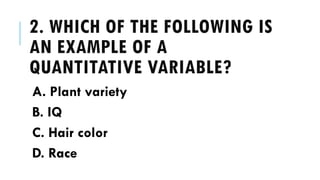
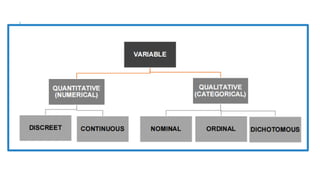
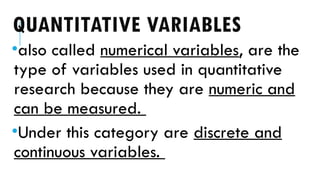
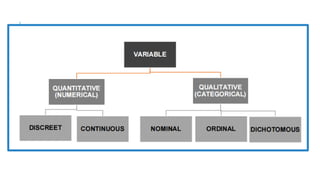
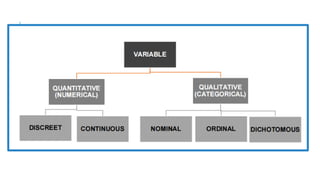
QUANTITATIVE VARIABLES
•also callednumerical variables, are the
type of variables used in quantitative
research because they are numeric and
can be measured.
•Under this category are discrete and
continuous variables.
40.
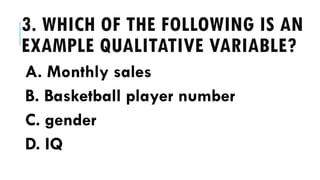
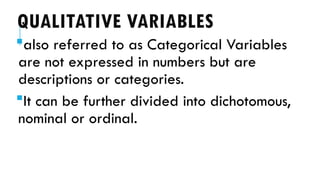
QUALITATIVE VARIABLES
also referredto as Categorical Variables
are not expressed in numbers but are
descriptions or categories.
It can be further divided into dichotomous,
nominal or ordinal.
42.
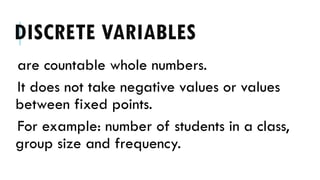
DISCRETE VARIABLES
are countablewhole numbers.
It does not take negative values or values
between fixed points.
For example: number of students in a class,
group size and frequency.
43.
Continuous variables takefractional
(non-whole number) values that can
either be a positive or a negative.
Example: height, temperature.
INTERVALS
are quantitative variableswhere
the interval or differences
between consecutive values are
equal and meaningful, but the
numbers are arbitrary.
46.
For example, thedifference
between 36 degrees and 37
degrees is the same as
between 100 degrees and
101 degrees.
47.
The zero pointdoes not suggest the
absence of a property being
measured.
Temperature at 0 degree Celsius is
assigned as the melting point of ice.
Other examples of interval data
would be year and IQ score.
48.
RATIO
type of datais similar to interval.
The only difference is the presence of a true
zero value.
The zero point in this scale indicates the
absence of the quantity being measured.
Examples are age, height, weight, and
distance.
50.
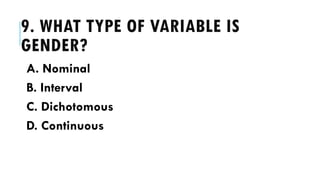
DICHOTOMOUS VARIABLE
consists ofonly two distinct
categories or values, for example,
a response to a question either be
a yes or no.
51.
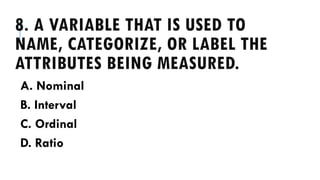
NOMINAL VARIABLE
simply definesgroups of subjects. In here, you may have
more than 2 categories of equivalent magnitude.
For example, a basketball player’s number is used to
distinguish him from other players.
It certainly does not follow that player 10 is better than
player 8.
Other examples are blood type, hair color and mode of
transportation.
52.
ORDINAL VARIABLE
from thename itself, denotes that a
variable is ranked in a certain
order.
This variable can have a
qualitative or quantitative attribute.
53.
For example, asurvey questionnaire may have a
numerical rating as choices like 1, 2, 3, 4,
5ranked accordingly (5=highest, 1=lowest) or
categorical rating like strongly agree, agree,
neutral, disagree and strongly disagree.
Other examples or ordinal variable: cancer
stage (Stage I, Stage II, Stage III), Spotify Top 20
hits, academic honors (with highest, with high, with
honors).
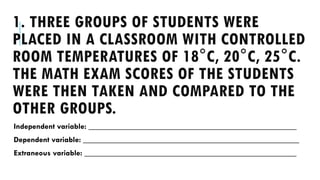
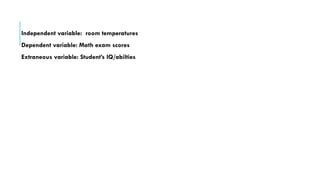
1. THREE GROUPSOF STUDENTS WERE
PLACED IN A CLASSROOM WITH CONTROLLED
ROOM TEMPERATURES OF 18°C, 20°C, 25°C.
THE MATH EXAM SCORES OF THE STUDENTS
WERE THEN TAKEN AND COMPARED TO THE
OTHER GROUPS.
Independent variable: ____________________________________________________
Dependent variable: ______________________________________________________
Extraneous variable: _____________________________________________________
2. AN ONLINESELLER WOULD LIKE TO KNOW WHETHER
THE INDICATION OF PRICE ON FACEBOOK POSTS WILL
ATTRACT CONSUMERS MORE. HE POSTED 50 PRODUCTS
FOR SALE ON FACEBOOK MARKET, 25 OF WHICH
HE INDICATED THE PRICE WHILE THE REMAINING 25
PRODUCTS, DID NOT HAVE PRICES. BUYERS WERE
JUST INSTRUCTED TO SEND HIM A PERSONAL MESSAGE
(PM) IF THEY WANT TO KNOW THE PRICE. HE
THEN IDENTIFIED WHICH PRODUCTS HAVE GREATER
SALES.
3. A HOUSEWIFEWANTED TO KNOW WHICH SOIL IS
BEST FOR HER PECHAY PLANTS: THE SOIL
PURCHASED FROM AN ONLINE SELLER, SOIL FROM
HER BACKYARD COMPOST OR THE SOIL
UNDERNEATH THE NEARBY BAMBOO TREE. SHE
PLANTED 30 PECHAY SEEDS INTO EACH SOIL SOURCE
AND THEN COMPARED THE GROWTH OF PECHAY
AFTER A MONTH.
61.
3.
Independent variable: SOURCEOF SOIL
Dependent variable: GROWTH OF PECHAY
Extraneous variable: WEATHER OR ENVIRONMENTAL CONDITIONS/PESTS
62.
4. A TEACHERWANTED TO KNOW WHICH LEARNING DELIVERY MODES (PURE ONLINE, PURE MODULAR,
COMBINATION OF ONLINE AND MODULAR) IS MOST EFFECTIVE AND HAS THE FASTEST TURNAROUND TIME IN
THE SUBMISSION OF ACCOMPLISHED ACTIVITIES AMONG HER GRADE 12 STUDENTS. SHE DIVIDED
THE STUDENTS INTO 3 GROUPS, GAVE THEM THE SAME ACTIVITY SHEETS AND ASKED THEM TO SUBMIT AS SOON
AS IT IS COMPLETED. SHE THEN COMPARED THE SCORES AND COMPLETION TIME OF THE 3 GROUPS.
ASSESSMENT
Directions: Explain brieflywhat is being asked
for.
1. Compare and contrast qualitative variables
and quantitative variables using Venn Diagram.
2. Why are dependent and independent
variables not applicable in a descriptive type of
research?
65.
3. How importantis it for the researcher to
identify the type of variables used in the
study?
4. How does confounding variable affect the
validity of the study?
5. When do we use discrete, continuous,
nominal, ordinal?