Research Papers
     Drafting
Writing a First Draft

• Now that your research is done and you’ve made a
  good plan in your outline, it’s time to begin actually
  putting words to paper.
• Don’t worry about making everything perfect this
  first time around—that’s why they call it a draft.
• Just get all of your ideas down in a way that makes
  sense.
Keys to Effective Drafting
1. Write with your purpose, form and audience in mind. Ask
    yourself these questions as you write:
    a) What do I want my readers to learn from my report?
    b) How will I organize my writing to make it easy to understand?
2. Use your first paragraph to introduce your topic, get your reader’s
    attention, and present your thesis statement.
3. In the next few paragraphs, tell about what is important for your
    topic.
4. Remember to cite your sources in your paper and list those
    sources alphabetically on a works cited page (more details later).
Citing Sources Within the Paper

• When you have all the information:
   • The most common citation lists the author’s last name and the page
     number in parentheses:
       • “Marco Polo discovered that Tibetans used salt cakes stamped with the
          imperial seal of the great Kublai Khan as money” (Kemper 70).
   • If you already named the author in your sentence, or if you’re quoting
     from the same item for a second time within the same paragraph, just
     include the page number in parentheses.
       • Steve Kemper explains that during the Civil War, the North sent troops
          to attack the South’s salt producers in order to make the South weaker
          (71).
Citing Sources Within the Paper

• When you DO NOT have all the information:
   • Some sources do not list an author. In those cases use the title (or a
      shortened version of it) and the page number:
        • At first, the salt was used mainly for storing meat and fish and for making ice
           cream (Detroit 167).
   • Some sources, especially websites, do not use page numbers. In those cases,
      just list the author:
        • The seven-foot-tall tires for the dump trucks had to be compressed and bound
           with straps to fit down the shaft (Zacharias).
   • IF a source does not list the author or page number, use the title.
        • Early settlers would collect that liquid and boil away the water to get the salt
           (“Dry”).
5-Paragraph Essay Form
       Say what you’re going to say, say it, then say that you said it.
1. Opening Paragraph
     a) Remember the funnel!
     b) End with your thesis statement.
2.   First Body Paragraph (first point about topic)
3.   Second Body Paragraph (second point about topic)
4.   Third Body Paragraph (third point about topic)
5.   Conclusion Paragraph
     a) Reverse the funnel.
     b) Start by restating your thesis.
Opening Paragraph Approaches

• Start with an interesting fact with broad appeal.
    • Twelve hundred feet below the ground, an enormous mine has been
       operating almost nonstop for more than a century.
• Ask an interesting question.
    • How many people know that there are cars and trucks driving on roads
       more than 1,200 feet below the city of Detroit?
• Start with a quotation.
    • “The only dirty part of this job is getting to work,” says salt miner Joel
       Payton.
Opening Paragraph Example

     Twelve hundred feet below the ground, an enormous mine
has been operating almost nonstop for more than a century. A
hundred miles of tunnels connect its huge chambers. It has
underground roads for cars, trucks, and mining machines. This
mine produces hundreds of tons of “rock” every day.
However, the rock from this mine is not gold, or iron ore, or
even coal; it is salt. This enormous, hundred-year-old salt mine
lies beneath the city of Detroit, Michigan.
Developing the Middle Part

• The middle part of your paper should start by stating why
  your topic is important.
• Each paragraph should focus on one aspect of your topic.
   • Each paragraph should begin with a topic sentence covering one
      main point about your overall topic. This sentence is sort of a mini-
      thesis sentence for just this paragraph.
• Use your outline to help you keep your focus.
First Body Paragraph Example

    Salt is more important than most people realize. Wars have been
fought over it. In ancient China, salt coins were used for money, and
Roman soldiers were often paid in salt, which is where the word
“salary” comes from. Bettina Werner, an artist known as the “Salt
Queen” says, “Salt is like a fifth element, it’s so important to life”
(Lin). In the human body, salt carries electrical signals that keep a
person alive. To stay healthy, a person needs to eat about three
pounds of salt a year (Modern). Salt is also used to preserve meat
and fish, to tan leather, to soften water, and to make many different
chemicals. However, most of the salt from the Detroit mine is now
used to melt ice and snow on streets and highways (Zacharias).
Second Body Paragraph Example

     Scientists say that the Detroit mine digs into a bed of salt that is
several hundred million years old. From 600 million to 230 million
years ago, seawater flooded the middle of North America many
times. As sun and wind evaporated the water, sea salt was deposited
on the submerged land. According to the Salt Institute, “Trillions of
tons of salt, collected in a layer 400 to 1,600 feet thick, reached from
western Michigan all the way to New York . . . . Eventually, it was
covered by silt that became rock more than 1,000 feet thick” (“Dry”).
Later, when people came to the area to settle, they found springs of
salty water bubbling from the ground. They would collect that liquid
and boil away the water to get the salt.
Third Body Paragraph Example
      In 1896, the Detroit salt mine was started in order to dig the salt out of
the ground. It began as a shaft 1,200 feet deep and about six feet wide. At
first, the salt was used mainly for storing meat and fish and for making ice
cream (Detroit 167). In 1940, though, Detroit became the first city to use
rock salt on icy roads. Other cities soon followed Detroit’s example, and the
mine began selling most of its salt to road crews (“Dry”). In 1983, however,
low sales and competition from Canadian mines caused the Detroit mine to
close. Crystal Mines bought the mine, hoping to store hazardous wastes
there. In 1985, while waiting for a permit, they ran public tours of the mine.
“Crystal Mines permit was declined in 1997 and [they] then sold the mine to
the Detroit Salt Company,” explained Kim Roberts, manager of the mine
(Roberts). The mine was reopened, and it again become one of the main
sources of road salt in the United States.
This Example Continues . . .

• This example paper continues beyond what I ask for
  in your assignment. I ask only that you write three
  body paragraphs.
• This sample paper was divided into history of the
  mine, the mine today, and the mine’s future.
• I will share the rest of the example paper so that you
  have further examples of well-written paragraphs,
  and you can see how the conclusion fits into the
  whole.
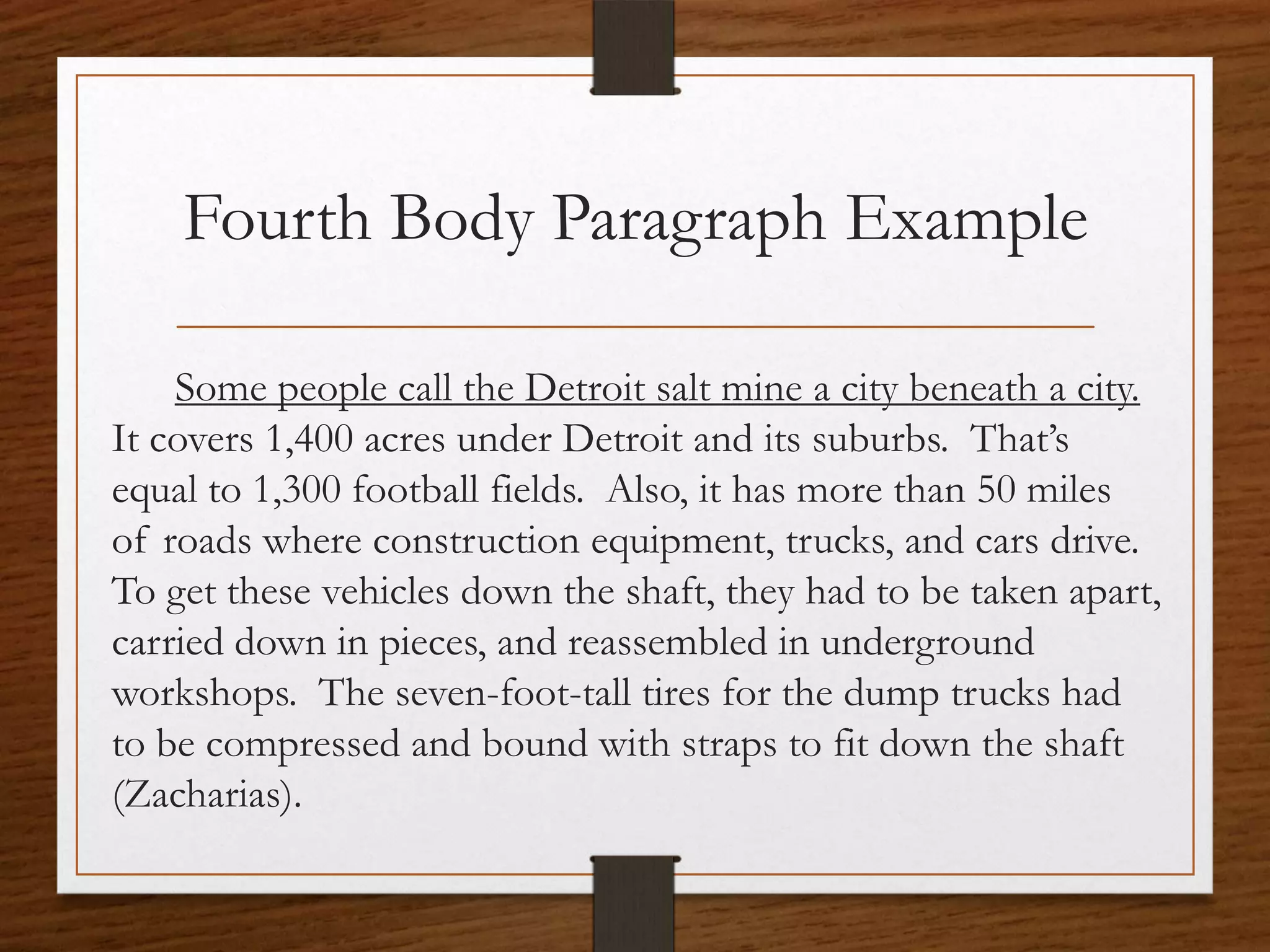
Fourth Body Paragraph Example

    Some people call the Detroit salt mine a city beneath a city.
It covers 1,400 acres under Detroit and its suburbs. That’s
equal to 1,300 football fields. Also, it has more than 50 miles
of roads where construction equipment, trucks, and cars drive.
To get these vehicles down the shaft, they had to be taken apart,
carried down in pieces, and reassembled in underground
workshops. The seven-foot-tall tires for the dump trucks had
to be compressed and bound with straps to fit down the shaft
(Zacharias).
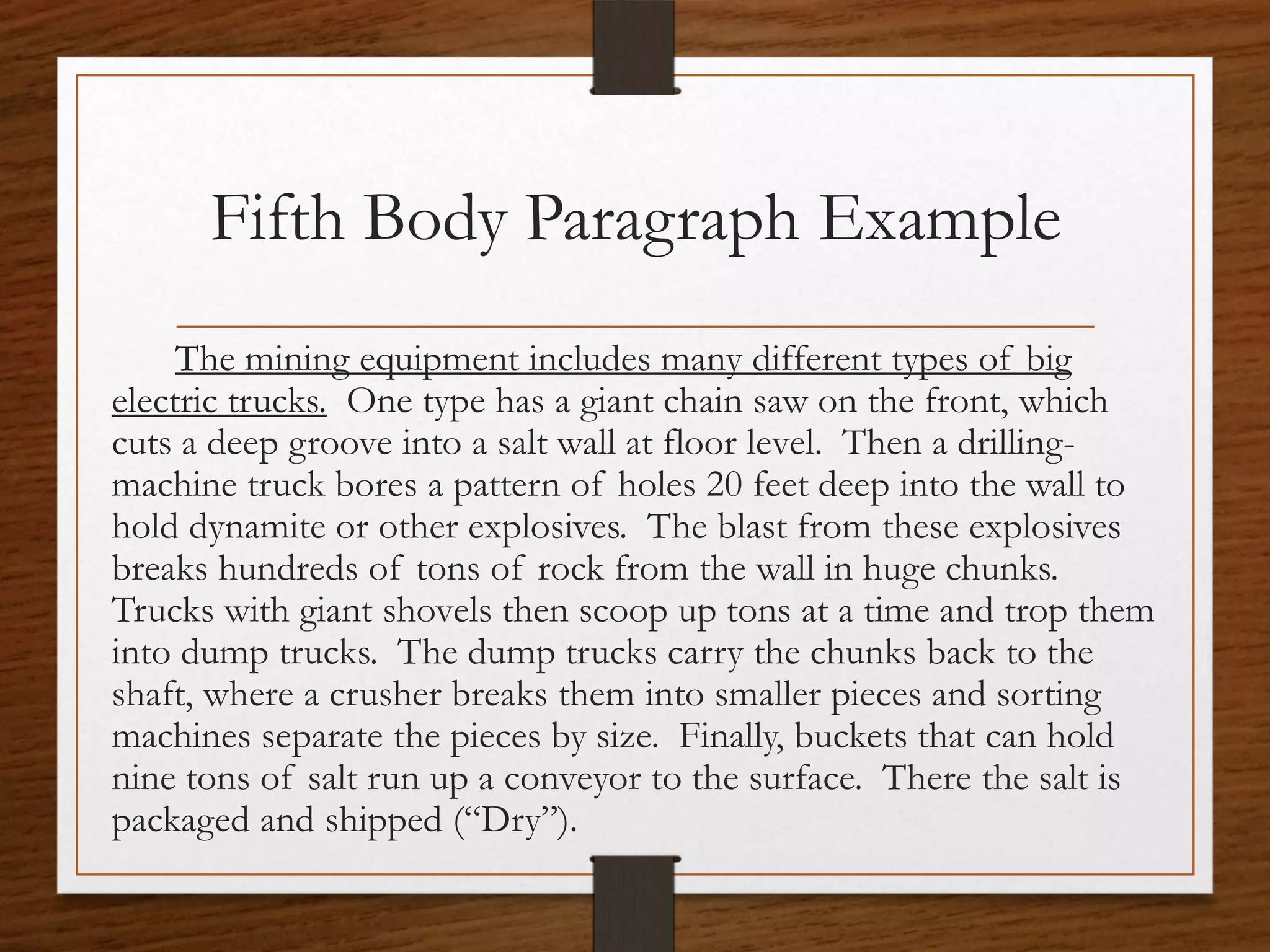
Fifth Body Paragraph Example
     The mining equipment includes many different types of big
electric trucks. One type has a giant chain saw on the front, which
cuts a deep groove into a salt wall at floor level. Then a drilling-
machine truck bores a pattern of holes 20 feet deep into the wall to
hold dynamite or other explosives. The blast from these explosives
breaks hundreds of tons of rock from the wall in huge chunks.
Trucks with giant shovels then scoop up tons at a time and trop them
into dump trucks. The dump trucks carry the chunks back to the
shaft, where a crusher breaks them into smaller pieces and sorting
machines separate the pieces by size. Finally, buckets that can hold
nine tons of salt run up a conveyor to the surface. There the salt is
packaged and shipped (“Dry”).
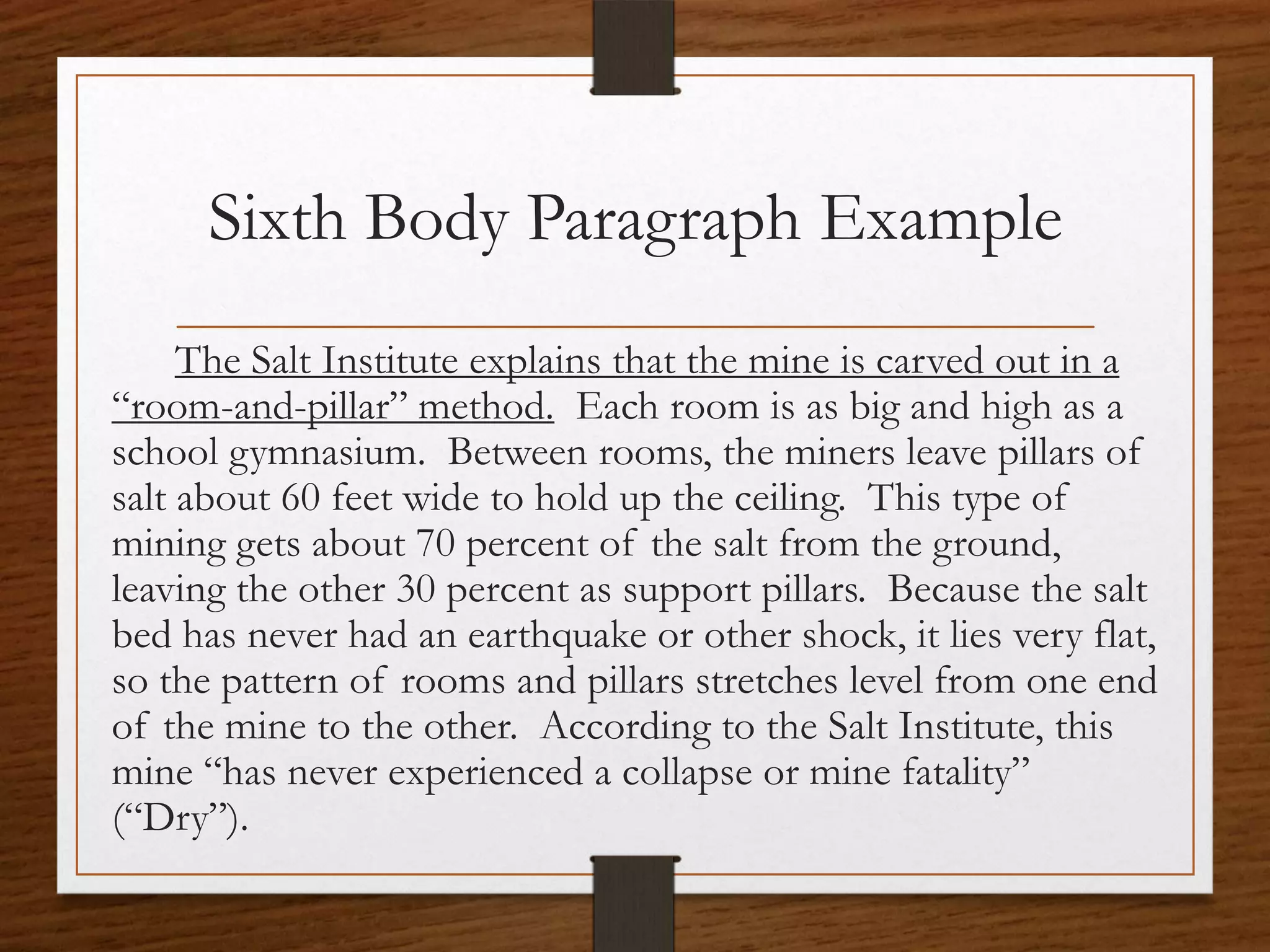
Sixth Body Paragraph Example
     The Salt Institute explains that the mine is carved out in a
“room-and-pillar” method. Each room is as big and high as a
school gymnasium. Between rooms, the miners leave pillars of
salt about 60 feet wide to hold up the ceiling. This type of
mining gets about 70 percent of the salt from the ground,
leaving the other 30 percent as support pillars. Because the salt
bed has never had an earthquake or other shock, it lies very flat,
so the pattern of rooms and pillars stretches level from one end
of the mine to the other. According to the Salt Institute, this
mine “has never experienced a collapse or mine fatality”
(“Dry”).
Seventh Body Paragraph Example

     Miners say that the mine is a very clean and healthy place to
work. The temperature stays a cool 58 degrees year-round.
There are no bugs, rats, or other animals living in the mine,
because there is nothing for them to eat (Zacharias). “I love
working here. The air you breathe in the mine feels great. It’s
very clean, with no allergens or mold like on the surface. I’ve
worked here for 15 years, and I wouldn’t want to be anywhere
else,” shared Mike Yeling, a miner (Yeling).
Conclusion Paragraph

• Your final paragraph should sum up your report and bring it
  to a thoughtful close.
• State any conclusions you have drawn and the reasons for
  them.
• Other possible endings include:
   • Remind the reader of the overall main idea (your thesis sentence).
   • Provide information about the future of your topic.
   • Make a final observation for the reader.
Conclusion Paragraph Example
     The Detroit salt mine could have a very interesting future.
According to geologists, there is enough salt to last for 70
million years (“Dry”). Many people worry, though, that the
runoff from road salt is having a negative effect on our rivers
and lakes. If people stop using salt on icy streets and highways,
there may not be enough business to keep the Detroit mine
open. In that case, the mine could be used to store important
documents, films, and artwork, as some other salt mines do
(Tanner). If nothing else, the Detroit salt mine could be turned
into a public museum because it is an important part of the
city’s history.
Don’t Forget the Homework

• Write your opening paragraph, complete with thesis
  statement.
• Create an outline to give me the direction of where
  you are going on the paper.
• Due on Friday, January 25th, 2013 at the beginning of
  class.
• Worth 100 points. Do not earn a zero!

Research Papers - Drafting

  • 1.
  • 2.
    Writing a FirstDraft • Now that your research is done and you’ve made a good plan in your outline, it’s time to begin actually putting words to paper. • Don’t worry about making everything perfect this first time around—that’s why they call it a draft. • Just get all of your ideas down in a way that makes sense.
  • 3.
  • 4.
    Keys to EffectiveDrafting 1. Write with your purpose, form and audience in mind. Ask yourself these questions as you write: a) What do I want my readers to learn from my report? b) How will I organize my writing to make it easy to understand? 2. Use your first paragraph to introduce your topic, get your reader’s attention, and present your thesis statement. 3. In the next few paragraphs, tell about what is important for your topic. 4. Remember to cite your sources in your paper and list those sources alphabetically on a works cited page (more details later).
  • 5.
    Citing Sources Withinthe Paper • When you have all the information: • The most common citation lists the author’s last name and the page number in parentheses: • “Marco Polo discovered that Tibetans used salt cakes stamped with the imperial seal of the great Kublai Khan as money” (Kemper 70). • If you already named the author in your sentence, or if you’re quoting from the same item for a second time within the same paragraph, just include the page number in parentheses. • Steve Kemper explains that during the Civil War, the North sent troops to attack the South’s salt producers in order to make the South weaker (71).
  • 6.
    Citing Sources Withinthe Paper • When you DO NOT have all the information: • Some sources do not list an author. In those cases use the title (or a shortened version of it) and the page number: • At first, the salt was used mainly for storing meat and fish and for making ice cream (Detroit 167). • Some sources, especially websites, do not use page numbers. In those cases, just list the author: • The seven-foot-tall tires for the dump trucks had to be compressed and bound with straps to fit down the shaft (Zacharias). • IF a source does not list the author or page number, use the title. • Early settlers would collect that liquid and boil away the water to get the salt (“Dry”).
  • 7.
    5-Paragraph Essay Form Say what you’re going to say, say it, then say that you said it. 1. Opening Paragraph a) Remember the funnel! b) End with your thesis statement. 2. First Body Paragraph (first point about topic) 3. Second Body Paragraph (second point about topic) 4. Third Body Paragraph (third point about topic) 5. Conclusion Paragraph a) Reverse the funnel. b) Start by restating your thesis.
  • 8.
    Opening Paragraph Approaches •Start with an interesting fact with broad appeal. • Twelve hundred feet below the ground, an enormous mine has been operating almost nonstop for more than a century. • Ask an interesting question. • How many people know that there are cars and trucks driving on roads more than 1,200 feet below the city of Detroit? • Start with a quotation. • “The only dirty part of this job is getting to work,” says salt miner Joel Payton.
  • 9.
    Opening Paragraph Example Twelve hundred feet below the ground, an enormous mine has been operating almost nonstop for more than a century. A hundred miles of tunnels connect its huge chambers. It has underground roads for cars, trucks, and mining machines. This mine produces hundreds of tons of “rock” every day. However, the rock from this mine is not gold, or iron ore, or even coal; it is salt. This enormous, hundred-year-old salt mine lies beneath the city of Detroit, Michigan.
  • 10.
    Developing the MiddlePart • The middle part of your paper should start by stating why your topic is important. • Each paragraph should focus on one aspect of your topic. • Each paragraph should begin with a topic sentence covering one main point about your overall topic. This sentence is sort of a mini- thesis sentence for just this paragraph. • Use your outline to help you keep your focus.
  • 11.
    First Body ParagraphExample Salt is more important than most people realize. Wars have been fought over it. In ancient China, salt coins were used for money, and Roman soldiers were often paid in salt, which is where the word “salary” comes from. Bettina Werner, an artist known as the “Salt Queen” says, “Salt is like a fifth element, it’s so important to life” (Lin). In the human body, salt carries electrical signals that keep a person alive. To stay healthy, a person needs to eat about three pounds of salt a year (Modern). Salt is also used to preserve meat and fish, to tan leather, to soften water, and to make many different chemicals. However, most of the salt from the Detroit mine is now used to melt ice and snow on streets and highways (Zacharias).
  • 12.
    Second Body ParagraphExample Scientists say that the Detroit mine digs into a bed of salt that is several hundred million years old. From 600 million to 230 million years ago, seawater flooded the middle of North America many times. As sun and wind evaporated the water, sea salt was deposited on the submerged land. According to the Salt Institute, “Trillions of tons of salt, collected in a layer 400 to 1,600 feet thick, reached from western Michigan all the way to New York . . . . Eventually, it was covered by silt that became rock more than 1,000 feet thick” (“Dry”). Later, when people came to the area to settle, they found springs of salty water bubbling from the ground. They would collect that liquid and boil away the water to get the salt.
  • 13.
    Third Body ParagraphExample In 1896, the Detroit salt mine was started in order to dig the salt out of the ground. It began as a shaft 1,200 feet deep and about six feet wide. At first, the salt was used mainly for storing meat and fish and for making ice cream (Detroit 167). In 1940, though, Detroit became the first city to use rock salt on icy roads. Other cities soon followed Detroit’s example, and the mine began selling most of its salt to road crews (“Dry”). In 1983, however, low sales and competition from Canadian mines caused the Detroit mine to close. Crystal Mines bought the mine, hoping to store hazardous wastes there. In 1985, while waiting for a permit, they ran public tours of the mine. “Crystal Mines permit was declined in 1997 and [they] then sold the mine to the Detroit Salt Company,” explained Kim Roberts, manager of the mine (Roberts). The mine was reopened, and it again become one of the main sources of road salt in the United States.
  • 14.
    This Example Continues. . . • This example paper continues beyond what I ask for in your assignment. I ask only that you write three body paragraphs. • This sample paper was divided into history of the mine, the mine today, and the mine’s future. • I will share the rest of the example paper so that you have further examples of well-written paragraphs, and you can see how the conclusion fits into the whole.
  • 15.
    Fourth Body ParagraphExample Some people call the Detroit salt mine a city beneath a city. It covers 1,400 acres under Detroit and its suburbs. That’s equal to 1,300 football fields. Also, it has more than 50 miles of roads where construction equipment, trucks, and cars drive. To get these vehicles down the shaft, they had to be taken apart, carried down in pieces, and reassembled in underground workshops. The seven-foot-tall tires for the dump trucks had to be compressed and bound with straps to fit down the shaft (Zacharias).
  • 16.
    Fifth Body ParagraphExample The mining equipment includes many different types of big electric trucks. One type has a giant chain saw on the front, which cuts a deep groove into a salt wall at floor level. Then a drilling- machine truck bores a pattern of holes 20 feet deep into the wall to hold dynamite or other explosives. The blast from these explosives breaks hundreds of tons of rock from the wall in huge chunks. Trucks with giant shovels then scoop up tons at a time and trop them into dump trucks. The dump trucks carry the chunks back to the shaft, where a crusher breaks them into smaller pieces and sorting machines separate the pieces by size. Finally, buckets that can hold nine tons of salt run up a conveyor to the surface. There the salt is packaged and shipped (“Dry”).
  • 17.
    Sixth Body ParagraphExample The Salt Institute explains that the mine is carved out in a “room-and-pillar” method. Each room is as big and high as a school gymnasium. Between rooms, the miners leave pillars of salt about 60 feet wide to hold up the ceiling. This type of mining gets about 70 percent of the salt from the ground, leaving the other 30 percent as support pillars. Because the salt bed has never had an earthquake or other shock, it lies very flat, so the pattern of rooms and pillars stretches level from one end of the mine to the other. According to the Salt Institute, this mine “has never experienced a collapse or mine fatality” (“Dry”).
  • 18.
    Seventh Body ParagraphExample Miners say that the mine is a very clean and healthy place to work. The temperature stays a cool 58 degrees year-round. There are no bugs, rats, or other animals living in the mine, because there is nothing for them to eat (Zacharias). “I love working here. The air you breathe in the mine feels great. It’s very clean, with no allergens or mold like on the surface. I’ve worked here for 15 years, and I wouldn’t want to be anywhere else,” shared Mike Yeling, a miner (Yeling).
  • 19.
    Conclusion Paragraph • Yourfinal paragraph should sum up your report and bring it to a thoughtful close. • State any conclusions you have drawn and the reasons for them. • Other possible endings include: • Remind the reader of the overall main idea (your thesis sentence). • Provide information about the future of your topic. • Make a final observation for the reader.
  • 20.
    Conclusion Paragraph Example The Detroit salt mine could have a very interesting future. According to geologists, there is enough salt to last for 70 million years (“Dry”). Many people worry, though, that the runoff from road salt is having a negative effect on our rivers and lakes. If people stop using salt on icy streets and highways, there may not be enough business to keep the Detroit mine open. In that case, the mine could be used to store important documents, films, and artwork, as some other salt mines do (Tanner). If nothing else, the Detroit salt mine could be turned into a public museum because it is an important part of the city’s history.
  • 21.
    Don’t Forget theHomework • Write your opening paragraph, complete with thesis statement. • Create an outline to give me the direction of where you are going on the paper. • Due on Friday, January 25th, 2013 at the beginning of class. • Worth 100 points. Do not earn a zero!