READING, RESEARCH, AND REFERENCE Writing Styles, Genres, Parts of a Book, Styles of Type
REVIEW Reference Materials  &  Resources Almanac Atlas Brochure/Pamphlet Dictionary Directory Encyclopedia Experts Internet Magazine Museum artifacts Newspaper Thesaurus
TYPES OF WRITING Narrative Tells a story Fictional or Nonfictional Usually contains dialogue Can teach a moral or lesson Past, present, or future tense Examples Adventure stories Mysteries Historical fiction Science fiction Horror stories Tall tales Realistic stories
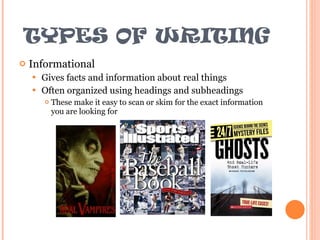
TYPES OF WRITING Informational  Gives facts and information about real things Often organized using headings and subheadings These make it easy to scan or skim for the exact information you are looking for
USING THE RESOURCES Table of Contents Index Glossary Special Type Headings/subheadings Captions Footnotes Taking Notes
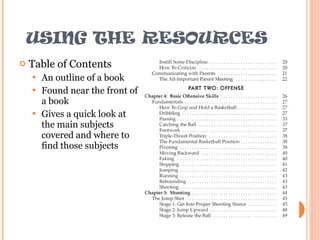
USING THE RESOURCES Table of Contents An outline of a book Found near the front of a book Gives a quick look at the main subjects covered and where to find those subjects
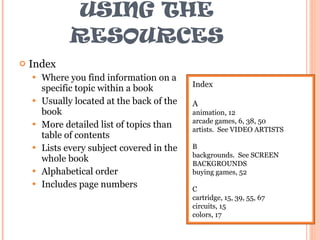
USING THE RESOURCES Index Where you find information on a specific topic within a book Usually located at the back of the book More detailed list of topics than table of contents Lists every subject covered in the whole book Alphabetical order Includes page numbers Index A animation, 12 arcade games, 6, 38, 50 artists.  See VIDEO ARTISTS B backgrounds.  See SCREEN BACKGROUNDS buying games, 52 C cartridge, 15, 39, 55, 67 circuits, 15 colors, 17
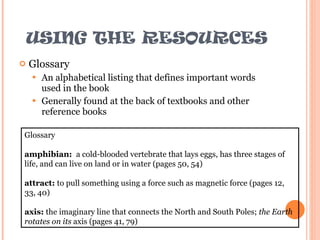
USING THE RESOURCES Glossary An alphabetical listing that defines important words used in the book Generally found at the back of textbooks and other reference books Glossary amphibian:  a cold-blooded vertebrate that lays eggs, has three stages of life, and can live on land or in water (pages 50, 54) attract:  to pull something using a force such as magnetic force (pages 12, 33, 40) axis:  the imaginary line that connects the North and South Poles;  the Earth rotates on its  axis (pages 41, 79)
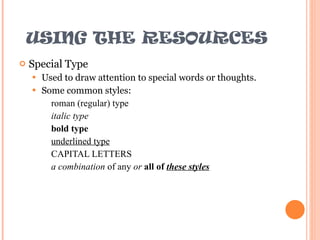
USING THE RESOURCES Special Type Used to draw attention to special words or thoughts.  Some common styles: roman (regular) type italic type bold type underlined type CAPITAL LETTERS a combination  of any  or   all of  these styles
USING THE RESOURCES Titles and subtitles read carefully Title =name Usually printed in larger type than any other text in the story, article, book, or poem Subtitle – explains a little more about the title Example:  I saw Esau: The School Child’s Pocket Book
USING THE RESOURCES Headings and Subheadings Often occur in informational/expository writing Act like subtitles Tell what a part of the written work is about Allow readers to scan/skim the article to find the most important information Let the reader know what is coming next Example:  A magazine article about video games might have sections under such headings as: Sports Games Maze Games Other Games
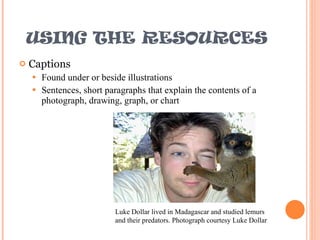
USING THE RESOURCES Captions Found under or beside illustrations Sentences, short paragraphs that explain the contents of a photograph, drawing, graph, or chart Luke Dollar lived in Madagascar and studied lemurs and their predators. Photograph courtesy Luke Dollar
USING THE RESOURCES Footnotes Small notes at the bottom of a page. Explain, define, or expand on information in the text Marked by a small number or symbol following a word or sentence dolmen1 A matching symbol or number will appear next to an explanation or definition at the bottom of the page 1 dolmen : a prehistoric monument of two or more stones supporting a table-like slab of stone.  Found in France and England, they are thought to mark ancient graves.
USING THE RESOURCES Taking Notes A way to record information for your report or project and to help reinforce your learning Boil Down Good note taking is taking the bare facts/main points from what you have read.  (In your own words) Read a paragraph or short section of the information Think about what you have read.  Figure out what it says. Make an outline of what you have read in short, simple sentences.
USING THE RESOURCES Taking Notes A way to record information for your report or project and to help reinforce your learning Boil Down Good note taking is taking the bare facts/main points from what you have read.  (In your own words) Read a paragraph or short section of the information Think about what you have read.  Figure out what it says. Make an outline of what you have read in short, simple sentences. Remember that you need acknowledge your sources. Tell where you found your information  Use quotation marks when you use other people’s words
QUIZ
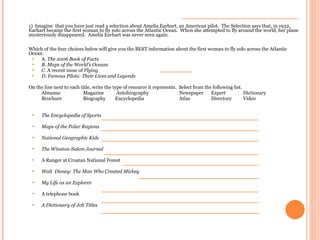
1)  Imagine  that you have just read a selection about Amelia Earhart, an American pilot.  The Selection says that, in 1932, Earhart became the first woman to fly solo across the Atlantic Ocean.  When she attempted to fly around the world, her plane mysteriously disappeared.  Amelia Earhart was never seen again. Which of the four choices below will give you the BEST information about the first woman to fly solo across the Atlantic Ocean. A.  The 2006 Book of Facts B. Maps of the World’s Oceans C.  A recent issue of  Flying D. Famous Pilots: Their Lives and Legends On the line next to each title, write the type of resource it represents.  Select from the following list. Almanac Magazine  Autobiography  Newspaper Expert Dictionary Brochure Biography Encyclopedia Atlas Directory Video The Encyclopedia of Sports Maps of the Polar Regions National Geographic Kids The Winston-Salem Journal A Ranger at Croatan National Forest Walt  Disney: The Man Who Created Mickey My Life as an Explorer A telephone book A Dictionary of Job Titles

Reference3

  • 1.
    READING, RESEARCH, ANDREFERENCE Writing Styles, Genres, Parts of a Book, Styles of Type
  • 2.
    REVIEW Reference Materials & Resources Almanac Atlas Brochure/Pamphlet Dictionary Directory Encyclopedia Experts Internet Magazine Museum artifacts Newspaper Thesaurus
  • 3.
    TYPES OF WRITINGNarrative Tells a story Fictional or Nonfictional Usually contains dialogue Can teach a moral or lesson Past, present, or future tense Examples Adventure stories Mysteries Historical fiction Science fiction Horror stories Tall tales Realistic stories
  • 4.
    TYPES OF WRITINGInformational Gives facts and information about real things Often organized using headings and subheadings These make it easy to scan or skim for the exact information you are looking for
  • 5.
    USING THE RESOURCESTable of Contents Index Glossary Special Type Headings/subheadings Captions Footnotes Taking Notes
  • 6.
    USING THE RESOURCESTable of Contents An outline of a book Found near the front of a book Gives a quick look at the main subjects covered and where to find those subjects
  • 7.
    USING THE RESOURCESIndex Where you find information on a specific topic within a book Usually located at the back of the book More detailed list of topics than table of contents Lists every subject covered in the whole book Alphabetical order Includes page numbers Index A animation, 12 arcade games, 6, 38, 50 artists. See VIDEO ARTISTS B backgrounds. See SCREEN BACKGROUNDS buying games, 52 C cartridge, 15, 39, 55, 67 circuits, 15 colors, 17
  • 8.
    USING THE RESOURCESGlossary An alphabetical listing that defines important words used in the book Generally found at the back of textbooks and other reference books Glossary amphibian: a cold-blooded vertebrate that lays eggs, has three stages of life, and can live on land or in water (pages 50, 54) attract: to pull something using a force such as magnetic force (pages 12, 33, 40) axis: the imaginary line that connects the North and South Poles; the Earth rotates on its axis (pages 41, 79)
  • 9.
    USING THE RESOURCESSpecial Type Used to draw attention to special words or thoughts. Some common styles: roman (regular) type italic type bold type underlined type CAPITAL LETTERS a combination of any or all of these styles
  • 10.
    USING THE RESOURCESTitles and subtitles read carefully Title =name Usually printed in larger type than any other text in the story, article, book, or poem Subtitle – explains a little more about the title Example: I saw Esau: The School Child’s Pocket Book
  • 11.
    USING THE RESOURCESHeadings and Subheadings Often occur in informational/expository writing Act like subtitles Tell what a part of the written work is about Allow readers to scan/skim the article to find the most important information Let the reader know what is coming next Example: A magazine article about video games might have sections under such headings as: Sports Games Maze Games Other Games
  • 12.
    USING THE RESOURCESCaptions Found under or beside illustrations Sentences, short paragraphs that explain the contents of a photograph, drawing, graph, or chart Luke Dollar lived in Madagascar and studied lemurs and their predators. Photograph courtesy Luke Dollar
  • 13.
    USING THE RESOURCESFootnotes Small notes at the bottom of a page. Explain, define, or expand on information in the text Marked by a small number or symbol following a word or sentence dolmen1 A matching symbol or number will appear next to an explanation or definition at the bottom of the page 1 dolmen : a prehistoric monument of two or more stones supporting a table-like slab of stone. Found in France and England, they are thought to mark ancient graves.
  • 14.
    USING THE RESOURCESTaking Notes A way to record information for your report or project and to help reinforce your learning Boil Down Good note taking is taking the bare facts/main points from what you have read. (In your own words) Read a paragraph or short section of the information Think about what you have read. Figure out what it says. Make an outline of what you have read in short, simple sentences.
  • 15.
    USING THE RESOURCESTaking Notes A way to record information for your report or project and to help reinforce your learning Boil Down Good note taking is taking the bare facts/main points from what you have read. (In your own words) Read a paragraph or short section of the information Think about what you have read. Figure out what it says. Make an outline of what you have read in short, simple sentences. Remember that you need acknowledge your sources. Tell where you found your information Use quotation marks when you use other people’s words
  • 16.
  • 17.
    1) Imagine that you have just read a selection about Amelia Earhart, an American pilot. The Selection says that, in 1932, Earhart became the first woman to fly solo across the Atlantic Ocean. When she attempted to fly around the world, her plane mysteriously disappeared. Amelia Earhart was never seen again. Which of the four choices below will give you the BEST information about the first woman to fly solo across the Atlantic Ocean. A. The 2006 Book of Facts B. Maps of the World’s Oceans C. A recent issue of Flying D. Famous Pilots: Their Lives and Legends On the line next to each title, write the type of resource it represents. Select from the following list. Almanac Magazine Autobiography Newspaper Expert Dictionary Brochure Biography Encyclopedia Atlas Directory Video The Encyclopedia of Sports Maps of the Polar Regions National Geographic Kids The Winston-Salem Journal A Ranger at Croatan National Forest Walt Disney: The Man Who Created Mickey My Life as an Explorer A telephone book A Dictionary of Job Titles