

Unit I: Concept of Research
PROF. SHAILJA BHAKAR
Definitions
 Martin Shuttleworth - "In the broadest sense

of the word, the definition of research includes
any gathering of data, information and facts
for the advancement of knowledge.“

 Another definition of research is given by

Creswell who states - "Research is a process of
steps used to collect and analyze information
to increase our understanding of a topic or
issue". It consists of three steps: Pose a
question, collect data to answer the
question, and present an answer to the
question.
Definition
 The Merriam-Webster Online Dictionary defines

research in more detail as "a studious inquiry or
examination; especially : investigation or
experimentation aimed at the discovery and
interpretation of facts, revision of accepted
theories or laws in the light of new facts, or
practical application of such new or revised
theories or laws".
 “The systematic and objective process of
gathering, recording and analyzing data for aid in
making business decisions”
Objectives
 It can be used to establish or confirm facts
 Reaffirm the results of previous work
 Solve new or existing problems
 Develop new theories
 Support theorems

 An expansion on past work in a field
 In

order
to
test
the
validity
of
instruments, procedures, or experiments, research may
replicate elements of prior projects, or the project as a
whole
 To test the relationship between the variables
Objectives
 To

understand the characteristics of a
particular individual, situation or a group
 To determine the frequency with which
something occurs
 The primary purposes of basic research (as
opposed to applied research) are:
a) Discovery
b) Documentation
c) Interpretation
d) The research and development of methods
and systems for the advancement of
human knowledge
Nature of Research
1. It is systematic

2. It is scientific
3. It has objectivity
4. It has verifiability
5. It has definiteness
6. It is art & science both
7. It has wider scope
Nature of Research
9. It serves as basis of management principles
10.It aids in decision making
11. It is qualitative & quantitative both
12. It is helpful in prediction & control
13. It has psychological approaches too
14. It relies on empirical evidences
15. It explores new insights/describes in
detail/obtain cause & effect relationships
Significance of Research
 Research for decision making

Throws light on risk and uncertainty
2. Identify alternative courses of action
3. Helps in economic use of scarce resources
4. Helps in project identification
5. Solves allocation problem
6. Investment problem
7. Helps in planning
 Research for Government Policies and Economic Systems
1. Government Budgets
2. Facilitates the decision of the policy makers
1.
Significance of Research
3.
4.
5.
6.


1.
2.
3.

Improves worse condition of farmers
The problem of big and small business and industry, working conditions, trade
union activities, the problem of distribution, size and nature of defense services
Collecting information on the economic and social structure of the nation
Prediction of future developments
Research for solving various operational and planning problems of
business and industry
Market research- Investigation of the structure and development of market
Operations research- Application of mathematical logical and analytical
Motivational research- Market characteristics
Significance of Research
 Research for Social Scientists
1.
2.
3.

1.
2.
3.
4.
5.

In studying social relationship
Seeking answers to various social problems such as understanding and
predicting human interactions
Provides practical guidance in solving immediate problems of human relations
In addition to this
For students research means careerism
For professionals in research
For philosophers and thinkers outlets of new ideas
For literary men and women development of new styles
For analysts and intellectuals generalization of new theories
Scientific Method
 Definition:

Scientific method refers to a body of techniques for
investigating phenomena, acquiring new knowledge, or correcting and
integrating previous knowledge. To be termed scientific, a method of
inquiry must be based on gathering empirical and measurable evidence
subject to specific principles of reasoning.
 The Oxford English Dictionary says that scientific method is: "a method or
procedure that has characterized natural science since the 17th
century, consisting in systematic observation, measurement, and
experiment, and the formulation, testing, and modification of hypotheses.“
 Whereas business research is a study of psychology of Human Behavior in
organization and developing theories to explain facts and laws.
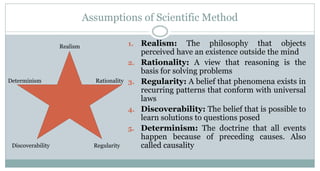
Assumptions of Scientific Method
1.

Realism

2.
Determinism

Rationality 3.

4.
5.
Discoverability

Regularity

Realism: The philosophy that objects
perceived have an existence outside the mind
Rationality: A view that reasoning is the
basis for solving problems
Regularity: A belief that phenomena exists in
recurring patterns that conform with universal
laws
Discoverability: The belief that is possible to
learn solutions to questions posed
Determinism: The doctrine that all events
happen because of preceding causes. Also
called causality
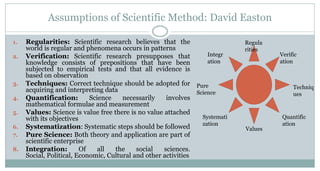
Assumptions of Scientific Method: David Easton
1.
2.

3.

4.
5.
6.
7.
8.

Regularities: Scientific research believes that the
world is regular and phenomena occurs in patterns
Integr
Verification: Scientific research presupposes that
ation
knowledge consists of prepositions that have been
subjected to empirical tests and that all evidence is
based on observation
Techniques: Correct technique should be adopted for Pure
acquiring and interpreting data
Science
Quantification:
Science
necessarily
involves
mathematical formulae and measurement
Values: Science is value free there is no value attached
Systemati
with its objectives
zation
Systematization: Systematic steps should be followed
Pure Science: Both theory and application are part of
scientific enterprise
Integration:
Of
all
the
social
sciences.
Social, Political, Economic, Cultural and other activities

Regula
rities

Verific
ation

Techniq
ues

Values

Quantific
ation
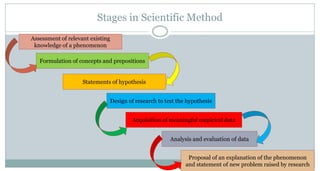
Stages in Scientific Method
Assessment of relevant existing
knowledge of a phenomenon
Formulation of concepts and prepositions

Statements of hypothesis
Design of research to test the hypothesis
Acquisition of meaningful empirical data
Analysis and evaluation of data
Proposal of an explanation of the phenomenon
and statement of new problem raised by research
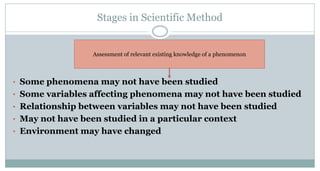
Stages in Scientific Method

Assessment of relevant existing knowledge of a phenomenon

• Some phenomena may not have been studied
• Some variables affecting phenomena may not have been studied
• Relationship between variables may not have been studied
• May not have been studied in a particular context
• Environment may have changed
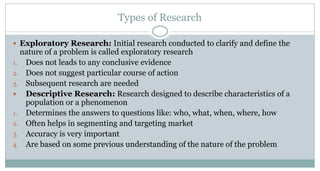
Types of Research
 Exploratory Research: Initial research conducted to clarify and define the

nature of a problem is called exploratory research
1. Does not leads to any conclusive evidence
2. Does not suggest particular course of action
3. Subsequent research are needed
 Descriptive Research: Research designed to describe characteristics of a
population or a phenomenon
1. Determines the answers to questions like: who, what, when, where, how
2. Often helps in segmenting and targeting market
3. Accuracy is very important
4. Are based on some previous understanding of the nature of the problem
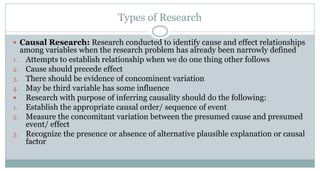
Types of Research
 Causal Research: Research conducted to identify cause and effect relationships

among variables when the research problem has already been narrowly defined
1. Attempts to establish relationship when we do one thing other follows
2. Cause should precede effect
3. There should be evidence of concominent variation
4. May be third variable has some influence
 Research with purpose of inferring causality should do the following:
1. Establish the appropriate causal order/ sequence of event
2. Measure the concomitant variation between the presumed cause and presumed
event/ effect
3. Recognize the presence or absence of alternative plausible explanation or causal
factor
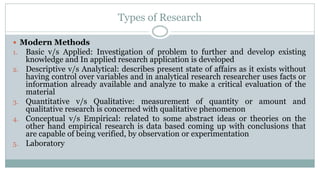
Types of Research
 Modern Methods
1. Basic v/s Applied: Investigation of problem to further and develop existing
2.

3.
4.

5.

knowledge and In applied research application is developed
Descriptive v/s Analytical: describes present state of affairs as it exists without
having control over variables and in analytical research researcher uses facts or
information already available and analyze to make a critical evaluation of the
material
Quantitative v/s Qualitative: measurement of quantity or amount and
qualitative research is concerned with qualitative phenomenon
Conceptual v/s Empirical: related to some abstract ideas or theories on the
other hand empirical research is data based coming up with conclusions that
are capable of being verified, by observation or experimentation
Laboratory
Types of Research
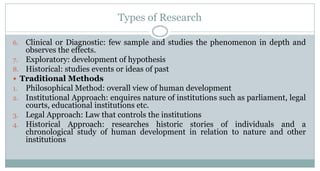
Clinical or Diagnostic: few sample and studies the phenomenon in depth and
observes the effects.
7. Exploratory: development of hypothesis
8. Historical: studies events or ideas of past
 Traditional Methods
1. Philosophical Method: overall view of human development
2. Institutional Approach: enquires nature of institutions such as parliament, legal
courts, educational institutions etc.
3. Legal Approach: Law that controls the institutions
4. Historical Approach: researches historic stories of individuals and a
chronological study of human development in relation to nature and other
institutions
6.
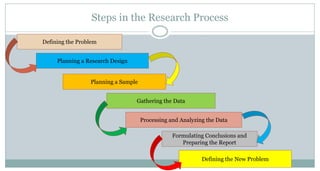
Steps in the Research Process
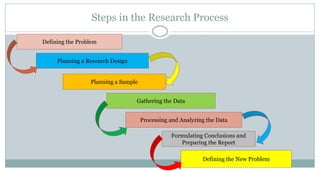
Defining the Problem
Planning a Research Design

Planning a Sample
Gathering the Data
Processing and Analyzing the Data

Formulating Conclusions and
Preparing the Report
Defining the New Problem
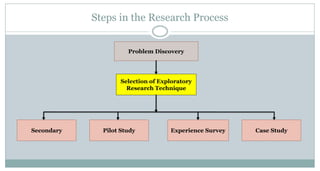
Steps in the Research Process
Problem Discovery

Selection of Exploratory
Research Technique

Secondary

Pilot Study

Experience Survey

Case Study
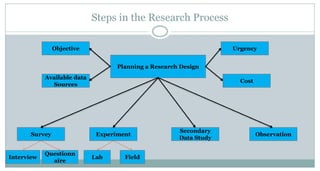
Steps in the Research Process
Objective

Urgency
Planning a Research Design

Available data
Sources

Survey

Interview

Questionn
aire

Cost

Experiment

Lab

Field

Secondary
Data Study

Observation
Steps in the Research Process

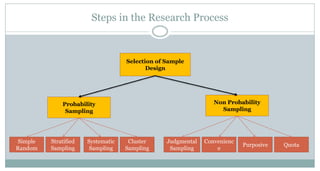
Selection of Sample
Design

Non Probability
Sampling

Probability
Sampling

Simple
Random

Stratified
Sampling

Systematic
Sampling

Cluster
Sampling

Judgmental
Sampling

Convenienc
e

Purposive

Quota
Steps in the Research Process
Defining the Problem
Planning a Research Design

Planning a Sample
Gathering the Data
Processing and Analyzing the Data

Formulating Conclusions and
Preparing the Report
Defining the New Problem

Rm

  • 1.
    Unit I: Conceptof Research PROF. SHAILJA BHAKAR
  • 2.
    Definitions  Martin Shuttleworth- "In the broadest sense of the word, the definition of research includes any gathering of data, information and facts for the advancement of knowledge.“  Another definition of research is given by Creswell who states - "Research is a process of steps used to collect and analyze information to increase our understanding of a topic or issue". It consists of three steps: Pose a question, collect data to answer the question, and present an answer to the question.
  • 3.
    Definition  The Merriam-WebsterOnline Dictionary defines research in more detail as "a studious inquiry or examination; especially : investigation or experimentation aimed at the discovery and interpretation of facts, revision of accepted theories or laws in the light of new facts, or practical application of such new or revised theories or laws".  “The systematic and objective process of gathering, recording and analyzing data for aid in making business decisions”
  • 4.
    Objectives  It canbe used to establish or confirm facts  Reaffirm the results of previous work  Solve new or existing problems  Develop new theories  Support theorems  An expansion on past work in a field  In order to test the validity of instruments, procedures, or experiments, research may replicate elements of prior projects, or the project as a whole  To test the relationship between the variables
  • 5.
    Objectives  To understand thecharacteristics of a particular individual, situation or a group  To determine the frequency with which something occurs  The primary purposes of basic research (as opposed to applied research) are: a) Discovery b) Documentation c) Interpretation d) The research and development of methods and systems for the advancement of human knowledge
  • 6.
    Nature of Research 1.It is systematic 2. It is scientific 3. It has objectivity 4. It has verifiability 5. It has definiteness 6. It is art & science both 7. It has wider scope
  • 7.
    Nature of Research 9.It serves as basis of management principles 10.It aids in decision making 11. It is qualitative & quantitative both 12. It is helpful in prediction & control 13. It has psychological approaches too 14. It relies on empirical evidences 15. It explores new insights/describes in detail/obtain cause & effect relationships
  • 8.
    Significance of Research Research for decision making Throws light on risk and uncertainty 2. Identify alternative courses of action 3. Helps in economic use of scarce resources 4. Helps in project identification 5. Solves allocation problem 6. Investment problem 7. Helps in planning  Research for Government Policies and Economic Systems 1. Government Budgets 2. Facilitates the decision of the policy makers 1.
  • 9.
    Significance of Research 3. 4. 5. 6.  1. 2. 3. Improvesworse condition of farmers The problem of big and small business and industry, working conditions, trade union activities, the problem of distribution, size and nature of defense services Collecting information on the economic and social structure of the nation Prediction of future developments Research for solving various operational and planning problems of business and industry Market research- Investigation of the structure and development of market Operations research- Application of mathematical logical and analytical Motivational research- Market characteristics
  • 10.
    Significance of Research Research for Social Scientists 1. 2. 3.  1. 2. 3. 4. 5. In studying social relationship Seeking answers to various social problems such as understanding and predicting human interactions Provides practical guidance in solving immediate problems of human relations In addition to this For students research means careerism For professionals in research For philosophers and thinkers outlets of new ideas For literary men and women development of new styles For analysts and intellectuals generalization of new theories
  • 11.
    Scientific Method  Definition: Scientificmethod refers to a body of techniques for investigating phenomena, acquiring new knowledge, or correcting and integrating previous knowledge. To be termed scientific, a method of inquiry must be based on gathering empirical and measurable evidence subject to specific principles of reasoning.  The Oxford English Dictionary says that scientific method is: "a method or procedure that has characterized natural science since the 17th century, consisting in systematic observation, measurement, and experiment, and the formulation, testing, and modification of hypotheses.“  Whereas business research is a study of psychology of Human Behavior in organization and developing theories to explain facts and laws.
  • 12.
    Assumptions of ScientificMethod 1. Realism 2. Determinism Rationality 3. 4. 5. Discoverability Regularity Realism: The philosophy that objects perceived have an existence outside the mind Rationality: A view that reasoning is the basis for solving problems Regularity: A belief that phenomena exists in recurring patterns that conform with universal laws Discoverability: The belief that is possible to learn solutions to questions posed Determinism: The doctrine that all events happen because of preceding causes. Also called causality
  • 13.
    Assumptions of ScientificMethod: David Easton 1. 2. 3. 4. 5. 6. 7. 8. Regularities: Scientific research believes that the world is regular and phenomena occurs in patterns Integr Verification: Scientific research presupposes that ation knowledge consists of prepositions that have been subjected to empirical tests and that all evidence is based on observation Techniques: Correct technique should be adopted for Pure acquiring and interpreting data Science Quantification: Science necessarily involves mathematical formulae and measurement Values: Science is value free there is no value attached Systemati with its objectives zation Systematization: Systematic steps should be followed Pure Science: Both theory and application are part of scientific enterprise Integration: Of all the social sciences. Social, Political, Economic, Cultural and other activities Regula rities Verific ation Techniq ues Values Quantific ation
  • 14.
    Stages in ScientificMethod Assessment of relevant existing knowledge of a phenomenon Formulation of concepts and prepositions Statements of hypothesis Design of research to test the hypothesis Acquisition of meaningful empirical data Analysis and evaluation of data Proposal of an explanation of the phenomenon and statement of new problem raised by research
  • 15.
    Stages in ScientificMethod Assessment of relevant existing knowledge of a phenomenon • Some phenomena may not have been studied • Some variables affecting phenomena may not have been studied • Relationship between variables may not have been studied • May not have been studied in a particular context • Environment may have changed
  • 16.
    Types of Research Exploratory Research: Initial research conducted to clarify and define the nature of a problem is called exploratory research 1. Does not leads to any conclusive evidence 2. Does not suggest particular course of action 3. Subsequent research are needed  Descriptive Research: Research designed to describe characteristics of a population or a phenomenon 1. Determines the answers to questions like: who, what, when, where, how 2. Often helps in segmenting and targeting market 3. Accuracy is very important 4. Are based on some previous understanding of the nature of the problem
  • 17.
    Types of Research Causal Research: Research conducted to identify cause and effect relationships among variables when the research problem has already been narrowly defined 1. Attempts to establish relationship when we do one thing other follows 2. Cause should precede effect 3. There should be evidence of concominent variation 4. May be third variable has some influence  Research with purpose of inferring causality should do the following: 1. Establish the appropriate causal order/ sequence of event 2. Measure the concomitant variation between the presumed cause and presumed event/ effect 3. Recognize the presence or absence of alternative plausible explanation or causal factor
  • 18.
    Types of Research Modern Methods 1. Basic v/s Applied: Investigation of problem to further and develop existing 2. 3. 4. 5. knowledge and In applied research application is developed Descriptive v/s Analytical: describes present state of affairs as it exists without having control over variables and in analytical research researcher uses facts or information already available and analyze to make a critical evaluation of the material Quantitative v/s Qualitative: measurement of quantity or amount and qualitative research is concerned with qualitative phenomenon Conceptual v/s Empirical: related to some abstract ideas or theories on the other hand empirical research is data based coming up with conclusions that are capable of being verified, by observation or experimentation Laboratory
  • 19.
    Types of Research Clinicalor Diagnostic: few sample and studies the phenomenon in depth and observes the effects. 7. Exploratory: development of hypothesis 8. Historical: studies events or ideas of past  Traditional Methods 1. Philosophical Method: overall view of human development 2. Institutional Approach: enquires nature of institutions such as parliament, legal courts, educational institutions etc. 3. Legal Approach: Law that controls the institutions 4. Historical Approach: researches historic stories of individuals and a chronological study of human development in relation to nature and other institutions 6.
  • 20.
    Steps in theResearch Process Defining the Problem Planning a Research Design Planning a Sample Gathering the Data Processing and Analyzing the Data Formulating Conclusions and Preparing the Report Defining the New Problem
  • 21.
    Steps in theResearch Process Problem Discovery Selection of Exploratory Research Technique Secondary Pilot Study Experience Survey Case Study
  • 22.
    Steps in theResearch Process Objective Urgency Planning a Research Design Available data Sources Survey Interview Questionn aire Cost Experiment Lab Field Secondary Data Study Observation
  • 23.
    Steps in theResearch Process Selection of Sample Design Non Probability Sampling Probability Sampling Simple Random Stratified Sampling Systematic Sampling Cluster Sampling Judgmental Sampling Convenienc e Purposive Quota
  • 24.
    Steps in theResearch Process Defining the Problem Planning a Research Design Planning a Sample Gathering the Data Processing and Analyzing the Data Formulating Conclusions and Preparing the Report Defining the New Problem