Research is asystematic investigation, driven by curiosity and critical thinking, aimed at establishing
facts and generating new knowledge. It's a structured process of inquiry, where we meticulously gather
and analyze data to reach novel conclusions. This dedication to rigorous investigation allows us to
expand our understanding, innovate, and ultimately contribute to the advancement of our respective
fields.
Research Methodology
OBJECTIVES OF RESEARCH
The purpose of research is to discover answers to questions through the application of scientific
procedures. Though each research study has its own specific purpose, we may think of research
objectives as falling into a number of following broad groupings:
1. To gain familiarity with a phenomenon or to achieve new insights into it
2. To portray accurately the characteristics of a particular individual, situation or a
3. To determine the frequency with which something occurs or with which it is associated with
something
4. To test a hypothesis of a causal relationship between
3.
Motivation research isdefined as the study of understanding why individuals engage in specific
activities at work, the level of effort they put in, and how long they persist in those activities. It focuses
on how individuals prioritize tasks at work and the reasons behind their actions. The possible motives
for doing research may be either one or more of the following:
1. Desire to get a research degree along with its consequential benefits
2. Desire to face the challenge in solving the unsolved problems, i.e. concern over practical problems
initiates research
3. Desire to get intellectual joy of doing some creative work
4. Desire to be of service to society
5. Desire to get respectability
Motivation in Research
4.
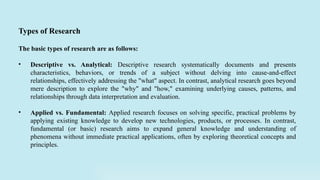
The basic typesof research are as follows:
• Descriptive vs. Analytical: Descriptive research systematically documents and presents
characteristics, behaviors, or trends of a subject without delving into cause-and-effect
relationships, effectively addressing the "what" aspect. In contrast, analytical research goes beyond
mere description to explore the "why" and "how," examining underlying causes, patterns, and
relationships through data interpretation and evaluation.
• Applied vs. Fundamental: Applied research focuses on solving specific, practical problems by
applying existing knowledge to develop new technologies, products, or processes. In contrast,
fundamental (or basic) research aims to expand general knowledge and understanding of
phenomena without immediate practical applications, often by exploring theoretical concepts and
principles.
Types of Research
5.
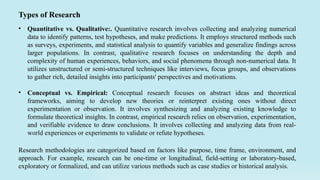
• Quantitative vs.Qualitative:. Quantitative research involves collecting and analyzing numerical
data to identify patterns, test hypotheses, and make predictions. It employs structured methods such
as surveys, experiments, and statistical analysis to quantify variables and generalize findings across
larger populations. In contrast, qualitative research focuses on understanding the depth and
complexity of human experiences, behaviors, and social phenomena through non-numerical data. It
utilizes unstructured or semi-structured techniques like interviews, focus groups, and observations
to gather rich, detailed insights into participants' perspectives and motivations.
• Conceptual vs. Empirical: Conceptual research focuses on abstract ideas and theoretical
frameworks, aiming to develop new theories or reinterpret existing ones without direct
experimentation or observation. It involves synthesizing and analyzing existing knowledge to
formulate theoretical insights. In contrast, empirical research relies on observation, experimentation,
and verifiable evidence to draw conclusions. It involves collecting and analyzing data from real-
world experiences or experiments to validate or refute hypotheses.
Types of Research
Research methodologies are categorized based on factors like purpose, time frame, environment, and
approach. For example, research can be one-time or longitudinal, field-setting or laboratory-based,
exploratory or formalized, and can utilize various methods such as case studies or historical analysis.
6.
There are twobasic approaches to research, viz., Quantitative Approach and the Qualitative Approach.
Quantitative research involves generating data for rigorous analysis. It can be sub-classified into
inferential, experimental, and simulation approaches. Inferential research focuses on inferring
population characteristics through surveys. Experimental research allows for greater control over the
research environment, manipulating variables to observe their effects. Simulation involves creating an
artificial environment for observing dynamic system behavior under controlled conditions.
Qualitative research involves subjective assessment of attitudes, opinions, and behavior, generating
results in non-quantitative form or non-quantitative form. Techniques like focus group interviews,
projective techniques, and depth interviews are used.
Research Approaches
7.
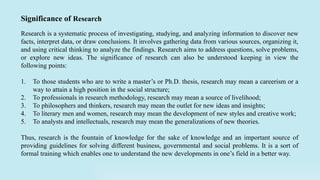
Research is asystematic process of investigating, studying, and analyzing information to discover new
facts, interpret data, or draw conclusions. It involves gathering data from various sources, organizing it,
and using critical thinking to analyze the findings. Research aims to address questions, solve problems,
or explore new ideas. The significance of research can also be understood keeping in view the
following points:
1. To those students who are to write a master’s or Ph.D. thesis, research may mean a careerism or a
way to attain a high position in the social structure;
2. To professionals in research methodology, research may mean a source of livelihood;
3. To philosophers and thinkers, research may mean the outlet for new ideas and insights;
4. To literary men and women, research may mean the development of new styles and creative work;
5. To analysts and intellectuals, research may mean the generalizations of new theories.
Thus, research is the fountain of knowledge for the sake of knowledge and an important source of
providing guidelines for solving different business, governmental and social problems. It is a sort of
formal training which enables one to understand the new developments in one’s field in a better way.
Significance of Research
8.
.
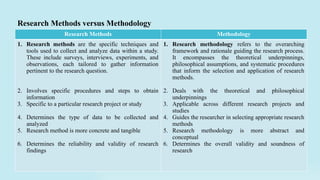
Research Methods versusMethodology
Research Methods Methodology
1. Research methods are the specific techniques and
tools used to collect and analyze data within a study.
These include surveys, interviews, experiments, and
observations, each tailored to gather information
pertinent to the research question.
2. Involves specific procedures and steps to obtain
information
3. Specific to a particular research project or study
4. Determines the type of data to be collected and
analyzed
5. Research method is more concrete and tangible
6. Determines the reliability and validity of research
findings
1. Research methodology refers to the overarching
framework and rationale guiding the research process.
It encompasses the theoretical underpinnings,
philosophical assumptions, and systematic procedures
that inform the selection and application of research
methods.
2. Deals with the theoretical and philosophical
underpinnings
3. Applicable across different research projects and
studies
4. Guides the researcher in selecting appropriate research
methods
5. Research methodology is more abstract and
conceptual
6. Determines the overall validity and soundness of
research
9.
The two terms,research and scientific method, are closely related. Research, as we have already stated,
can be termed as “an inquiry into the nature of, the reasons for, and the consequences of any particular
set of circumstances, whether these circumstances are experimentally controlled or recorded just as
they occur. Further, research implies the researcher is interested in more than particular results; he is
interested in the repeatability of the results and in their extension to more complicated and general
situations. On the other hand, the philosophy common to all research methods and techniques, although
they may vary considerably from one science to another, is usually given the name of scientific method
The scientific method is, thus, based on certain basic postulates which can be stated as under:
1. It relies on empirical evidence;
2. It utilizes relevant concepts;
3. It is committed to only objective considerations;
4. It presupposes ethical neutrality, i.e., it aims at nothing but making only adequate and correct
statements about population objects;
5. It results into probabilistic predictions;
6. Its methodology is made known to all concerned for critical scrutiny are for use in testing the
conclusions through replication;
7. It aims at formulating most general axioms or what can be termed as scientific theories.
Research and Scientific Method
10.
Importance of knowingthe methodology of research or how research is done stems from the following
considerations:
1. Developing Disciplined Thinking: It cultivates the ability to observe and analyze systematically,
leading to more effective and objective observations.
2. Evaluating and Utilizing Research Findings: Knowledge of research methodology enables
individuals to assess and apply research results with confidence, ensuring informed decision-
making.
3. Acquiring New Tools: It provides access to intelligent tools and techniques that enhance one's
ability to gather and interpret information effectively.
4. Making Rational Decisions: Understanding research processes aids in making rational decisions
when consuming research results, leading to more informed and effective choices.
Importance of Knowing How Research is Done
11.
Research process consistsof series of actions or steps necessary to effectively carry out research and
the desired sequencing of these steps. . The chart shown in Figure well illustrates a research process.
Research Process
12.
Good research ischaracterized by several key criteria that ensure its reliability, relevance, and
contribution to knowledge. Here are some primary criteria of good research-
1. Clarity and Precision
2. Systematic Methodology
3. Empirical Evidence
4. Replicability:
5. Validity:
6. Reliability
7. Ethical Considerations
8. Relevance
9. Originality
10. Ethical Integrity
Criteria of Good Research
13.
Researchers in Bangladeshencounter several challenges that hinder the advancement of knowledge and
innovation. Key issues include:
1. The lack of a scientific training in the methodology of research
2. Insufficient Institutional Support
3. Limited Access to Literature
4. Ethical and Practical Dilemmas
5. does not exist a code of conduct for researchers
6. Library management and functioning is not satisfactory
7. The difficulty of timely availability of published data
8. The problem of conceptualization
9. Political Instability
10. Limited Funding
Problems Encountered by Researchers in Bangladesh