





QURATULAIN
MUGHAL
BATCH IV
DOCTOR OF
PHYSICAL THERAPY
ISRA UNIVERSITY
FORMULATING A
RESEARCH PROBLEM
1
CONTENTS
1. Research problem
2. Steps in the formulation of a research problem
3. Example
4. Considerations in selecting a research problem
2
RESEARCH PROBLEM
 A situation or circumstance that
requires a solution to be described,
explained, or predicted.
 It is an unsatisfactory situation that
wants you to confront.
3
Formulating a research
problem
 refers to identifying what it is that you
want to find out about.
4
Steps in the formulation
of a research problem
1. Identify a broad field or subject area
of interest to you.
2. Dissect the broad area into
subareas.
3. Select what is of most interest to
you.
4. Raise research questions.
5. Formulate objectives
6. Assess your objectives 5
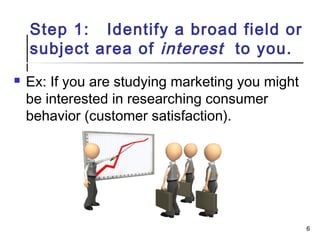
Step 1: Identify a broad field or
subject area of interest to you.
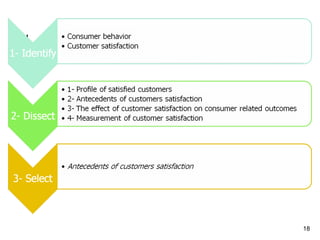
 Ex: If you are studying marketing you might
be interested in researching consumer
behavior (customer satisfaction).
6
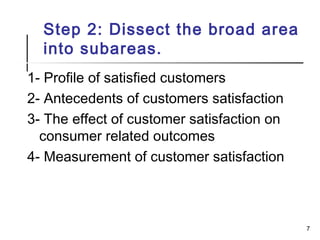
Step 2: Dissect the broad area
into subareas.
1- Profile of satisfied customers
2- Antecedents of customers satisfaction
3- The effect of customer satisfaction on
consumer related outcomes
4- Measurement of customer satisfaction
7
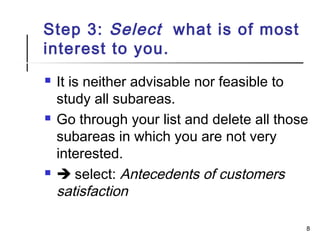
Step 3: Select what is of most
interest to you.
 It is neither advisable nor feasible to
study all subareas.
 Go through your list and delete all those
subareas in which you are not very
interested.
  select: Antecedents of customers
satisfaction
8
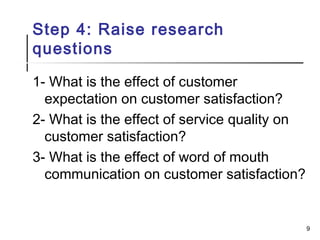
Step 4: Raise research
questions
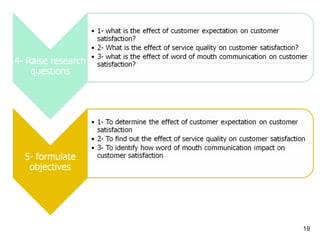
1- What is the effect of customer
expectation on customer satisfaction?
2- What is the effect of service quality on
customer satisfaction?
3- What is the effect of word of mouth
communication on customer satisfaction?
9
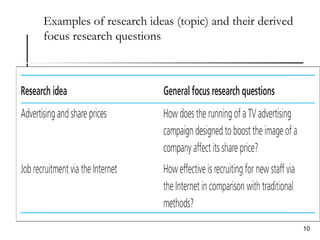
Examples of research ideas (topic) and their derived
focus research questions
10
Step 5: Formulate objectives
 Your objectives grow out of your research
questions.
 The main difference between objectives and
research questions is the way in which they
are written.
 Research questions are obviously that—
questions.
11
Step 5: Formulate objectives
 Objectives transform these questions into
behavioral aims by using action-oriented
words such as 'to find out', 'to determine', 'to
ascertain' and 'to examine‘, ‘to measure’, ‘to
explore’.
12
Some examples…
 To describe the types of incentives provides by five star hotels in
Colombo to their employees.
 To find out the opinion of the employees about the medical
facilities provided by five star hotels in Colombo.
 To ascertain the impact of training on employee retention.
 To compare the effectiveness of different loyalty programmes on
repeat clientele.
 To ascertain if an increase in working hours will increase the
incidence of drug abuse.
 To demonstrate that the provision of company accommodation
to employees in hotels will reduce staff turnover. 13
Step 5: Formulate objectives
Example:
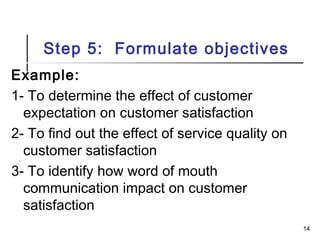
1- To determine the effect of customer
expectation on customer satisfaction
2- To find out the effect of service quality on
customer satisfaction
3- To identify how word of mouth
communication impact on customer
satisfaction
14
Paraphrasing research questions as
research objectives
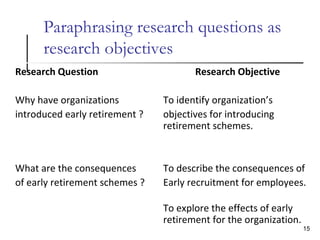
Research Question Research Objective
Why have organizations To identify organization’s
introduced early retirement ? objectives for introducing
retirement schemes.
What are the consequences To describe the consequences of
of early retirement schemes ? Early recruitment for employees.
To explore the effects of early
retirement for the organization.
15
Step 6: Assess your objectives
 Examine your objectives to ascertain the
feasibility of achieving them in the light of
the time, resources (financial and human)
and technical expertise at your disposal.
16
Step 7: Double-check
1. that you are really interested in the study
2. that you agree with the objectives
3. that you have adequate resources
4. that you have the technical expertise to
undertake the study
17
18
19
20
Considerations in selecting a
research problem
 interest,
 magnitude,
 measurement of concepts,
 level of expertise,
 relevance,
 availability of data,
 ethical issues.
21
REFERENCES
 Ranjit Kumar
Research_Methodology_A_Step-by-Step
22
23

Formulating research problem

  • 1.
    QURATULAIN MUGHAL BATCH IV DOCTOR OF PHYSICALTHERAPY ISRA UNIVERSITY FORMULATING A RESEARCH PROBLEM 1
  • 2.
    CONTENTS 1. Research problem 2.Steps in the formulation of a research problem 3. Example 4. Considerations in selecting a research problem 2
  • 3.
    RESEARCH PROBLEM  Asituation or circumstance that requires a solution to be described, explained, or predicted.  It is an unsatisfactory situation that wants you to confront. 3
  • 4.
    Formulating a research problem refers to identifying what it is that you want to find out about. 4
  • 5.
    Steps in theformulation of a research problem 1. Identify a broad field or subject area of interest to you. 2. Dissect the broad area into subareas. 3. Select what is of most interest to you. 4. Raise research questions. 5. Formulate objectives 6. Assess your objectives 5
  • 6.
    Step 1: Identifya broad field or subject area of interest to you.  Ex: If you are studying marketing you might be interested in researching consumer behavior (customer satisfaction). 6
  • 7.
    Step 2: Dissectthe broad area into subareas. 1- Profile of satisfied customers 2- Antecedents of customers satisfaction 3- The effect of customer satisfaction on consumer related outcomes 4- Measurement of customer satisfaction 7
  • 8.
    Step 3: Selectwhat is of most interest to you.  It is neither advisable nor feasible to study all subareas.  Go through your list and delete all those subareas in which you are not very interested.   select: Antecedents of customers satisfaction 8
  • 9.
    Step 4: Raiseresearch questions 1- What is the effect of customer expectation on customer satisfaction? 2- What is the effect of service quality on customer satisfaction? 3- What is the effect of word of mouth communication on customer satisfaction? 9
  • 10.
    Examples of researchideas (topic) and their derived focus research questions 10
  • 11.
    Step 5: Formulateobjectives  Your objectives grow out of your research questions.  The main difference between objectives and research questions is the way in which they are written.  Research questions are obviously that— questions. 11
  • 12.
    Step 5: Formulateobjectives  Objectives transform these questions into behavioral aims by using action-oriented words such as 'to find out', 'to determine', 'to ascertain' and 'to examine‘, ‘to measure’, ‘to explore’. 12
  • 13.
    Some examples…  Todescribe the types of incentives provides by five star hotels in Colombo to their employees.  To find out the opinion of the employees about the medical facilities provided by five star hotels in Colombo.  To ascertain the impact of training on employee retention.  To compare the effectiveness of different loyalty programmes on repeat clientele.  To ascertain if an increase in working hours will increase the incidence of drug abuse.  To demonstrate that the provision of company accommodation to employees in hotels will reduce staff turnover. 13
  • 14.
    Step 5: Formulateobjectives Example: 1- To determine the effect of customer expectation on customer satisfaction 2- To find out the effect of service quality on customer satisfaction 3- To identify how word of mouth communication impact on customer satisfaction 14
  • 15.
    Paraphrasing research questionsas research objectives Research Question Research Objective Why have organizations To identify organization’s introduced early retirement ? objectives for introducing retirement schemes. What are the consequences To describe the consequences of of early retirement schemes ? Early recruitment for employees. To explore the effects of early retirement for the organization. 15
  • 16.
    Step 6: Assessyour objectives  Examine your objectives to ascertain the feasibility of achieving them in the light of the time, resources (financial and human) and technical expertise at your disposal. 16
  • 17.
    Step 7: Double-check 1.that you are really interested in the study 2. that you agree with the objectives 3. that you have adequate resources 4. that you have the technical expertise to undertake the study 17
  • 18.
  • 19.
  • 20.
  • 21.
    Considerations in selectinga research problem  interest,  magnitude,  measurement of concepts,  level of expertise,  relevance,  availability of data,  ethical issues. 21
  • 22.
  • 23.