WELCOME

Literature Review
Raison Sam Raju
Department of Commerce
University of Kerala
Overview
Literature Review
• Definition
• Literature
• Types of literature review
• process
• Purpose
• What to review?
• Literature search procedure

• Sources of literature
• Planning the review work
• Note taking
Definition
• According to university of wincosin writing centre,
A literature review is a

“critical analysis of a segment of a
published body of knowledge through
summary, classification, and comparison
of prior research studies, reviews of
literature, and theoretical articles”
Key points of a literature review
• Tell me what the research says(Theory)

• Tell me how the research was carried out (Methodology)
• Tell me what is missing or the gap that research intends to fill.(Research gap)
Literature

literature in this context consists of:
Books
•Encyclopedias
•Year books
•Text books
•Reference books

Journals
•Published monthly,quarterly,half yearly or annually

Reports
•Reports of commissions appointed by Govt.
•Seminar reports

Research dissertations & Thesis
News papers
Micro forms: Audio & Video tapes
Types of Literature Review
On the purpose of research there are 3
main types of literature review

•Evaluative Review
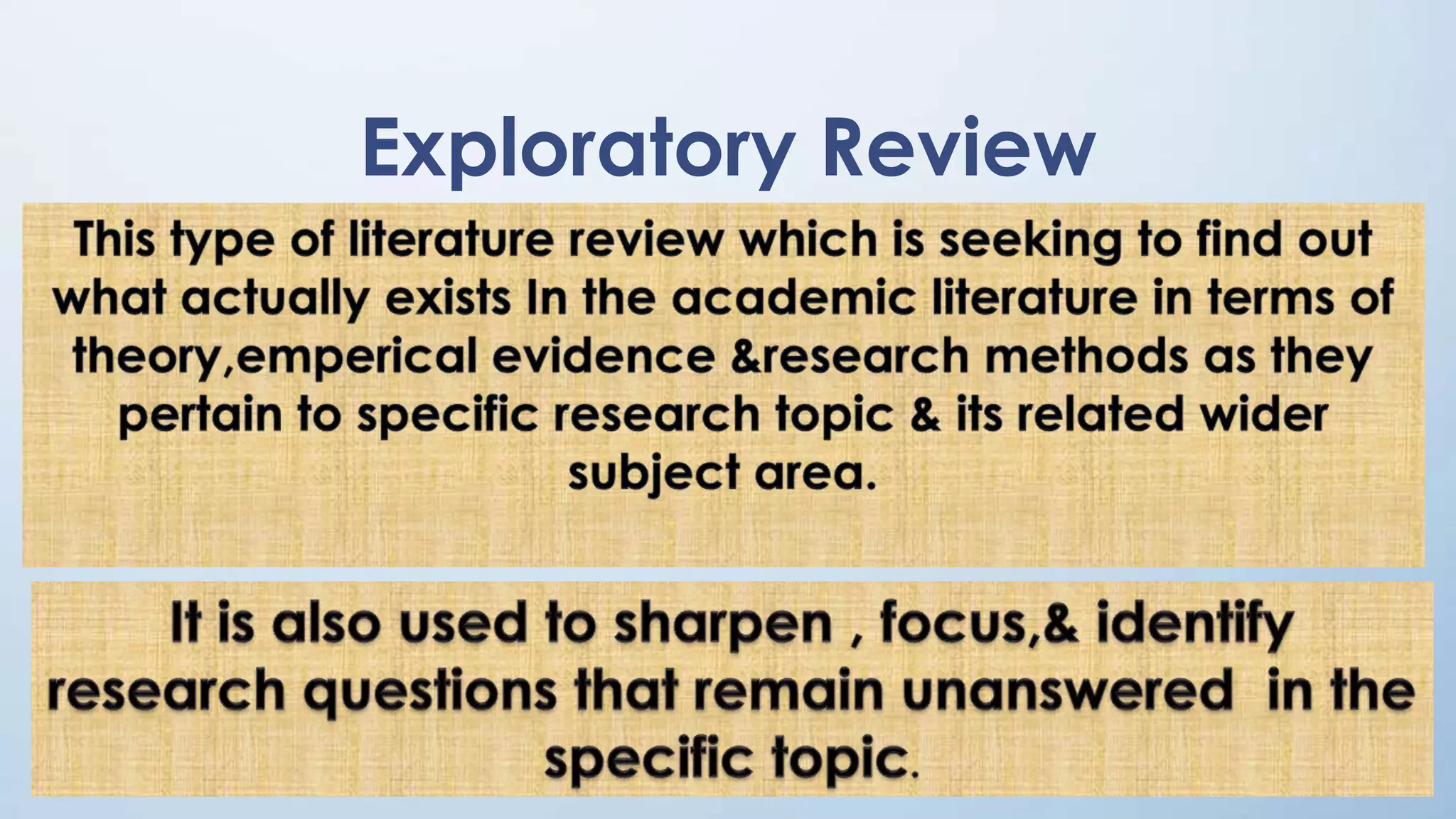
•Explorative Review
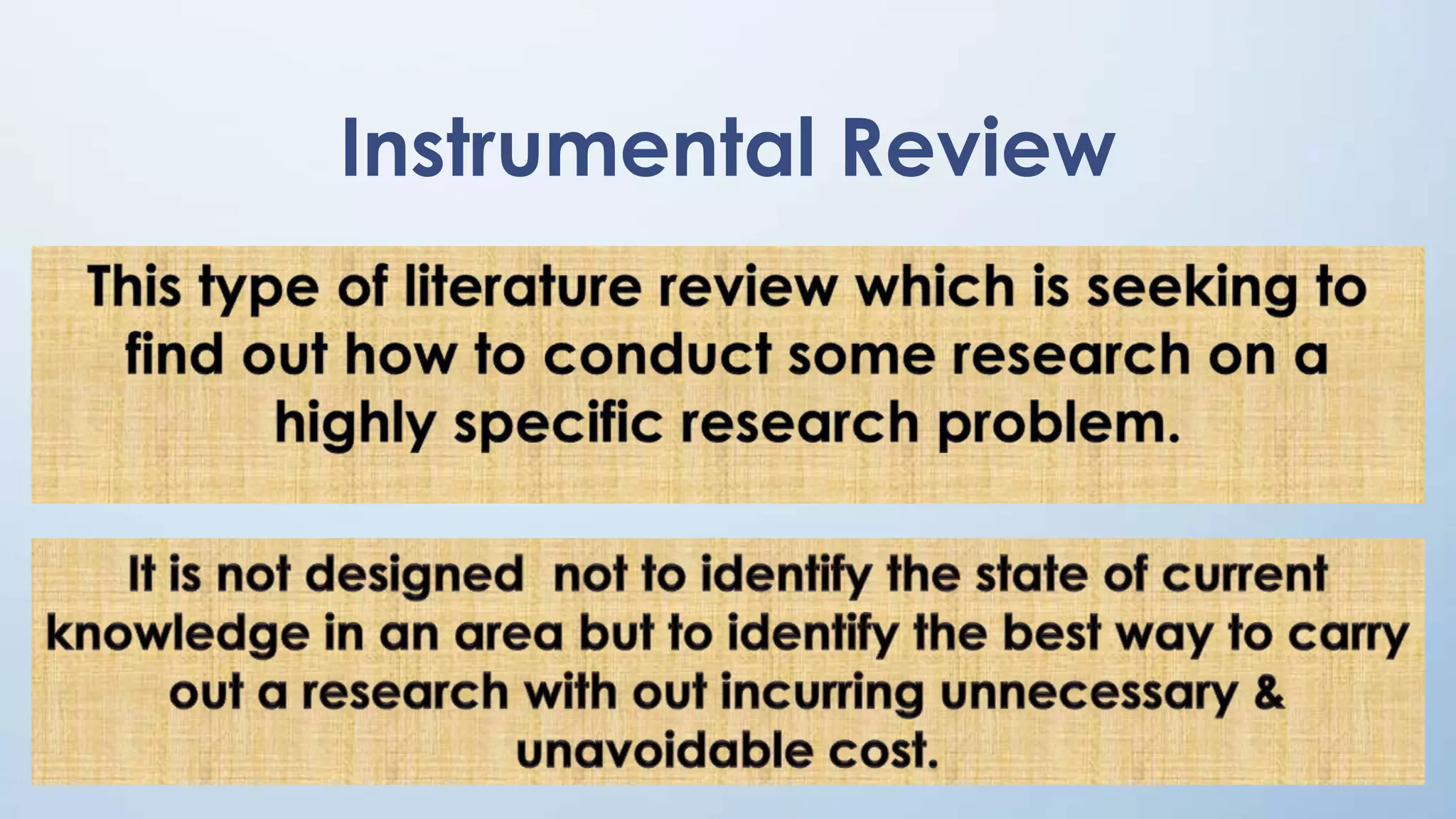
•Instrumental Review
Evaluative Review
Exploratory Review
Instrumental Review
PROCESS

A literature review can be divided into 2
process:
1.The search for material & resources
2.Writing literature review

In the first process topics include
1. What to review & purpose of review
2. Literature search procedure
3. Planning of research work
In the second process topics include:
Note taking
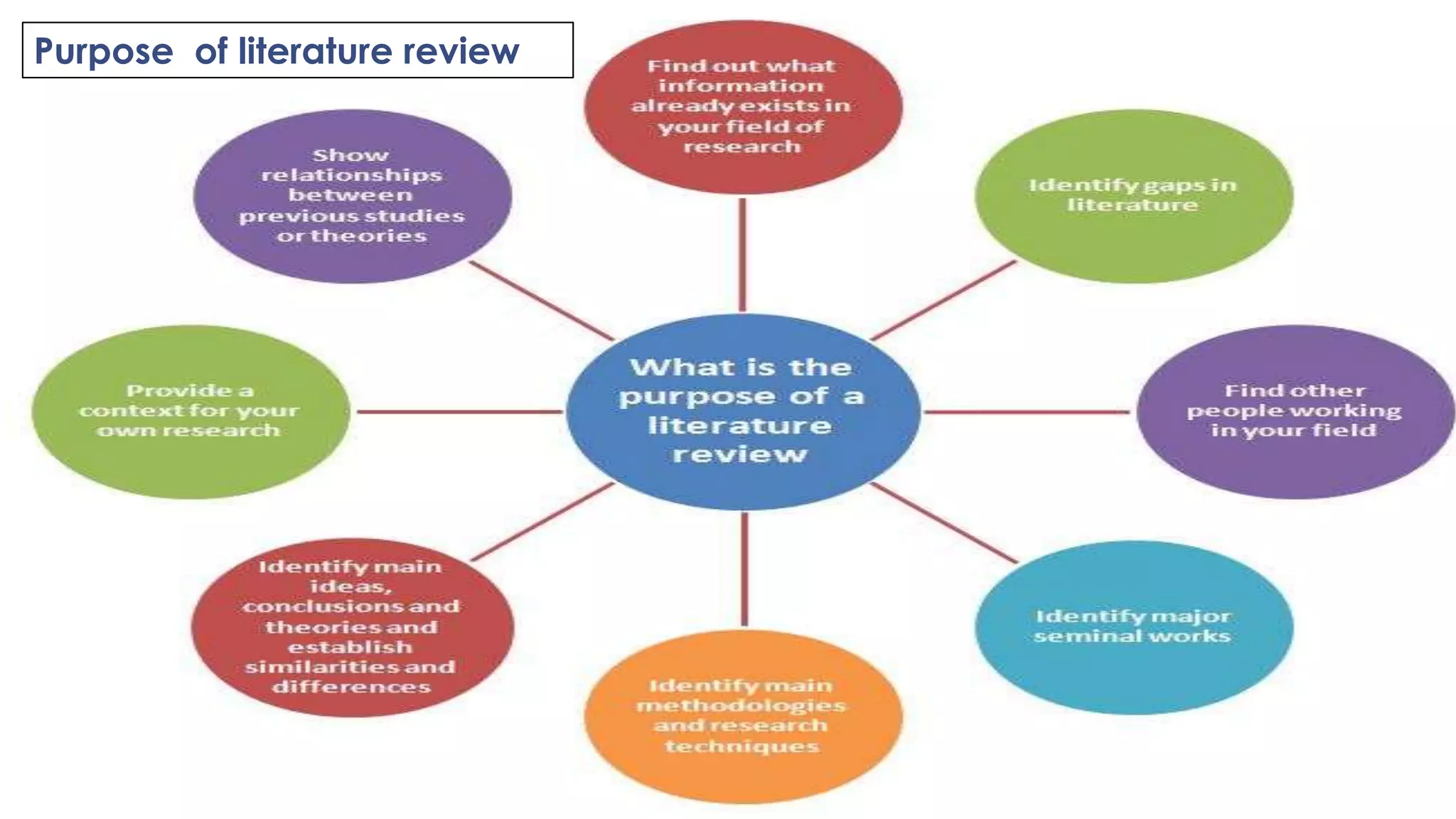
Purpose of literature review
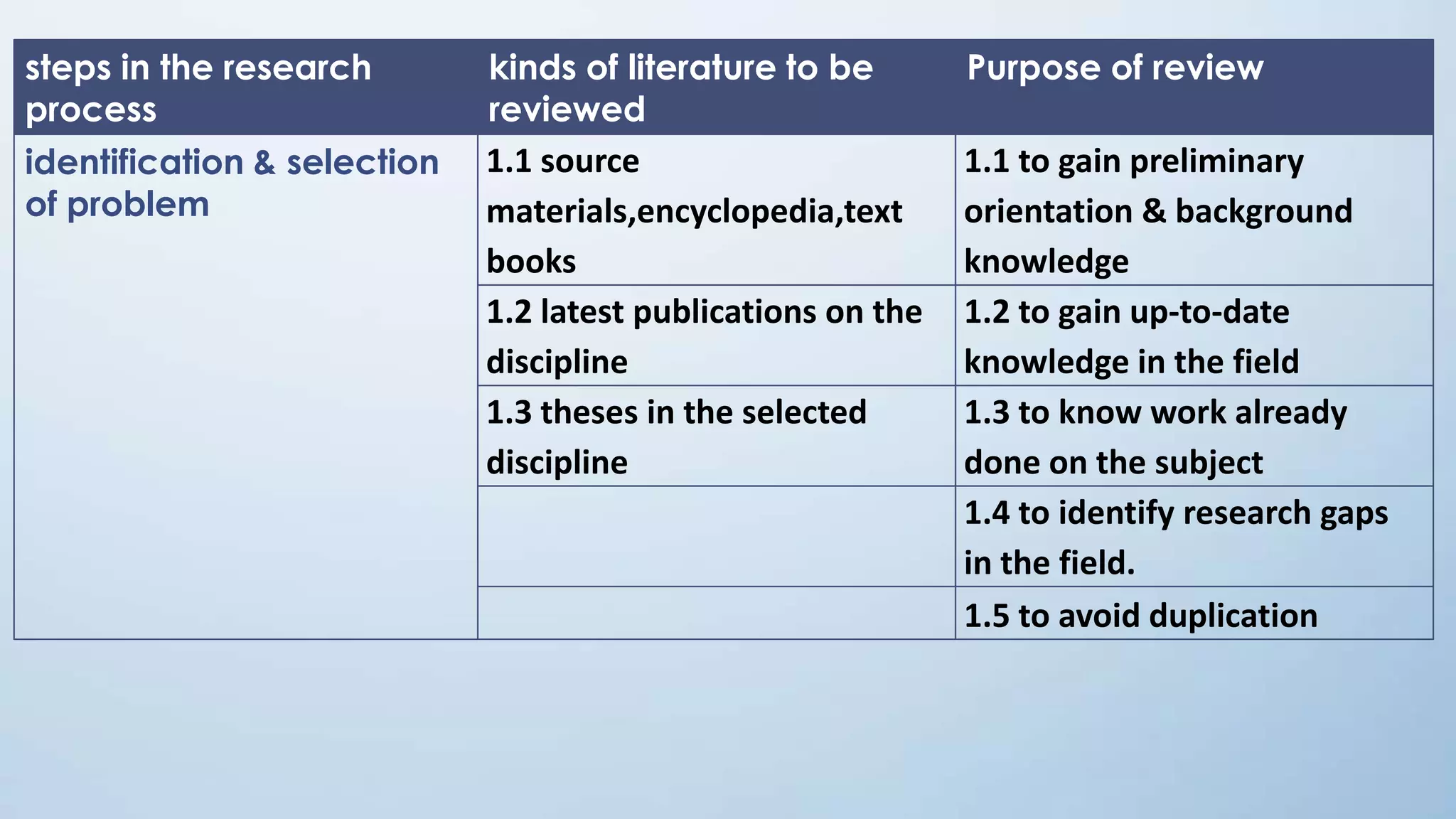
WHAT TO REVIEW ???

The kinds of literature to be revived at the
various stage of the research process and
specific purposes of the review are
indicated below:
steps in the research
process
identification & selection
of problem

kinds of literature to be
reviewed
1.1 source
materials,encyclopedia,text
books
1.2 latest publications on the
discipline
1.3 theses in the selected
discipline

Purpose of review

1.1 to gain preliminary
orientation & background
knowledge
1.2 to gain up-to-date
knowledge in the field
1.3 to know work already
done on the subject
1.4 to identify research gaps
in the field.
1.5 to avoid duplication
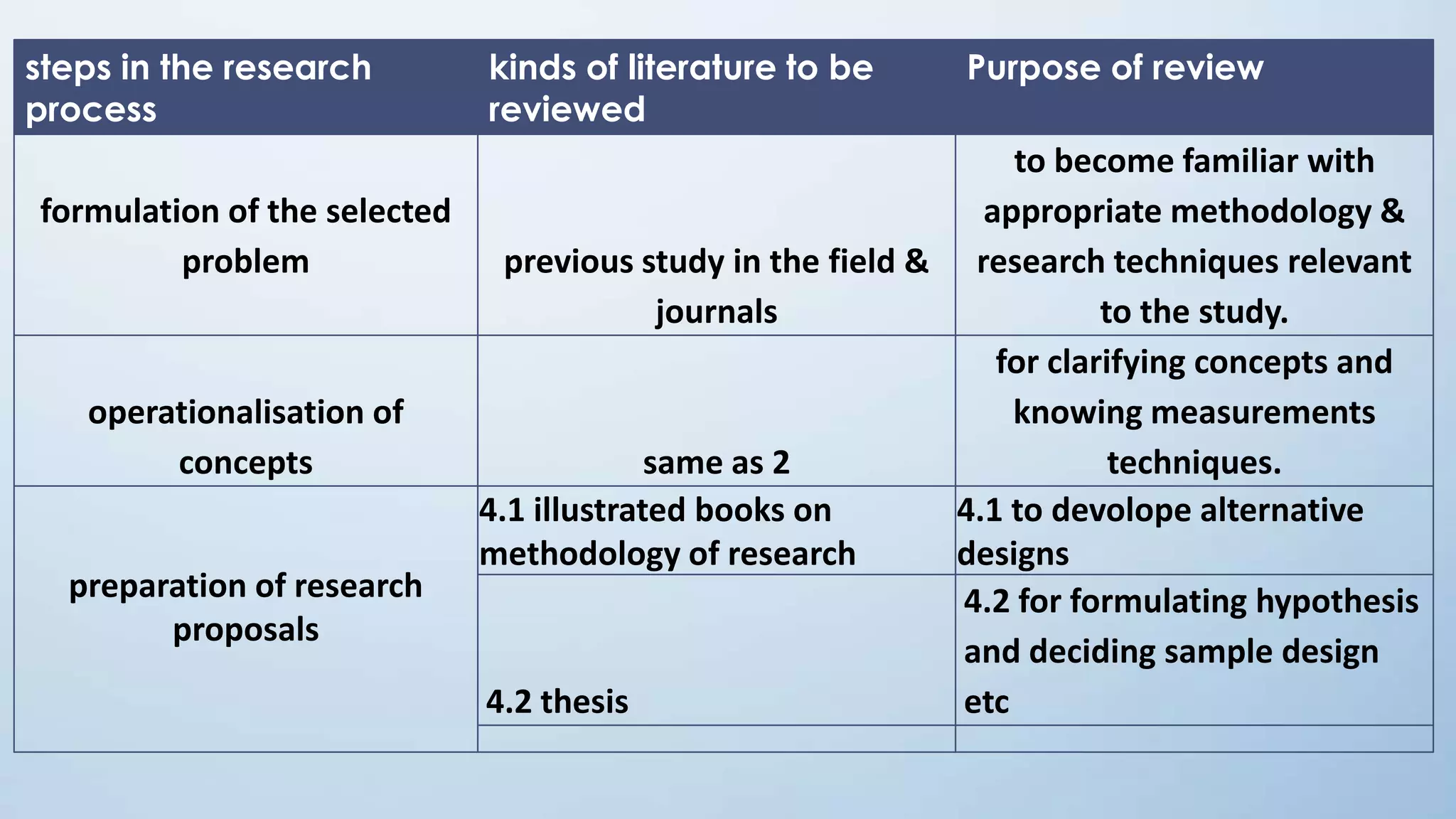
steps in the research
process

kinds of literature to be
reviewed

Purpose of review

to become familiar with
formulation of the selected
appropriate methodology &
problem
previous study in the field & research techniques relevant
journals
to the study.
for clarifying concepts and
operationalisation of
knowing measurements
concepts
same as 2
techniques.
4.1 illustrated books on
4.1 to devolope alternative
methodology of research
designs
preparation of research
4.2 for formulating hypothesis
proposals
and deciding sample design
4.2 thesis
etc
steps in the research
process

kinds of literature to be
reviewed

Purpose of review

5.1 same as 4.1 & 4.2
construction of tools for
collection of data

5.2 copies of tools & scales
furnished in the appendix of
theses.

for gaining thorough
knowledge of the process of
tools and measurement
techniques

journals
drafting theoretical chapters
text books
& theory parts of other
chapters
reference books

reports on subject matter

to take notes and compile
bibliography
LITERATURE SEARCH PROCEDURE
OR
HOW CAN WE FIND LITERATURE?

Literature search procedure involves a series of
steps which aims to identify the sources of
literature.
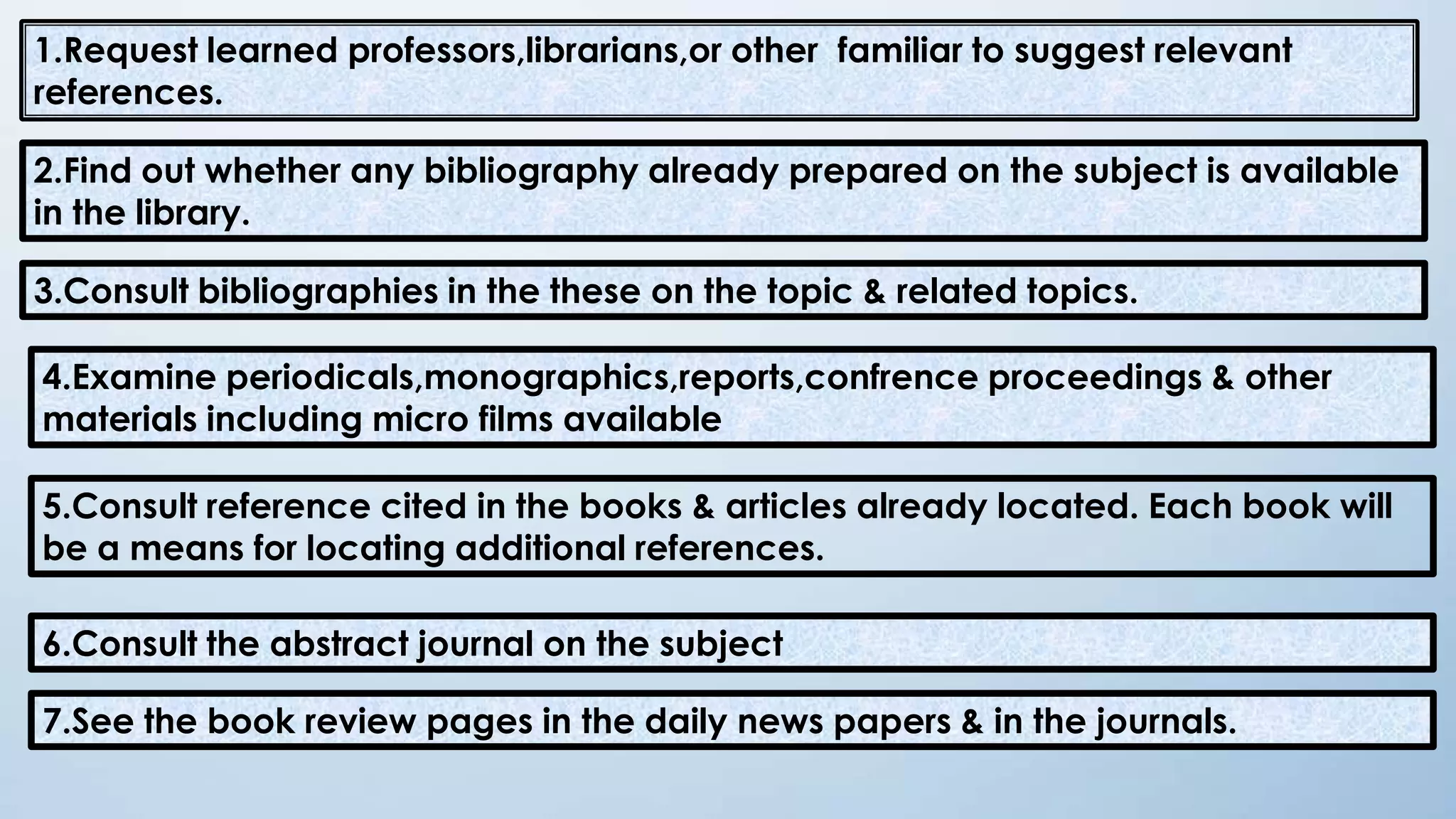
1.Request learned professors,librarians,or other familiar to suggest relevant
references.
2.Find out whether any bibliography already prepared on the subject is available
in the library.
3.Consult bibliographies in the these on the topic & related topics.
4.Examine periodicals,monographics,reports,confrence proceedings & other
materials including micro films available
5.Consult reference cited in the books & articles already located. Each book will
be a means for locating additional references.
6.Consult the abstract journal on the subject
7.See the book review pages in the daily news papers & in the journals.
Sources of Literature
Sources of literature can be divided into 3 :

1.Primary literature sources
2.Secondary literature sources
3. Tertiary literature sources

The different categories of literature sources
represents the flow of information from original source.
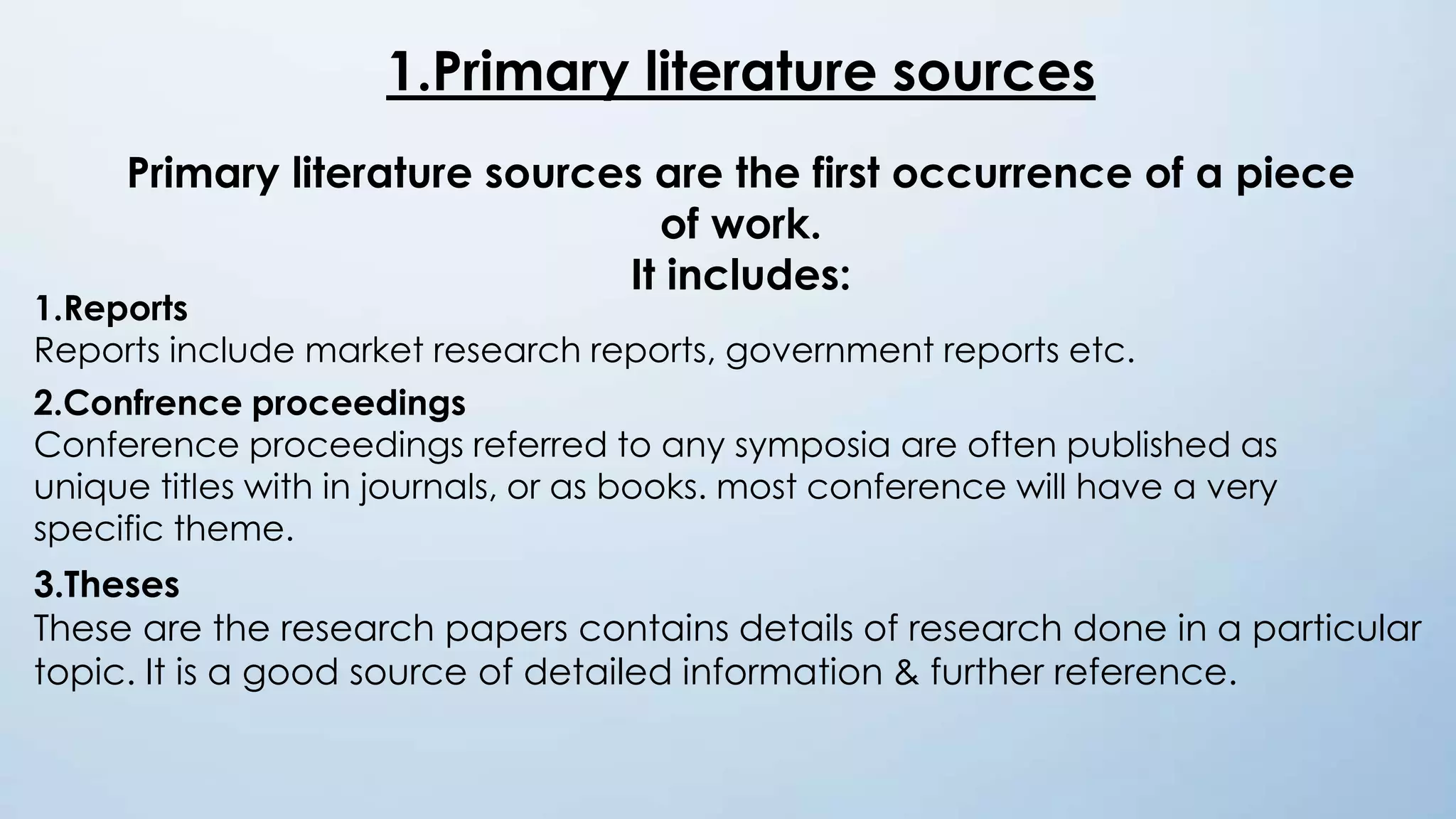
1.Primary literature sources
Primary literature sources are the first occurrence of a piece
of work.
It includes:

1.Reports
Reports include market research reports, government reports etc.

2.Confrence proceedings
Conference proceedings referred to any symposia are often published as
unique titles with in journals, or as books. most conference will have a very
specific theme.

3.Theses
These are the research papers contains details of research done in a particular
topic. It is a good source of detailed information & further reference.
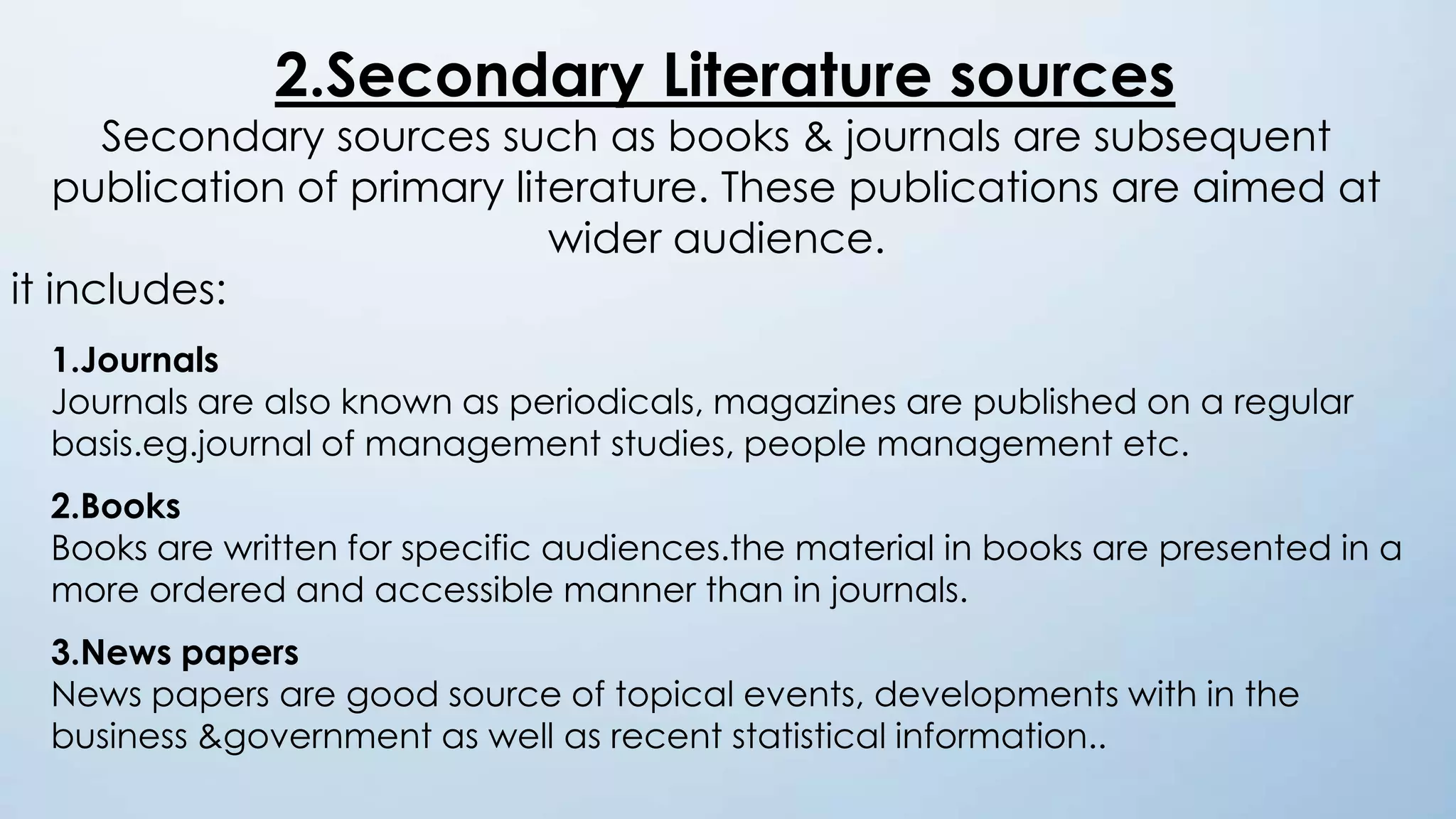
2.Secondary Literature sources

Secondary sources such as books & journals are subsequent
publication of primary literature. These publications are aimed at
wider audience.
it includes:
1.Journals
Journals are also known as periodicals, magazines are published on a regular
basis.eg.journal of management studies, people management etc.
2.Books
Books are written for specific audiences.the material in books are presented in a
more ordered and accessible manner than in journals.
3.News papers
News papers are good source of topical events, developments with in the
business &government as well as recent statistical information..
3. Tertiary literature sources
Tertiary literature sources also called as “search tools” are
designed either to help to locate primary & secondary
literature or to introduce a topic. They include indexes &
abstracts as well as encyclopaedias & bibliographies.

Eg:subject catalogues of libraries
List of books and publishers bulletins.
Planning the review work
One can identify many references relating to the selected topic. The problem
now is to go through the references one after the other & point out exact
information relevant to study.
Steps
This planning involves 3 steps:
1. To decide what information is useful &what is not useful.
The researcher should draw up a preliminary outline of the topic with reference
to objectives of study. it serve as a guide to take above decision.

2.To determine how to record what is gathered from a published material.

Should it be noted down as verbatim or paraphrased.

3.To set up as orderly recording or note taking system
In this decision the researcher must be guided by the requirement of a good
recording system. these requirements are:
(a) The recording system should facilitate ready location of the recorded
information when required.
(b) it should allow for more flexible handling & organising information.
(c) all notes relating to a particular concept of a topic should available
together.
All these requirements are meet with card system.
NOTE TAKING
Note taking means recording of information. the suitable
method of note taking is the use of cards. The recording
system involves uses of 2 sets of cards.

1.Source cards(3” * 5”)
2.Note cards(5” * 8”)
1.Source cards
An source card or index card or system card consists of
heavy paper stock cut to a standard size, used for recording and
storing bibliographic information. It was invented by Carl
Linnaeus, around 1760.
Source card serves 2 purposes.
1.Provide documentary information for foot notes to be given in
report
2.Used for compiling bibliography to be furnished at the end of
report.
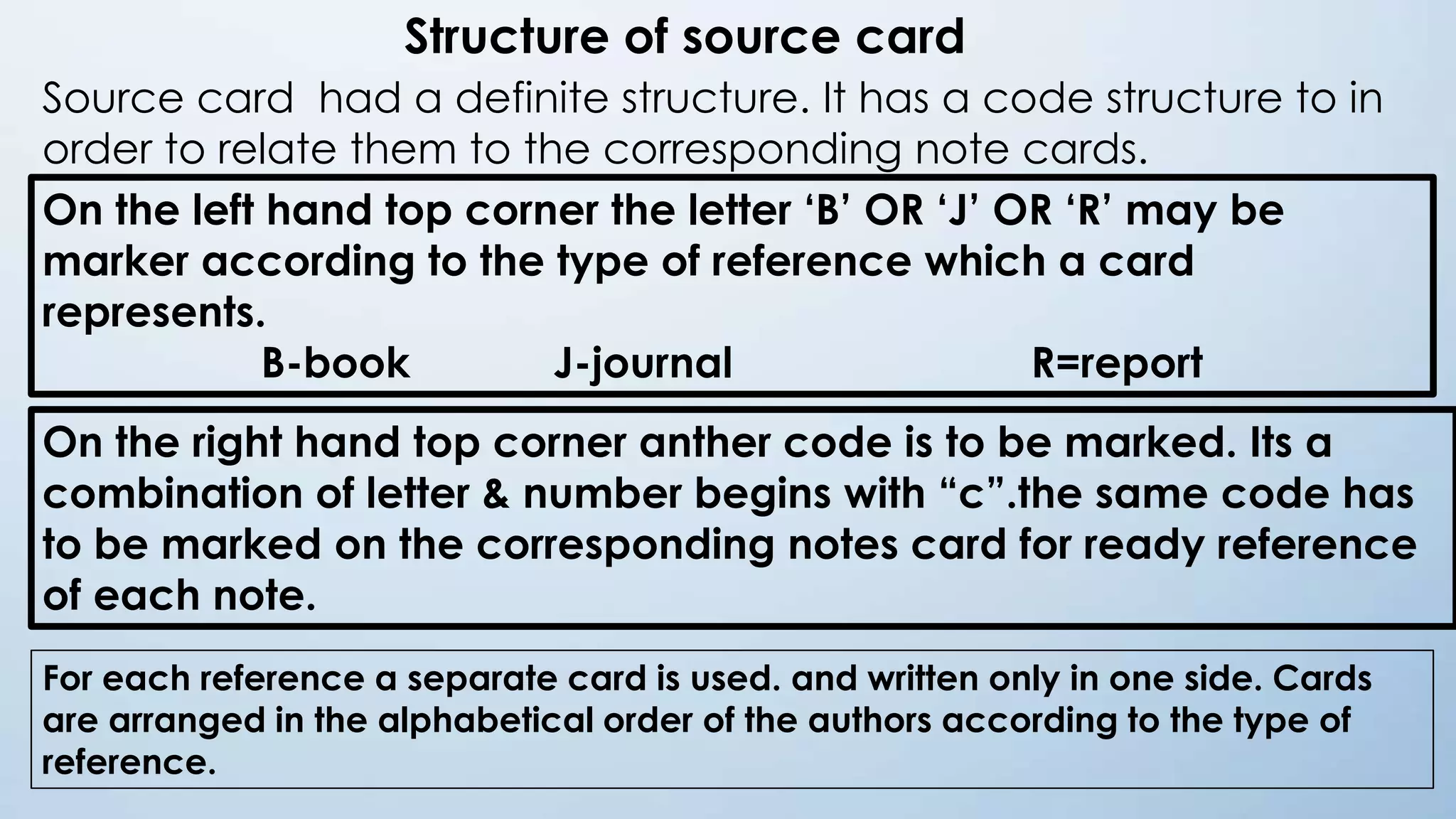
Structure of source card
Source card had a definite structure. It has a code structure to in
order to relate them to the corresponding note cards.
On the left hand top corner the letter „B‟ OR „J‟ OR „R‟ may be
marker according to the type of reference which a card
represents.
B-book
J-journal
R=report
On the right hand top corner anther code is to be marked. Its a
combination of letter & number begins with “c”.the same code has
to be marked on the corresponding notes card for ready reference
of each note.
For each reference a separate card is used. and written only in one side. Cards
are arranged in the alphabetical order of the authors according to the type of
reference.
The recording of bibliographic information in the source card should
be made in proper bibliographic format. Its varies for book and
article.
1.For a book
Two formats are used in popular. They are as below
(a)Authors name (starting with last name) , the title of book, place of
publication: the publisher's name, year.
E.g.:
Krishnaswami,o.r,methodology of research in social science
,Mumbai:himalaya publishing house,1993
(b)Authors name (starting with last name) , the title of book, the publisher's
name,place,year.
E.g.:
Krishnaswami,o.r,methodology of research in social science , Himalaya publishing
house, Mumbai,1993
If a work has 3 or more authors, the abbreviation “et al” meaning
„and others‟ may be used after the first author.
E.g..
Koontz,harold, et al.,management.newdelhi:mcgraw hill
international book comany,1980
If publication is an edited one ,use the abbreviation “ed” after the name.
2.For articles
Here also 2 forms are used.

(a).Authors name ,”the title of article", the journal
name,place.publishers name,vol,issue no.,date,pages
(b).Authors name ,”the title of article", the journal name,
publishers name, place,vol,issue no.,date,pages
SAMPLE OF SOURCE CARD
2.NOTE CARD
Information extracted from a printed source is recorded on the
note cards. There should be a single fact or idea on each card. The
structure of note card is as below:
(1). On the left hand top corner the source reference code is
marked.
(2).on the right hand top corner the number of researcher’s
proposed chapter to which the information is related is entered.
(3).On the space between top edge and first horizontal line, the
title of broad theme is written & in the next space the title of the
specific idea is marked.
(4).The idea or fact extracted from concerned reference is
recorded after above step.
SAMPLE OF NOTE CARD

NOTE CARDS PRESERVED IN A CARD INDEX BOX
CONCLUSION

LITERATURE REVIEW IS ESSENTIAL TO UNDERSTAND WHAT HAS
ALREADY DONE IN THE SPECIFIC TOPIC.ITS HELP TO
UNDERSTAND THE BACKGROUND OF THE SPECIFIC TOPIC
WHICH RESEARCHER INTENDS TO RESEARCH,METHODOLOGY
OF RESEARCH DONE BY PREVIOUS RESEARCHERS,AND
RESEARCH GAP.ITS AN ONGOING PROCESS FROM SELECTION
OF RESEARCH PROBLEM TO REPORT WRITTING.THERE IS SPECIFIC
STRUCTURE FOR NOTING LITERATURE IN RESEARCH PAPER.
REFRENCE
1.

Krishnaswami,o.r,methodology of research in social science ,Mumbai:himalaya
publishing house,1993

2.adams,john,etal.,research methods for graduate business and social
science students,usa:library of congress,2007

3.Lewis,philip, etal., Research methods for business
students,newdelhi:dorling kindersely,2000
Literature review in research methodology

Literature review in research methodology

  • 1.
    WELCOME Literature Review Raison SamRaju Department of Commerce University of Kerala
  • 2.
    Overview Literature Review • Definition •Literature • Types of literature review • process • Purpose • What to review? • Literature search procedure • Sources of literature • Planning the review work • Note taking
  • 3.
    Definition • According touniversity of wincosin writing centre, A literature review is a “critical analysis of a segment of a published body of knowledge through summary, classification, and comparison of prior research studies, reviews of literature, and theoretical articles”
  • 4.
    Key points ofa literature review • Tell me what the research says(Theory) • Tell me how the research was carried out (Methodology) • Tell me what is missing or the gap that research intends to fill.(Research gap)
  • 5.
    Literature literature in thiscontext consists of: Books •Encyclopedias •Year books •Text books •Reference books Journals •Published monthly,quarterly,half yearly or annually Reports •Reports of commissions appointed by Govt. •Seminar reports Research dissertations & Thesis News papers Micro forms: Audio & Video tapes
  • 6.
    Types of LiteratureReview On the purpose of research there are 3 main types of literature review •Evaluative Review •Explorative Review •Instrumental Review
  • 7.
  • 8.
  • 9.
  • 10.
    PROCESS A literature reviewcan be divided into 2 process: 1.The search for material & resources 2.Writing literature review In the first process topics include 1. What to review & purpose of review 2. Literature search procedure 3. Planning of research work In the second process topics include: Note taking
  • 11.
  • 12.
    WHAT TO REVIEW??? The kinds of literature to be revived at the various stage of the research process and specific purposes of the review are indicated below:
  • 13.
    steps in theresearch process identification & selection of problem kinds of literature to be reviewed 1.1 source materials,encyclopedia,text books 1.2 latest publications on the discipline 1.3 theses in the selected discipline Purpose of review 1.1 to gain preliminary orientation & background knowledge 1.2 to gain up-to-date knowledge in the field 1.3 to know work already done on the subject 1.4 to identify research gaps in the field. 1.5 to avoid duplication
  • 14.
    steps in theresearch process kinds of literature to be reviewed Purpose of review to become familiar with formulation of the selected appropriate methodology & problem previous study in the field & research techniques relevant journals to the study. for clarifying concepts and operationalisation of knowing measurements concepts same as 2 techniques. 4.1 illustrated books on 4.1 to devolope alternative methodology of research designs preparation of research 4.2 for formulating hypothesis proposals and deciding sample design 4.2 thesis etc
  • 15.
    steps in theresearch process kinds of literature to be reviewed Purpose of review 5.1 same as 4.1 & 4.2 construction of tools for collection of data 5.2 copies of tools & scales furnished in the appendix of theses. for gaining thorough knowledge of the process of tools and measurement techniques journals drafting theoretical chapters text books & theory parts of other chapters reference books reports on subject matter to take notes and compile bibliography
  • 16.
    LITERATURE SEARCH PROCEDURE OR HOWCAN WE FIND LITERATURE? Literature search procedure involves a series of steps which aims to identify the sources of literature.
  • 17.
    1.Request learned professors,librarians,orother familiar to suggest relevant references. 2.Find out whether any bibliography already prepared on the subject is available in the library. 3.Consult bibliographies in the these on the topic & related topics. 4.Examine periodicals,monographics,reports,confrence proceedings & other materials including micro films available 5.Consult reference cited in the books & articles already located. Each book will be a means for locating additional references. 6.Consult the abstract journal on the subject 7.See the book review pages in the daily news papers & in the journals.
  • 18.
    Sources of Literature Sourcesof literature can be divided into 3 : 1.Primary literature sources 2.Secondary literature sources 3. Tertiary literature sources The different categories of literature sources represents the flow of information from original source.
  • 19.
    1.Primary literature sources Primaryliterature sources are the first occurrence of a piece of work. It includes: 1.Reports Reports include market research reports, government reports etc. 2.Confrence proceedings Conference proceedings referred to any symposia are often published as unique titles with in journals, or as books. most conference will have a very specific theme. 3.Theses These are the research papers contains details of research done in a particular topic. It is a good source of detailed information & further reference.
  • 20.
    2.Secondary Literature sources Secondarysources such as books & journals are subsequent publication of primary literature. These publications are aimed at wider audience. it includes: 1.Journals Journals are also known as periodicals, magazines are published on a regular basis.eg.journal of management studies, people management etc. 2.Books Books are written for specific audiences.the material in books are presented in a more ordered and accessible manner than in journals. 3.News papers News papers are good source of topical events, developments with in the business &government as well as recent statistical information..
  • 21.
    3. Tertiary literaturesources Tertiary literature sources also called as “search tools” are designed either to help to locate primary & secondary literature or to introduce a topic. They include indexes & abstracts as well as encyclopaedias & bibliographies. Eg:subject catalogues of libraries List of books and publishers bulletins.
  • 22.
    Planning the reviewwork One can identify many references relating to the selected topic. The problem now is to go through the references one after the other & point out exact information relevant to study. Steps This planning involves 3 steps:
  • 23.
    1. To decidewhat information is useful &what is not useful. The researcher should draw up a preliminary outline of the topic with reference to objectives of study. it serve as a guide to take above decision. 2.To determine how to record what is gathered from a published material. Should it be noted down as verbatim or paraphrased. 3.To set up as orderly recording or note taking system In this decision the researcher must be guided by the requirement of a good recording system. these requirements are: (a) The recording system should facilitate ready location of the recorded information when required. (b) it should allow for more flexible handling & organising information. (c) all notes relating to a particular concept of a topic should available together. All these requirements are meet with card system.
  • 24.
    NOTE TAKING Note takingmeans recording of information. the suitable method of note taking is the use of cards. The recording system involves uses of 2 sets of cards. 1.Source cards(3” * 5”) 2.Note cards(5” * 8”)
  • 25.
    1.Source cards An sourcecard or index card or system card consists of heavy paper stock cut to a standard size, used for recording and storing bibliographic information. It was invented by Carl Linnaeus, around 1760. Source card serves 2 purposes. 1.Provide documentary information for foot notes to be given in report 2.Used for compiling bibliography to be furnished at the end of report.
  • 26.
    Structure of sourcecard Source card had a definite structure. It has a code structure to in order to relate them to the corresponding note cards. On the left hand top corner the letter „B‟ OR „J‟ OR „R‟ may be marker according to the type of reference which a card represents. B-book J-journal R=report On the right hand top corner anther code is to be marked. Its a combination of letter & number begins with “c”.the same code has to be marked on the corresponding notes card for ready reference of each note. For each reference a separate card is used. and written only in one side. Cards are arranged in the alphabetical order of the authors according to the type of reference.
  • 27.
    The recording ofbibliographic information in the source card should be made in proper bibliographic format. Its varies for book and article. 1.For a book Two formats are used in popular. They are as below (a)Authors name (starting with last name) , the title of book, place of publication: the publisher's name, year. E.g.: Krishnaswami,o.r,methodology of research in social science ,Mumbai:himalaya publishing house,1993 (b)Authors name (starting with last name) , the title of book, the publisher's name,place,year. E.g.: Krishnaswami,o.r,methodology of research in social science , Himalaya publishing house, Mumbai,1993
  • 28.
    If a workhas 3 or more authors, the abbreviation “et al” meaning „and others‟ may be used after the first author. E.g.. Koontz,harold, et al.,management.newdelhi:mcgraw hill international book comany,1980 If publication is an edited one ,use the abbreviation “ed” after the name. 2.For articles Here also 2 forms are used. (a).Authors name ,”the title of article", the journal name,place.publishers name,vol,issue no.,date,pages (b).Authors name ,”the title of article", the journal name, publishers name, place,vol,issue no.,date,pages
  • 29.
  • 30.
    2.NOTE CARD Information extractedfrom a printed source is recorded on the note cards. There should be a single fact or idea on each card. The structure of note card is as below: (1). On the left hand top corner the source reference code is marked. (2).on the right hand top corner the number of researcher’s proposed chapter to which the information is related is entered. (3).On the space between top edge and first horizontal line, the title of broad theme is written & in the next space the title of the specific idea is marked. (4).The idea or fact extracted from concerned reference is recorded after above step.
  • 31.
    SAMPLE OF NOTECARD NOTE CARDS PRESERVED IN A CARD INDEX BOX
  • 32.
    CONCLUSION LITERATURE REVIEW ISESSENTIAL TO UNDERSTAND WHAT HAS ALREADY DONE IN THE SPECIFIC TOPIC.ITS HELP TO UNDERSTAND THE BACKGROUND OF THE SPECIFIC TOPIC WHICH RESEARCHER INTENDS TO RESEARCH,METHODOLOGY OF RESEARCH DONE BY PREVIOUS RESEARCHERS,AND RESEARCH GAP.ITS AN ONGOING PROCESS FROM SELECTION OF RESEARCH PROBLEM TO REPORT WRITTING.THERE IS SPECIFIC STRUCTURE FOR NOTING LITERATURE IN RESEARCH PAPER.
  • 33.
    REFRENCE 1. Krishnaswami,o.r,methodology of researchin social science ,Mumbai:himalaya publishing house,1993 2.adams,john,etal.,research methods for graduate business and social science students,usa:library of congress,2007 3.Lewis,philip, etal., Research methods for business students,newdelhi:dorling kindersely,2000