R E S E A R C H M E T H O D O L O G Y
LECTURE # 3:
“Reviewing the literature”
by Muhammad Salman Jamil
Literature Review
 Essential preliminary task in order to acquaint yourself
with the available body of knowledge in your area of
interest.
 Literature review is an integral part of entire research
process and makes valuable contribution to every
operational step.
 Reviewing literature can be time-consuming, daunting
and frustrating, but is also rewarding.
2
FUNCTIONS OF
LITERATURE REVIEW
3
 Bring clarity and focus to research problem
 Improve methodology
 Broaden knowledge base
 Contextualize findings
Bring clarity & focus to research
problem
 The process of reviewing the literature helps in
understanding the subject area better and
conceptualizing research problem clearly and
precisely.
 It also builds the relationship between research
problem and the body of knowledge in the subject
area.
 Reviewing the literature would help the researcher
to identify gaps in multiple aspects of subject area.
4
Improving research
methodology
 A literature review tells if others have used procedures
and methods similar to the ones that you are proposing,
which procedures and methods have worked well for
them and what problems they have faced.
 It lets you to be better positioned to select a methodology
that is capable of providing valid answer to your research
questions.
 By knowing the problems and pitfalls, you will have the
confidence in the methodology that is being planned to
use and will be equipped him to defend its use.
5
Broaden knowledge Base
 It ensures you to read widely around the subject area in
which you intend to conduct your research study.
 As you are expected to be an expert in your area of study, it
helps fulfill this expectation.
 “Literature review also helps you to understand how the
findings of your study fit into the existing body of
knowledge” (Martin 1985: 30)
 Literature review covers broader area of research study.
Better literature review provides the chance to researcher
to achieve its objectives precisely.
6
Contextualize research findings
 How do answers to your research questions compare
with what others have found?
 What contribution have you been able to make in to
the existing body of knowledge?
 How are your findings differ from those of others?
 It is important to place your findings in the context of
what is already known in your field of inquiry.
7
HOW TO REVIEW THE
LITERATURE
8
How to review the Literature
 Research problem helps the literature in a way to narrow down
the broad area of interest according to required objective.
 Therefore, it is needed to conceptualize the research problem
before undertaking your major literature review.
 Below are steps to review the literature are:
1) Search for existing literature in your area of study
2) Review the literature selected
3) Develop a theoretical framework
4) Develop a conceptual framework
9
1. Search for existing literature
 To effectively search for literature in your field of
enquiry, it is imperative that you have in mind at
least some idea of broad subject area and of the
problem you wish to investigate, in order to set
parameters for your search.
 A bibliography for this broad area & Sources are
derived from these sources are :
◦ Books
◦ Journals
◦ Internet
10
11
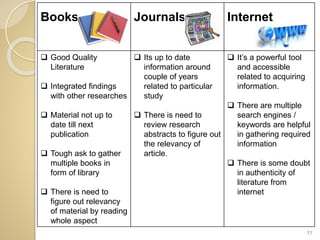
Books Journals Internet
 Good Quality
Literature
 Integrated findings
with other researches
 Material not up to
date till next
publication
 Tough ask to gather
multiple books in
form of library
 There is need to
figure out relevancy
of material by reading
whole aspect
 Its up to date
information around
couple of years
related to particular
study
 There is need to
review research
abstracts to figure out
the relevancy of
article.
 It’s a powerful tool
and accessible
related to acquiring
information.
 There are multiple
search engines /
keywords are helpful
in gathering required
information
 There is some doubt
in authenticity of
literature from
internet
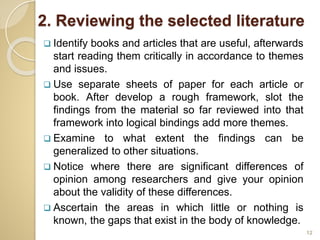
2. Reviewing the selected literature
 Identify books and articles that are useful, afterwards
start reading them critically in accordance to themes
and issues.
 Use separate sheets of paper for each article or
book. After develop a rough framework, slot the
findings from the material so far reviewed into that
framework into logical bindings add more themes.
 Examine to what extent the findings can be
generalized to other situations.
 Notice where there are significant differences of
opinion among researchers and give your opinion
about the validity of these differences.
 Ascertain the areas in which little or nothing is
known, the gaps that exist in the body of knowledge.
12
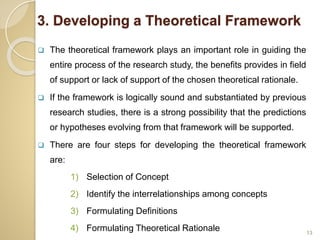
3. Developing a Theoretical Framework
 The theoretical framework plays an important role in guiding the
entire process of the research study, the benefits provides in field
of support or lack of support of the chosen theoretical rationale.
 If the framework is logically sound and substantiated by previous
research studies, there is a strong possibility that the predictions
or hypotheses evolving from that framework will be supported.
 There are four steps for developing the theoretical framework
are:
1) Selection of Concept
2) Identify the interrelationships among concepts
3) Formulating Definitions
4) Formulating Theoretical Rationale 13
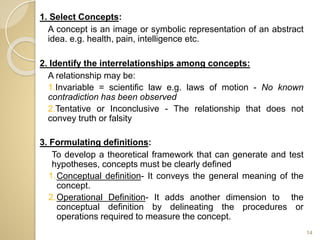
1. Select Concepts:
A concept is an image or symbolic representation of an abstract
idea. e.g. health, pain, intelligence etc.
2. Identify the interrelationships among concepts:
A relationship may be:
1.Invariable = scientific law e.g. laws of motion - No known
contradiction has been observed
2.Tentative or Inconclusive - The relationship that does not
convey truth or falsity
3. Formulating definitions:
To develop a theoretical framework that can generate and test
hypotheses, concepts must be clearly defined
1.Conceptual definition- It conveys the general meaning of the
concept.
2.Operational Definition- It adds another dimension to the
conceptual definition by delineating the procedures or
operations required to measure the concept.
14
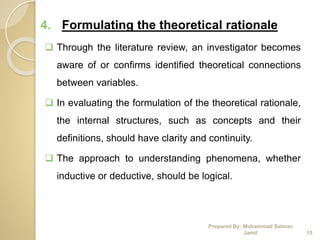
4. Formulating the theoretical rationale
 Through the literature review, an investigator becomes
aware of or confirms identified theoretical connections
between variables.
 In evaluating the formulation of the theoretical rationale,
the internal structures, such as concepts and their
definitions, should have clarity and continuity.
 The approach to understanding phenomena, whether
inductive or deductive, should be logical.
Prepared By: Muhammad Salman
Jamil 15
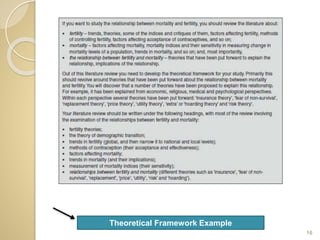
16
Theoretical Framework Example
4. Developing a Conceptual framework
 A conceptual framework is an analytical tool with several
variations and contexts.
 It is used to make conceptual distinctions and organize ideas.
 Strong conceptual frameworks capture something real and do
this in a way that is easy to remember and apply.
 The theoretical framework consists of the theories or issues in
which your study is embedded, the conceptual framework
describes the aspects you selected from the theoretical
framework to become the basis of your enquiry
17
18
Conceptual Framework Example
Writing about literature reviewed
 In order to comply with the first function of literature review i.e.
to provide theoretical background to your study:
 List the main themes that have emerged while reading
literature.
 Convert them into subheadings to be precise, descriptive of
the theme in question, and follow a logical progression.
 By subheading, record the main findings with respect to the
theme in question, highlighting the reasoning for argument &
identify gaps and issues.
 The next function contextualizing the findings of your study is
undertaking at the research report writing stage.
 It places your findings in the context of what others have found
out.
 It needs to quote your findings either contradict or confirm and
add to them.
19
Prepared By: Muhammad Salman
Jamil 20

Research Methodology

  • 1.
    R E SE A R C H M E T H O D O L O G Y LECTURE # 3: “Reviewing the literature” by Muhammad Salman Jamil
  • 2.
    Literature Review  Essentialpreliminary task in order to acquaint yourself with the available body of knowledge in your area of interest.  Literature review is an integral part of entire research process and makes valuable contribution to every operational step.  Reviewing literature can be time-consuming, daunting and frustrating, but is also rewarding. 2
  • 3.
    FUNCTIONS OF LITERATURE REVIEW 3 Bring clarity and focus to research problem  Improve methodology  Broaden knowledge base  Contextualize findings
  • 4.
    Bring clarity &focus to research problem  The process of reviewing the literature helps in understanding the subject area better and conceptualizing research problem clearly and precisely.  It also builds the relationship between research problem and the body of knowledge in the subject area.  Reviewing the literature would help the researcher to identify gaps in multiple aspects of subject area. 4
  • 5.
    Improving research methodology  Aliterature review tells if others have used procedures and methods similar to the ones that you are proposing, which procedures and methods have worked well for them and what problems they have faced.  It lets you to be better positioned to select a methodology that is capable of providing valid answer to your research questions.  By knowing the problems and pitfalls, you will have the confidence in the methodology that is being planned to use and will be equipped him to defend its use. 5
  • 6.
    Broaden knowledge Base It ensures you to read widely around the subject area in which you intend to conduct your research study.  As you are expected to be an expert in your area of study, it helps fulfill this expectation.  “Literature review also helps you to understand how the findings of your study fit into the existing body of knowledge” (Martin 1985: 30)  Literature review covers broader area of research study. Better literature review provides the chance to researcher to achieve its objectives precisely. 6
  • 7.
    Contextualize research findings How do answers to your research questions compare with what others have found?  What contribution have you been able to make in to the existing body of knowledge?  How are your findings differ from those of others?  It is important to place your findings in the context of what is already known in your field of inquiry. 7
  • 8.
    HOW TO REVIEWTHE LITERATURE 8
  • 9.
    How to reviewthe Literature  Research problem helps the literature in a way to narrow down the broad area of interest according to required objective.  Therefore, it is needed to conceptualize the research problem before undertaking your major literature review.  Below are steps to review the literature are: 1) Search for existing literature in your area of study 2) Review the literature selected 3) Develop a theoretical framework 4) Develop a conceptual framework 9
  • 10.
    1. Search forexisting literature  To effectively search for literature in your field of enquiry, it is imperative that you have in mind at least some idea of broad subject area and of the problem you wish to investigate, in order to set parameters for your search.  A bibliography for this broad area & Sources are derived from these sources are : ◦ Books ◦ Journals ◦ Internet 10
  • 11.
    11 Books Journals Internet Good Quality Literature  Integrated findings with other researches  Material not up to date till next publication  Tough ask to gather multiple books in form of library  There is need to figure out relevancy of material by reading whole aspect  Its up to date information around couple of years related to particular study  There is need to review research abstracts to figure out the relevancy of article.  It’s a powerful tool and accessible related to acquiring information.  There are multiple search engines / keywords are helpful in gathering required information  There is some doubt in authenticity of literature from internet
  • 12.
    2. Reviewing theselected literature  Identify books and articles that are useful, afterwards start reading them critically in accordance to themes and issues.  Use separate sheets of paper for each article or book. After develop a rough framework, slot the findings from the material so far reviewed into that framework into logical bindings add more themes.  Examine to what extent the findings can be generalized to other situations.  Notice where there are significant differences of opinion among researchers and give your opinion about the validity of these differences.  Ascertain the areas in which little or nothing is known, the gaps that exist in the body of knowledge. 12
  • 13.
    3. Developing aTheoretical Framework  The theoretical framework plays an important role in guiding the entire process of the research study, the benefits provides in field of support or lack of support of the chosen theoretical rationale.  If the framework is logically sound and substantiated by previous research studies, there is a strong possibility that the predictions or hypotheses evolving from that framework will be supported.  There are four steps for developing the theoretical framework are: 1) Selection of Concept 2) Identify the interrelationships among concepts 3) Formulating Definitions 4) Formulating Theoretical Rationale 13
  • 14.
    1. Select Concepts: Aconcept is an image or symbolic representation of an abstract idea. e.g. health, pain, intelligence etc. 2. Identify the interrelationships among concepts: A relationship may be: 1.Invariable = scientific law e.g. laws of motion - No known contradiction has been observed 2.Tentative or Inconclusive - The relationship that does not convey truth or falsity 3. Formulating definitions: To develop a theoretical framework that can generate and test hypotheses, concepts must be clearly defined 1.Conceptual definition- It conveys the general meaning of the concept. 2.Operational Definition- It adds another dimension to the conceptual definition by delineating the procedures or operations required to measure the concept. 14
  • 15.
    4. Formulating thetheoretical rationale  Through the literature review, an investigator becomes aware of or confirms identified theoretical connections between variables.  In evaluating the formulation of the theoretical rationale, the internal structures, such as concepts and their definitions, should have clarity and continuity.  The approach to understanding phenomena, whether inductive or deductive, should be logical. Prepared By: Muhammad Salman Jamil 15
  • 16.
  • 17.
    4. Developing aConceptual framework  A conceptual framework is an analytical tool with several variations and contexts.  It is used to make conceptual distinctions and organize ideas.  Strong conceptual frameworks capture something real and do this in a way that is easy to remember and apply.  The theoretical framework consists of the theories or issues in which your study is embedded, the conceptual framework describes the aspects you selected from the theoretical framework to become the basis of your enquiry 17
  • 18.
  • 19.
    Writing about literaturereviewed  In order to comply with the first function of literature review i.e. to provide theoretical background to your study:  List the main themes that have emerged while reading literature.  Convert them into subheadings to be precise, descriptive of the theme in question, and follow a logical progression.  By subheading, record the main findings with respect to the theme in question, highlighting the reasoning for argument & identify gaps and issues.  The next function contextualizing the findings of your study is undertaking at the research report writing stage.  It places your findings in the context of what others have found out.  It needs to quote your findings either contradict or confirm and add to them. 19
  • 20.
    Prepared By: MuhammadSalman Jamil 20