RESEARCH DESIGN
CONTENT
 The Research Design.
 Purpose of the Study
 Types of Investigation
 Extent of Researcher Interference
 Study Setting
 Unit of Analysis
 Time Horizon
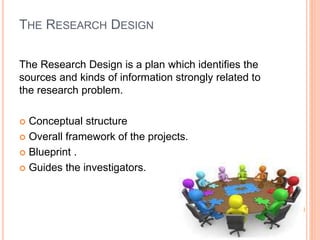
THE RESEARCH DESIGN
The Research Design is a plan which identifies the
sources and kinds of information strongly related to
the research problem.
 Conceptual structure
 Overall framework of the projects.
 Blueprint .
 Guides the investigators.
1-PURPOSE OF THE STUDY
A method of solving problems, or for understanding
phenomena of interest and generating further
knowledge in that area. The nature of study whether it
is
 Exploratory
 Descriptive
 Hypothesis Testing
Depend on the stage on which knowledge about the
research level.
EXPLORATORY STUDY
Exploratory Research is research conducted for a
problem that has not been clearly defined.
 Main objective: Major emphasis is on discovery of
ideas & insights.
 Interviews with many people to understand the
phenomena.
 Qualitative studies are exploratory.
 The objective is general rather than specific.
 Save time and other resources
DESCRIPTIVE STUDY
A descriptive study is undertaken to determine and
able to describe the characteristics of the variables of
interest in a situation.
 Main objective: Major emphasis is on discovery of
ideas & insights.
 Quantitative study are descriptive.
 Research has specific objective.
 Findings are definite.
 Comparing Groups and Issues
HYPOTHESES TESTING
Explain the nature of certain relationships, or
establish the differences among groups or the
independence of two or more factors in a situation.
 Main objective: Researchers test the hypotheses of
causal relationships between variables.
 Control the influence of one variable on other
dependent variable.
2-TYPE OF INVESTIGATION
A manager should determine whether a casual or a
correlational study is needed to find an answer to the
issue.
 Causal Study
 Correlational study
CAUSAL STUDY
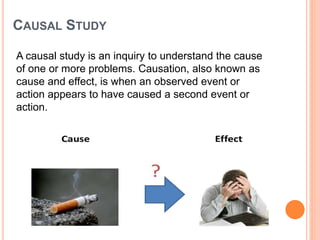
A causal study is an inquiry to understand the cause
of one or more problems. Causation, also known as
cause and effect, is when an observed event or
action appears to have caused a second event or
action.
CORRELATIONAL STUDY
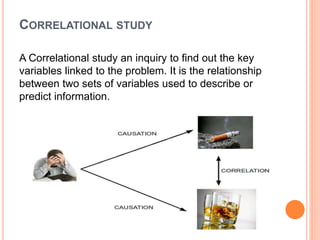
A Correlational study an inquiry to find out the key
variables linked to the problem. It is the relationship
between two sets of variables used to describe or
predict information.
EXTENT OF RESEARCHER INTERFERENCE
The extent of interference by the researcher with the
normal flow of work at the workplace has a direct
bearing on whether the study undertaken is causal or
correlational. A correlational study is conducted in the
natural environment of the organization with minimum
interference by the researcher with the normal flow of
work.
STUDY SETTING
 Non-contrived settings: If organizational research
be done in the natural environment where work
proceeds normally, the research is in non-contrived
settings.
 Contrived settings: If organizational research be
done in artificial environment the research is in
contrived settings.
UNIT OF ANALYSIS
 The unit of analysis is the major entity that is
being analyzed in a study. The unit of analysis
means the degree of aggregation of the data
gathered through the subsequent data analysis.
 Unit of analysis is the “who” or the “what” that you
are analyzing for your study.
 Individual
 Dyads
 Groups
 Departmental
 Organizational
TIME HORIZON
Cross-sectional studies or One-shot
 A study can be carried out in which data are collected
only once, perhaps during a period of days or weeks or
months, to be able to answer a research question
known as cross-sectional studies.
Longitudinal Studies or Multi-shot
 If the researcher might want to study people or
phenomena at more than one point in time in order to
answer the research question or when data on the
dependent variable are gathered at two or more points
in time to answer the research question, the studies are
called longitudinal studies.
research framwork chapter 6 quantitative business analysis

research framwork chapter 6 quantitative business analysis

  • 1.
  • 2.
    CONTENT  The ResearchDesign.  Purpose of the Study  Types of Investigation  Extent of Researcher Interference  Study Setting  Unit of Analysis  Time Horizon
  • 3.
    THE RESEARCH DESIGN TheResearch Design is a plan which identifies the sources and kinds of information strongly related to the research problem.  Conceptual structure  Overall framework of the projects.  Blueprint .  Guides the investigators.
  • 5.
    1-PURPOSE OF THESTUDY A method of solving problems, or for understanding phenomena of interest and generating further knowledge in that area. The nature of study whether it is  Exploratory  Descriptive  Hypothesis Testing Depend on the stage on which knowledge about the research level.
  • 6.
    EXPLORATORY STUDY Exploratory Researchis research conducted for a problem that has not been clearly defined.  Main objective: Major emphasis is on discovery of ideas & insights.  Interviews with many people to understand the phenomena.  Qualitative studies are exploratory.  The objective is general rather than specific.  Save time and other resources
  • 7.
    DESCRIPTIVE STUDY A descriptivestudy is undertaken to determine and able to describe the characteristics of the variables of interest in a situation.  Main objective: Major emphasis is on discovery of ideas & insights.  Quantitative study are descriptive.  Research has specific objective.  Findings are definite.  Comparing Groups and Issues
  • 8.
    HYPOTHESES TESTING Explain thenature of certain relationships, or establish the differences among groups or the independence of two or more factors in a situation.  Main objective: Researchers test the hypotheses of causal relationships between variables.  Control the influence of one variable on other dependent variable.
  • 9.
    2-TYPE OF INVESTIGATION Amanager should determine whether a casual or a correlational study is needed to find an answer to the issue.  Causal Study  Correlational study
  • 10.
    CAUSAL STUDY A causalstudy is an inquiry to understand the cause of one or more problems. Causation, also known as cause and effect, is when an observed event or action appears to have caused a second event or action.
  • 11.
    CORRELATIONAL STUDY A Correlationalstudy an inquiry to find out the key variables linked to the problem. It is the relationship between two sets of variables used to describe or predict information.
  • 12.
    EXTENT OF RESEARCHERINTERFERENCE The extent of interference by the researcher with the normal flow of work at the workplace has a direct bearing on whether the study undertaken is causal or correlational. A correlational study is conducted in the natural environment of the organization with minimum interference by the researcher with the normal flow of work.
  • 13.
    STUDY SETTING  Non-contrivedsettings: If organizational research be done in the natural environment where work proceeds normally, the research is in non-contrived settings.  Contrived settings: If organizational research be done in artificial environment the research is in contrived settings.
  • 14.
    UNIT OF ANALYSIS The unit of analysis is the major entity that is being analyzed in a study. The unit of analysis means the degree of aggregation of the data gathered through the subsequent data analysis.  Unit of analysis is the “who” or the “what” that you are analyzing for your study.  Individual  Dyads  Groups  Departmental  Organizational
  • 15.
    TIME HORIZON Cross-sectional studiesor One-shot  A study can be carried out in which data are collected only once, perhaps during a period of days or weeks or months, to be able to answer a research question known as cross-sectional studies. Longitudinal Studies or Multi-shot  If the researcher might want to study people or phenomena at more than one point in time in order to answer the research question or when data on the dependent variable are gathered at two or more points in time to answer the research question, the studies are called longitudinal studies.

Editor's Notes

  • #4 Decisions have to be made as the type of sample to be used, how the data will b collected, how variables will be measured and how they will be analyzed to test the hypothesis. Research design minimizes bias and maximizes the reliability of the data collected and analyzed. The extent of research study depends on how carefully the researcher chooses the appropriate design alternatives, taking into consideration its specific purpose. For Example , if critical financial decision to invest millions of dollars in a project is to be based on the research investigation and careful attention to detail is necessary to ensure that it has acceptable level of confidence. This implies that close attention is paid to sampling, measurement, data collection and analyzing.
  • #6 The choice of appropriate design largely depends on the objectives of the research and how much is known about the problem and its objectives.
  • #7 For Example interviewed a manager to explore the nature of managerial work, Based on the analysis of his interview data, theories of managerial roles, the nature and types of managerial activities. A service provider wants to know why his customers are switching to other service providers.
  • #8 For Example a study of a class in terms of percentage of member who are in their senior and junior years, age grouping, number of semester left, and number of business courses taken, can be considered as descriptive study. A bank manager wants to have a profile of the individuals who have loan payments outstanding for 6 months and more. It would include details of their average age, earnings, nature of occupation, full-time/part-time employment status, and the like.
  • #9 For Example a marketing manager wants to know if the sales of the company will increase if he doubles the advertising dollars.
  • #12 A causal study question: Does cigarette smoking cause cancer? A correlational study question: Are cigarette smoking and cancer associated? Or Are cigarette smoking, consuming alcohol, and chewing tobacco related to cancer?
  • #16 For Example Data collected from stock brokers between April and June of last year to study their concerns in stock market. For Example one could study the sales volume of a product before and after an advertisement.