How Science Works

 Experimental method
Experimental Process
1. Ask questions and develop theories
  about how, why and where things
  happen
2. Develop these into a specific
  hypothesis (predictions)
3. Design & Carry out research to test
  these theories – what happens when
  we try it out?
Experimental Process


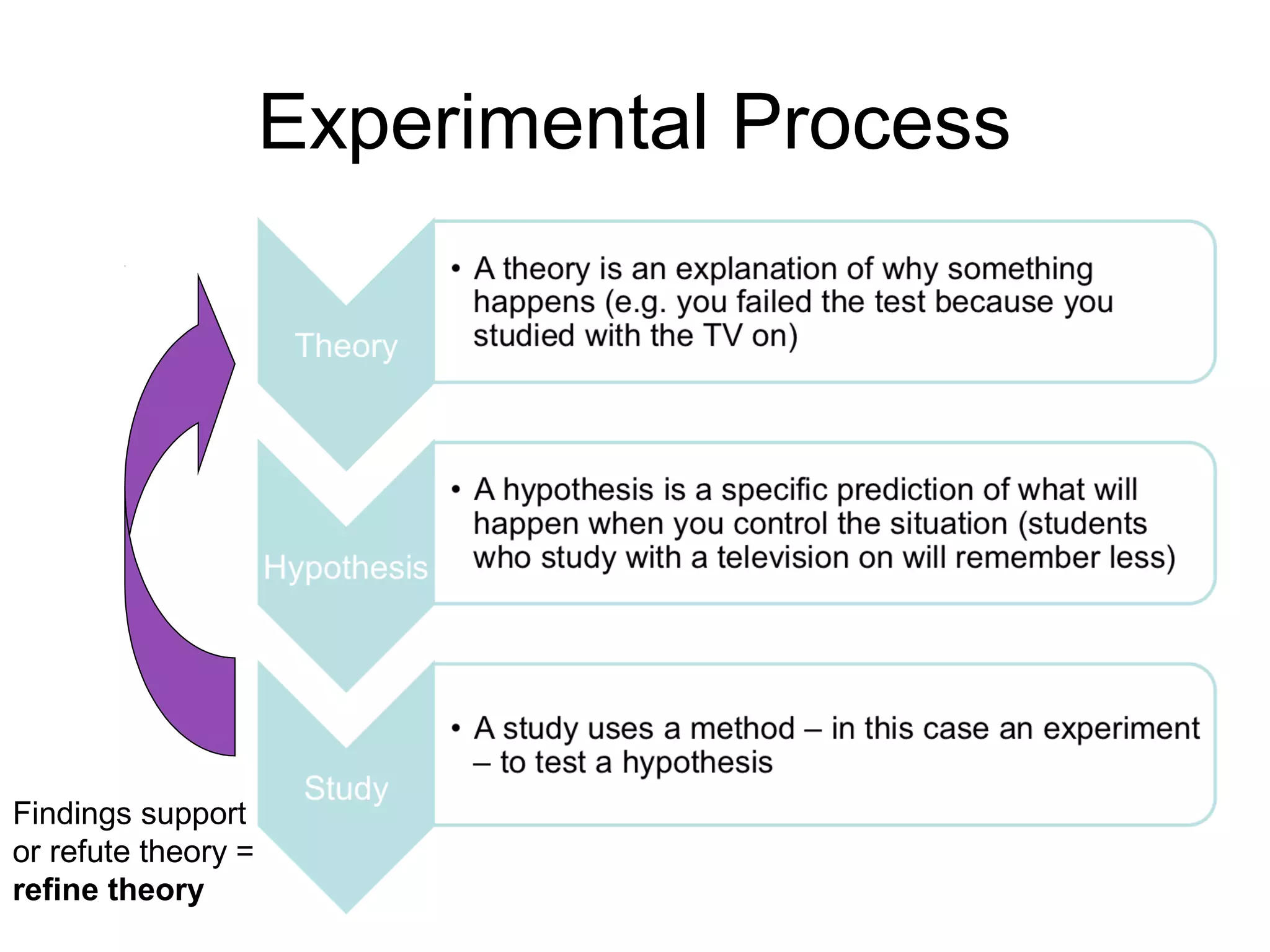
Findings support
or refute theory =
refine theory
Hypotheses
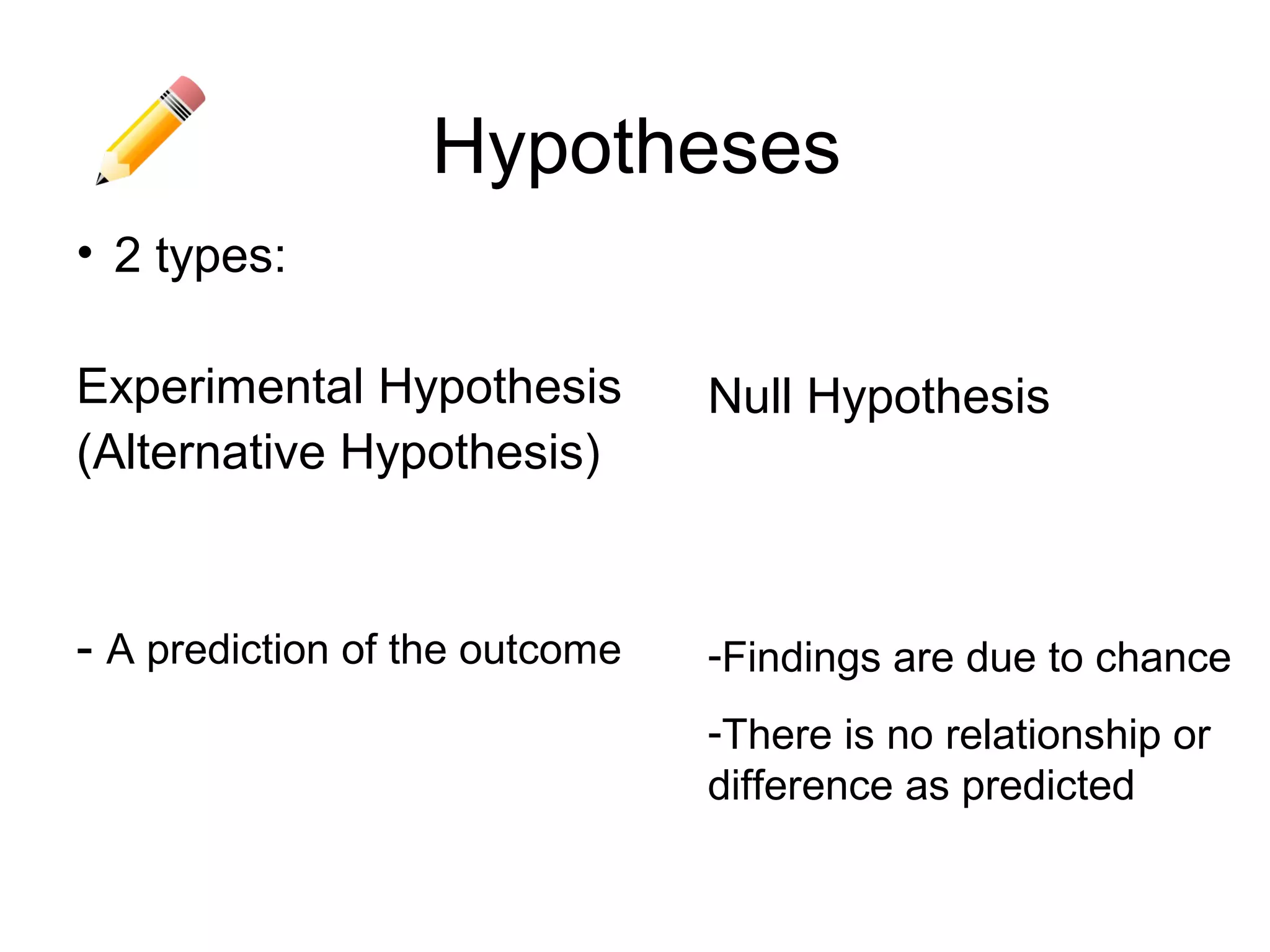
• 2 types:

Experimental Hypothesis         Null Hypothesis
(Alternative Hypothesis)


- A prediction of the outcome   -Findings are due to chance
                                -There is no relationship or
                                difference as predicted
Try writing an Experimental & Null
   hypothesis for these possible
               studies
1. A study that aims to look at the effect of music
   on concentration

2. A study that aims to look at the amount of TV a
   child watches and their behaviour at school

3. A study that aims to see whether a task, such
   as counting backwards from the number 15
   after seeing a list of letters, will affect the
   ability to recall of those letters
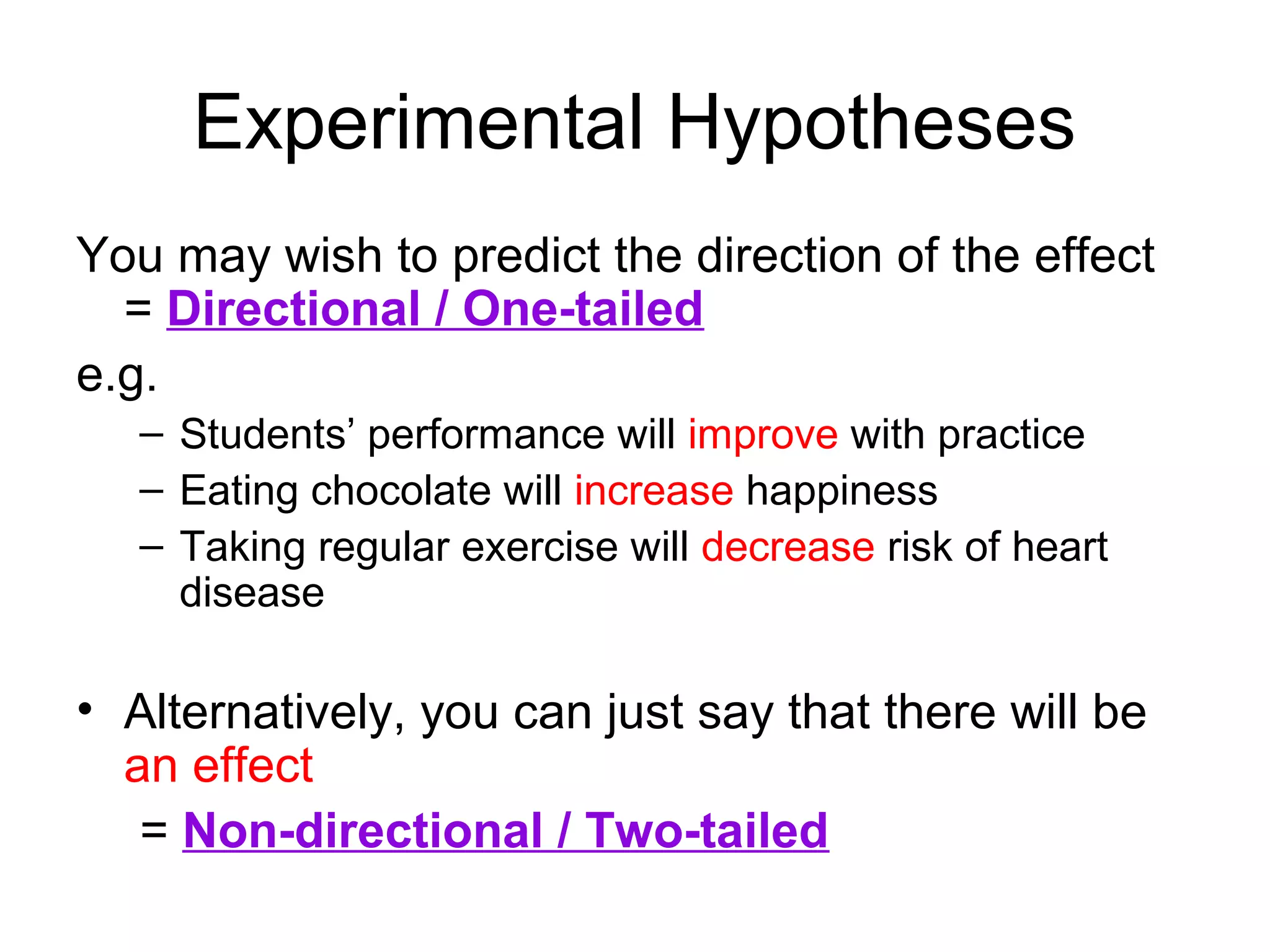
Experimental Hypotheses
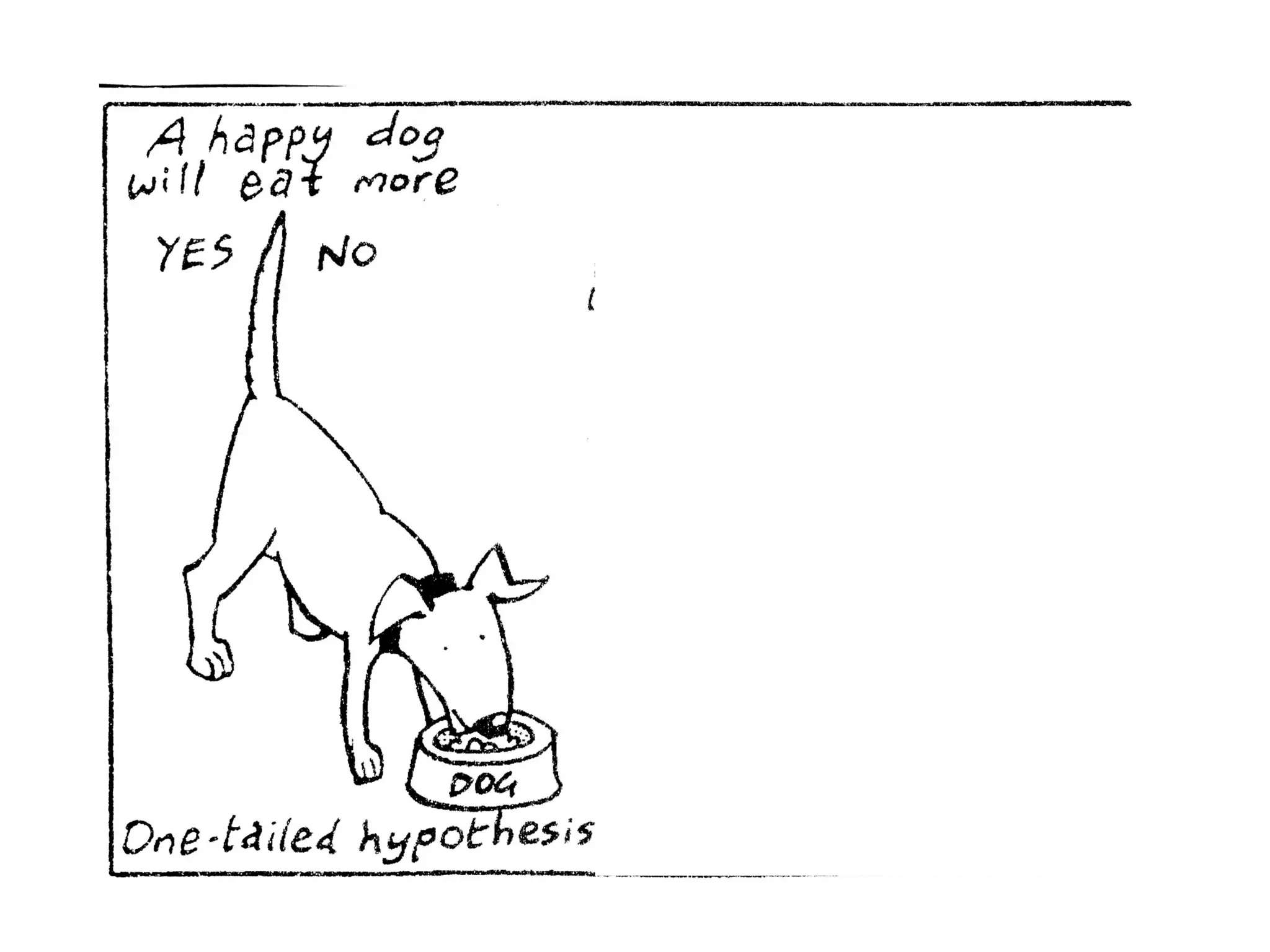
You may wish to predict the direction of the effect
  = Directional / One-tailed
e.g.
   – Students’ performance will improve with practice
   – Eating chocolate will increase happiness
   – Taking regular exercise will decrease risk of heart
     disease

• Alternatively, you can just say that there will be
  an effect
   = Non-directional / Two-tailed
Examples

1. Students remember more words when
   recalling them in the same location in
   which they were learnt than when in a
   different location.

2. Recall of a story is affected by the length
   of time since hearing the story.
Experimental Process
• Experiments are one of the most commonly used
  methods in psychology

• An experiment is a research method in which the
  researcher – the experimenter – has a high
  degree of control.

• The experimenter controls/manipulates the
  independent variable (IV) and measures the
  dependent variable (DV)
Example
• If we were to conduct an experiment
  on whether television distracts
  students from studying, what would
  be the IV and the DV?

HINT:
Look for what is being measured (DV)
 first, IV is then easy to identify!
• Both IV & DV MUST be measurable =
  Operationalise

• There are usually two values of the IV e.g.
  – Noise or no noise
  – Smoker or non-smoker
  – Male or Female

• These determine the conditions of the
  experiment

• The conditions can be arranged in several
  different ways (There can be more than 2
  conditions)
Other variables
• What else might affect the study?

• Any variable (except for the IV) that
  can influence your findings =
  extraneous variables
E.g.
Participant Variables = age, gender,
  experience, emotion
Situational Variables = noise, light, time
  of day, crowds, interruptions
• If an extraneous variable is NOT
  controlled for and impacts the results =
  Confounding variable

Hypothesis and IV and DV

  • 1.
    How Science Works Experimental method
  • 2.
    Experimental Process 1. Askquestions and develop theories about how, why and where things happen 2. Develop these into a specific hypothesis (predictions) 3. Design & Carry out research to test these theories – what happens when we try it out?
  • 3.
    Experimental Process Findings support orrefute theory = refine theory
  • 4.
    Hypotheses • 2 types: ExperimentalHypothesis Null Hypothesis (Alternative Hypothesis) - A prediction of the outcome -Findings are due to chance -There is no relationship or difference as predicted
  • 5.
    Try writing anExperimental & Null hypothesis for these possible studies 1. A study that aims to look at the effect of music on concentration 2. A study that aims to look at the amount of TV a child watches and their behaviour at school 3. A study that aims to see whether a task, such as counting backwards from the number 15 after seeing a list of letters, will affect the ability to recall of those letters
  • 6.
    Experimental Hypotheses You maywish to predict the direction of the effect = Directional / One-tailed e.g. – Students’ performance will improve with practice – Eating chocolate will increase happiness – Taking regular exercise will decrease risk of heart disease • Alternatively, you can just say that there will be an effect = Non-directional / Two-tailed
  • 8.
    Examples 1. Students remembermore words when recalling them in the same location in which they were learnt than when in a different location. 2. Recall of a story is affected by the length of time since hearing the story.
  • 9.
    Experimental Process • Experimentsare one of the most commonly used methods in psychology • An experiment is a research method in which the researcher – the experimenter – has a high degree of control. • The experimenter controls/manipulates the independent variable (IV) and measures the dependent variable (DV)
  • 10.
    Example • If wewere to conduct an experiment on whether television distracts students from studying, what would be the IV and the DV? HINT: Look for what is being measured (DV) first, IV is then easy to identify!
  • 11.
    • Both IV& DV MUST be measurable = Operationalise • There are usually two values of the IV e.g. – Noise or no noise – Smoker or non-smoker – Male or Female • These determine the conditions of the experiment • The conditions can be arranged in several different ways (There can be more than 2 conditions)
  • 12.
    Other variables • Whatelse might affect the study? • Any variable (except for the IV) that can influence your findings = extraneous variables E.g. Participant Variables = age, gender, experience, emotion Situational Variables = noise, light, time of day, crowds, interruptions
  • 13.
    • If anextraneous variable is NOT controlled for and impacts the results = Confounding variable

Editor's Notes

  • #2 Register Q ’s / register and quiz (memory, information processing, encoding, storage, retrieval) Explain why doing the experimental method – Recap what are cognitive psych interested in? As mentioned in the first lesson, Experiments are used in cog approach and other approaches. Before going into the really interesting content of cog approach there are some key features of the experimental process that you need to be familiar with. *NB – all methods across all approaches BUT Cog = Experiment for exam; Social = survey
  • #3 Who does science? What are the components of a scientific experiment – what is the first thing you do?
  • #4 Study: Aim – general statement why study being done Procedure, Results, Conclusion
  • #5 Gender affects driving ability Alcohol will affect reaction times Driving will be affected by tiredness Smoking will impact lung capacity Null: etc There will be no difference in driving between those who have slept and those who have stayed awake. Any difference is due to chance or some other factor in the study. Ie. Different driving abilities
  • #6 Feedback – exp & null Directional or non?
  • #7 In pairs : Work out if you wrote a one-tailed or a two-tailed and write the opposite
  • #8 Help you rem
  • #9 Directional or non?? WS – one tailed or two tailed
  • #10 Why NB for control? Replicable & scientific & Objective - Also produce quantitative results Variables are whatever is likely to affect the experiment – tested, measured, affects results If we wanted to investigate if smoking lowers your lung capacity? alcohol slows reaction times?? Fatigue and driving performance?… how would we do it? What do you think (hyp)? What would we control (manipulate) and what would we measure? Smokers vs non smokers (IV) Measure- time can hold breathe? Blow into a lung capacity? (DV)
  • #11 Easier to Identify DV (what is being measured first) and then easy to find IV Look at your hyp circle IV & underline DV WS – either use one tailed two tailed or new WS in file ‘Hypotheses’
  • #12 Will come back to conditions later
  • #13 E.g. I want to test your intelligence so, I was to give you and the other AS psych class a test to see which group was better but I gave the one group the test first thing in the morning and the other group the test after a whole day at school and after playing sport and before supper– would I be able to fairly compare the two results and come to conclusions about which class is more intelligent? What else could affect results?? Participant variables = use driving / tired example. What participant variables? How can control? Situational Variables
  • #14 Extraneous = possibilities that need to be aware of when designing exp Confounding = actually did affect results We will look at methods of control later on ….