M E T H O D S TO
VALUE A
STARTUP5
The formulas in the following slides are automatically computed by the
Equidam algorithm. The concepts explained here are the underlying
principles of the 5 most frequently used valuation methods to be aware of
when negotiating with investors.
DISCLAIMER
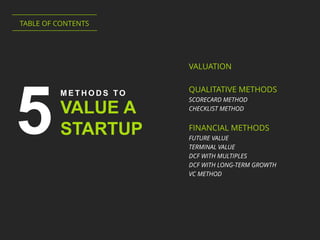
VALUATION
QUALITATIVE METHODS
SCORECARD METHOD
CHECKLIST METHOD
FINANCIAL METHODS
FUTURE VALUE
TERMINAL VALUE
DCF WITH MULTIPLES
DCF WITH LONG-TERM GROWTH
VC METHOD
TABLE OF CONTENTS
M E T H O D S TO
VALUE A
STARTUP5
Business valuation is defined as the process of determining the
economic value of a business or company by analyzing a set of
economic factors using various formulas and models.
VALUATION OF A BUSINESS IS ITS PRICE ON THE MARKET
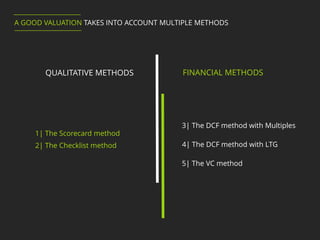
3| The DCF method with Multiples
1| The Scorecard method
2| The Checklist method
QUALITATIVE METHODS FINANCIAL METHODS
4| The DCF method with LTG
5| The VC method
A GOOD VALUATION TAKES INTO ACCOUNT MULTIPLE METHODS
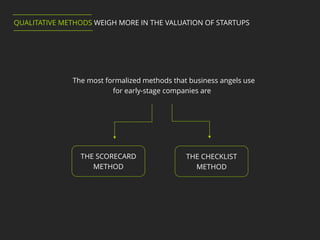
The most formalized methods that business angels use
for early-stage companies are
THE SCORECARD
METHOD
THE CHECKLIST
METHOD
QUALITATIVE METHODS WEIGH MORE IN THE VALUATION OF STARTUPS
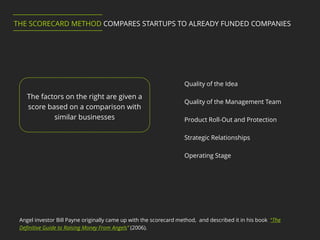
Angel investor Bill Payne originally came up with the scorecard method, and described it in his book “The
Definitive Guide to Raising Money From Angels” (2006).
The factors on the right are given a
score based on a comparison with
similar businesses
Quality of the Idea
Quality of the Management Team
Product Roll-Out and Protection
Strategic Relationships
Operating Stage
THE SCORECARD METHOD COMPARES STARTUPS TO ALREADY FUNDED COMPANIES
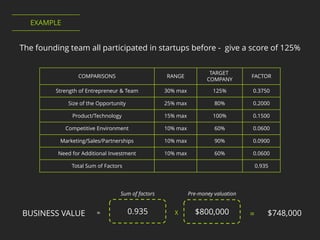
COMPARISONS RANGE
TARGET
COMPANY
FACTOR
Strength of Entrepreneur & Team 30% max 125% 0.3750
Size of the Opportunity 25% max 80% 0.2000
Product/Technology 15% max 100% 0.1500
Competitive Environment 10% max 60% 0.0600
Marketing/Sales/Partnerships 10% max 90% 0.0900
Need for Additional Investment 10% max 60% 0.0600
Total Sum of Factors 0.935
The founding team all participated in startups before - give a score of 125%
EXAMPLE
Pre-money valuation
0.935 = $748,000= $800,000X
Sum of factors
BUSINESS VALUE
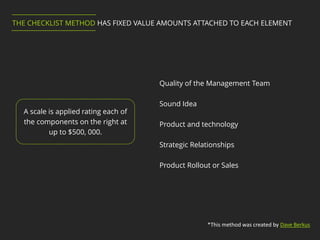
*This method was created by Dave Berkus
Quality of the Management Team
Sound Idea
Product and technology
Strategic Relationships
Product Rollout or Sales
A scale is applied rating each of
the components on the right at
up to $500, 000.
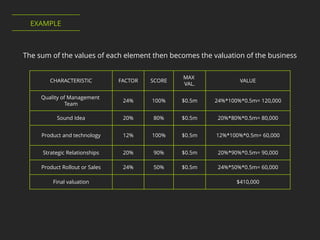
THE CHECKLIST METHOD HAS FIXED VALUE AMOUNTS ATTACHED TO EACH ELEMENT
CHARACTERISTIC FACTOR SCORE
MAX
VAL.
VALUE
Quality of Management
Team
24% 100% $0.5m 24%*100%*0.5m= 120,000
Sound Idea 20% 80% $0.5m 20%*80%*0.5m= 80,000
Product and technology 12% 100% $0.5m 12%*100%*0.5m= 60,000
Strategic Relationships 20% 90% $0.5m 20%*90%*0.5m= 90,000
Product Rollout or Sales 24% 50% $0.5m 24%*50%*0.5m= 60,000
Final valuation $410,000
The sum of the values of each element then becomes the valuation of the business
EXAMPLE
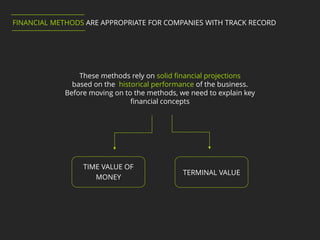
FINANCIAL METHODS ARE APPROPRIATE FOR COMPANIES WITH TRACK RECORD
These methods rely on solid financial projections
based on the historical performance of the business.
Before moving on to the methods, we need to explain key
financial concepts
TIME VALUE OF
MONEY
TERMINAL VALUE
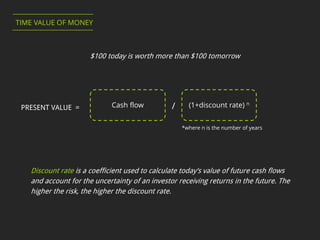
PRESENT VALUE = /
Discount rate is a coefficient used to calculate today’s value of future cash flows
and account for the uncertainty of an investor receiving returns in the future. The
higher the risk, the higher the discount rate.
*where n is the number of years
TIME VALUE OF MONEY
$100 today is worth more than $100 tomorrow
(1+discount rate) nCash flow
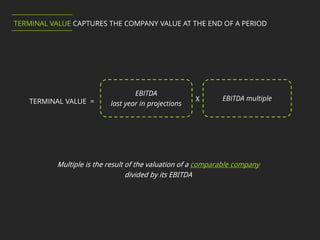
TERMINAL VALUE = X
EBITDA
last year in projections
EBITDA multiple
Multiple is the result of the valuation of a comparable company
divided by its EBITDA
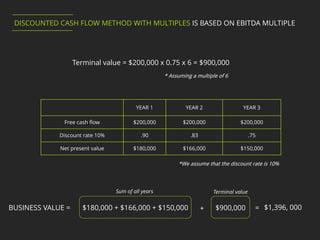
TERMINAL VALUE CAPTURES THE COMPANY VALUE AT THE END OF A PERIOD
*We assume that the discount rate is 10%
Sum of all years Terminal value
$1,396, 000BUSINESS VALUE = $180,000 + $166,000 + $150,000 + $900,000 =
Terminal value = $200,000 x 0.75 x 6 = $900,000
* Assuming a multiple of 6
DISCOUNTED CASH FLOW METHOD WITH MULTIPLES IS BASED ON EBITDA MULTIPLE
YEAR 1 YEAR 2 YEAR 3
Free cash flow $200,000 $200,000 $200,000
Discount rate 10% .90 .83 .75
Net present value $180,000 $166,000 $150,000
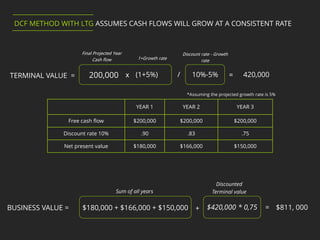
DCF METHOD WITH LTG ASSUMES CASH FLOWS WILL GROW AT A CONSISTENT RATE
YEAR 1 YEAR 2 YEAR 3
Free cash flow $200,000 $200,000 $200,000
Discount rate 10% .90 .83 .75
Net present value $180,000 $166,000 $150,000
TERMINAL VALUE = (1+5%) / 10%-5%
Final Projected Year
Cash flow 1+Growth rate
= 420,000200,000 x
*Assuming the projected growth rate is 5%
Discount rate - Growth
rate
Sum of all years
Discounted
Terminal value
$811, 000BUSINESS VALUE = $180,000 + $166,000 + $150,000 + =$420,000 * 0,75
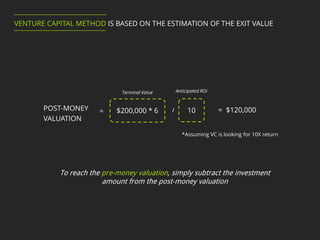
POST-MONEY
VALUATION
/$200,000 * 6 10=
*Assuming VC is looking for 10X return
Terminal Value Anticipated ROI
= $120,000
VENTURE CAPITAL METHOD IS BASED ON THE ESTIMATION OF THE EXIT VALUE
To reach the pre-money valuation, simply subtract the investment
amount from the post-money valuation
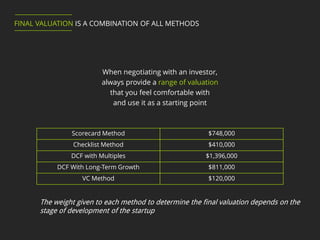
Scorecard Method $748,000
Checklist Method $410,000
DCF with Multiples $1,396,000
DCF With Long-Term Growth $811,000
VC Method $120,000
When negotiating with an investor,
always provide a range of valuation
that you feel comfortable with
and use it as a starting point
FINAL VALUATION IS A COMBINATION OF ALL METHODS
The weight given to each method to determine the final valuation depends on the
stage of development of the startup
Try Equidam for free at
www.equidam.com
Curious about your valuation?

Startup Valuation: 5 Methods

  • 1.
    M E TH O D S TO VALUE A STARTUP5
  • 2.
    The formulas inthe following slides are automatically computed by the Equidam algorithm. The concepts explained here are the underlying principles of the 5 most frequently used valuation methods to be aware of when negotiating with investors. DISCLAIMER
  • 3.
    VALUATION QUALITATIVE METHODS SCORECARD METHOD CHECKLISTMETHOD FINANCIAL METHODS FUTURE VALUE TERMINAL VALUE DCF WITH MULTIPLES DCF WITH LONG-TERM GROWTH VC METHOD TABLE OF CONTENTS M E T H O D S TO VALUE A STARTUP5
  • 4.
    Business valuation isdefined as the process of determining the economic value of a business or company by analyzing a set of economic factors using various formulas and models. VALUATION OF A BUSINESS IS ITS PRICE ON THE MARKET
  • 5.
    3| The DCFmethod with Multiples 1| The Scorecard method 2| The Checklist method QUALITATIVE METHODS FINANCIAL METHODS 4| The DCF method with LTG 5| The VC method A GOOD VALUATION TAKES INTO ACCOUNT MULTIPLE METHODS
  • 6.
    The most formalizedmethods that business angels use for early-stage companies are THE SCORECARD METHOD THE CHECKLIST METHOD QUALITATIVE METHODS WEIGH MORE IN THE VALUATION OF STARTUPS
  • 7.
    Angel investor BillPayne originally came up with the scorecard method, and described it in his book “The Definitive Guide to Raising Money From Angels” (2006). The factors on the right are given a score based on a comparison with similar businesses Quality of the Idea Quality of the Management Team Product Roll-Out and Protection Strategic Relationships Operating Stage THE SCORECARD METHOD COMPARES STARTUPS TO ALREADY FUNDED COMPANIES
  • 8.
    COMPARISONS RANGE TARGET COMPANY FACTOR Strength ofEntrepreneur & Team 30% max 125% 0.3750 Size of the Opportunity 25% max 80% 0.2000 Product/Technology 15% max 100% 0.1500 Competitive Environment 10% max 60% 0.0600 Marketing/Sales/Partnerships 10% max 90% 0.0900 Need for Additional Investment 10% max 60% 0.0600 Total Sum of Factors 0.935 The founding team all participated in startups before - give a score of 125% EXAMPLE Pre-money valuation 0.935 = $748,000= $800,000X Sum of factors BUSINESS VALUE
  • 9.
    *This method wascreated by Dave Berkus Quality of the Management Team Sound Idea Product and technology Strategic Relationships Product Rollout or Sales A scale is applied rating each of the components on the right at up to $500, 000. THE CHECKLIST METHOD HAS FIXED VALUE AMOUNTS ATTACHED TO EACH ELEMENT
  • 10.
    CHARACTERISTIC FACTOR SCORE MAX VAL. VALUE Qualityof Management Team 24% 100% $0.5m 24%*100%*0.5m= 120,000 Sound Idea 20% 80% $0.5m 20%*80%*0.5m= 80,000 Product and technology 12% 100% $0.5m 12%*100%*0.5m= 60,000 Strategic Relationships 20% 90% $0.5m 20%*90%*0.5m= 90,000 Product Rollout or Sales 24% 50% $0.5m 24%*50%*0.5m= 60,000 Final valuation $410,000 The sum of the values of each element then becomes the valuation of the business EXAMPLE
  • 11.
    FINANCIAL METHODS AREAPPROPRIATE FOR COMPANIES WITH TRACK RECORD These methods rely on solid financial projections based on the historical performance of the business. Before moving on to the methods, we need to explain key financial concepts TIME VALUE OF MONEY TERMINAL VALUE
  • 12.
    PRESENT VALUE =/ Discount rate is a coefficient used to calculate today’s value of future cash flows and account for the uncertainty of an investor receiving returns in the future. The higher the risk, the higher the discount rate. *where n is the number of years TIME VALUE OF MONEY $100 today is worth more than $100 tomorrow (1+discount rate) nCash flow
  • 13.
    TERMINAL VALUE =X EBITDA last year in projections EBITDA multiple Multiple is the result of the valuation of a comparable company divided by its EBITDA TERMINAL VALUE CAPTURES THE COMPANY VALUE AT THE END OF A PERIOD
  • 14.
    *We assume thatthe discount rate is 10% Sum of all years Terminal value $1,396, 000BUSINESS VALUE = $180,000 + $166,000 + $150,000 + $900,000 = Terminal value = $200,000 x 0.75 x 6 = $900,000 * Assuming a multiple of 6 DISCOUNTED CASH FLOW METHOD WITH MULTIPLES IS BASED ON EBITDA MULTIPLE YEAR 1 YEAR 2 YEAR 3 Free cash flow $200,000 $200,000 $200,000 Discount rate 10% .90 .83 .75 Net present value $180,000 $166,000 $150,000
  • 15.
    DCF METHOD WITHLTG ASSUMES CASH FLOWS WILL GROW AT A CONSISTENT RATE YEAR 1 YEAR 2 YEAR 3 Free cash flow $200,000 $200,000 $200,000 Discount rate 10% .90 .83 .75 Net present value $180,000 $166,000 $150,000 TERMINAL VALUE = (1+5%) / 10%-5% Final Projected Year Cash flow 1+Growth rate = 420,000200,000 x *Assuming the projected growth rate is 5% Discount rate - Growth rate Sum of all years Discounted Terminal value $811, 000BUSINESS VALUE = $180,000 + $166,000 + $150,000 + =$420,000 * 0,75
  • 16.
    POST-MONEY VALUATION /$200,000 * 610= *Assuming VC is looking for 10X return Terminal Value Anticipated ROI = $120,000 VENTURE CAPITAL METHOD IS BASED ON THE ESTIMATION OF THE EXIT VALUE To reach the pre-money valuation, simply subtract the investment amount from the post-money valuation
  • 17.
    Scorecard Method $748,000 ChecklistMethod $410,000 DCF with Multiples $1,396,000 DCF With Long-Term Growth $811,000 VC Method $120,000 When negotiating with an investor, always provide a range of valuation that you feel comfortable with and use it as a starting point FINAL VALUATION IS A COMBINATION OF ALL METHODS The weight given to each method to determine the final valuation depends on the stage of development of the startup
  • 18.
    Try Equidam forfree at www.equidam.com Curious about your valuation?