


METHODS
OF
RESEARCH
MEANING:
Research is defined as a careful consideration of study
regarding a particular concern or a problem using
scientific methods.
DEFINITION:
“Research is a process of steps used to collect and analyze
information to increase our understanding of a topic or
issue.”
John W. Creswell
RESEARCH - MEANING
THREE STEPS IN RESEARCH
I. Pose A Question,
II. Collect Data To Answer The
Question
III. And Present An Answer To The
Question.”
CHARACTERISTICS OF RESEARCH
 A systematic approach is followed in research. Rules and
procedures are an integral part of research that set the
objective of a research process.
 Research is based on logical reasoning and involves both
inductive and deductive methods.
 The data or knowledge that is derived is in real time, actual
observations in the natural settings.
 There is an in-depth analysis of all the data collected from
research.
 Research creates a path for generating new questions. More
research opportunity can be generated from existing research.
 Accuracy is one of the important character of research, the
information that is obtained while conducting the research
should be accurate and true to its nature.
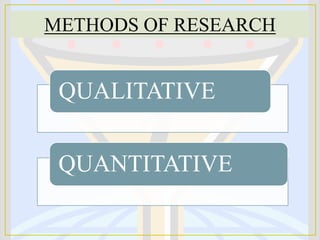
METHODS OF RESEARCH
QUALITATIVE
QUANTITATIVE
Qualitative research is a process that is about inquiry, that helps in-depth
understanding of the problems or issues in their natural settings. This is a NON-
STATISTICAL RESEARCH METHOD
Collects data using conversational methods, where participants involved in the
research are asked open-ended questions. The responses collected are essentially
NON-NUMERICAL. This method not only helps a researcher understand “what”
participant think but also, “why "they think in a particular way.
QUALITATIVE RESEARCH
TYPES OF QUALITATIVE RESEARCH
 ONE – ONE INTERVIEW
 FOCUS GROUPS
 ETHNOGRAPHIC GROUPS
 TEXT ANALYSIS
 CASE STUDY RESEARCH
The One to One interview is the most common
interview where only the interviewer and the
interviewee is present.
1. One-to-one interviews need a researcher to
prepare questions in advance and to make
sure the researcher asks only the most
important questions to the participant.
2. This type of interview lasts anywhere
between 20 minutes to half an hour. During
this time the researcher collects as many
meaningful data as possible from the
participants to draw inferences.
ONE-ONE INTERVIEW
FOCUS GROUPS
Focus groups are small groups comprising of around 6-10
participants who are usually experts in the subject matter.
1. A moderator is assigned to a focus group who facilitates
the discussion amongst the group members.
2. A moderator’s experience in conducting focus group plays
an important role.
3. An experienced moderator can probe the participants by
asking the correct research questions that will help
him/her collect a sizable amount of information related to
the research.
ETHNOGRAPHIC GROUPS
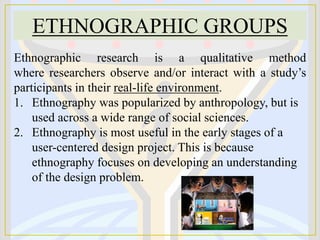
Ethnographic research is a qualitative method
where researchers observe and/or interact with a study’s
participants in their real-life environment.
1. Ethnography was popularized by anthropology, but is
used across a wide range of social sciences.
2. Ethnography is most useful in the early stages of a
user-centered design project. This is because
ethnography focuses on developing an understanding
of the design problem.
TEXT ANALYSIS
Text analysis is the method communication researchers use to
describe and interpret the characteristics of a recorded or visual
message.
1. The purpose of textual analysis is to describe the content,
structure, and functions of the messages contained in texts.
2. The important considerations in textual analysis include
selecting the types of texts to be studied, acquiring appropriate
texts, and determining which particular approach to employ in
analyzing them.
CASE STUDY RESEARCH
Case studies are a popular research method in business area. Case
studies aim to analyze specific issues within the boundaries of a
specific environment, situation or organization.
According to its design, case studies in business research can be
divided into three categories: explanatory, descriptive and
exploratory.
1. Explanatory case studies aim to answer ‘how’ or ’why’
questions with little control on behalf of researcher over
occurrence of events.
2. Descriptive case studies aim to analyze the sequence of
interpersonal events after a certain amount of time has passed.
3. Exploratory case studies aim to find answers to the questions
of ‘what’ or ‘who’
Quantitative research methods are the methods that deal
with numbers and anything that can be dealt with a
measurable form, in a systematic way of investigating the
phenomenon. It is used to answer questions in terms of
justifying relationships with measurable variables to either
explain, predict or control a phenomenon
TYPES OF QUANTITATIVE RESEARCH
Survey Research.
Correlational Research.
Causal-Comparative Research.
Experimental Research
QUANTITATIVE RESEARCH
SURVEY RESEARCH
Survey research is the collection of data attained by asking
individuals questions either in person, on paper, by phone or
online.
1. Conducting surveys is one form of primary research,
which is the gathering data first-hand from its source.
2. Survey research is used to gather the opinions, beliefs and
feelings of selected groups of individuals, often chosen
for demographic sampling
3. Common types of surveys include interviews and
questionnaires, which are comprised of multiple choice
questionnaires, opinions and polls.
CORRELATIONAL RESEARCH
Correlationalresearchisatypeofnon-experimentalresearchmethod,inwhicha
researcher measures two variables, understands and assess the statistical
relationshipbetweenthemwithnoinfluencefromanyirrelevantvariable.
1. A positive correlation between two variables is when an
increase in one variable leads to an increase in the other
variable vice versa.
2. A negative correlation is quite literally the opposite of positive
correlation. This means, if there is an increase in one variable,
the second variable will show a decrease and vice versa.
3. No correlation, a change in one variable may not necessarily
see a change in the other variable.
CAUSAL-COMPARATIVE RESEARCH
Causal-comparative research is an attempt to identify a
causative relationship between an independent variable
and a dependent variable.
Also known as “ex post facto” research. (Latin for “after
the fact”) since both the effect and the alleged cause have
already occurred and must be studied in retrospect .In
this type of research investigators attempt to determine
the cause or consequences of differences that already
exist between or among groups of individuals.
1. Exploration of Effects
2. Exploration of Causes
3. Exploration of Consequences
EXPERIMENTAL RESEARCH
Experimental research is any research conducted with a
scientific approach, where a set of variables are kept
constant while the other set of variables are being
measured as the subject of experiment.
The simplest example of an experimental research is
conducting a laboratory test. As long as research is being
conducted under scientifically acceptable conditions – it
qualifies as an experimental research. A true
experimental research is considered to be successful
only when the researcher confirms that a change in the
dependent variable is solely due to the manipulation of
the independent variable.
THANK
YOU

METHODS OF RESEARCH QUALITATIVE AND QUANTITATIVE

  • 1.
  • 2.
    MEANING: Research is definedas a careful consideration of study regarding a particular concern or a problem using scientific methods. DEFINITION: “Research is a process of steps used to collect and analyze information to increase our understanding of a topic or issue.” John W. Creswell RESEARCH - MEANING
  • 3.
    THREE STEPS INRESEARCH I. Pose A Question, II. Collect Data To Answer The Question III. And Present An Answer To The Question.”
  • 4.
    CHARACTERISTICS OF RESEARCH A systematic approach is followed in research. Rules and procedures are an integral part of research that set the objective of a research process.  Research is based on logical reasoning and involves both inductive and deductive methods.  The data or knowledge that is derived is in real time, actual observations in the natural settings.  There is an in-depth analysis of all the data collected from research.  Research creates a path for generating new questions. More research opportunity can be generated from existing research.  Accuracy is one of the important character of research, the information that is obtained while conducting the research should be accurate and true to its nature.
  • 5.
  • 6.
    Qualitative research isa process that is about inquiry, that helps in-depth understanding of the problems or issues in their natural settings. This is a NON- STATISTICAL RESEARCH METHOD Collects data using conversational methods, where participants involved in the research are asked open-ended questions. The responses collected are essentially NON-NUMERICAL. This method not only helps a researcher understand “what” participant think but also, “why "they think in a particular way. QUALITATIVE RESEARCH TYPES OF QUALITATIVE RESEARCH  ONE – ONE INTERVIEW  FOCUS GROUPS  ETHNOGRAPHIC GROUPS  TEXT ANALYSIS  CASE STUDY RESEARCH
  • 7.
    The One toOne interview is the most common interview where only the interviewer and the interviewee is present. 1. One-to-one interviews need a researcher to prepare questions in advance and to make sure the researcher asks only the most important questions to the participant. 2. This type of interview lasts anywhere between 20 minutes to half an hour. During this time the researcher collects as many meaningful data as possible from the participants to draw inferences. ONE-ONE INTERVIEW
  • 8.
    FOCUS GROUPS Focus groupsare small groups comprising of around 6-10 participants who are usually experts in the subject matter. 1. A moderator is assigned to a focus group who facilitates the discussion amongst the group members. 2. A moderator’s experience in conducting focus group plays an important role. 3. An experienced moderator can probe the participants by asking the correct research questions that will help him/her collect a sizable amount of information related to the research.
  • 9.
    ETHNOGRAPHIC GROUPS Ethnographic researchis a qualitative method where researchers observe and/or interact with a study’s participants in their real-life environment. 1. Ethnography was popularized by anthropology, but is used across a wide range of social sciences. 2. Ethnography is most useful in the early stages of a user-centered design project. This is because ethnography focuses on developing an understanding of the design problem.
  • 10.
    TEXT ANALYSIS Text analysisis the method communication researchers use to describe and interpret the characteristics of a recorded or visual message. 1. The purpose of textual analysis is to describe the content, structure, and functions of the messages contained in texts. 2. The important considerations in textual analysis include selecting the types of texts to be studied, acquiring appropriate texts, and determining which particular approach to employ in analyzing them.
  • 11.
    CASE STUDY RESEARCH Casestudies are a popular research method in business area. Case studies aim to analyze specific issues within the boundaries of a specific environment, situation or organization. According to its design, case studies in business research can be divided into three categories: explanatory, descriptive and exploratory. 1. Explanatory case studies aim to answer ‘how’ or ’why’ questions with little control on behalf of researcher over occurrence of events. 2. Descriptive case studies aim to analyze the sequence of interpersonal events after a certain amount of time has passed. 3. Exploratory case studies aim to find answers to the questions of ‘what’ or ‘who’
  • 12.
    Quantitative research methodsare the methods that deal with numbers and anything that can be dealt with a measurable form, in a systematic way of investigating the phenomenon. It is used to answer questions in terms of justifying relationships with measurable variables to either explain, predict or control a phenomenon TYPES OF QUANTITATIVE RESEARCH Survey Research. Correlational Research. Causal-Comparative Research. Experimental Research QUANTITATIVE RESEARCH
  • 13.
    SURVEY RESEARCH Survey researchis the collection of data attained by asking individuals questions either in person, on paper, by phone or online. 1. Conducting surveys is one form of primary research, which is the gathering data first-hand from its source. 2. Survey research is used to gather the opinions, beliefs and feelings of selected groups of individuals, often chosen for demographic sampling 3. Common types of surveys include interviews and questionnaires, which are comprised of multiple choice questionnaires, opinions and polls.
  • 14.
    CORRELATIONAL RESEARCH Correlationalresearchisatypeofnon-experimentalresearchmethod,inwhicha researcher measurestwo variables, understands and assess the statistical relationshipbetweenthemwithnoinfluencefromanyirrelevantvariable. 1. A positive correlation between two variables is when an increase in one variable leads to an increase in the other variable vice versa. 2. A negative correlation is quite literally the opposite of positive correlation. This means, if there is an increase in one variable, the second variable will show a decrease and vice versa. 3. No correlation, a change in one variable may not necessarily see a change in the other variable.
  • 15.
    CAUSAL-COMPARATIVE RESEARCH Causal-comparative researchis an attempt to identify a causative relationship between an independent variable and a dependent variable. Also known as “ex post facto” research. (Latin for “after the fact”) since both the effect and the alleged cause have already occurred and must be studied in retrospect .In this type of research investigators attempt to determine the cause or consequences of differences that already exist between or among groups of individuals. 1. Exploration of Effects 2. Exploration of Causes 3. Exploration of Consequences
  • 16.
    EXPERIMENTAL RESEARCH Experimental researchis any research conducted with a scientific approach, where a set of variables are kept constant while the other set of variables are being measured as the subject of experiment. The simplest example of an experimental research is conducting a laboratory test. As long as research is being conducted under scientifically acceptable conditions – it qualifies as an experimental research. A true experimental research is considered to be successful only when the researcher confirms that a change in the dependent variable is solely due to the manipulation of the independent variable.
  • 17.