Research design, philosophy and 
methods 
Mark Reed
Plan 
• Choosing your research topic: where are you? 
• Research philosophy: what is knowledge? 
• Research design
1 What is knowledge?
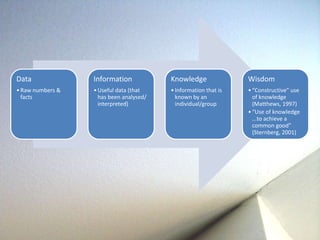
Data 
• Raw numbers & 
facts 
Information 
• Useful data (that 
has been analysed/ 
interpreted) 
Knowledge 
• Information that is 
known by an 
individual/group 
Wisdom 
• “Constructive” use 
of knowledge 
(Matthews, 1997) 
• “Use of knowledge 
...to achieve a 
common good” 
(Sternberg, 2001)
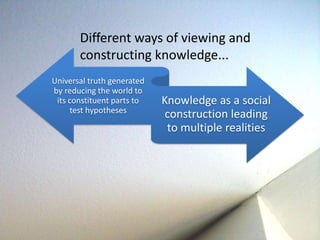
Different ways of viewing and 
constructing knowledge... 
Universal truth generated 
by reducing the world to 
its constituent parts to 
test hypotheses 
Knowledge as a social 
construction leading 
to multiple realities
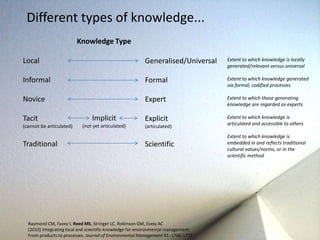
Different types of knowledge... 
Knowledge Type 
Implicit 
(not yet articulated) 
Local 
Informal 
Novice 
Tacit 
(cannot be articulated) 
Traditional 
Generalised/Universal 
Formal 
Expert 
Explicit 
(articulated) 
Scientific 
Raymond CM, Fazey I, Reed MS, Stringer LC, Robinson GM, Evely AC 
(2010) Integrating local and scientific knowledge for environmental management: 
From products to processes. Journal of Environmental Management 91: 1766-1777 
Extent to which knowledge is locally 
generated/relevant versus universal 
Extent to which knowledge generated 
via formal, codified processes 
Extent to which those generating 
knowledge are regarded as experts 
Extent to which knowledge is 
articulated and accessible to others 
Extent to which knowledge is 
embedded in and reflects traditional 
cultural values/norms, or in the 
scientific method
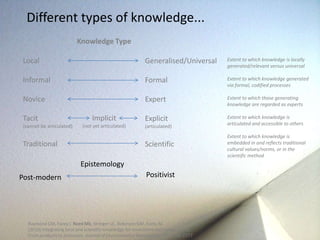
Different types of knowledge... 
Knowledge Type 
Implicit 
(not yet articulated) 
Local 
Informal 
Novice 
Tacit 
(cannot be articulated) 
Traditional 
Generalised/Universal 
Formal 
Expert 
Explicit 
(articulated) 
Scientific 
Epistemology 
Raymond CM, Fazey I, Reed MS, Stringer LC, Robinson GM, Evely AC 
(2010) Integrating local and scientific knowledge for environmental management: 
From products to processes. Journal of Environmental Management 91: 1766-1777 
Extent to which knowledge is locally 
generated/relevant versus universal 
Extent to which knowledge generated 
via formal, codified processes 
Extent to which those generating 
knowledge are regarded as experts 
Extent to which knowledge is 
articulated and accessible to others 
Extent to which knowledge is 
embedded in and reflects traditional 
cultural values/norms, or in the 
scientific method 
Post-modern Positivist
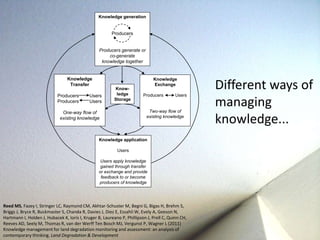
Different ways of 
managing 
knowledge... 
Knowledge 
Transfer 
Producers Users 
Producers Users 
One-way flow of 
existing knowledge 
Knowledge 
Exchange 
Producers Users 
Two-way flow of 
existing knowledge 
Knowledge generation 
Producers 
Producers generate or 
co-generate 
knowledge together 
Know-ledge 
Storage 
Knowledge application 
Users 
Users apply knowledge 
gained through transfer 
or exchange and provide 
feedback to or become 
producers of knowledge 
Reed MS, Fazey I, Stringer LC, Raymond CM, Akhtar-Schuster M, Begni G, Bigas H, Brehm S, 
Briggs J, Bryce R, Buckmaster S, Chanda R, Davies J, Diez E, Essahli W, Evely A, Geeson N, 
Hartmann I, Holden J, Hubacek K, Ioris I, Kruger B, Laureano P, Phillipson J, Prell C, Quinn CH, 
Reeves AD, Seely M, Thomas R, van der Werff Ten Bosch MJ, Vergunst P, Wagner L (2011) 
Knowledge management for land degradation monitoring and assessment: an analysis of 
contemporary thinking. Land Degradation & Development
2 Research design
How to choose research design 
Choice influenced by: 
• Research questions you want to answer 
• Epistemology 
• Preferences towards qualitative/quantitative
Designing to questions 
The questions you can answer will depend on: 
• Existing data availability 
• Can you measure/collect relevant new data? 
– Skills, equipment, time etc. 
• The more focused your question, the easier it 
will be to design your research
Epistemology 
• How do you perceive knowledge, how it is 
generated and what constitutes valid 
knowledge? 
• Positivists: define hypotheses and quantify, 
proving beyond doubt 
• Post-modernists: more open-ended research 
questions and qualitative, providing a range of 
perspectives to build credible arguments
Qualitative versus quantitative 
• Examples of reasons to choose qualitative 
versus quantitative in different contexts? 
• Benefits/challenges of mixing both?
Qualitative or quantitative? 
• Depending on research question and 
epistemology, qual/quant may be obvious 
• Alternatively, start with a qual/quant 
preference and select research questions 
accordingly 
• More on choosing qual/quant later
Writing up research design 
• Methodology chapter: difference between 
research design and methods 
• Create a sub-section for both 
• Explain your design and methods in enough 
detail for someone else to replicate 
• Justify your choice – theoretically and/or 
empirically
3 Methods
Should I use or collect Primary or 
secondary Data?
Primary data 
• Primary data is collected by you, first-hand
Secondary data 
• Secondary data has been collected by someone else, 
and you are using it “second-hand”
What should I use? 
• For your dissertation it is safest to focus on 
primary data collection 
– Easier to demonstrate originality 
– Harder to fall into trap of writing extended lit 
review 
• Supplement your primary data with secondary 
data to check/deepen your analysis 
– Handy if you don’t think you’ve got enough 
primary data
Qualitative or quantitative?
What is qualitative? 
• Understanding the quality or nature of things, 
rather than their quantity 
– Good for asking “why” questions and gaining an 
in-depth understanding of many different 
perspectives on an issue (i.e. often subjective) 
– Not so suited to statistical analysis and clear-cut, 
“objective” answers 
– Typically use quite small sample sizes (e.g. 20 
interviews and a focus group) 
– Can be flexible – adapt your methods as you go
Examples of qualitative 
– Examples of qualitative data collection methods: 
• Open-ended questions in questionnaires 
• Semi-structured interviews 
• Focus groups 
• Participant observation 
• In-depth case studies 
– Examples of qualitative data: 
• Transcripts, audio, interview notes, documents 
– Examples of qualitative analysis: 
• Content analysis e.g. Grounded Theory Analysis
What is quantitative? 
• Understanding the quantity of things – being able to 
quantify relationships and describe them 
mathematically or in terms of their statistical 
significance 
– Good when you need to be able to answer a research 
question with precision, determine if there is a 
relationship between two things (x varies with y) or you 
need to determine something is statistically significant 
– Harder to determine causality (x causes y to vary) and 
answer “why” questions 
– Typically large data sets (min 50 data points, ideally >100) 
– Inflexible – have to stick to and replicate your method
Examples or quantitative 
• Examples of quantitative data collection 
methods: 
– Ecological and soil-based survey techniques e.g. 
counting plants in quadrats or along transects 
– Experiments 
– Closed questions in questionnaires e.g. Likert scale 
and categorical or numerical questions 
• Examples of quantitative analysis 
– Calculating percentages, means & standard deviations 
– Statistical analyses
Qualitative or quantitative? 
– I need to ask mainly what, where and when 
questions 
– I need to understand exactly how something has 
changed or might change in future 
– I need to understand if something influences 
something else 
– I need to know of something is significantly greater 
or lesser than something else 
– The people reading my research want a precise or 
“objective” answer to my research questions 
– PROBABLY QUANTITATIVE
Qualitative or quantitative? 
– I need to ask why questions 
– I want an in-depth understanding of the issue 
– I want to understand what happens in one 
particular area in-depth 
– I want to interview people 
– I want to consider differing perspectives 
– I don’t like numbers 
– PROBABLY QUALITATIVE
Qualitative or quantitative? 
– All of the above! 
– MIXES METHODS APPROACH
Quantitative Methods
Quantitative research design 
• Representing reality 
– Systematic e.g. transects 
– Random and random stratified (i.e. random within 
different groups such as socio-economic classes or 
habitats)
Quantitative data collection 
• Counting things… 
• Closed ended question surveys with large 
samples e.g. via internet 
• Ecological and soil-based techniques e.g. 
chemical analysis or counting plants in 
quadrats
Quantitative data analysis 
– Descriptive statistics e.g. mean, median, standard 
deviation, percentages 
– Parametric statistics (sample size >50, not too 
much variation) 
• Significant differences e.g. T-Test 
• Correlations e.g. regression 
• Multi-variate e.g. multiple-regression, ordination 
– Non-parametric (sample size <50, lots of variation) 
• Significant differences e.g. Mann Whitney U 
• Correlations e.g. Pearson Product Moment Correlation
Qualitative Methods
Qualitative research design 
• Purposive sampling 
– Selecting respondents on the basis of pre-defined categories 
that cover key aspects of your research question 
• Snowball sampling 
– Keep interviewing within a category till no new ideas 
– Get respondents to recommend others for you to interview 
• Case studies 
– Common in qualitative research 
– In-depth understanding of a particular case from which you may 
be able to generalise more widely 
– Multiple cases representing different perspectives, locations or 
components of your issue
Qualitative data collection 
• Understanding the quality/nature of things… 
• Open ended question surveys with large 
samples e.g. via internet 
• Semi-structured interviews with small samples 
(e.g. 12-20 people) 
• Participant observation – transcripts and 
behaviour 
• Make sure you get informed consent from 
respondents
Qualitative data analysis 
– Different types of content analysis and ways of 
summarising large bodies of text 
• Key word counts (aggregating synonyms) 
• Coding for themes – preset or emergent (Grounded Theory 
Analysis) 
• Discourse analysis to capture context and power relations 
• Recursive abstraction – summarising and summarising 
summaries and so on, to reach core themes
Triangulation 
• Simply “checking” your data and interpretation 
of results 
• Commonly used to increase the reliability of 
qualitative studies 
• Is there another way of collecting data to 
answer the same question a different way? 
– Follow your interviews with a focus group 
– Follow up historical documents to check an oral 
history
Summary 
• Primary or secondary? 
• Qualitative or quantitative? 
– Research design 
– Data collection methods 
– Analysis methods 
– Triangulation

Research design, philosophy and methods

  • 1.
    Research design, philosophyand methods Mark Reed
  • 2.
    Plan • Choosingyour research topic: where are you? • Research philosophy: what is knowledge? • Research design
  • 3.
    1 What isknowledge?
  • 4.
    Data • Rawnumbers & facts Information • Useful data (that has been analysed/ interpreted) Knowledge • Information that is known by an individual/group Wisdom • “Constructive” use of knowledge (Matthews, 1997) • “Use of knowledge ...to achieve a common good” (Sternberg, 2001)
  • 5.
    Different ways ofviewing and constructing knowledge... Universal truth generated by reducing the world to its constituent parts to test hypotheses Knowledge as a social construction leading to multiple realities
  • 6.
    Different types ofknowledge... Knowledge Type Implicit (not yet articulated) Local Informal Novice Tacit (cannot be articulated) Traditional Generalised/Universal Formal Expert Explicit (articulated) Scientific Raymond CM, Fazey I, Reed MS, Stringer LC, Robinson GM, Evely AC (2010) Integrating local and scientific knowledge for environmental management: From products to processes. Journal of Environmental Management 91: 1766-1777 Extent to which knowledge is locally generated/relevant versus universal Extent to which knowledge generated via formal, codified processes Extent to which those generating knowledge are regarded as experts Extent to which knowledge is articulated and accessible to others Extent to which knowledge is embedded in and reflects traditional cultural values/norms, or in the scientific method
  • 7.
    Different types ofknowledge... Knowledge Type Implicit (not yet articulated) Local Informal Novice Tacit (cannot be articulated) Traditional Generalised/Universal Formal Expert Explicit (articulated) Scientific Epistemology Raymond CM, Fazey I, Reed MS, Stringer LC, Robinson GM, Evely AC (2010) Integrating local and scientific knowledge for environmental management: From products to processes. Journal of Environmental Management 91: 1766-1777 Extent to which knowledge is locally generated/relevant versus universal Extent to which knowledge generated via formal, codified processes Extent to which those generating knowledge are regarded as experts Extent to which knowledge is articulated and accessible to others Extent to which knowledge is embedded in and reflects traditional cultural values/norms, or in the scientific method Post-modern Positivist
  • 8.
    Different ways of managing knowledge... Knowledge Transfer Producers Users Producers Users One-way flow of existing knowledge Knowledge Exchange Producers Users Two-way flow of existing knowledge Knowledge generation Producers Producers generate or co-generate knowledge together Know-ledge Storage Knowledge application Users Users apply knowledge gained through transfer or exchange and provide feedback to or become producers of knowledge Reed MS, Fazey I, Stringer LC, Raymond CM, Akhtar-Schuster M, Begni G, Bigas H, Brehm S, Briggs J, Bryce R, Buckmaster S, Chanda R, Davies J, Diez E, Essahli W, Evely A, Geeson N, Hartmann I, Holden J, Hubacek K, Ioris I, Kruger B, Laureano P, Phillipson J, Prell C, Quinn CH, Reeves AD, Seely M, Thomas R, van der Werff Ten Bosch MJ, Vergunst P, Wagner L (2011) Knowledge management for land degradation monitoring and assessment: an analysis of contemporary thinking. Land Degradation & Development
  • 9.
  • 10.
    How to chooseresearch design Choice influenced by: • Research questions you want to answer • Epistemology • Preferences towards qualitative/quantitative
  • 11.
    Designing to questions The questions you can answer will depend on: • Existing data availability • Can you measure/collect relevant new data? – Skills, equipment, time etc. • The more focused your question, the easier it will be to design your research
  • 12.
    Epistemology • Howdo you perceive knowledge, how it is generated and what constitutes valid knowledge? • Positivists: define hypotheses and quantify, proving beyond doubt • Post-modernists: more open-ended research questions and qualitative, providing a range of perspectives to build credible arguments
  • 13.
    Qualitative versus quantitative • Examples of reasons to choose qualitative versus quantitative in different contexts? • Benefits/challenges of mixing both?
  • 14.
    Qualitative or quantitative? • Depending on research question and epistemology, qual/quant may be obvious • Alternatively, start with a qual/quant preference and select research questions accordingly • More on choosing qual/quant later
  • 15.
    Writing up researchdesign • Methodology chapter: difference between research design and methods • Create a sub-section for both • Explain your design and methods in enough detail for someone else to replicate • Justify your choice – theoretically and/or empirically
  • 16.
  • 17.
    Should I useor collect Primary or secondary Data?
  • 18.
    Primary data •Primary data is collected by you, first-hand
  • 19.
    Secondary data •Secondary data has been collected by someone else, and you are using it “second-hand”
  • 20.
    What should Iuse? • For your dissertation it is safest to focus on primary data collection – Easier to demonstrate originality – Harder to fall into trap of writing extended lit review • Supplement your primary data with secondary data to check/deepen your analysis – Handy if you don’t think you’ve got enough primary data
  • 21.
  • 22.
    What is qualitative? • Understanding the quality or nature of things, rather than their quantity – Good for asking “why” questions and gaining an in-depth understanding of many different perspectives on an issue (i.e. often subjective) – Not so suited to statistical analysis and clear-cut, “objective” answers – Typically use quite small sample sizes (e.g. 20 interviews and a focus group) – Can be flexible – adapt your methods as you go
  • 23.
    Examples of qualitative – Examples of qualitative data collection methods: • Open-ended questions in questionnaires • Semi-structured interviews • Focus groups • Participant observation • In-depth case studies – Examples of qualitative data: • Transcripts, audio, interview notes, documents – Examples of qualitative analysis: • Content analysis e.g. Grounded Theory Analysis
  • 24.
    What is quantitative? • Understanding the quantity of things – being able to quantify relationships and describe them mathematically or in terms of their statistical significance – Good when you need to be able to answer a research question with precision, determine if there is a relationship between two things (x varies with y) or you need to determine something is statistically significant – Harder to determine causality (x causes y to vary) and answer “why” questions – Typically large data sets (min 50 data points, ideally >100) – Inflexible – have to stick to and replicate your method
  • 25.
    Examples or quantitative • Examples of quantitative data collection methods: – Ecological and soil-based survey techniques e.g. counting plants in quadrats or along transects – Experiments – Closed questions in questionnaires e.g. Likert scale and categorical or numerical questions • Examples of quantitative analysis – Calculating percentages, means & standard deviations – Statistical analyses
  • 26.
    Qualitative or quantitative? – I need to ask mainly what, where and when questions – I need to understand exactly how something has changed or might change in future – I need to understand if something influences something else – I need to know of something is significantly greater or lesser than something else – The people reading my research want a precise or “objective” answer to my research questions – PROBABLY QUANTITATIVE
  • 27.
    Qualitative or quantitative? – I need to ask why questions – I want an in-depth understanding of the issue – I want to understand what happens in one particular area in-depth – I want to interview people – I want to consider differing perspectives – I don’t like numbers – PROBABLY QUALITATIVE
  • 28.
    Qualitative or quantitative? – All of the above! – MIXES METHODS APPROACH
  • 29.
  • 30.
    Quantitative research design • Representing reality – Systematic e.g. transects – Random and random stratified (i.e. random within different groups such as socio-economic classes or habitats)
  • 31.
    Quantitative data collection • Counting things… • Closed ended question surveys with large samples e.g. via internet • Ecological and soil-based techniques e.g. chemical analysis or counting plants in quadrats
  • 32.
    Quantitative data analysis – Descriptive statistics e.g. mean, median, standard deviation, percentages – Parametric statistics (sample size >50, not too much variation) • Significant differences e.g. T-Test • Correlations e.g. regression • Multi-variate e.g. multiple-regression, ordination – Non-parametric (sample size <50, lots of variation) • Significant differences e.g. Mann Whitney U • Correlations e.g. Pearson Product Moment Correlation
  • 33.
  • 34.
    Qualitative research design • Purposive sampling – Selecting respondents on the basis of pre-defined categories that cover key aspects of your research question • Snowball sampling – Keep interviewing within a category till no new ideas – Get respondents to recommend others for you to interview • Case studies – Common in qualitative research – In-depth understanding of a particular case from which you may be able to generalise more widely – Multiple cases representing different perspectives, locations or components of your issue
  • 35.
    Qualitative data collection • Understanding the quality/nature of things… • Open ended question surveys with large samples e.g. via internet • Semi-structured interviews with small samples (e.g. 12-20 people) • Participant observation – transcripts and behaviour • Make sure you get informed consent from respondents
  • 36.
    Qualitative data analysis – Different types of content analysis and ways of summarising large bodies of text • Key word counts (aggregating synonyms) • Coding for themes – preset or emergent (Grounded Theory Analysis) • Discourse analysis to capture context and power relations • Recursive abstraction – summarising and summarising summaries and so on, to reach core themes
  • 37.
    Triangulation • Simply“checking” your data and interpretation of results • Commonly used to increase the reliability of qualitative studies • Is there another way of collecting data to answer the same question a different way? – Follow your interviews with a focus group – Follow up historical documents to check an oral history
  • 38.
    Summary • Primaryor secondary? • Qualitative or quantitative? – Research design – Data collection methods – Analysis methods – Triangulation