ACADEMIC WRITING 
DR NIRAJ THURAIRAJAH 
BIRMINGHAM CITY UNIVERSITY
ACADEMIC WRITING 
Academic writing is: 
Complex 
Formal 
Objective 
Explicit 
Hedged 
Precise
COMPLEXITY 
Written English usually has a higher lexical density 
than spoken English 
 Lexical density is a measure of the proportion of 
content words in a sentence or text 
 A content word is any verb, noun, adverb or adjective 
which has a stable and significant lexical meaning 
 capability (noun) 
 organisational (adjective) 
 enhance (verb) 
 productively (adverb)
COMPLEXITY 
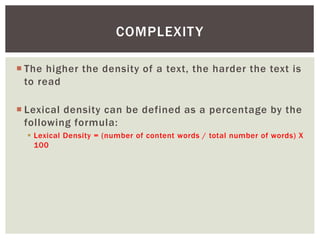
 The higher the density of a text, the harder the text is 
to read 
 Lexical density can be defined as a percentage by the 
following formula: 
 Lexical Density = (number of content words / total number of words) X 
100
COMPLEXITY 
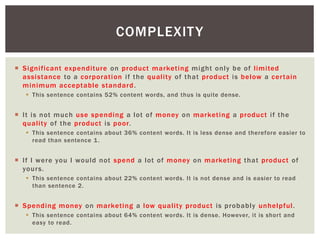
 Signi f icant expendi ture on product market ing might only be of l imi ted 
assistance to a corporat ion i f the qual i ty of that product is below a cer tain 
minimum acceptable standard. 
 This sentence contains 52% content words, and thus is quite dense. 
 I t is not much use spending a lot of money on market ing a product i f the 
qual i ty of the product is poor. 
 This sentence contains about 36% content words. It is less dense and therefore easier to 
read than sentence 1. 
 I f I were you I would not spend a lot of money on market ing that product of 
yours. 
 This sentence contains about 22% content words. It is not dense and is easier to read 
than sentence 2. 
 Spending money on market ing a low qual i ty product is probably unhelpful . 
 This sentence contains about 64% content words. It is dense. However, it is shor t and 
easy to read.
STRATEGIES FOR ELIMINATING WORDINESS 
 You can eliminate wordiness in your writing: 
 Mark sections of your writing that you struggled to produce 
 Pass through your paper once, focusing only on eliminating 
unnecessary and repetitive language 
 Remove filler phrases in your writing 
 Before editing, give yourself a breather 
 Learn what wordiness and repetition patterns are typical of your 
writing, and edit with those patterns in mind
FORMALITY 
 In general, in academic writing you should avoid: 
 colloquial words and informal expressions; “stuf f”, “a lot of”, “thing”, “sor t of” 
 features of speech such as “well”, “anyway” 
 repetition, redundancy and wordiness; “completely unique”, “adding together” 
 two word verbs: “put of f”, “bring up” 
 abbreviated forms: “can't”, “doesn't”, “shouldn't” 
 sub-headings, numbering and bullet -points in formal essays, but use them in 
reports 
 using “etc.”
FORMALITY 
 Fleming did well in isolating a streptococcus from 
the cerebrospinal fluid of the patient. 
 Fleming succeeded in isolating a streptococcus from 
the cerebrospinal fluid of the patient. 
 The material amenities of life have gone up in 
Western society. 
 The material amenities of life have increased in 
Western society.
OBJECTIVITY 
 The main emphasis should be on the information that you 
want to give and the arguments you want to make, rather than 
you 
 No b o d y r e a l ly wa nt s to k now wh a t yo u “ t h i nk” o r " b e l ieve” 
 They want to know what you have studied and learned and 
how this has led you to your various conclusions 
 The thoughts and bel iefs should be based on your lectures, 
reading, discussion and research
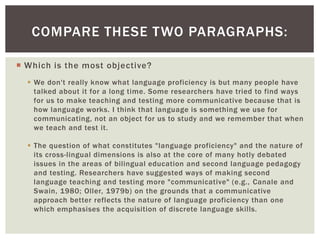
COMPARE THESE TWO PARAGRAPHS: 
 Which is the most objective? 
 We don't really know what language proficiency is but many people have 
talked about it for a long time. Some researchers have tried to find ways 
for us to make teaching and testing more communicative because that is 
how language works. I think that language is something we use for 
communicating, not an object for us to study and we remember that when 
we teach and test it. 
 The question of what constitutes "language proficiency" and the nature of 
its cross-lingual dimensions is also at the core of many hotly debated 
issues in the areas of bilingual education and second language pedagogy 
and testing. Researchers have suggested ways of making second 
language teaching and testing more "communicative" (e.g., Canale and 
Swain, 1980; Oller, 1979b) on the grounds that a communicative 
approach better reflects the nature of language proficiency than one 
which emphasises the acquisition of discrete language skills.
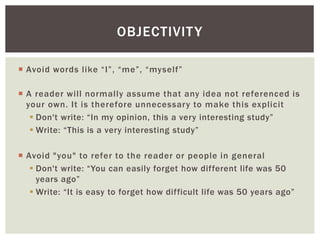
OBJECTIVITY 
 Avo i d wo r d s l i ke “ I ” , “me ”, “my s e lf ” 
 A reader wi l l normal ly assume that any idea not referenced is 
your own. It is therefore unnecessary to make this explicit 
 Don't write: “In my opinion, this a very interesting study” 
 Write: “This is a very interesting study” 
 Avoid "you" to refer to the reader or people in general 
 Don't write: “You can easily forget how different life was 50 
years ago” 
 Write: “It is easy to forget how difficult life was 50 years ago”
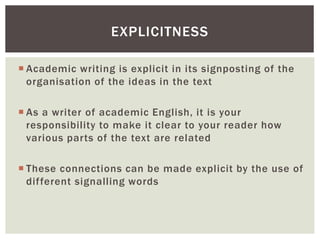
EXPLICITNESS 
 Academic writing is explicit in its signposting of the 
organisation of the ideas in the text 
 As a writer of academic English, it is your 
responsibility to make it clear to your reader how 
various par ts of the text are related 
 These connections can be made explicit by the use of 
dif ferent signalling words
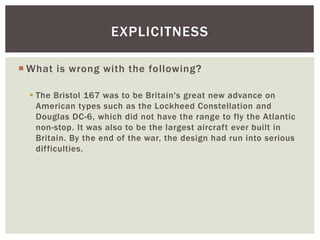
EXPLICITNESS 
What is wrong with the following? 
 The Bristol 167 was to be Britain's great new advance on 
American types such as the Lockheed Constellation and 
Douglas DC-6, which did not have the range to fly the Atlantic 
non-stop. It was also to be the largest aircraft ever built in 
Britain. By the end of the war, the design had run into serious 
difficulties.
EXPLICITNESS 
 If you want to tell your reader that your line of 
argument is going to change, make it clear. 
 The Bristol 167 was to be Britain's great new advance on 
American types such as the Lockheed Constellation and 
Douglas DC-6, which did not have the range to fly the Atlantic 
non-stop. It was also to be the largest aircraft ever built in 
Britain. By the end of the war, the design had run into serious 
difficulties. 
 The Bristol 167 was to be Britain's great new advance on 
American types such as the Lockheed Constellation and 
Douglas DC-6, which did not have the range to fly the Atlantic 
non-stop. It was also to be the largest aircraft ever built in 
Britain. However, even by the end of the war, the design had 
run into serious difficulties.
EXPLICITNESS 
 I f you are giving examples, do it expl icitly 
 For example 
 I f you think that one sentence gives reasons for something in 
another sentence, make it expl icit 
 Because 
 Be explicit in your acknowledgment of the sources of the 
ideas 
 You can either paraphrase i f you want to keep the length the 
same, summarise i f you want to make the text shor ter or 
synthesise i f you need to use information from several 
sources
CITING SOURCES 
 One of the most impor tant aspects of academic writing is 
making use of the ideas of other people 
 Show that you have understood the materials that you have 
studied and that you can use their ideas and findings in your 
own way 
 Any academic text you read or write wi l l contain the voices of 
other writers as wel l as your own 
 In your writing, the main voice should be your own and it 
should be clear what your point of view is in relation to the 
topic or essay question
HEDGING 
 An impor tant feature of academic writing is the concept of 
c a u t i o us l a n g u ag e , o f te n c a l l e d “ h e dg in g ” o r “ va g ue l a n g uag e ” 
 I t is necessary to make decisions about your stance on a 
par ticular subject, or the strength of the claims you are 
making 
 Weismann proved that animals become old because, if they did not, 
there could be no successive replacement of individuals and hence 
no evolution. 
 Weismann suggested that animals become old because, if they did 
not, there could be no successive replacement of individuals and 
hence no evolution. 
 Nowadays the urinary symptoms are of a lesser order. 
 Nowadays the urinary symptoms seem to be of a lesser order.
PRECISION 
 In academic writing you need to be precise when you 
use information, dates or figures 
 “a lot of people” or “50 million people” 
 “the past” or “ from 1964 to 1997” 
 “recently” or “during the last 12 years”, or “since 
1997”
ACADEMIC WRITING 
Academic writing 
is: 
Complex 
Formal 
Objective 
Explicit 
Hedged 
Precise
FURTHER READING: 
Using English for Academic Purposes: A 
Guide for Students in Higher Education 
http://www.uefap.com 
Gillett, A., Hammond, A. And Martala, M. 
(2009) Inside Track to Successful Academic 
Writing. Pearson Education Limited.

Academic writing

  • 1.
    ACADEMIC WRITING DRNIRAJ THURAIRAJAH BIRMINGHAM CITY UNIVERSITY
  • 2.
    ACADEMIC WRITING Academicwriting is: Complex Formal Objective Explicit Hedged Precise
  • 3.
    COMPLEXITY Written Englishusually has a higher lexical density than spoken English  Lexical density is a measure of the proportion of content words in a sentence or text  A content word is any verb, noun, adverb or adjective which has a stable and significant lexical meaning  capability (noun)  organisational (adjective)  enhance (verb)  productively (adverb)
  • 4.
    COMPLEXITY  Thehigher the density of a text, the harder the text is to read  Lexical density can be defined as a percentage by the following formula:  Lexical Density = (number of content words / total number of words) X 100
  • 5.
    COMPLEXITY  Signif icant expendi ture on product market ing might only be of l imi ted assistance to a corporat ion i f the qual i ty of that product is below a cer tain minimum acceptable standard.  This sentence contains 52% content words, and thus is quite dense.  I t is not much use spending a lot of money on market ing a product i f the qual i ty of the product is poor.  This sentence contains about 36% content words. It is less dense and therefore easier to read than sentence 1.  I f I were you I would not spend a lot of money on market ing that product of yours.  This sentence contains about 22% content words. It is not dense and is easier to read than sentence 2.  Spending money on market ing a low qual i ty product is probably unhelpful .  This sentence contains about 64% content words. It is dense. However, it is shor t and easy to read.
  • 6.
    STRATEGIES FOR ELIMINATINGWORDINESS  You can eliminate wordiness in your writing:  Mark sections of your writing that you struggled to produce  Pass through your paper once, focusing only on eliminating unnecessary and repetitive language  Remove filler phrases in your writing  Before editing, give yourself a breather  Learn what wordiness and repetition patterns are typical of your writing, and edit with those patterns in mind
  • 7.
    FORMALITY  Ingeneral, in academic writing you should avoid:  colloquial words and informal expressions; “stuf f”, “a lot of”, “thing”, “sor t of”  features of speech such as “well”, “anyway”  repetition, redundancy and wordiness; “completely unique”, “adding together”  two word verbs: “put of f”, “bring up”  abbreviated forms: “can't”, “doesn't”, “shouldn't”  sub-headings, numbering and bullet -points in formal essays, but use them in reports  using “etc.”
  • 8.
    FORMALITY  Flemingdid well in isolating a streptococcus from the cerebrospinal fluid of the patient.  Fleming succeeded in isolating a streptococcus from the cerebrospinal fluid of the patient.  The material amenities of life have gone up in Western society.  The material amenities of life have increased in Western society.
  • 9.
    OBJECTIVITY  Themain emphasis should be on the information that you want to give and the arguments you want to make, rather than you  No b o d y r e a l ly wa nt s to k now wh a t yo u “ t h i nk” o r " b e l ieve”  They want to know what you have studied and learned and how this has led you to your various conclusions  The thoughts and bel iefs should be based on your lectures, reading, discussion and research
  • 10.
    COMPARE THESE TWOPARAGRAPHS:  Which is the most objective?  We don't really know what language proficiency is but many people have talked about it for a long time. Some researchers have tried to find ways for us to make teaching and testing more communicative because that is how language works. I think that language is something we use for communicating, not an object for us to study and we remember that when we teach and test it.  The question of what constitutes "language proficiency" and the nature of its cross-lingual dimensions is also at the core of many hotly debated issues in the areas of bilingual education and second language pedagogy and testing. Researchers have suggested ways of making second language teaching and testing more "communicative" (e.g., Canale and Swain, 1980; Oller, 1979b) on the grounds that a communicative approach better reflects the nature of language proficiency than one which emphasises the acquisition of discrete language skills.
  • 11.
    OBJECTIVITY  Avoi d wo r d s l i ke “ I ” , “me ”, “my s e lf ”  A reader wi l l normal ly assume that any idea not referenced is your own. It is therefore unnecessary to make this explicit  Don't write: “In my opinion, this a very interesting study”  Write: “This is a very interesting study”  Avoid "you" to refer to the reader or people in general  Don't write: “You can easily forget how different life was 50 years ago”  Write: “It is easy to forget how difficult life was 50 years ago”
  • 12.
    EXPLICITNESS  Academicwriting is explicit in its signposting of the organisation of the ideas in the text  As a writer of academic English, it is your responsibility to make it clear to your reader how various par ts of the text are related  These connections can be made explicit by the use of dif ferent signalling words
  • 13.
    EXPLICITNESS What iswrong with the following?  The Bristol 167 was to be Britain's great new advance on American types such as the Lockheed Constellation and Douglas DC-6, which did not have the range to fly the Atlantic non-stop. It was also to be the largest aircraft ever built in Britain. By the end of the war, the design had run into serious difficulties.
  • 14.
    EXPLICITNESS  Ifyou want to tell your reader that your line of argument is going to change, make it clear.  The Bristol 167 was to be Britain's great new advance on American types such as the Lockheed Constellation and Douglas DC-6, which did not have the range to fly the Atlantic non-stop. It was also to be the largest aircraft ever built in Britain. By the end of the war, the design had run into serious difficulties.  The Bristol 167 was to be Britain's great new advance on American types such as the Lockheed Constellation and Douglas DC-6, which did not have the range to fly the Atlantic non-stop. It was also to be the largest aircraft ever built in Britain. However, even by the end of the war, the design had run into serious difficulties.
  • 15.
    EXPLICITNESS  If you are giving examples, do it expl icitly  For example  I f you think that one sentence gives reasons for something in another sentence, make it expl icit  Because  Be explicit in your acknowledgment of the sources of the ideas  You can either paraphrase i f you want to keep the length the same, summarise i f you want to make the text shor ter or synthesise i f you need to use information from several sources
  • 16.
    CITING SOURCES One of the most impor tant aspects of academic writing is making use of the ideas of other people  Show that you have understood the materials that you have studied and that you can use their ideas and findings in your own way  Any academic text you read or write wi l l contain the voices of other writers as wel l as your own  In your writing, the main voice should be your own and it should be clear what your point of view is in relation to the topic or essay question
  • 17.
    HEDGING  Animpor tant feature of academic writing is the concept of c a u t i o us l a n g u ag e , o f te n c a l l e d “ h e dg in g ” o r “ va g ue l a n g uag e ”  I t is necessary to make decisions about your stance on a par ticular subject, or the strength of the claims you are making  Weismann proved that animals become old because, if they did not, there could be no successive replacement of individuals and hence no evolution.  Weismann suggested that animals become old because, if they did not, there could be no successive replacement of individuals and hence no evolution.  Nowadays the urinary symptoms are of a lesser order.  Nowadays the urinary symptoms seem to be of a lesser order.
  • 18.
    PRECISION  Inacademic writing you need to be precise when you use information, dates or figures  “a lot of people” or “50 million people”  “the past” or “ from 1964 to 1997”  “recently” or “during the last 12 years”, or “since 1997”
  • 19.
    ACADEMIC WRITING Academicwriting is: Complex Formal Objective Explicit Hedged Precise
  • 20.
    FURTHER READING: UsingEnglish for Academic Purposes: A Guide for Students in Higher Education http://www.uefap.com Gillett, A., Hammond, A. And Martala, M. (2009) Inside Track to Successful Academic Writing. Pearson Education Limited.

Editor's Notes

  • #12 impersonal constructions
  • #15 if you want to tell your reader that your line of argument is going to change, make it clear.
  • #16 If you think two ideas are almost the same, say so.