Topic: Reference writing for books,
journals, anonymous, internet etc.
The Islamia University of Bahawalpur
Muhammad Khizer Hayat
Khaleel Ahmad
Session: 2016-18 (Spring)
Semester: 3rd
Supervised By: Dr.Fakhra Shamim
What is reference
????
• Referencing is a standardized method of formatting
the information sources you have used in your
assignments or written work. Any given referencing
style serves two purposes: acknowledges the
source. allows the reader to trace the source.
Why to reference
• Proves that substantial research has been done to support our analysis .
• Enables others to follow up on our work .
• Gives credit to other people's work .
• Avoids charges of plagiarism.
• Required to support all significant statements.
• Used to indicate the origin of material & source for research & further reading.
Types of references
• Books
• Journals
• Anonymous
• Internet
Reference Elements
•Authors name
•Journal name
•Page numbers
•Article title
•Volume
•Year
Different styles of writing
references
• Harvard style
• Vancouver style
• The Chicago manual of style
• Royal society of chemistry style
• American Psychological Association style (APA)
• MLA citation style (modern language association )
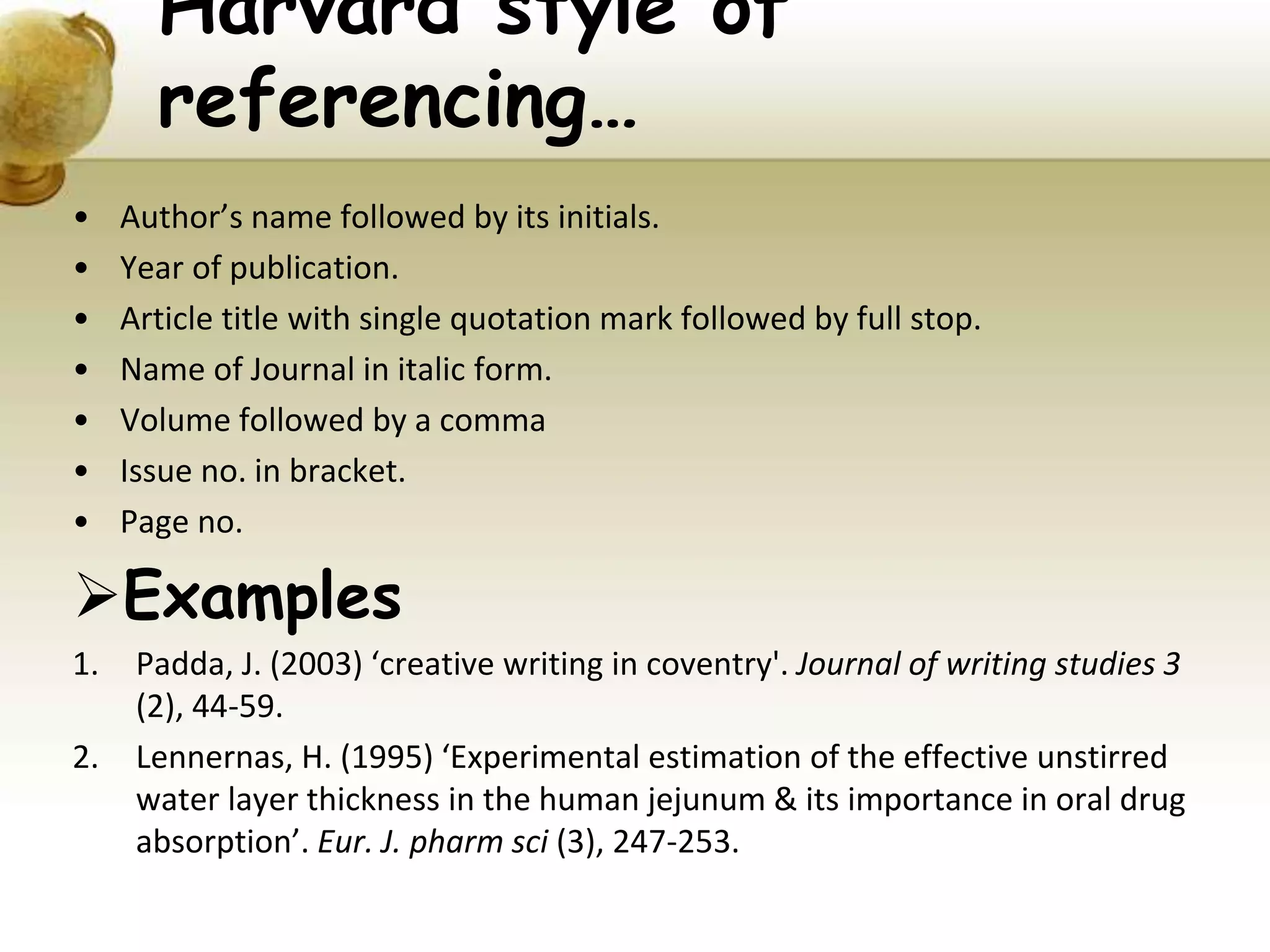
Harvard style of
referencing…
• Author’s name followed by its initials.
• Year of publication.
• Article title with single quotation mark followed by full stop.
• Name of Journal in italic form.
• Volume followed by a comma
• Issue no. in bracket.
• Page no.
Examples
1. Padda, J. (2003) ‘creative writing in coventry'. Journal of writing studies 3
(2), 44-59.
2. Lennernas, H. (1995) ‘Experimental estimation of the effective unstirred
water layer thickness in the human jejunum & its importance in oral drug
absorption’. Eur. J. pharm sci (3), 247-253.
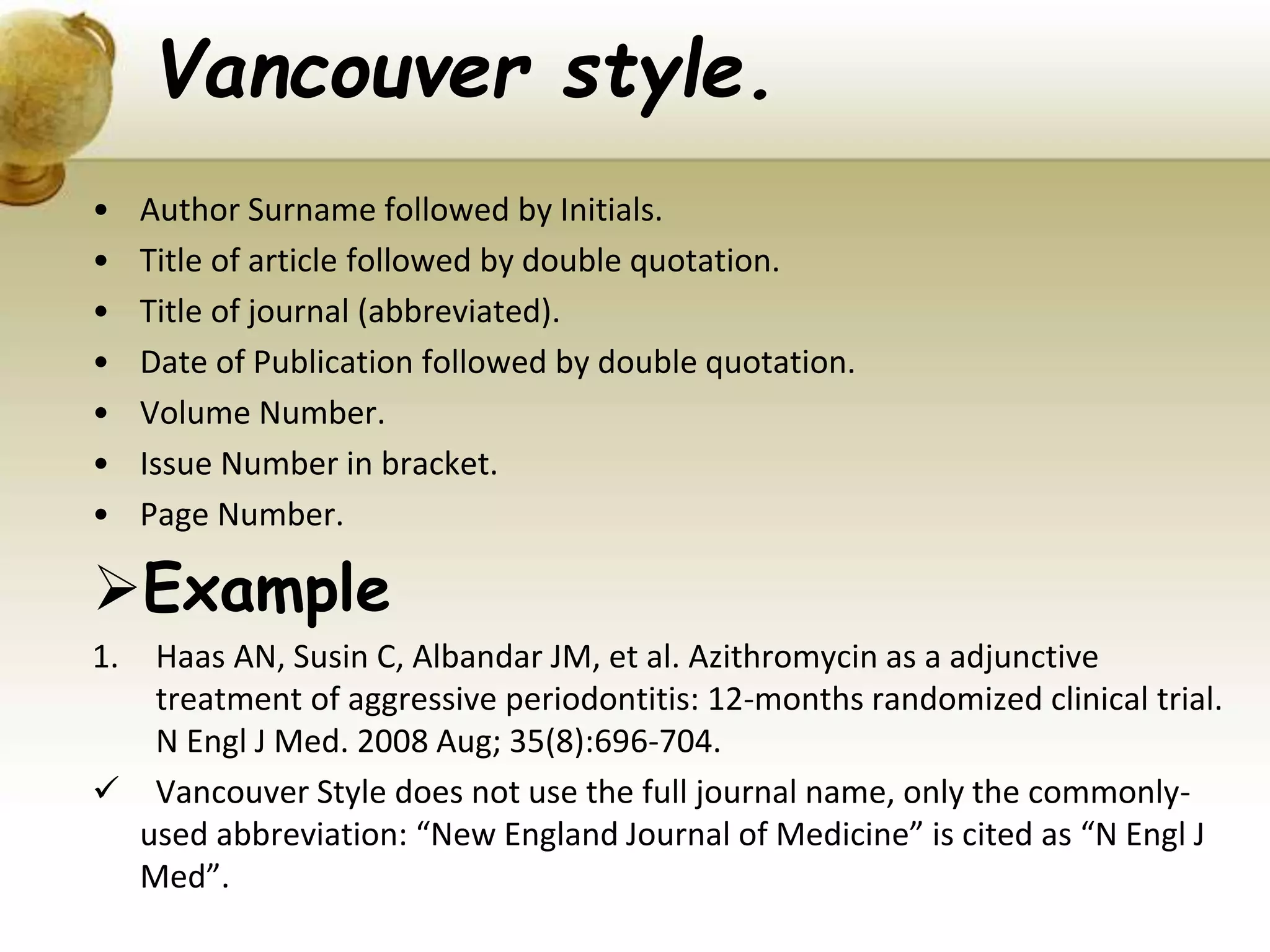
Vancouver style.
• Author Surname followed by Initials.
• Title of article followed by double quotation.
• Title of journal (abbreviated).
• Date of Publication followed by double quotation.
• Volume Number.
• Issue Number in bracket.
• Page Number.
Example
1. Haas AN, Susin C, Albandar JM, et al. Azithromycin as a adjunctive
treatment of aggressive periodontitis: 12-months randomized clinical trial.
N Engl J Med. 2008 Aug; 35(8):696-704.
 Vancouver Style does not use the full journal name, only the commonly-
used abbreviation: “New England Journal of Medicine” is cited as “N Engl J
Med”.
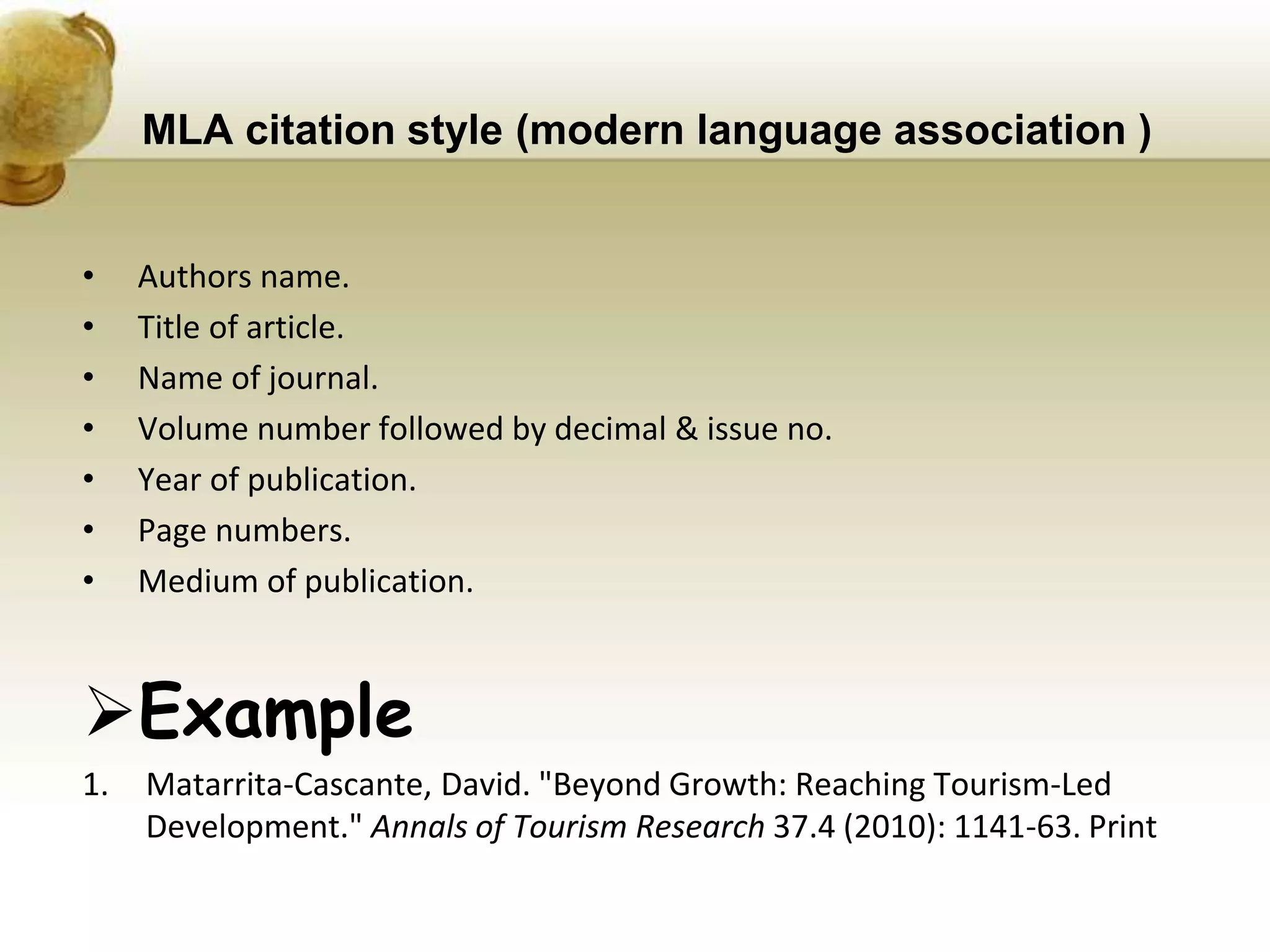
MLA citation style (modern language association )
• Authors name.
• Title of article.
• Name of journal.
• Volume number followed by decimal & issue no.
• Year of publication.
• Page numbers.
• Medium of publication.
Example
1. Matarrita-Cascante, David. "Beyond Growth: Reaching Tourism-Led
Development." Annals of Tourism Research 37.4 (2010): 1141-63. Print
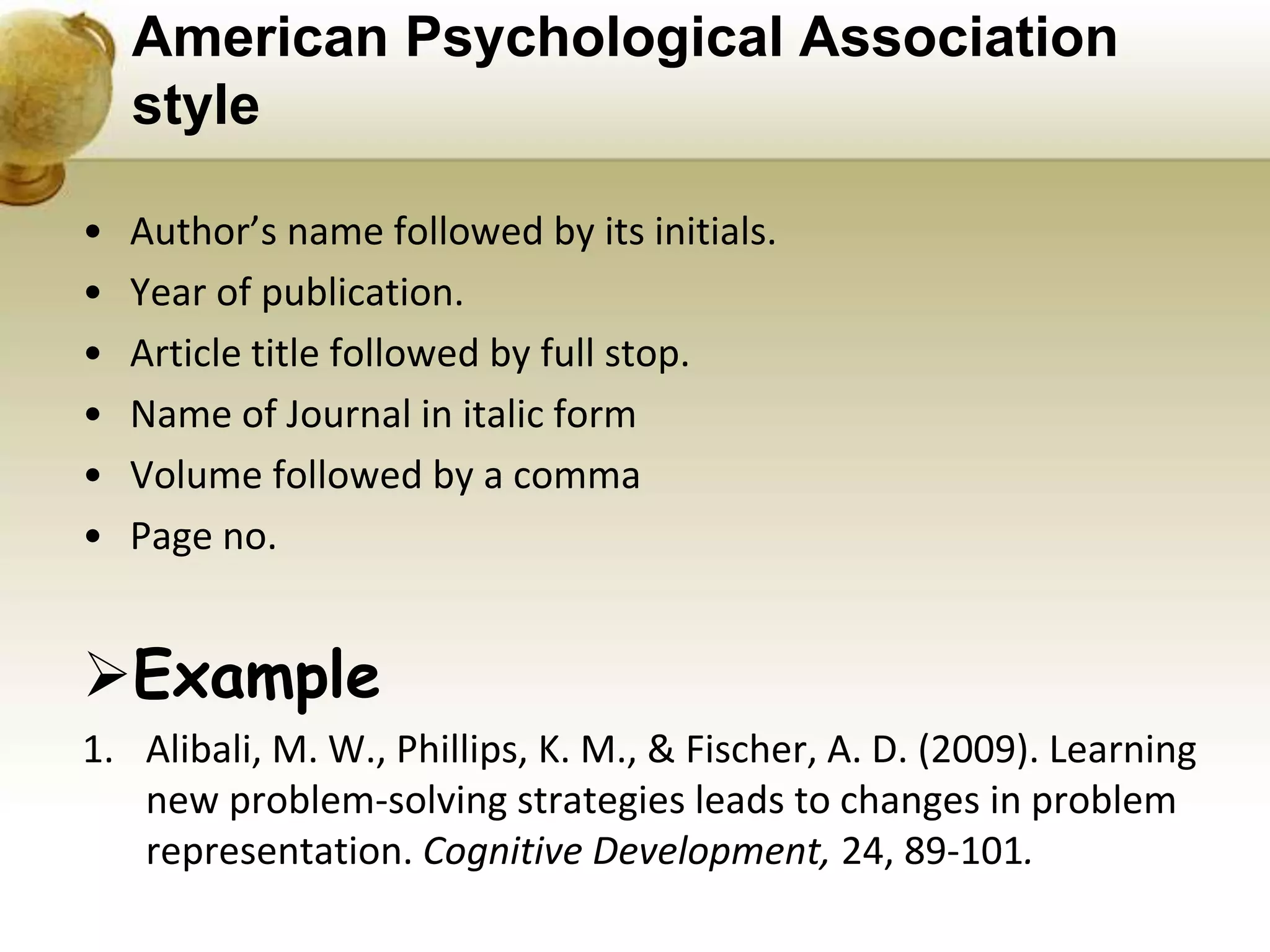
American Psychological Association
style
• Author’s name followed by its initials.
• Year of publication.
• Article title followed by full stop.
• Name of Journal in italic form
• Volume followed by a comma
• Page no.
Example
1. Alibali, M. W., Phillips, K. M., & Fischer, A. D. (2009). Learning
new problem-solving strategies leads to changes in problem
representation. Cognitive Development, 24, 89-101.
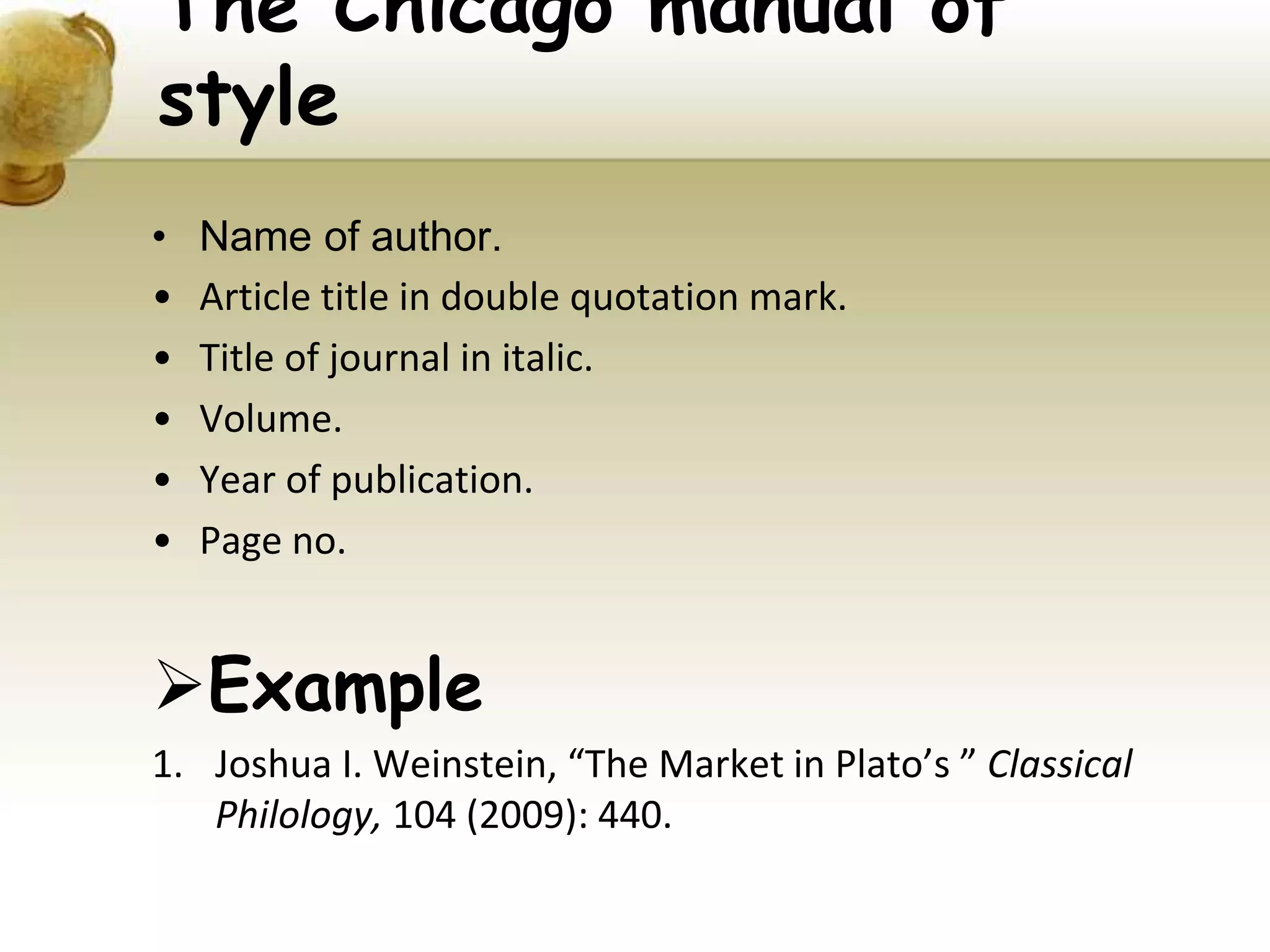
• Name of author.
• Article title in double quotation mark.
• Title of journal in italic.
• Volume.
• Year of publication.
• Page no.
Example
1. Joshua I. Weinstein, “The Market in Plato’s ” Classical
Philology, 104 (2009): 440.
The Chicago manual of
style
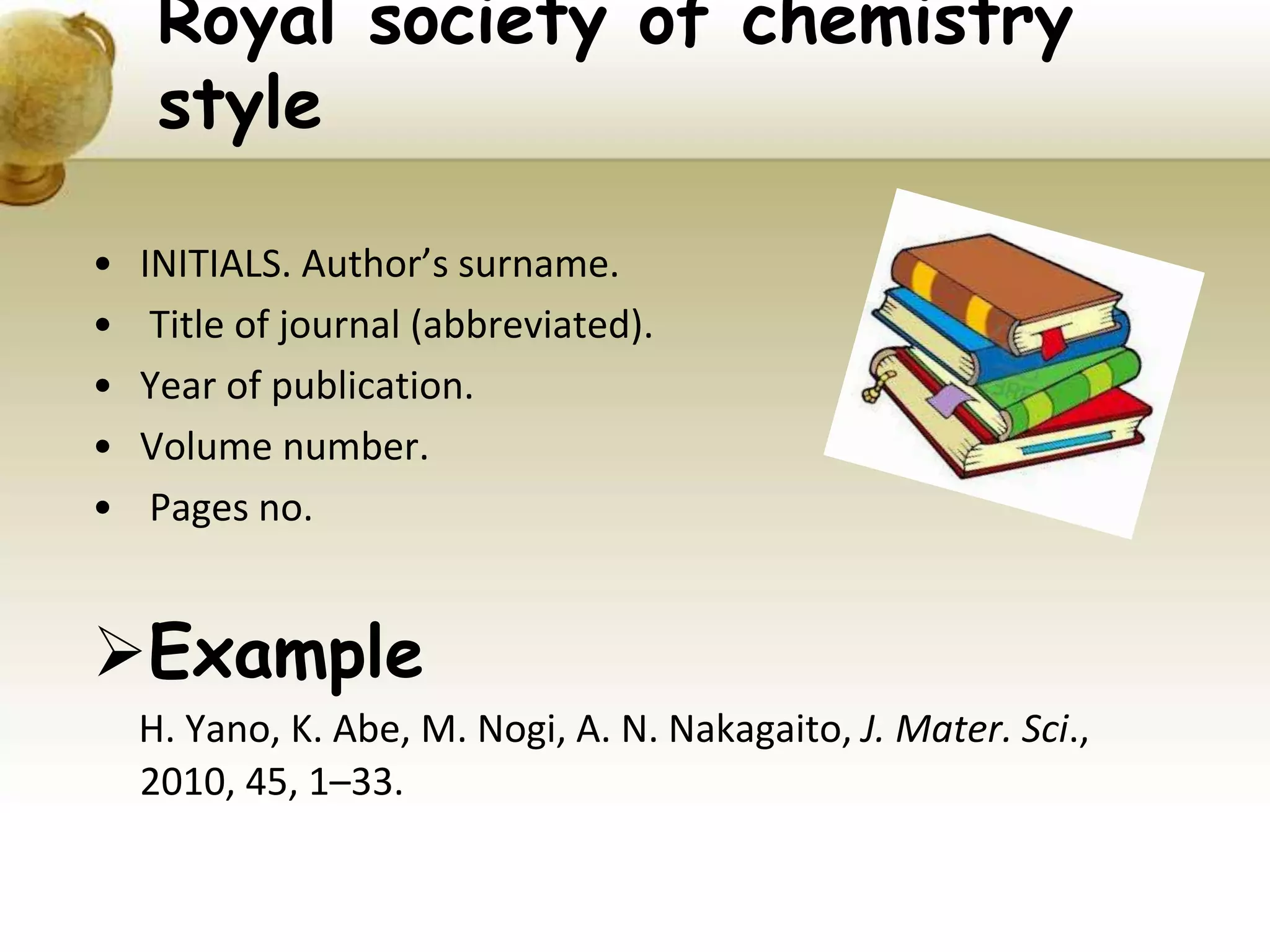
Royal society of chemistry
style
• INITIALS. Author’s surname.
• Title of journal (abbreviated).
• Year of publication.
• Volume number.
• Pages no.
Example
H. Yano, K. Abe, M. Nogi, A. N. Nakagaito, J. Mater. Sci.,
2010, 45, 1–33.
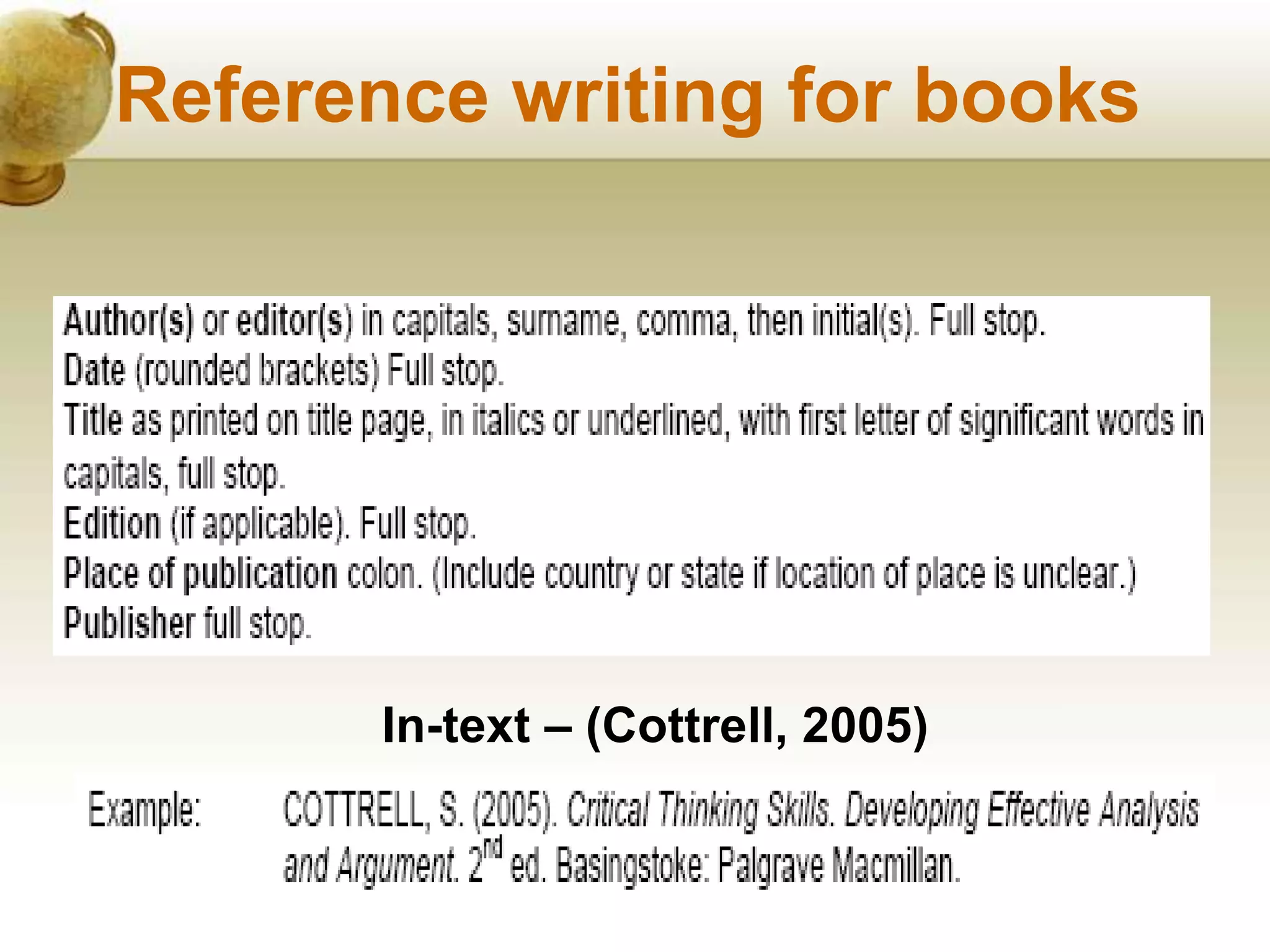
In-text – (Cottrell, 2005)
Reference writing for books
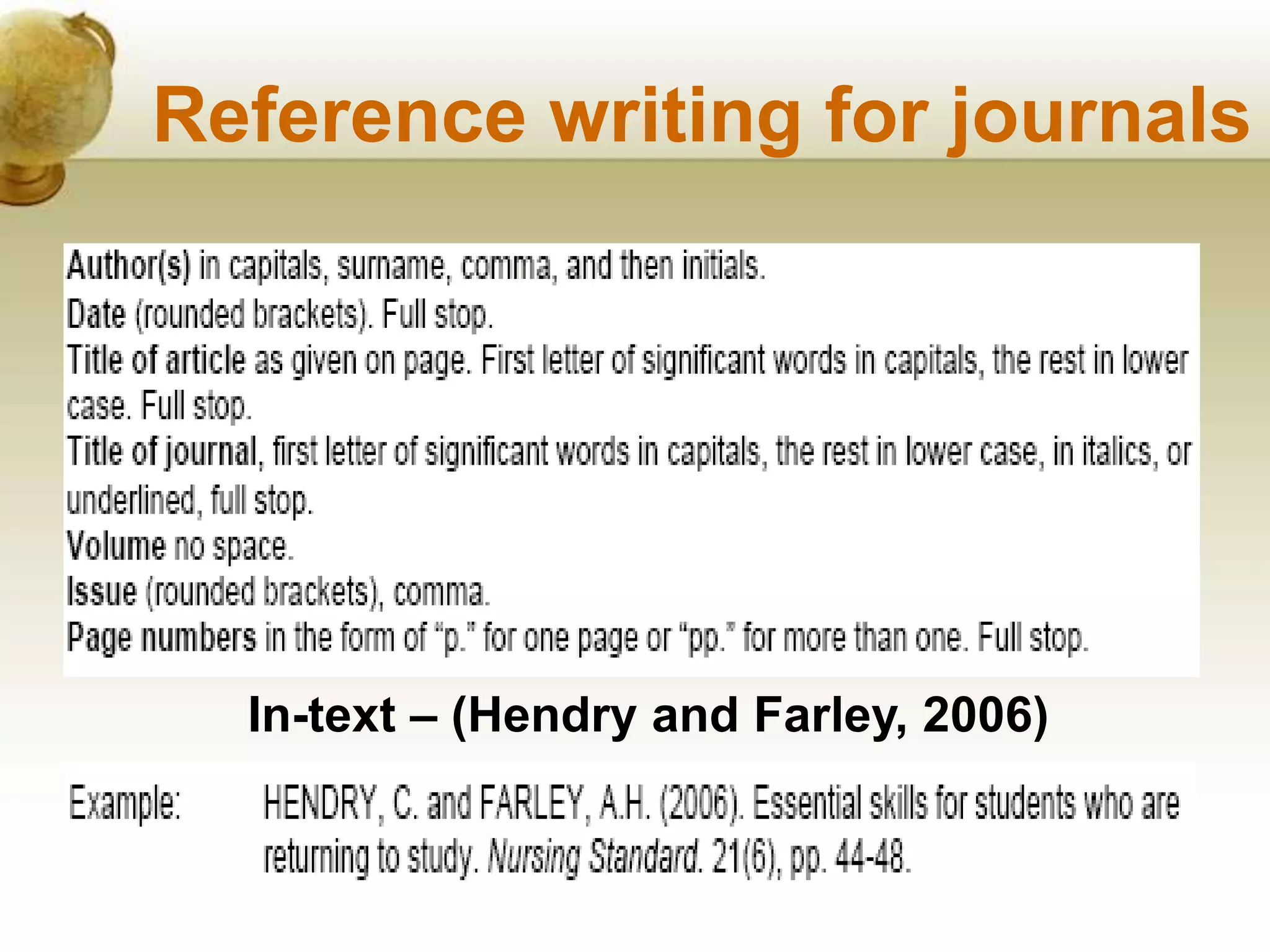
Reference writing for journals
In-text – (Hendry and Farley, 2006)
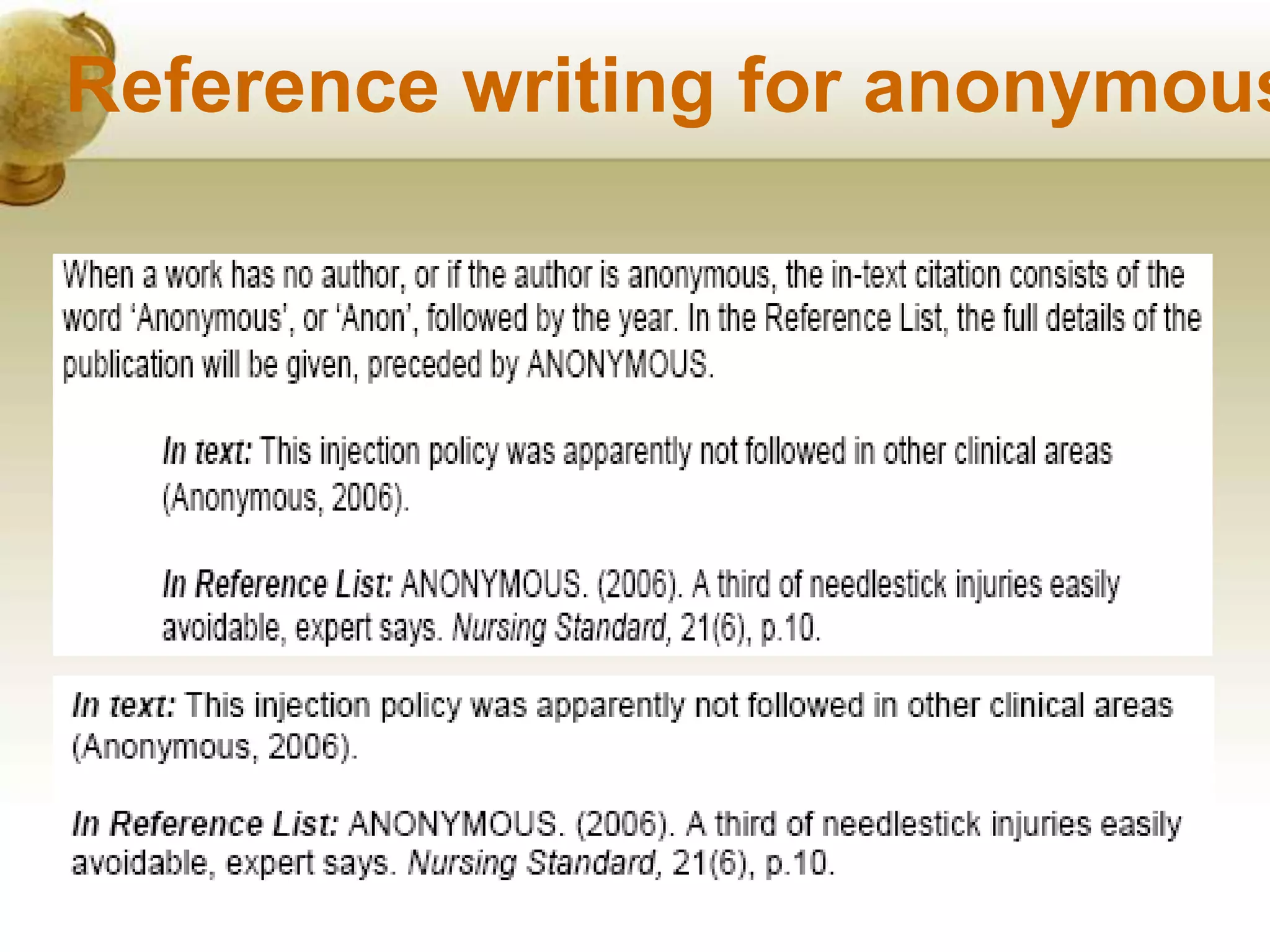
Reference writing for anonymous
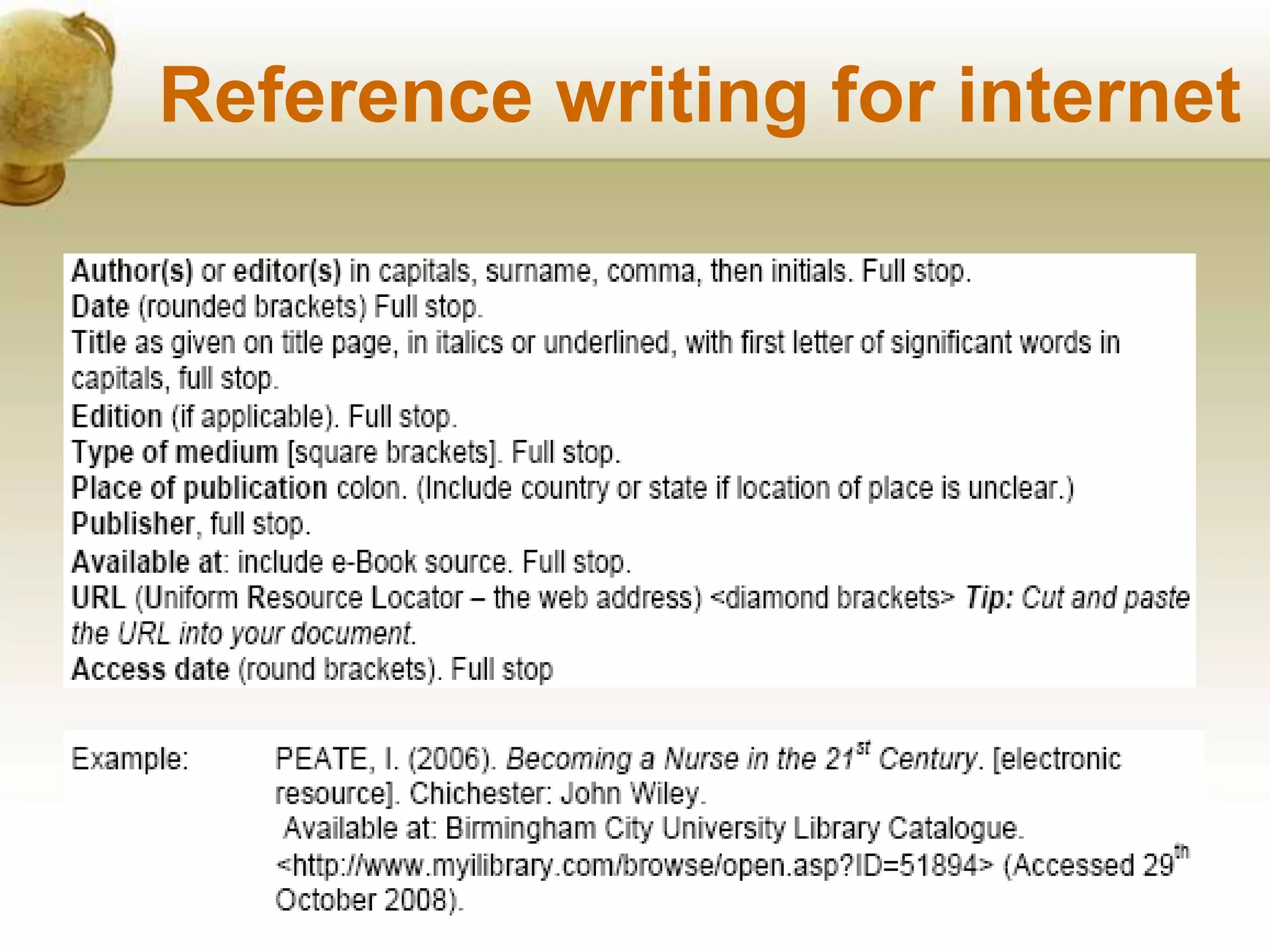
Reference writing for internet

Reference writing for books, journals, anonymous, internet etc.

  • 1.
    Topic: Reference writingfor books, journals, anonymous, internet etc. The Islamia University of Bahawalpur Muhammad Khizer Hayat Khaleel Ahmad Session: 2016-18 (Spring) Semester: 3rd Supervised By: Dr.Fakhra Shamim
  • 2.
    What is reference ???? •Referencing is a standardized method of formatting the information sources you have used in your assignments or written work. Any given referencing style serves two purposes: acknowledges the source. allows the reader to trace the source.
  • 3.
    Why to reference •Proves that substantial research has been done to support our analysis . • Enables others to follow up on our work . • Gives credit to other people's work . • Avoids charges of plagiarism. • Required to support all significant statements. • Used to indicate the origin of material & source for research & further reading.
  • 4.
    Types of references •Books • Journals • Anonymous • Internet Reference Elements •Authors name •Journal name •Page numbers •Article title •Volume •Year
  • 5.
    Different styles ofwriting references • Harvard style • Vancouver style • The Chicago manual of style • Royal society of chemistry style • American Psychological Association style (APA) • MLA citation style (modern language association )
  • 6.
    Harvard style of referencing… •Author’s name followed by its initials. • Year of publication. • Article title with single quotation mark followed by full stop. • Name of Journal in italic form. • Volume followed by a comma • Issue no. in bracket. • Page no. Examples 1. Padda, J. (2003) ‘creative writing in coventry'. Journal of writing studies 3 (2), 44-59. 2. Lennernas, H. (1995) ‘Experimental estimation of the effective unstirred water layer thickness in the human jejunum & its importance in oral drug absorption’. Eur. J. pharm sci (3), 247-253.
  • 7.
    Vancouver style. • AuthorSurname followed by Initials. • Title of article followed by double quotation. • Title of journal (abbreviated). • Date of Publication followed by double quotation. • Volume Number. • Issue Number in bracket. • Page Number. Example 1. Haas AN, Susin C, Albandar JM, et al. Azithromycin as a adjunctive treatment of aggressive periodontitis: 12-months randomized clinical trial. N Engl J Med. 2008 Aug; 35(8):696-704.  Vancouver Style does not use the full journal name, only the commonly- used abbreviation: “New England Journal of Medicine” is cited as “N Engl J Med”.
  • 8.
    MLA citation style(modern language association ) • Authors name. • Title of article. • Name of journal. • Volume number followed by decimal & issue no. • Year of publication. • Page numbers. • Medium of publication. Example 1. Matarrita-Cascante, David. "Beyond Growth: Reaching Tourism-Led Development." Annals of Tourism Research 37.4 (2010): 1141-63. Print
  • 9.
    American Psychological Association style •Author’s name followed by its initials. • Year of publication. • Article title followed by full stop. • Name of Journal in italic form • Volume followed by a comma • Page no. Example 1. Alibali, M. W., Phillips, K. M., & Fischer, A. D. (2009). Learning new problem-solving strategies leads to changes in problem representation. Cognitive Development, 24, 89-101.
  • 10.
    • Name ofauthor. • Article title in double quotation mark. • Title of journal in italic. • Volume. • Year of publication. • Page no. Example 1. Joshua I. Weinstein, “The Market in Plato’s ” Classical Philology, 104 (2009): 440. The Chicago manual of style
  • 11.
    Royal society ofchemistry style • INITIALS. Author’s surname. • Title of journal (abbreviated). • Year of publication. • Volume number. • Pages no. Example H. Yano, K. Abe, M. Nogi, A. N. Nakagaito, J. Mater. Sci., 2010, 45, 1–33.
  • 12.
    In-text – (Cottrell,2005) Reference writing for books
  • 13.
    Reference writing forjournals In-text – (Hendry and Farley, 2006)
  • 14.
  • 15.