DATA
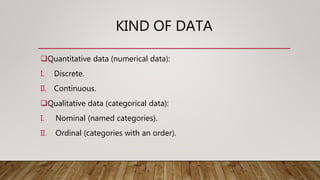
KIND OF DATA
Quantitative data (numerical data):
I. Discrete.
II. Continuous.
Qualitative data (categorical data):
I. Nominal (named categories).
II. Ordinal (categories with an order).
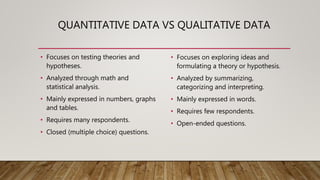
QUANTITATIVE DATA VS QUALITATIVE DATA
• Focuses on testing theories and
hypotheses.
• Analyzed through math and
statistical analysis.
• Mainly expressed in numbers, graphs
and tables.
• Requires many respondents.
• Closed (multiple choice) questions.
• Focuses on exploring ideas and
formulating a theory or hypothesis.
• Analyzed by summarizing,
categorizing and interpreting.
• Mainly expressed in words.
• Requires few respondents.
• Open-ended questions.
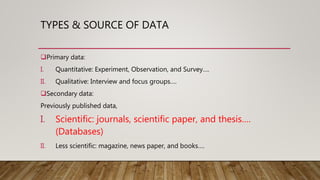
TYPES & SOURCE OF DATA
Primary data:
I. Quantitative: Experiment, Observation, and Survey….
II. Qualitative: Interview and focus groups….
Secondary data:
Previously published data,
I. Scientific: journals, scientific paper, and thesis….
(Databases)
II. Less scientific: magazine, news paper, and books….
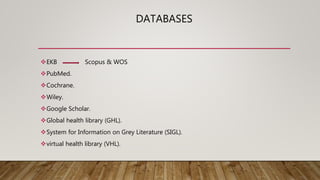
DATABASES
EKB Scopus & WOS
PubMed.
Cochrane.
Wiley.
Google Scholar.
Global health library (GHL).
System for Information on Grey Literature (SIGL).
virtual health library (VHL).

Types of Data & Different Databases

  • 1.
  • 2.
    KIND OF DATA Quantitativedata (numerical data): I. Discrete. II. Continuous. Qualitative data (categorical data): I. Nominal (named categories). II. Ordinal (categories with an order).
  • 3.
    QUANTITATIVE DATA VSQUALITATIVE DATA • Focuses on testing theories and hypotheses. • Analyzed through math and statistical analysis. • Mainly expressed in numbers, graphs and tables. • Requires many respondents. • Closed (multiple choice) questions. • Focuses on exploring ideas and formulating a theory or hypothesis. • Analyzed by summarizing, categorizing and interpreting. • Mainly expressed in words. • Requires few respondents. • Open-ended questions.
  • 4.
    TYPES & SOURCEOF DATA Primary data: I. Quantitative: Experiment, Observation, and Survey…. II. Qualitative: Interview and focus groups…. Secondary data: Previously published data, I. Scientific: journals, scientific paper, and thesis…. (Databases) II. Less scientific: magazine, news paper, and books….
  • 5.
    DATABASES EKB Scopus &WOS PubMed. Cochrane. Wiley. Google Scholar. Global health library (GHL). System for Information on Grey Literature (SIGL). virtual health library (VHL).