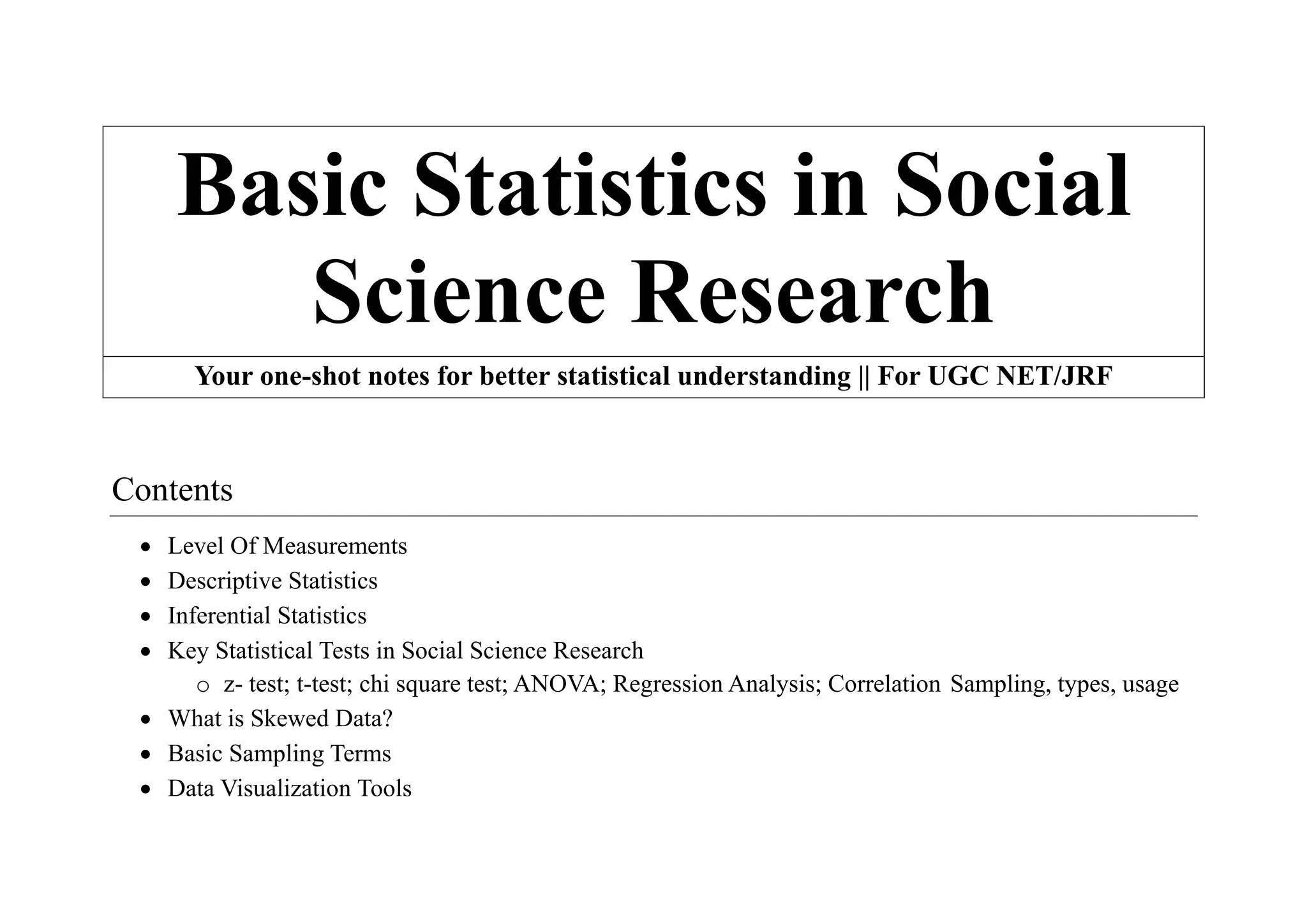
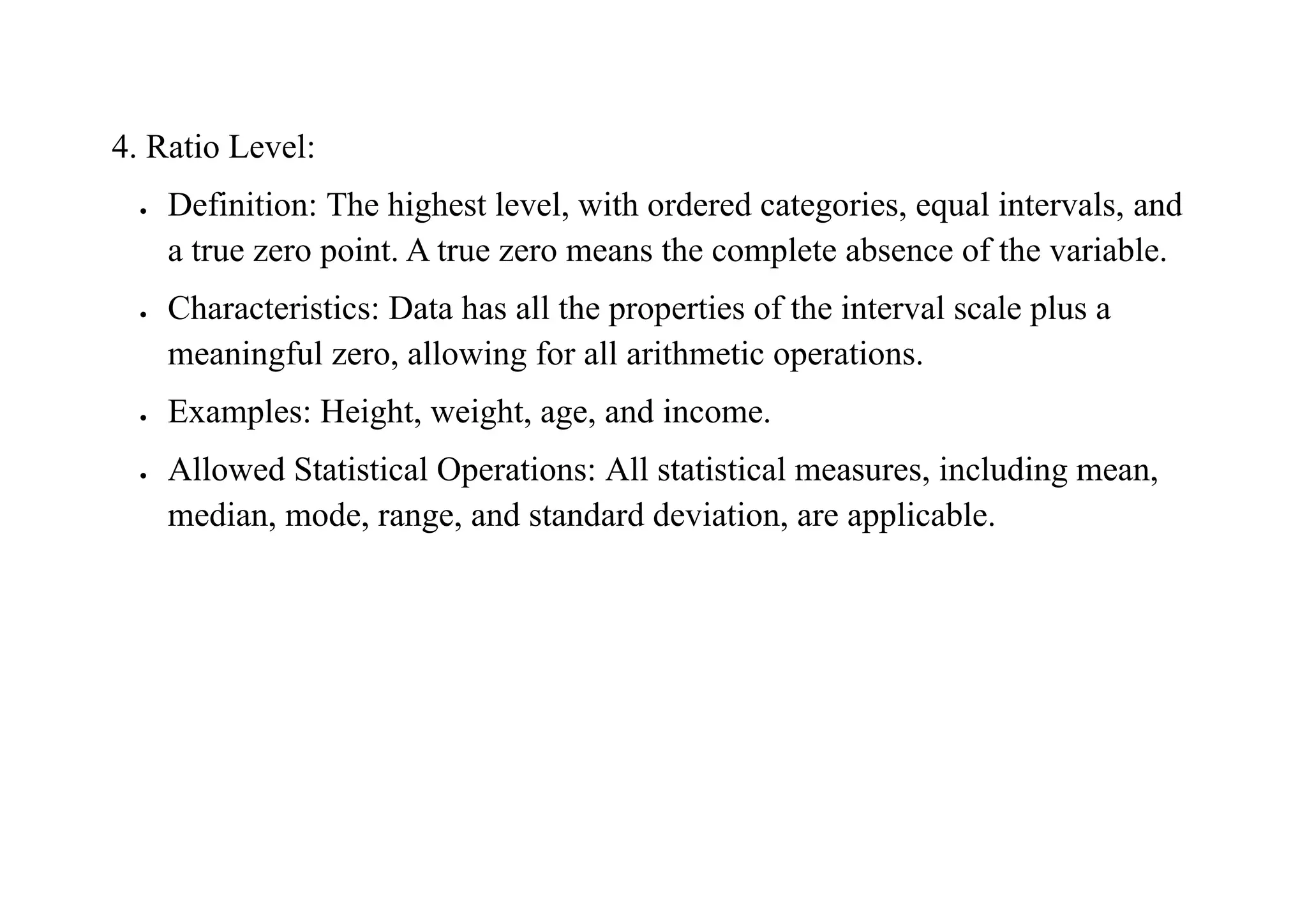
This presentation on basic statistics for social science provides a foundational overview for students, educators, and researchers in the social sciences. It covers key topics such as levels of measurement, including nominal, ordinal, interval, and ratio scales, which are essential for selecting appropriate statistical methods.
It explains the difference between descriptive and inferential statistics, helping learners understand how data can be summarized and how conclusions can be drawn from samples to populations. The slide deck introduces essential statistical tests used in social science research, such as the z-test, t-test, chi-square test, ANOVA, correlation, and regression analysis, with explanations of when and how they are used.
The section on sampling describes various types of sampling methods, their definitions, and practical applications in field research. It also includes a concise discussion on skewed data, explaining what it is, why it matters, and how it affects the interpretation of results.
The resource further defines basic sampling terms like population, sample, and sampling frame. A segment on data visualization tools introduces commonly used visual formats such as bar charts, histograms, pie charts, and scatter plots, with guidance on when to use each.
This PDF is ideal for students preparing for competitive exams, research projects, or academic coursework involving statistical methods in psychology, sociology, political science, and related disciplines.
This PDF is especially helpful for students preparing for the UGC NET JRF Paper 1. It covers essential topics in basic statistics that are frequently asked in the exam, including levels of measurement, descriptive and inferential statistics, key statistical tests like t-test, chi-square, and ANOVA, as well as concepts of sampling, skewed data, and data visualization. The content is designed to build conceptual clarity and support exam-oriented preparation for aspiring researchers and lecturers in social science and education.
This PDF is also valuable if you are involved in statistics for office or professional use. Whether you're working in research, marketing, education, administration, or data-driven decision-making, it provides a practical understanding of key statistical concepts. Topics like data visualization, sampling methods, skewed data, and common statistical tests (t-test, chi-square, regression, ANOVA) are presented in a clear and accessible format, making it easier to apply statistical thinking in day-to-day reporting, project analysis, and strategic planning.
If you are an academician, this PDF is a helpful resource for teaching and guiding research. It covers key statistical concepts useful for lectures, student projects, and UGC NET JRF Paper 1 preparation. Clear explanations and visuals make it ideal for classroom and academic use.