19A04301 SIGNALS AND SYSTEMS
1
 PREPARED BY
S.Raghavendra swami
Assistant Professor,
Department of ECE.
COURSE OUTCOMES
2
 C213.1 Explain various types of signals & systems and
represent using Fourier series
 C213.2 Analyze continuous time signals using Fourier
transform
 C213.3 Examine signal transmission through liner systems
 C213.4 Analyze discrete time signals using discrete time
Fourier transform
 C213.5 Apply Laplace and z transform to analyze
continuous & discrete time systems
SUB:ES UNIT:2
Signals and systems 3
Syllabus:
UnitI: Introduction&FourierSeries
Introduction: Basic definitions and Classificationof Signals and Systems (Continuous Time and DiscreteTime), Operations onSignals, Concepts
of Convolution andCorrelation of Signals, Analogy betweenVectors andSignals - Orthogonality, MeanSquareError.
Fourierseries: Trigonometric &Exponential, Properties of Fourier series, Conceptof discretespectrum, Illustrative Problems.
UnitII: ContinuousTimeFourierTransform( CTFT orFT)
Definition, Computation and Properties of Fourier Transform for different types of Signals and Systems, Inverse Fourier transform, Statement and
Proof of Sampling Theoremof LowPassSignals, Illustrative Problems.
UnitIII: DiscreteTimeFourierTransform(DTFT)
Definition, Computation andproperties of DiscreteTime, Fourier transformfordifferent types of Signals andSystems, Illustrative Problems.
Signals and systems 4
UnitIV: Signal TransmissionThroughLinearSystems
Linear System, ImpulseResponse, Response of a Linear System for different input Signals, Linear Time-Invariant (LTI) System,
Linear Time Variant (LTV) System, Transfer function of a LTI system. Filter characteristics of Linear Systems. Distortion less
transmission through a System, Signal Bandwidth, System Bandwidth, Ideal LPF, HPF and BPF Characteristics, Causality and
Paley-Wiener Criterion for Physical Realization, Relationship between Bandwidth and Rise time, Energy and Power Spectral
Densities, Illustrative Problems.
UnitV: LaplaceTransform&Z–Transform
LaplaceTransform: Definition, ROC, Properties, InverseLaplacetransforms, theS-planeand BIBO Stability, Transfer Functions,
SystemResponsetoStandard Signals, Solution of Differential Equations with Initial conditions.
Z–Transform: Definition, ROC, Properties, Poles and Zeros in Z-plane, The inverse Z-Transform, System Analysis, Transfer
Function, BIBO Stability, System Response to Standard Signals, Solution of Difference Equations with initial conditions,
Illustrative Problems.
SUB:ES UNIT:2
Signals and systems 5
Text Books:
1. A.V. Oppenheim, A.S. Willsky and S.H. Nawab, “Signals and Systems”, 2nd Edition, PHI, 2009.
2. Simon Haykin and Van Veen, “Signals & Systems”, 2nd Edition, Wiley, 2005.
References:
1. BP Lathi, “Principles of Linear Systems and Signals”, 2nd Edition, Oxford University Press, 015.
2. Matthew Sadiku and Warsame H. Ali, “Signals and Systems A primer with MATLAB”, CRC Press,
2016.
3. Hwei Hsu, “Schaum's Outline of Signals and Systems”, 4th Edition, TMH, 2019.
SUB:ES UNIT:2
Signals and systems overview 6
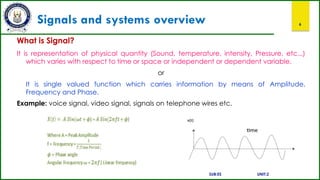
What is Signal?
It is representation of physical quantity (Sound, temperature, intensity, Pressure, etc..,)
which varies with respect to time or space or independent or dependent variable.
or
It is single valued function which carries information by means of Amplitude,
Frequency and Phase.
Example: voice signal, video signal, signals on telephone wires etc.
SUB:ES UNIT:2
Signals and systems overview
7
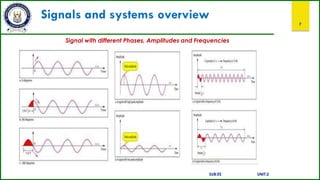
Signal with different Phases, Amplitudes and Frequencies
SUB:ES UNIT:2
Classification of Signals
8
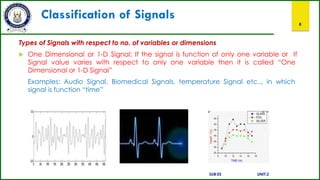
Types of Signals with respect to no. of variables or dimensions
 One Dimensional or 1-D Signal: If the signal is function of only one variable or If
Signal value varies with respect to only one variable then it is called “One
Dimensional or 1-D Signal”
Examples: Audio Signal, Biomedical Signals, temperature Signal etc.., in which
signal is function “time”
SUB:ES UNIT:2
Classification of Signals
9
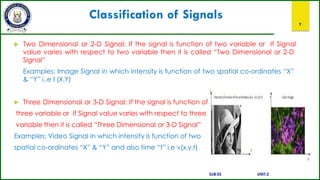
 Two Dimensional or 2-D Signal: If the signal is function of two variable or If Signal
value varies with respect to two variable then it is called “Two Dimensional or 2-D
Signal”
Examples: Image Signal in which intensity is function of two spatial co-ordinates “X”
& “Y” i,.e I (X,Y)
 Three Dimensional or 3-D Signal: If the signal is function of
three variable or If Signal value varies with respect to three
variable then it is called “Three Dimensional or 3-D Signal”
Examples: Video Signal in which intensity is function of two
spatial co-ordinates “X” & “Y” and also time “t” i.e v(x,y,t)
SUB:ES UNIT:2
Classification of Signals
10
Types of Signal with respect to nature of the signal
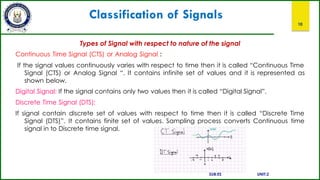
Continuous Time Signal (CTS) or Analog Signal :
If the signal values continuously varies with respect to time then it is called “Continuous Time
Signal (CTS) or Analog Signal “. It contains infinite set of values and it is represented as
shown below.
Digital Signal: If the signal contains only two values then it is called “Digital Signal”.
Discrete Time Signal (DTS):
If signal contain discrete set of values with respect to time then it is called “Discrete Time
Signal (DTS)”. It contains finite set of values. Sampling process converts Continuous time
signal in to Discrete time signal.
SUB:ES UNIT:2
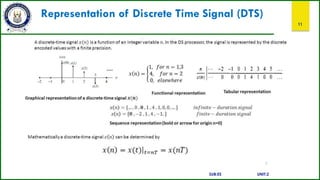
Representation of Discrete Time Signal (DTS)
11
SUB:ES UNIT:2
Basic Types of Signals
12
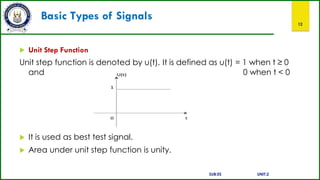
 Unit Step Function
Unit step function is denoted by u(t). It is defined as u(t) = 1 when t ≥ 0
and 0 when t < 0
 It is used as best test signal.
 Area under unit step function is unity.
SUB:ES UNIT:2
Basic Types of Signals
13
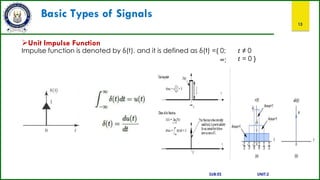
Unit Impulse Function
Impulse function is denoted by δ(t). and it is defined as δ(t) ={ 0;
∞;
푡 ≠ 0
푡 = 0 }
SUB:ES UNIT:2
Basic Types of Signals
14
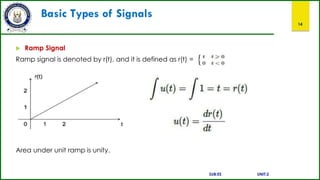
 Ramp Signal
Ramp signal is denoted by r(t), and it is defined as r(t) =
Area under unit ramp is unity.
SUB:ES UNIT:2
Basic Types of Signals
15
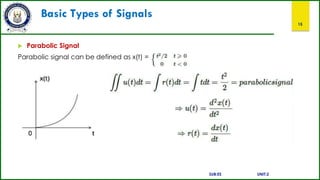
 Parabolic Signal
Parabolic signal can be defined as x(t) =
SUB:ES UNIT:2
Basic Types of Signals
16
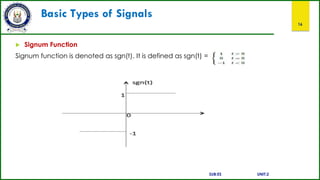
 Signum Function
Signum function is denoted as sgn(t). It is defined as sgn(t) =
SUB:ES UNIT:2
Basic Types of Signals
17
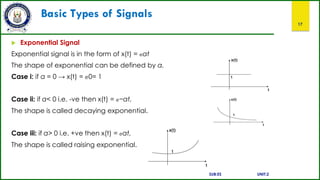
 Exponential Signal
Exponential signal is in the form of x(t) = eαt
The shape of exponential can be defined by α.
Case i: if α = 0 → x(t) = e0= 1
Case ii: if α< 0 i.e. -ve then x(t) = e−αt,
The shape is called decaying exponential.
Case iii: if α> 0 i.e. +ve then x(t) = eαt,
The shape is called raising exponential.
SUB:ES UNIT:2
Basic Types of Signals
18
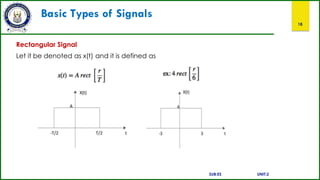
Rectangular Signal
Let it be denoted as x(t) and it is defined as
SUB:ES UNIT:2
Basic Types of Signals
19
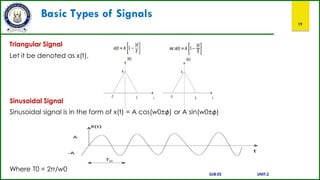
Triangular Signal
Let it be denoted as x(t),
Sinusoidal Signal
Sinusoidal signal is in the form of x(t) = A cos(w0±ϕ) or A sin(w0±ϕ)
Where T0 = 2π/w0
SUB:ES UNIT:2
Classification of Signals
20
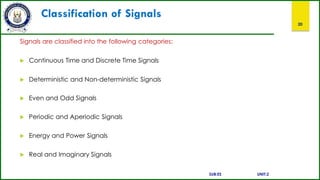
Signals are classified into the following categories:
 Continuous Time and Discrete Time Signals
 Deterministic and Non-deterministic Signals
 Even and Odd Signals
 Periodic and Aperiodic Signals
 Energy and Power Signals
 Real and Imaginary Signals
SUB:ES UNIT:2
Classification of Signals
21
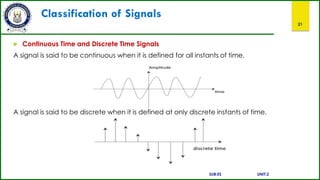
 Continuous Time and Discrete Time Signals
A signal is said to be continuous when it is defined for all instants of time.
A signal is said to be discrete when it is defined at only discrete instants of time.
SUB:ES UNIT:2
Classification of Signals
22
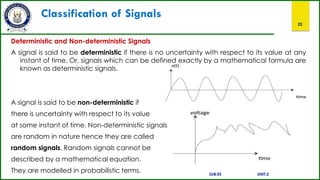
Deterministic and Non-deterministic Signals
A signal is said to be deterministic if there is no uncertainty with respect to its value at any
instant of time. Or, signals which can be defined exactly by a mathematical formula are
known as deterministic signals.
A signal is said to be non-deterministic if
there is uncertainty with respect to its value
at some instant of time. Non-deterministic signals
are random in nature hence they are called
random signals. Random signals cannot be
described by a mathematical equation.
They are modelled in probabilistic terms. SUB:ES UNIT:2
Classification of Signals
23
Even and Odd signals
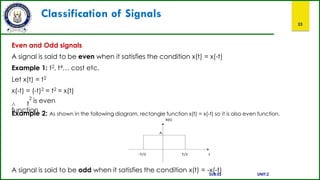
A signal is said to be even when it satisfies the condition x(t) = x(-t)
Example 1: t2, t4… cost etc.
Let x(t) = t2
x(-t) = (-t)2 = t2 = x(t)
∴ t
2
is even
function
Example 2: As shown in the following diagram, rectangle function x(t) = x(-t) so it is also even function.
A signal is said to be odd when it satisfies the condition x(t) = -x(-t)
SUB:ES UNIT:2
Classification of Signals
24
Periodic and Aperiodic Signals
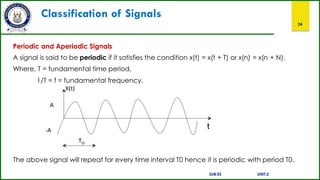
A signal is said to be periodic if it satisfies the condition x(t) = x(t + T) or x(n) = x(n + N).
Where, T = fundamental time period,
1/T = f = fundamental frequency.
The above signal will repeat for every time interval T0 hence it is periodic with period T0.
SUB:ES UNIT:2
Classification of Signals
25
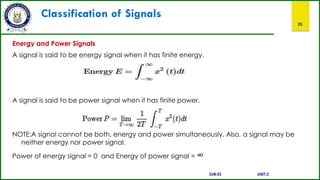
Energy and Power Signals
A signal is said to be energy signal when it has finite energy.
A signal is said to be power signal when it has finite power.
NOTE:A signal cannot be both, energy and power simultaneously. Also, a signal may be
neither energy nor power signal.
Power of energy signal = 0 and Energy of power signal = ∞
SUB:ES UNIT:2
Classification of Signals
26
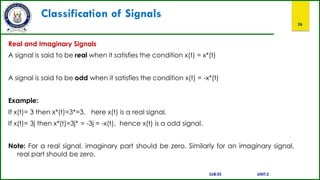
Real and Imaginary Signals
A signal is said to be real when it satisfies the condition x(t) = x*(t)
A signal is said to be odd when it satisfies the condition x(t) = -x*(t)
Example:
If x(t)= 3 then x*(t)=3*=3, here x(t) is a real signal.
If x(t)= 3j then x*(t)=3j* = -3j = -x(t), hence x(t) is a odd signal.
Note: For a real signal, imaginary part should be zero. Similarly for an imaginary signal,
real part should be zero.
SUB:ES UNIT:2
Basic Operations on Signals
27
There are two variable parameters in general:
 Amplitude
 Time
The following operation can be performed with amplitude:
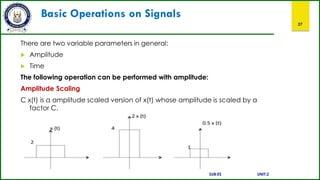
Amplitude Scaling
C x(t) is a amplitude scaled version of x(t) whose amplitude is scaled by a
factor C.
SUB:ES UNIT:2
Basic Operations on Signals
28
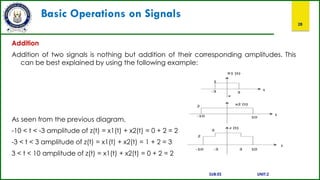
Addition
Addition of two signals is nothing but addition of their corresponding amplitudes. This
can be best explained by using the following example:
As seen from the previous diagram,
-10 < t < -3 amplitude of z(t) = x1(t) + x2(t) = 0 + 2 = 2
-3 < t < 3 amplitude of z(t) = x1(t) + x2(t) = 1 + 2 = 3
3 < t < 10 amplitude of z(t) = x1(t) + x2(t) = 0 + 2 = 2
SUB:ES UNIT:2
Basic Operations on Signals
29
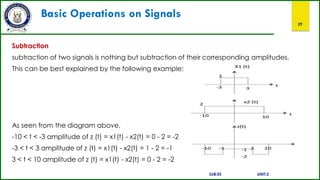
Subtraction
subtraction of two signals is nothing but subtraction of their corresponding amplitudes.
This can be best explained by the following example:
As seen from the diagram above,
-10 < t < -3 amplitude of z (t) = x1(t) - x2(t) = 0 - 2 = -2
-3 < t < 3 amplitude of z (t) = x1(t) - x2(t) = 1 - 2 = -1
3 < t < 10 amplitude of z (t) = x1(t) - x2(t) = 0 - 2 = -2
SUB:ES UNIT:2
Basic Operations on Signals
30
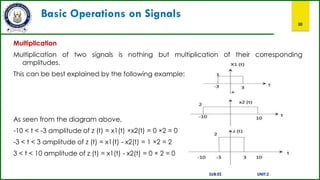
Multiplication
Multiplication of two signals is nothing but multiplication of their corresponding
amplitudes.
This can be best explained by the following example:
As seen from the diagram above,
-10 < t < -3 amplitude of z (t) = x1(t) ×x2(t) = 0 ×2 = 0
-3 < t < 3 amplitude of z (t) = x1(t) - x2(t) = 1 ×2 = 2
3 < t < 10 amplitude of z (t) = x1(t) - x2(t) = 0 × 2 = 0
SUB:ES UNIT:2
Basic Operations on Signals
31
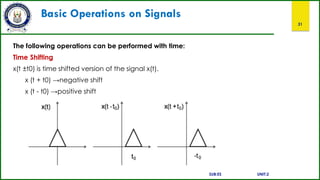
The following operations can be performed with time:
Time Shifting
x(t ±t0) is time shifted version of the signal x(t).
x (t + t0) →negative shift
x (t - t0) →positive shift
SUB:ES UNIT:2
Basic Operations on Signals
32
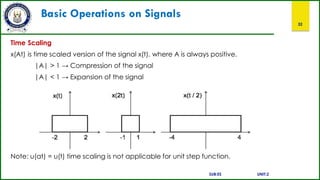
Time Scaling
x(At) is time scaled version of the signal x(t). where A is always positive.
|A| > 1 → Compression of the signal
|A| < 1 → Expansion of the signal
Note: u(at) = u(t) time scaling is not applicable for unit step function.
SUB:ES UNIT:2
Basic Operations on Signals
33
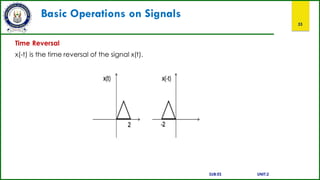
Time Reversal
x(-t) is the time reversal of the signal x(t).
SUB:ES UNIT:2
Basic Operations on Signals
34
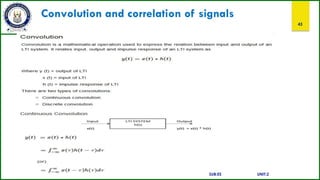
Convolution: Convolution between two continuous time signals can be written as
The following operations are required to compute convolution
1. Time reversal
2. Time Shifting ( Delay & Advance)
3. Signal Multiplication
4. Integration
Note: If two signals are finite duration then Graphical Method is used and Else Function
Method is employed to compute Convolution
SUB:ES UNIT:2
System Definition 35
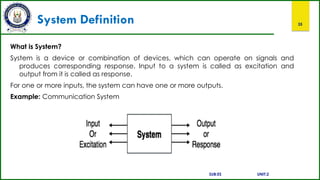
What is System?
System is a device or combination of devices, which can operate on signals and
produces corresponding response. Input to a system is called as excitation and
output from it is called as response.
For one or more inputs, the system can have one or more outputs.
Example: Communication System
SUB:ES UNIT:2
Classification of Systems
36
Systems are classified into the following categories:
 linear and Non-linear Systems
 Time Variant and Time Invariant Systems
 linear Time variant and linear Time invariant systems
 Static and Dynamic Systems
 Causal and Non-causal Systems
 Invertible and Non-Invertible Systems
 Stable and Unstable Systems
SUB:ES UNIT:2
Classification of Systems
37
Linear and Non-linear Systems
A system is said to be linear when it satisfies superposition and homogenate principles. Consider two
systems with inputs as x1(t), x2(t), and outputs as y1(t), y2(t) respectively. Then, according to the
superposition and homogenate principles,
T [a1 x1(t) + a2 x2(t)] = a1 T[x1(t)] + a2 T[x2(t)]
∴ T [a1 x1(t) + a2 x2(t)] = a1 y1(t) + a2
y2(t)
From the above expression, is clear that response of overall system is equal to response of individual
system.
Example: y(t) = x2(t)
Solution:
y1 (t) = T[x1(t)] = x12(t)
y2 (t) = T[x2(t)] = x22(t)
T [a1 x1(t) + a2 x2(t)] = [ a1 x1(t) + a2 x2(t)]2
Which is not equal to a1 y1(t) + a2 y2(t). Hence the system is said to be non linear.
SUB:ES UNIT:2
Classification of Systems
38
Time Variant and Time Invariant Systems
A system is said to be time variant if its input and output characteristics vary with time.
Otherwise, the system is considered as time invariant. The condition for time invariant system is:
y (n , t) = y(n-t)
The condition for time variant system is:
y (n , t) ≠ y(n-t)
Where y (n , t) = T[x(n-t)] = input change
y (n-t) = output change
Example:
y(n) = x(-n)
y(n, t) = T[x(n-t)] = x(-n-t)
y(n-t) = x(-(n-t)) = x(-n + t)
∴ y(n, t) ≠ y(n-t). Hence, the system is time
variant. SUB:ES UNIT:2
Classification of Systems
39
Liner Time variant (LTV) and Liner Time Invariant (LTI) Systems
If a system is both liner and time variant, then it is called liner time variant (LTV) system.
If a system is both liner and time Invariant then that system is called liner time invariant (LTI)
system.
Static and Dynamic Systems
Static system is memory-less whereas dynamic system is a memory system.
Example 1: y(t) = 2 x(t)
For present value t=0, the system output is y(0) = 2x(0). Here, the output is only dependent
upon present input. Hence the system is memory less or static.
Example 2: y(t) = 2 x(t) + 3 x(t-3)
For present value t=0, the system output is y(0) = 2x(0) + 3x(-3).
Here x(-3) is past value for the present input for which the system requires memory to get
this output. Hence, the system is a dynamic system. SUB:ES UNIT:2
Classification of Systems
40
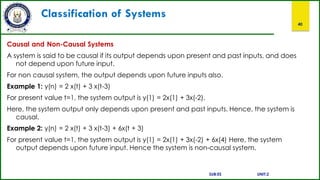
Causal and Non-Causal Systems
A system is said to be causal if its output depends upon present and past inputs, and does
not depend upon future input.
For non causal system, the output depends upon future inputs also.
Example 1: y(n) = 2 x(t) + 3 x(t-3)
For present value t=1, the system output is y(1) = 2x(1) + 3x(-2).
Here, the system output only depends upon present and past inputs. Hence, the system is
causal.
Example 2: y(n) = 2 x(t) + 3 x(t-3) + 6x(t + 3)
For present value t=1, the system output is y(1) = 2x(1) + 3x(-2) + 6x(4) Here, the system
output depends upon future input. Hence the system is non-causal system.
SUB:ES UNIT:2
Classification of Systems
41
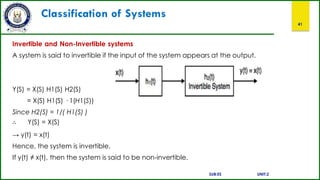
Invertible and Non-Invertible systems
A system is said to invertible if the input of the system appears at the output.
Y(S) = X(S) H1(S) H2(S)
= X(S) H1(S) · 1(H1(S))
Since H2(S) = 1/( H1(S) )
∴ Y(S) = X(S)
→ y(t) = x(t)
Hence, the system is invertible.
If y(t) ≠ x(t), then the system is said to be non-invertible.
SUB:ES UNIT:2
Classification of Systems
42
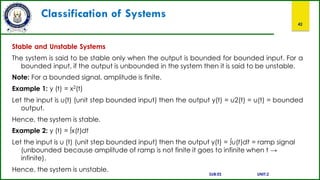
Stable and Unstable Systems
The system is said to be stable only when the output is bounded for bounded input. For a
bounded input, if the output is unbounded in the system then it is said to be unstable.
Note: For a bounded signal, amplitude is finite.
Example 1: y (t) = x2(t)
Let the input is u(t) (unit step bounded input) then the output y(t) = u2(t) = u(t) = bounded
output.
Hence, the system is stable.
Example 2: y (t) = ∫x(t)dt
Let the input is u (t) (unit step bounded input) then the output y(t) = ∫u(t)dt = ramp signal
(unbounded because amplitude of ramp is not finite it goes to infinite when t →
infinite).
Hence, the system is unstable.
SUB:ES UNIT:2
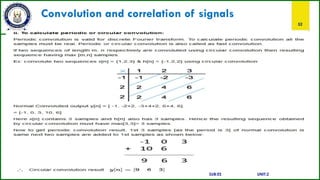
Convolution and correlation of signals
43
SUB:ES UNIT:2
Convolution and correlation of signals
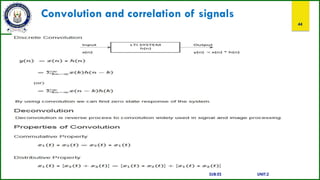
44
SUB:ES UNIT:2
Convolution and correlation of signals
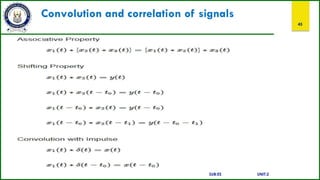
45
SUB:ES UNIT:2
Convolution and correlation of signals
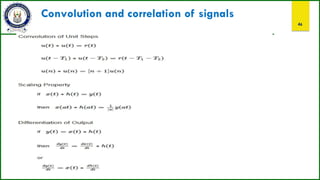
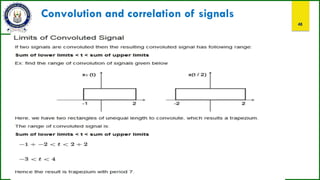
46
Convolution and correlation of signals
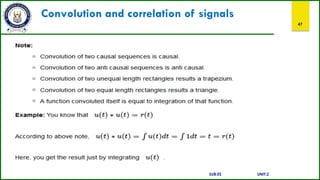
47
SUB:ES UNIT:2
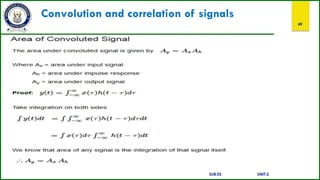
Convolution and correlation of signals
48
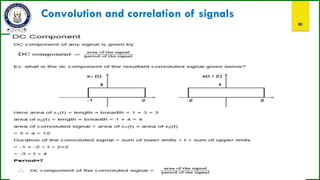
Convolution and correlation of signals
49
SUB:ES UNIT:2
Convolution and correlation of signals
50
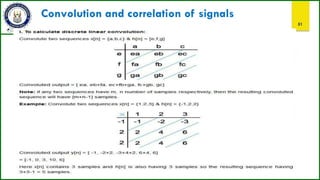
Convolution and correlation of signals
51
Convolution and correlation of signals
52
SUB:ES UNIT:2
Convolution and correlation of signals
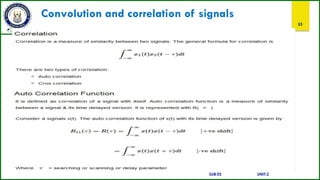
53
SUB:ES UNIT:2
Convolution and correlation of signals
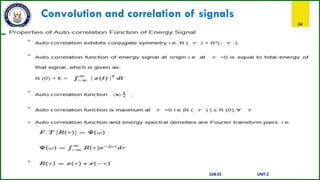
54
SUB:ES UNIT:2
Convolution and correlation of signals
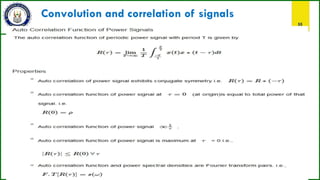
55
Convolution and correlation of signals
56
SUB:ES UNIT:2
Convolution and correlation of signals
57
Convolution and correlation of signals
58
SUB:ES UNIT:2
Convolution and correlation of signals
59
SUB:ES UNIT:2
Analogy between vectors and signals
60
There is a perfect analogy between vectors and signals.
Vector
A vector contains magnitude and direction. The name of the vector is denoted by
bold face type and their magnitude is denoted by light face type.
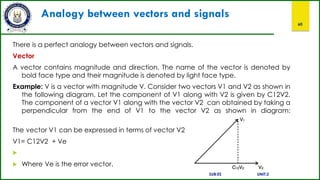
Example: V is a vector with magnitude V. Consider two vectors V1 and V2 as shown in
the following diagram. Let the component of V1 along with V2 is given by C12V2.
The component of a vector V1 along with the vector V2 can obtained by taking a
perpendicular from the end of V1 to the vector V2 as shown in diagram:
The vector V1 can be expressed in terms of vector V2
V1= C12V2 + Ve

 Where Ve is the error vector.
SUB:ES UNIT:2
Analogy between vectors and signals
61
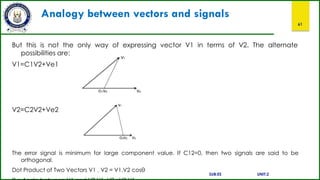
But this is not the only way of expressing vector V1 in terms of V2. The alternate
possibilities are:
V1=C1V2+Ve1
V2=C2V2+Ve2
The error signal is minimum for large component value. If C12=0, then two signals are said to be
orthogonal.
Dot Product of Two Vectors V1 . V2 = V1.V2 cosθ
SUB:ES UNIT:2
Analogy between vectors and signals
62
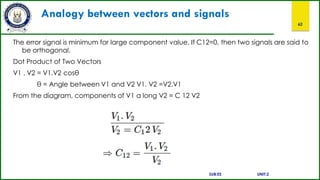
The error signal is minimum for large component value. If C12=0, then two signals are said to
be orthogonal.
Dot Product of Two Vectors
V1 . V2 = V1.V2 cosθ
θ = Angle between V1 and V2 V1. V2 =V2.V1
From the diagram, components of V1 a long V2 = C 12 V2
SUB:ES UNIT:2
Analogy between vectors and signals
63
Signal
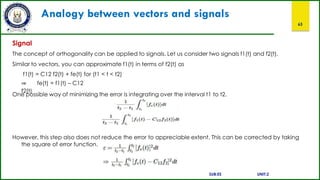
The concept of orthogonality can be applied to signals. Let us consider two signals f1(t) and f2(t).
Similar to vectors, you can approximate f1(t) in terms of f2(t) as
f1(t) = C12 f2(t) + fe(t) for (t1 < t < t2)
⇒ fe(t) = f1(t) – C12
f2(t)
One possible way of minimizing the error is integrating over the interval t1 to t2.
However, this step also does not reduce the error to appreciable extent. This can be corrected by taking
the square of error function.
SUB:ES UNIT:2
Analogy between vectors and signals
64
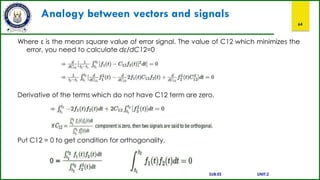
Where ε is the mean square value of error signal. The value of C12 which minimizes the
error, you need to calculate dε/dC12=0
Derivative of the terms which do not have C12 term are zero.
Put C12 = 0 to get condition for orthogonality.
SUB:ES UNIT:2
Analogy between vectors and signals
65
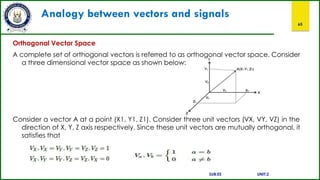
Orthogonal Vector Space
A complete set of orthogonal vectors is referred to as orthogonal vector space. Consider
a three dimensional vector space as shown below:
Consider a vector A at a point (X1, Y1, Z1). Consider three unit vectors (VX, VY, VZ) in the
direction of X, Y, Z axis respectively. Since these unit vectors are mutually orthogonal, it
satisfies that
SUB:ES UNIT:2
Analogy between vectors and signals
66
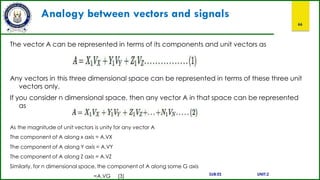
The vector A can be represented in terms of its components and unit vectors as
Any vectors in this three dimensional space can be represented in terms of these three unit
vectors only.
If you consider n dimensional space, then any vector A in that space can be represented
as
As the magnitude of unit vectors is unity for any vector A
The component of A along x axis = A.VX
The component of A along Y axis = A.VY
The component of A along Z axis = A.VZ
Similarly, for n dimensional space, the component of A along some G axis
SUB:ES UNIT:2
=A.VG (3)
Analogy between vectors and signals
67
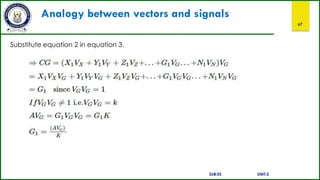
Substitute equation 2 in equation 3.
SUB:ES UNIT:2
Analogy between vectors and signals
68
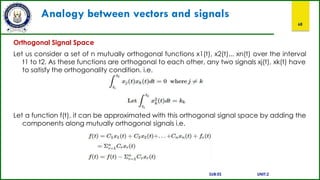
Orthogonal Signal Space
Let us consider a set of n mutually orthogonal functions x1(t), x2(t)... xn(t) over the interval
t1 to t2. As these functions are orthogonal to each other, any two signals xj(t), xk(t) have
to satisfy the orthogonality condition. i.e.
Let a function f(t), it can be approximated with this orthogonal signal space by adding the
components along mutually orthogonal signals i.e.
SUB:ES UNIT:2
Analogy between vectors and signals
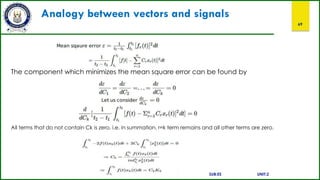
69
The component which minimizes the mean square error can be found by
All terms that do not contain Ck is zero. i.e. in summation, r=k term remains and all other terms are zero.
SUB:ES UNIT:2
Analogy between vectors and signals
70
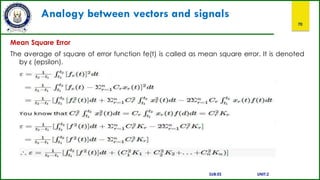
Mean Square Error
The average of square of error function fe(t) is called as mean square error. It is denoted
by ε (epsilon).
SUB:ES UNIT:2
Fourier Series
71
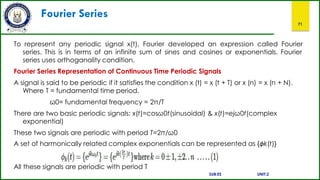
To represent any periodic signal x(t), Fourier developed an expression called Fourier
series. This is in terms of an infinite sum of sines and cosines or exponentials. Fourier
series uses orthoganality condition.
Fourier Series Representation of Continuous Time Periodic Signals
A signal is said to be periodic if it satisfies the condition x (t) = x (t + T) or x (n) = x (n + N).
Where T = fundamental time period,
ω0= fundamental frequency = 2π/T
There are two basic periodic signals: x(t)=cosω0t(sinusoidal) & x(t)=ejω0t(complex
exponential)
These two signals are periodic with period T=2π/ω0
A set of harmonically related complex exponentials can be represented as {ϕk(t)}
All these signals are periodic with period T
SUB:ES UNIT:2
Fourier Series
72
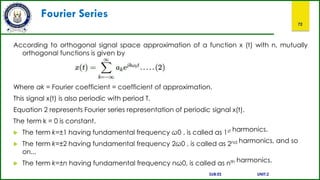
According to orthogonal signal space approximation of a function x (t) with n, mutually
orthogonal functions is given by
Where ak = Fourier coefficient = coefficient of approximation.
This signal x(t) is also periodic with period T.
Equation 2 represents Fourier series representation of periodic signal x(t).
The term k = 0 is constant.
 The term k=±1 having fundamental frequency ω0 , is called as 1st harmonics.
 The term k=±2 having fundamental frequency 2ω0 , is called as 2nd harmonics, and so
on...
 The term k=±n having fundamental frequency nω0, is called as nth harmonics.
SUB:ES UNIT:2
Fourier Series
73
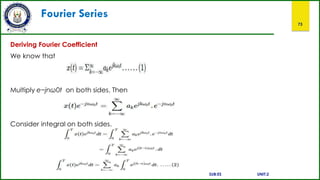
Deriving Fourier Coefficient
We know that
Multiply e−jnω0t on both sides. Then
Consider integral on both sides.
SUB:ES UNIT:2
Fourier Series
74
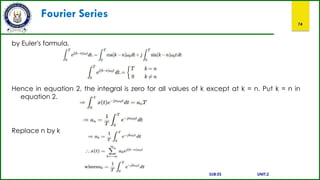
by Euler's formula,
Hence in equation 2, the integral is zero for all values of k except at k = n. Put k = n in
equation 2.
Replace n by k
SUB:ES UNIT:2
Fourier Series Properties
75
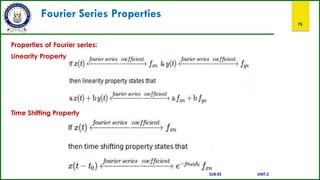
Properties of Fourier series:
Linearity Property
Time Shifting Property
SUB:ES UNIT:2
Fourier Series Properties
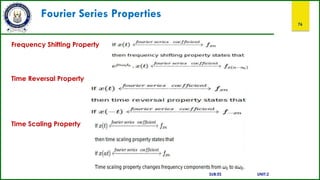
76
Frequency Shifting Property
Time Reversal Property
Time Scaling Property
SUB:ES UNIT:2
Fourier Series Properties
77
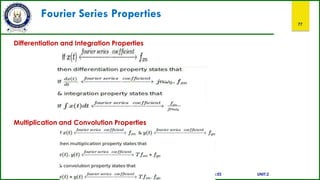
Differentiation and Integration Properties
Multiplication and Convolution Properties
:ES UNIT:2
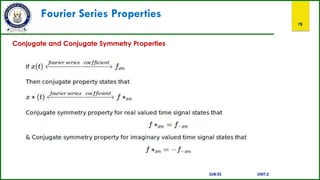
Fourier Series Properties
78
Conjugate and Conjugate Symmetry Properties
SUB:ES UNIT:2
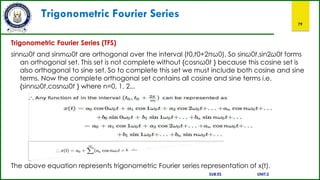
Trigonometric Fourier Series
79
Trigonometric Fourier Series (TFS)
sinnω0t and sinmω0t are orthogonal over the interval (t0,t0+2πω0). So sinω0t,sin2ω0t forms
an orthogonal set. This set is not complete without {cosnω0t } because this cosine set is
also orthogonal to sine set. So to complete this set we must include both cosine and sine
terms. Now the complete orthogonal set contains all cosine and sine terms i.e.
{sinnω0t,cosnω0t } where n=0, 1, 2...
The above equation represents trigonometric Fourier series representation of x(t).
SUB:ES UNIT:2
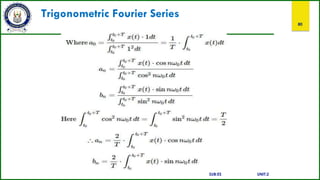
Trigonometric Fourier Series
80
SUB:ES UNIT:2
Exponential Fourier Series
81
Exponential Fourier Series (EFS):
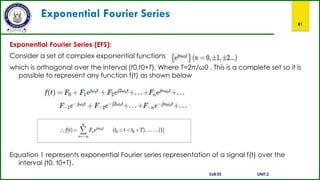
Consider a set of complex exponential functions
which is orthogonal over the interval (t0,t0+T). Where T=2π/ω0 . This is a complete set so it is
possible to represent any function f(t) as shown below
Equation 1 represents exponential Fourier series representation of a signal f(t) over the
interval (t0, t0+T).
SUB:ES UNIT:2
Exponential Fourier Series
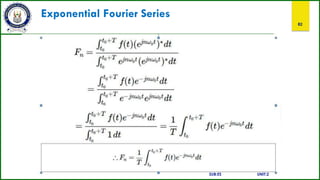
82
SUB:ES UNIT:2
Exponential Fourier Series
83
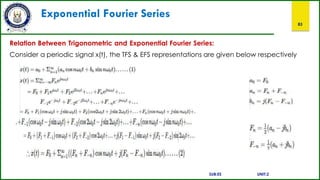
Relation Between Trigonometric and Exponential Fourier Series:
Consider a periodic signal x(t), the TFS & EFS representations are given below respectively
SUB:ES UNIT:2
Continuous Time Fourier Transform
84
INTRODUCTION:
The main drawback of Fourier series is, it is only applicable to periodic signals. There are
some naturally produced signals such as nonperiodic or aperiodic, which we cannot
represent using Fourier series. To overcome this shortcoming, Fourier developed a
mathematical model to transform signals between time (or spatial) domain to
frequency domain & vice versa, which is called 'Fourier transform'.
Fourier transform has many applications in physics and engineering such as analysis of LTI
systems, RADAR, astronomy, signal processing etc.
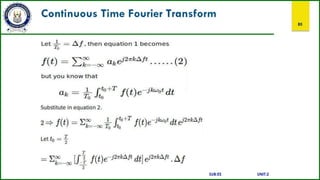
Deriving Fourier transform from Fourier series:
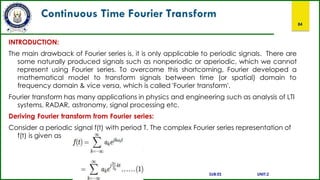
Consider a periodic signal f(t) with period T. The complex Fourier series representation of
f(t) is given as
SUB:ES UNIT:2
Continuous Time Fourier Transform
85
SUB:ES UNIT:2
Continuous Time Fourier Transform
86
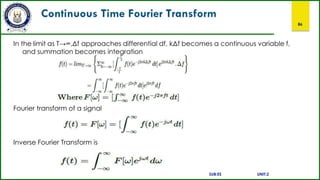
In the limit as T→∞,Δf approaches differential df, kΔf becomes a continuous variable f,
and summation becomes integration
Fourier transform of a signal
Inverse Fourier Transform is
SUB:ES UNIT:2
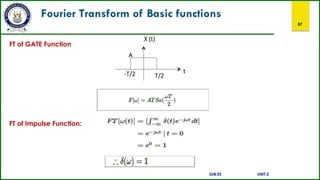
Fourier Transform of Basic functions
87
FT of GATE Function
FT of Impulse Function:
SUB:ES UNIT:2
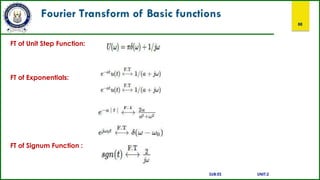
Fourier Transform of Basic functions
88
FT of Unit Step Function:
FT of Exponentials:
FT of Signum Function :
SUB:ES UNIT:2
Continuous Time Fourier Transform
89
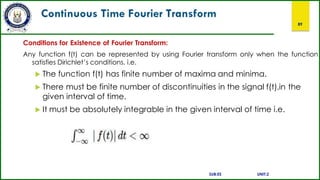
Conditions for Existence of Fourier Transform:
Any function f(t) can be represented by using Fourier transform only when the function
satisfies Dirichlet’s conditions. i.e.
 The function f(t) has finite number of maxima and minima.
 There must be finite number of discontinuities in the signal f(t),in the
given interval of time.
 It must be absolutely integrable in the given interval of time i.e.
SUB:ES UNIT:2
Fourier Transform Properties
90
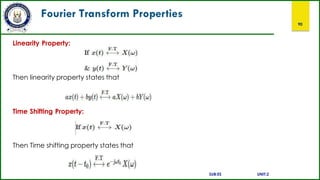
Linearity Property:
Then linearity property states that
Time Shifting Property:
Then Time shifting property states that
SUB:ES UNIT:2
Fourier Transform Properties
91
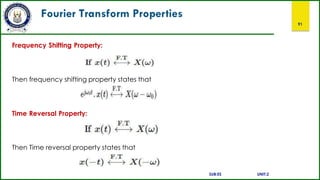
Frequency Shifting Property:
Then frequency shifting property states that
Time Reversal Property:
Then Time reversal property states that
SUB:ES UNIT:2
Fourier Transform Properties
92
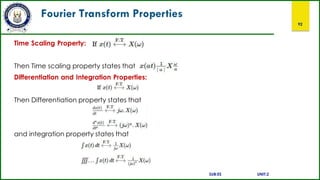
Time Scaling Property:
Then Time scaling property states that
Differentiation and Integration Properties:
Then Differentiation property states that
and integration property states that
SUB:ES UNIT:2
Fourier Transform Properties
93
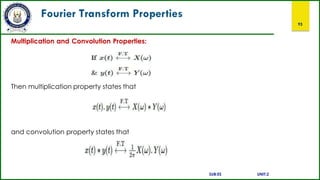
Multiplication and Convolution Properties:
Then multiplication property states that
and convolution property states that
SUB:ES UNIT:2
Sampling theorem of low pass signals
94
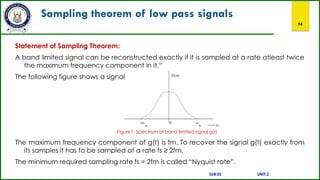
Statement of Sampling Theorem:
A band limited signal can be reconstructed exactly if it is sampled at a rate atleast twice
the maximum frequency component in it.“
The following figure shows a signal
Figure1: Spectrum of band limited signal g(t)
The maximum frequency component of g(t) is fm. To recover the signal g(t) exactly from
its samples it has to be sampled at a rate fs ≥ 2fm.
The minimum required sampling rate fs = 2fm is called “Nyquist rate”.
SUB:ES UNIT:2
Sampling theorem of low pass signals
95
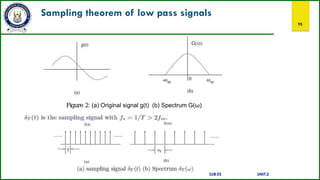
Figure 2: (a) Original signal g(t) (b) Spectrum G(ω)
SUB:ES UNIT:2
Sampling theorem of low pass signals
96
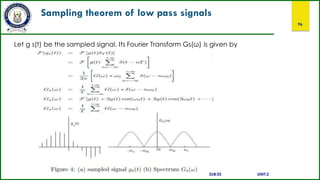
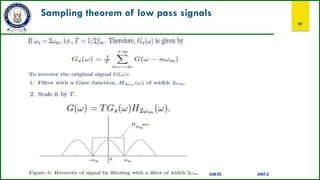
Let g s(t) be the sampled signal. Its Fourier Transform Gs(ω) is given by
SUB:ES UNIT:2
Sampling theorem of low pass signals
97
SUB:ES UNIT:2
Sampling theorem of low pass signals
98
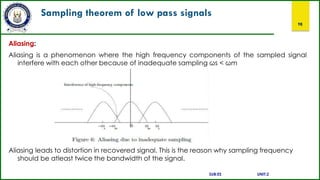
Aliasing:
Aliasing is a phenomenon where the high frequency components of the sampled signal
interfere with each other because of inadequate sampling ωs < ωm
Aliasing leads to distortion in recovered signal. This is the reason why sampling frequency
should be atleast twice the bandwidth of the signal.
SUB:ES UNIT:2
Sampling theorem of low pass signals
99
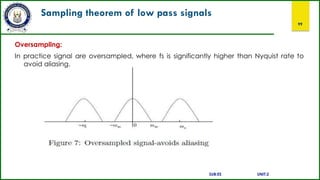
Oversampling:
In practice signal are oversampled, where fs is significantly higher than Nyquist rate to
avoid aliasing.
SUB:ES UNIT:2
Discrete Time Fourier Transform
100
Discrete Time Fourier Transforms (DTFT)
Here we take the exponential signals to be where ‘w’is a real number. The
representation is motivated by the Harmonic analysis, but instead of following the
historical development of the representation we
defining equation.
give directly the
Let {x[n]} be discrete time signal such that
summable.
, that is sequence is absolutely
The sequence {x[n]} can be represented by a Fourier integral of the form,
Where,
SUB:ES UNIT:2
Discrete Time Fourier Transform
101
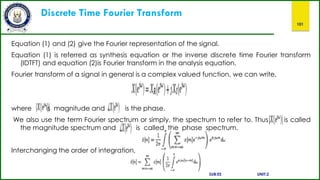
Equation (1) and (2) give the Fourier representation of the signal.
Equation (1) is referred as synthesis equation or the inverse discrete time Fourier transform
(IDTFT) and equation (2)is Fourier transform in the analysis equation.
Fourier transform of a signal in general is a complex valued function, we can write,
where s magnitude and is the phase.
We also use the term Fourier spectrum or simply, the spectrum to refer to. Thus is called
the magnitude spectrum and is called the phase spectrum.
Interchanging the order of integration,
SUB:ES UNIT:2
Discrete Time Fourier Transform
102
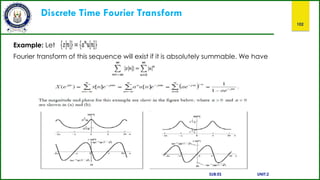
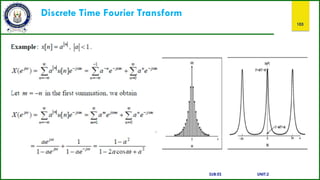
Example: Let
Fourier transform of this sequence will exist if it is absolutely summable. We have
SUB:ES UNIT:2
Discrete Time Fourier Transform
103
SUB:ES UNIT:2
Discrete Time Fourier Transform
104
SUB:ES UNIT:2
Discrete Time Fourier Transform
105
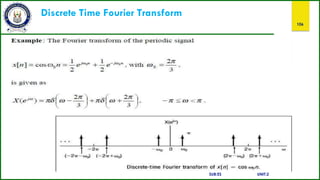
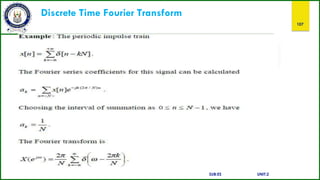
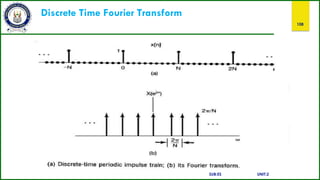
Fourier transform of Periodic Signals
For a periodic discrete-time signal,
its Fourier transform of this signal is periodic in w with period 2∏ , and is given
Now consider a periodic sequence x[n] with period N and with the Fourier series
representation
The Fourier transform is,
SUB:ES UNIT:2
Discrete Time Fourier Transform
106
SUB:ES UNIT:2
Discrete Time Fourier Transform
107
SUB:ES UNIT:2
Discrete Time Fourier Transform
108
SUB:ES UNIT:2
Discrete Time Fourier Transform
109
Properties of the Discrete Time Fourier Transform:
Let {x[n]}and {y[n]} be two signal, then their DTFT is denoted by and. The notation
is used to say that left hand side is the signal x[n] whose DTFT is given at right hand side.
1.Periodicity of the DTFT:
SUB:ES UNIT:2
Discrete Time Fourier Transform
110
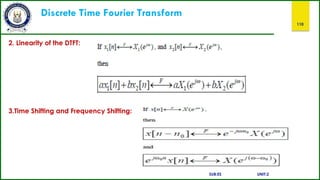
2. Linearity of the DTFT:
3.Time Shifting and Frequency Shifting:
SUB:ES UNIT:2
Discrete Time Fourier Transform
111
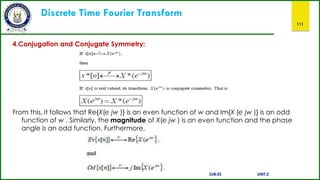
4.Conjugation and Conjugate Symmetry:
From this, it follows that Re{X(e jw )} is an even function of w and Im{X (e jw )} is an odd
function of w . Similarly, the magnitude of X(e jw ) is an even function and the phase
angle is an odd function. Furthermore,
SUB:ES UNIT:2
Discrete Time Fourier Transform
112
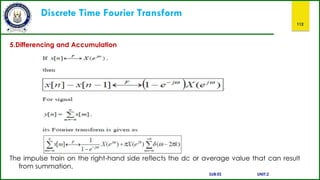
5.Differencing and Accumulation
The impulse train on the right-hand side reflects the dc or average value that can result
from summation.
SUB:ES UNIT:2
Discrete Time Fourier Transform
113
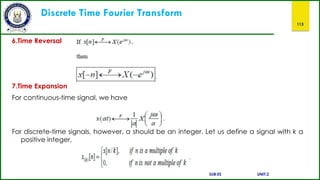
6.Time Reversal
7.Time Expansion
For continuous-time signal, we have
For discrete-time signals, however, a should be an integer. Let us define a signal with k a
positive integer,
SUB:ES UNIT:2
Discrete Time Fourier Transform
114
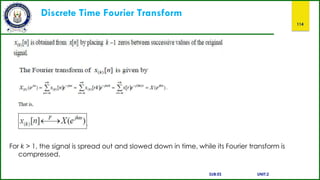
For k > 1, the signal is spread out and slowed down in time, while its Fourier transform is
compressed.
SUB:ES UNIT:2
Discrete Time Fourier Transform
115
8.Differentiation in Frequency
The right-hand side of the above equation is the Fourier transform of - jnx[n] . Therefore,
multiplying both sides by j , we see that
9.Parseval’s Relation
SUB:ES UNIT:2
SIGNAL TRANSMISSION THROUGH LINEAR SYSTEMS
116
Linear Systems:
A system is said to be linear when it satisfies superposition and homogenate principles. Consider two
systems with inputs as x1(t), x2(t), and outputs as y1(t), y2(t) respectively. Then, according to the
superposition and homogenate principles,
T [a1 x1(t) + a2 x2(t)] = a1 T[x1(t)] + a2 T[x2(t)]
∴ T [a1 x1(t) + a2 x2(t)] = a1 y1(t) + a2
y2(t)
From the above expression, is clear that response of overall system is equal to response of individual
system.
Example: y(t) = 2x(t)
Solution:
y1 (t) = T[x1(t)] = 2x1(t)
y2 (t) = T[x2(t)] = 2x2(t)
T [a1 x1(t) + a2 x2(t)] = 2[ a1 x1(t) + a2 x2(t)]
Which is equal to a1y1(t) + a2 y2(t). Hence the system is said to be UNIT:2
SIGNAL TRANSMISSION THROUGH LINEAR SYSTEMS
117
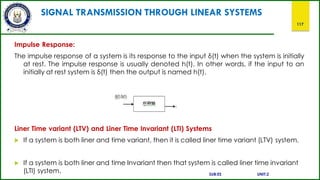
Impulse Response:
The impulse response of a system is its response to the input δ(t) when the system is initially
at rest. The impulse response is usually denoted h(t). In other words, if the input to an
initially at rest system is δ(t) then the output is named h(t).
Liner Time variant (LTV) and Liner Time Invariant (LTI) Systems
 If a system is both liner and time variant, then it is called liner time variant (LTV) system.
 If a system is both liner and time Invariant then that system is called liner time invariant
(LTI) system. SUB:ES UNIT:2
SIGNAL TRANSMISSION THROUGH LINEAR SYSTEMS
118
Response of a continuous-time LTI system and the convolution integral
Impulse Response:
The impulse response h(t) of a continuous-time LTI system (represented by T) is defined to
be the response of the system when the input is δ(t), that is,
h(t)= T{ δ(t)} (1)
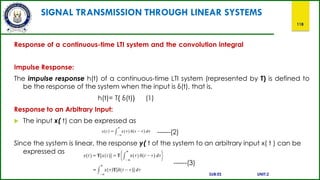
Response to an Arbitrary Input:
 The input x( t) can be expressed as
------(2)
Since the system is linear, the response y( t of the system to an arbitrary input x( t ) can be
expressed as
------(3)
SUB:ES UNIT:2
SIGNAL TRANSMISSION THROUGH LINEAR SYSTEMS
119
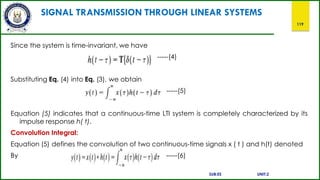
Since the system is time-invariant, we have
-----(4)
Substituting Eq. (4) into Eq. (3), we obtain
-----(5)
Equation (5) indicates that a continuous-time LTI system is completely characterized by its
impulse response h( t).
Convolution Integral:
Equation (5) defines the convolution of two continuous-time signals x ( t ) and h(t) denoted
By -----(6)
SUB:ES UNIT:2
SIGNAL TRANSMISSION THROUGH LINEAR SYSTEMS
120
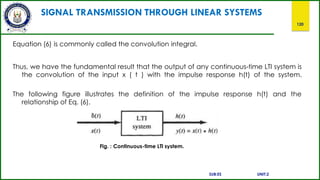
Equation (6) is commonly called the convolution integral.
Thus, we have the fundamental result that the output of any continuous-time LTI system is
the convolution of the input x ( t ) with the impulse response h(t) of the system.
The following figure illustrates the definition of the impulse response h(t) and the
relationship of Eq. (6).
Fig. : Continuous-time LTl system.
SUB:ES UNIT:2
SIGNAL TRANSMISSION THROUGH LINEAR SYSTEMS
121
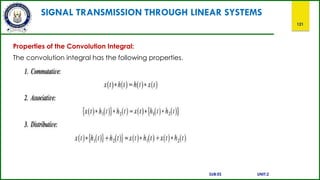
Properties of the Convolution Integral:
The convolution integral has the following properties.
SUB:ES UNIT:2
SIGNAL TRANSMISSION THROUGH LINEAR SYSTEMS
122
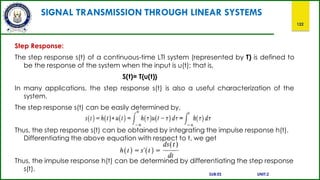
Step Response:
The step response s(t) of a continuous-time LTI system (represented by T) is defined to
be the response of the system when the input is u(t); that is,
S(t)= T{u(t)}
In many applications, the step response s(t) is also a useful characterization of the
system.
The step response s(t) can be easily determined by,
Thus, the step response s(t) can be obtained by integrating the impulse response h(t).
Differentiating the above equation with respect to t, we get
Thus, the impulse response h(t) can be determined by differentiating the step response
s(t).
SUB:ES UNIT:2
SIGNAL TRANSMISSION THROUGH LINEAR SYSTEMS
123
Distortion less transmission through a system:
Transmission is said to be distortion-less if the input and output have identical wave
shapes. i.e., in distortion-less transmission, the input x(t) and output y(t) satisfy the
condition:
y (t) = Kx(t - td)
Where td = delay time and
k = constant.
Take Fourier transform on both sides
FT[ y (t)] = FT[Kx(t - td)]
= K FT[x(t - td)]
SUB:ES UNIT:2
SIGNAL TRANSMISSION THROUGH LINEAR SYSTEMS
124
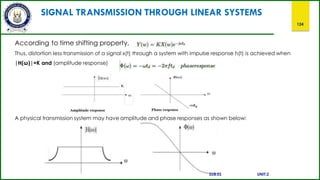
According to time shifting property,
Thus, distortion less transmission of a signal x(t) through a system with impulse response h(t) is achieved when
|H(ω)|=K and (amplitude response)
A physical transmission system may have amplitude and phase responses as shown below:
SUB:ES UNIT:2
SIGNAL TRANSMISSION THROUGH LINEAR SYSTEMS
125
SUB:ES UNIT:2
SIGNAL TRANSMISSION THROUGH LINEAR SYSTEMS
126
SUB:ES UNIT:2
SIGNAL TRANSMISSION THROUGH LINEAR SYSTEMS
127
FILTERING
One of the most basic operations in any signal processing system is filtering.
Filtering is the process by which the relative amplitudes of the frequency components in
a signal are changed or perhaps some frequency components are suppressed.
For continuous-time LTI systems, the spectrum of the output is that of the input multiplied
by the frequency response of the system.
Therefore, an LTI system acts as a filter on the input signal. Here the word "filter" is used to
denote a system that exhibits some sort of frequency-selective behavior.
Ideal Frequency-Selective Filters:
An ideal frequency-selective filter is one that exactly passes signals at one set of
frequencies and completely rejects the rest.
The band of frequencies passed by the filter is referred to as the pass band, and the
band of frequencies rejected by the filter is called the stop band.
SUB:ES UNIT:2
SIGNAL TRANSMISSION THROUGH LINEAR SYSTEMS
128
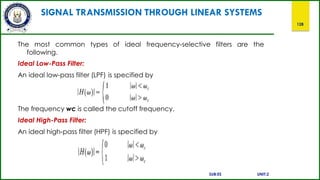
The most common types of ideal frequency-selective filters are the
following.
Ideal Low-Pass Filter:
An ideal low-pass filter (LPF) is specified by
The frequency wc is called the cutoff frequency.
Ideal High-Pass Filter:
An ideal high-pass filter (HPF) is specified by
SUB:ES UNIT:2
SIGNAL TRANSMISSION THROUGH LINEAR SYSTEMS
129
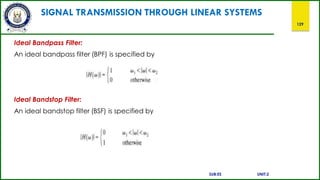
Ideal Bandpass Filter:
An ideal bandpass filter (BPF) is specified by
Ideal Bandstop Filter:
An ideal bandstop filter (BSF) is specified by
SUB:ES UNIT:2
SIGNAL TRANSMISSION THROUGH LINEAR SYSTEMS
130
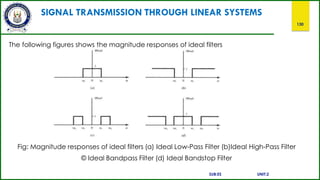
The following figures shows the magnitude responses of ideal filters
Fig: Magnitude responses of ideal filters (a) Ideal Low-Pass Filter (b)Ideal High-Pass Filter
© Ideal Bandpass Filter (d) Ideal Bandstop Filter
SUB:ES UNIT:2
SIGNAL TRANSMISSION THROUGH LINEAR SYSTEMS
131
SUB:ES UNIT:2
SIGNAL TRANSMISSION THROUGH LINEAR SYSTEMS
132
SUB:ES UNIT:2
SIGNAL TRANSMISSION THROUGH LINEAR SYSTEMS
133
SUB:ES UNIT:2
SIGNAL TRANSMISSION THROUGH LINEAR SYSTEMS
134
SUB:ES UNIT:2
SIGNAL TRANSMISSION THROUGH LINEAR SYSTEMS
135
SUB:ES UNIT:2
LAPLACE TRANSFORM
136
THE LAPLACE TRANSFORM
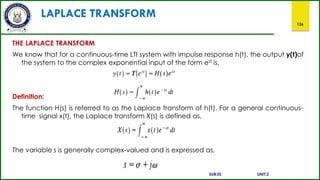
We know that for a continuous-time LTI system with impulse response h(t), the output y(t)of
the system to the complex exponential input of the form est is,
Definition:
The function H(s) is referred to as the Laplace transform of h(t). For a general continuous-
time signal x(t), the Laplace transform X(s) is defined as,
The variable s is generally complex-valued and is expressed as,
SUB:ES UNIT:2
LAPLACE TRANSFORM
137
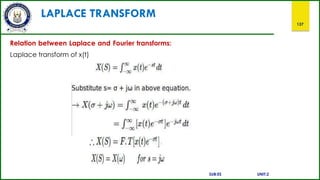
Relation between Laplace and Fourier transforms:
Laplace transform of x(t)
SUB:ES UNIT:2
LAPLACE TRANSFORM
138
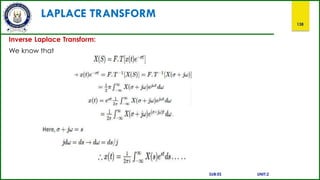
Inverse Laplace Transform:
We know that
SUB:ES UNIT:2
LAPLACE TRANSFORM
139
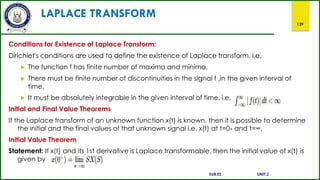
Conditions for Existence of Laplace Transform:
Dirichlet's conditions are used to define the existence of Laplace transform. i.e.
 The function f has finite number of maxima and minima.
 There must be finite number of discontinuities in the signal f ,in the given interval of
time.
 It must be absolutely integrable in the given interval of time. i.e.
Initial and Final Value Theorems
If the Laplace transform of an unknown function x(t) is known, then it is possible to determine
the initial and the final values of that unknown signal i.e. x(t) at t=0+ and t=∞.
Initial Value Theorem
Statement: If x(t) and its 1st derivative is Laplace transformable, then the initial value of x(t) is
given by
SUB:ES UNIT:2
LAPLACE TRANSFORM
140
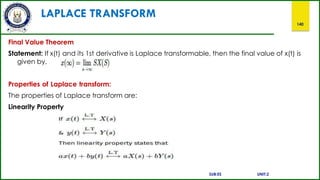
Final Value Theorem
Statement: If x(t) and its 1st derivative is Laplace transformable, then the final value of x(t) is
given by,
Properties of Laplace transform:
The properties of Laplace transform are:
Linearity Property
SUB:ES UNIT:2
LAPLACE TRANSFORM
141
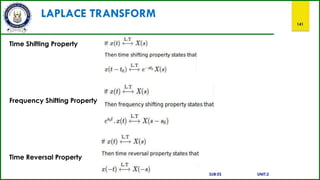
Time Shifting Property
Frequency Shifting Property
Time Reversal Property
SUB:ES UNIT:2
LAPLACE TRANSFORM
142
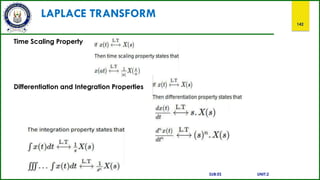
Time Scaling Property
Differentiation and Integration Properties
SUB:ES UNIT:2
LAPLACE TRANSFORM
143
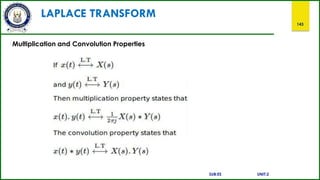
Multiplication and Convolution Properties
SUB:ES UNIT:2
LAPLACE TRANSFORM
144
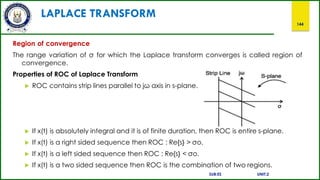
Region of convergence
The range variation of σ for which the Laplace transform converges is called region of
convergence.
Properties of ROC of Laplace Transform
 ROC contains strip lines parallel to jω axis in s-plane.
 If x(t) is absolutely integral and it is of finite duration, then ROC is entire s-plane.
 If x(t) is a right sided sequence then ROC : Re{s} > σo.
 If x(t) is a left sided sequence then ROC : Re{s} < σo.
 If x(t) is a two sided sequence then ROC is the combination of two regions.
SUB:ES UNIT:2
LAPLACE TRANSFORM
145
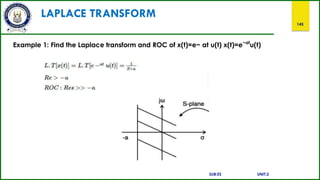
Example 1: Find the Laplace transform and ROC of x(t)=e− at u(t) x(t)=e−at
u(t)
SUB:ES UNIT:2
LAPLACE TRANSFORM
146
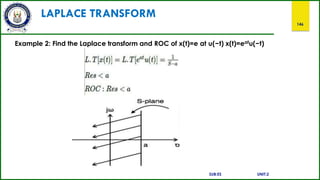
Example 2: Find the Laplace transform and ROC of x(t)=e at u(−t) x(t)=eatu(−t)
SUB:ES UNIT:2
LAPLACE TRANSFORM
147
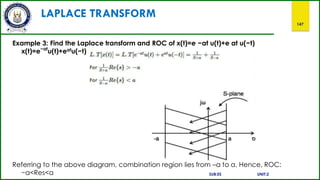
Example 3: Find the Laplace transform and ROC of x(t)=e −at u(t)+e at u(−t)
x(t)=e−at
u(t)+eatu(−t)
Referring to the above diagram, combination region lies from –a to a. Hence, ROC:
−a<Res<a SUB:ES UNIT:2
LAPLACE TRANSFORM
148
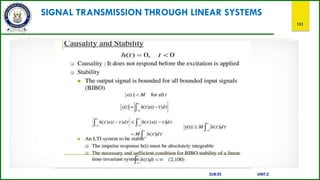
Causality and Stability
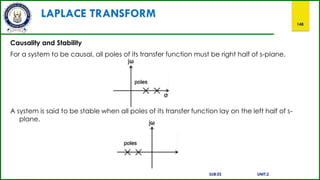
For a system to be causal, all poles of its transfer function must be right half of s-plane.
A system is said to be stable when all poles of its transfer function lay on the left half of s-
plane.
SUB:ES UNIT:2
LAPLACE TRANSFORM
149
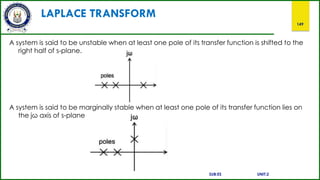
A system is said to be unstable when at least one pole of its transfer function is shifted to the
right half of s-plane.
A system is said to be marginally stable when at least one pole of its transfer function lies on
the jω axis of s-plane
SUB:ES UNIT:2
LAPLACE TRANSFORM
150
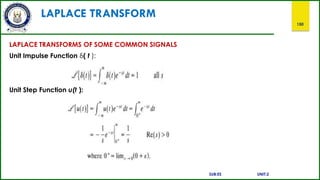
LAPLACE TRANSFORMS OF SOME COMMON SIGNALS
Unit Impulse Function δ( t ):
Unit Step Function u(t ):
SUB:ES UNIT:2
LAPLACE TRANSFORM
151
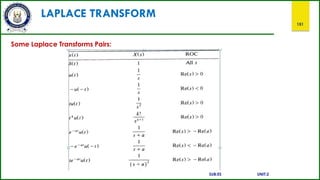
Some Laplace Transforms Pairs:
SUB:ES UNIT:2
Z-TRANSFORM
152
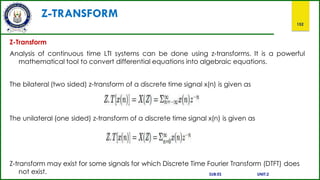
Z-Transform
Analysis of continuous time LTI systems can be done using z-transforms. It is a powerful
mathematical tool to convert differential equations into algebraic equations.
The bilateral (two sided) z-transform of a discrete time signal x(n) is given as
The unilateral (one sided) z-transform of a discrete time signal x(n) is given as
Z-transform may exist for some signals for which Discrete Time Fourier Transform (DTFT) does
not exist. SUB:ES UNIT:2
Z-TRANSFORM
153
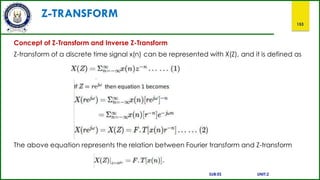
Concept of Z-Transform and Inverse Z-Transform
Z-transform of a discrete time signal x(n) can be represented with X(Z), and it is defined as
The above equation represents the relation between Fourier transform and Z-transform
SUB:ES UNIT:2
Z-TRANSFORM
154
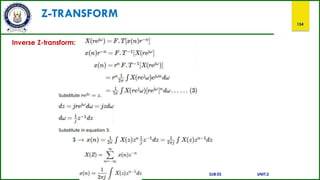
Inverse Z-transform:
SUB:ES UNIT:2
Z-TRANSFORM
155
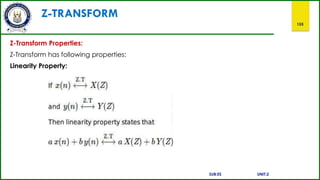
Z-Transform Properties:
Z-Transform has following properties:
Linearity Property:
SUB:ES UNIT:2
Z-TRANSFORM
156
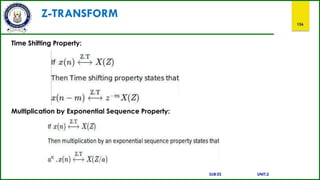
Time Shifting Property:
Multiplication by Exponential Sequence Property:
SUB:ES UNIT:2
Z-TRANSFORM
157
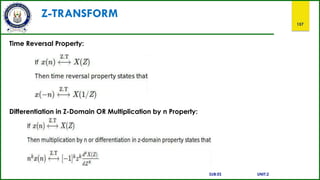
Time Reversal Property:
Differentiation in Z-Domain OR Multiplication by n Property:
SUB:ES UNIT:2
Z-TRANSFORM
158
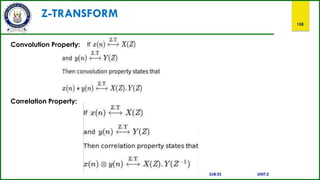
Convolution Property:
Correlation Property:
SUB:ES UNIT:2
Z-TRANSFORM
159
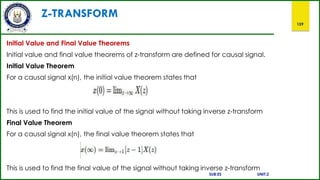
Initial Value and Final Value Theorems
Initial value and final value theorems of z-transform are defined for causal signal.
Initial Value Theorem
For a causal signal x(n), the initial value theorem states that
This is used to find the initial value of the signal without taking inverse z-transform
Final Value Theorem
For a causal signal x(n), the final value theorem states that
This is used to find the final value of the signal without taking inverse z-transform
SUB:ES UNIT:2
Z-TRANSFORM
160
Region of Convergence (ROC) of Z-Transform
The range of variation of z for which z-transform converges is called region of convergence
of z- transform.
Properties of ROC of Z-Transforms
 ROC of z-transform is indicated with circle in z-plane.
 ROC does not contain any poles.
 If x(n) is a finite duration causal sequence or right sided sequence, then the ROC is entire z-plane except at z
= 0.
 If x(n) is a finite duration anti-causal sequence or left sided sequence, then the ROC is entire z-plane except
at z = ∞.
 If x(n) is a infinite duration causal sequence, ROC is exterior of the circle with radius a.
i.e. |z| > a.
 If x(n) is a infinite duration anti-causal sequence, ROC is interior of the circle with radius
a. i.e. |z| < a.
SUB:ES UNIT:2
 f x(n) is a finite duration two sided sequence, then the ROC is entire z-plane except at z = 0 & z = ∞.
Z-TRANSFORM
161
Example 1: Find z-transform and ROC of a n u[n]+a − n
u[−n−1] anu[n]+a−n
u[−n−1]
The plot of ROC has two conditions as a > 1 and a < 1, as we do not know a.
In this case, there is no combination ROC.
SUB:ES UNIT:2
Z-TRANSFORM
162
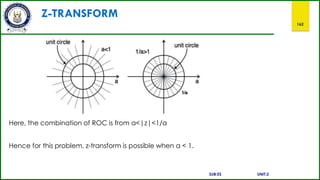
Here, the combination of ROC is from a<|z|<1/a
Hence for this problem, z-transform is possible when a < 1.
SUB:ES UNIT:2
Z-TRANSFORM
163
Causality and Stability
Causality condition for discrete time LTI systems is as follows:
A discrete time LTI system is causal when,
 ROC is outside the outermost pole.
 In The transfer function H[Z], the order of numerator cannot be grater than the order of
denominator.
Stability Condition for Discrete Time LTI Systems:
A discrete time LTI system is stable when
 its system function H[Z] include unit circle |z|=1.
 all poles of the transfer function lay inside the unit circle |z|=1.
SUB:ES UNIT:2
Z-TRANSFORM
164
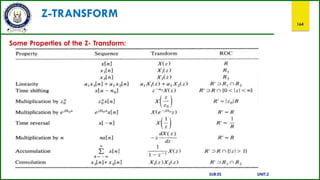
Some Properties of the Z- Transform:
SUB:ES UNIT:2
Z-TRANSFORM
165
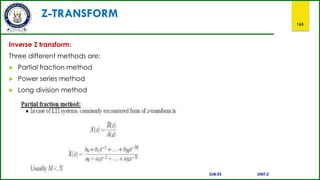
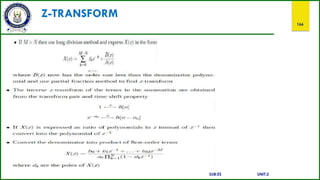
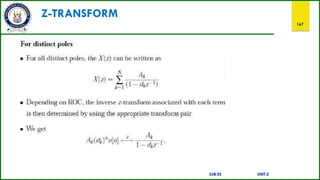
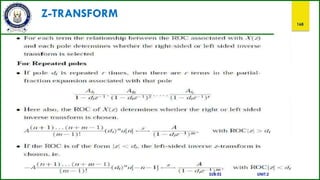
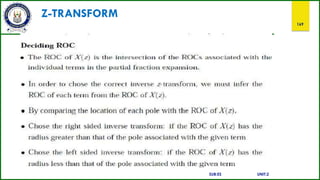
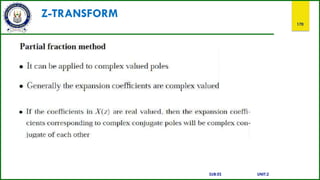
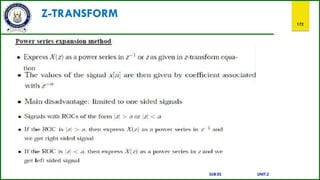
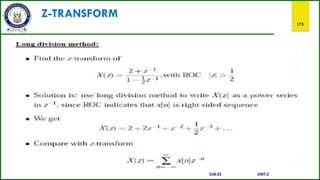
Inverse Z transform:
Three different methods are:
 Partial fraction method
 Power series method
 Long division method
SUB:ES UNIT:2
Z-TRANSFORM
166
SUB:ES UNIT:2
Z-TRANSFORM
167
SUB:ES UNIT:2
Z-TRANSFORM
168
SUB:ES UNIT:2
Z-TRANSFORM
169
SUB:ES UNIT:2
Z-TRANSFORM
170
SUB:ES UNIT:2
Z-TRANSFORM
171
SUB:ES UNIT:2
Z-TRANSFORM
172
SUB:ES UNIT:2
Z-TRANSFORM
173
SUB:ES UNIT:2
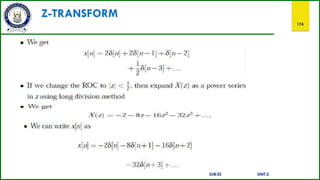
Z-TRANSFORM
174
SUB:ES UNIT:2
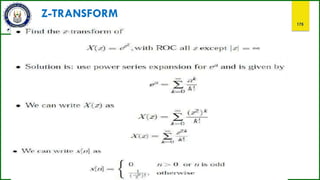
Z-TRANSFORM
175
Z-TRANSFORM
176
Example: A finite sequence x [ n ] is defined as
Find X(z) and its ROC.
Sol: We know that
For z not equal to zero or infinity, each term in X(z) will be finite and consequently X(z) will
converge. Note that X ( z ) includes both positive powers of z and negative powers of z.
Thus, from the result we conclude that the ROC of X ( z ) is 0 < lzl < m.
SUB:ES UNIT:2
Z-TRANSFORM
177
Example: Consider the sequence
Find X ( z ) and plot the poles and zeros of X(z).
Sol:
From the above equation we see that there is a pole of ( N - 1)th order at z = 0 and a pole at
z = a . Since x[n] is a finite sequence and is zero for n < 0, the ROC is IzI > 0. The N roots of
the numerator polynomial are at
SUB:ES UNIT:2
Z-TRANSFORM
178
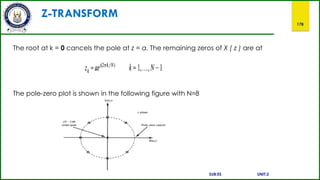
The root at k = 0 cancels the pole at z = a. The remaining zeros of X ( z ) are at
The pole-zero plot is shown in the following figure with N=8
SUB:ES UNIT:2

s and s ppt.pptx

  • 1.
    19A04301 SIGNALS ANDSYSTEMS 1  PREPARED BY S.Raghavendra swami Assistant Professor, Department of ECE.
  • 2.
    COURSE OUTCOMES 2  C213.1Explain various types of signals & systems and represent using Fourier series  C213.2 Analyze continuous time signals using Fourier transform  C213.3 Examine signal transmission through liner systems  C213.4 Analyze discrete time signals using discrete time Fourier transform  C213.5 Apply Laplace and z transform to analyze continuous & discrete time systems SUB:ES UNIT:2
  • 3.
    Signals and systems3 Syllabus: UnitI: Introduction&FourierSeries Introduction: Basic definitions and Classificationof Signals and Systems (Continuous Time and DiscreteTime), Operations onSignals, Concepts of Convolution andCorrelation of Signals, Analogy betweenVectors andSignals - Orthogonality, MeanSquareError. Fourierseries: Trigonometric &Exponential, Properties of Fourier series, Conceptof discretespectrum, Illustrative Problems. UnitII: ContinuousTimeFourierTransform( CTFT orFT) Definition, Computation and Properties of Fourier Transform for different types of Signals and Systems, Inverse Fourier transform, Statement and Proof of Sampling Theoremof LowPassSignals, Illustrative Problems. UnitIII: DiscreteTimeFourierTransform(DTFT) Definition, Computation andproperties of DiscreteTime, Fourier transformfordifferent types of Signals andSystems, Illustrative Problems.
  • 4.
    Signals and systems4 UnitIV: Signal TransmissionThroughLinearSystems Linear System, ImpulseResponse, Response of a Linear System for different input Signals, Linear Time-Invariant (LTI) System, Linear Time Variant (LTV) System, Transfer function of a LTI system. Filter characteristics of Linear Systems. Distortion less transmission through a System, Signal Bandwidth, System Bandwidth, Ideal LPF, HPF and BPF Characteristics, Causality and Paley-Wiener Criterion for Physical Realization, Relationship between Bandwidth and Rise time, Energy and Power Spectral Densities, Illustrative Problems. UnitV: LaplaceTransform&Z–Transform LaplaceTransform: Definition, ROC, Properties, InverseLaplacetransforms, theS-planeand BIBO Stability, Transfer Functions, SystemResponsetoStandard Signals, Solution of Differential Equations with Initial conditions. Z–Transform: Definition, ROC, Properties, Poles and Zeros in Z-plane, The inverse Z-Transform, System Analysis, Transfer Function, BIBO Stability, System Response to Standard Signals, Solution of Difference Equations with initial conditions, Illustrative Problems. SUB:ES UNIT:2
  • 5.
    Signals and systems5 Text Books: 1. A.V. Oppenheim, A.S. Willsky and S.H. Nawab, “Signals and Systems”, 2nd Edition, PHI, 2009. 2. Simon Haykin and Van Veen, “Signals & Systems”, 2nd Edition, Wiley, 2005. References: 1. BP Lathi, “Principles of Linear Systems and Signals”, 2nd Edition, Oxford University Press, 015. 2. Matthew Sadiku and Warsame H. Ali, “Signals and Systems A primer with MATLAB”, CRC Press, 2016. 3. Hwei Hsu, “Schaum's Outline of Signals and Systems”, 4th Edition, TMH, 2019. SUB:ES UNIT:2
  • 6.
    Signals and systemsoverview 6 What is Signal? It is representation of physical quantity (Sound, temperature, intensity, Pressure, etc..,) which varies with respect to time or space or independent or dependent variable. or It is single valued function which carries information by means of Amplitude, Frequency and Phase. Example: voice signal, video signal, signals on telephone wires etc. SUB:ES UNIT:2
  • 7.
    Signals and systemsoverview 7 Signal with different Phases, Amplitudes and Frequencies SUB:ES UNIT:2
  • 8.
    Classification of Signals 8 Typesof Signals with respect to no. of variables or dimensions  One Dimensional or 1-D Signal: If the signal is function of only one variable or If Signal value varies with respect to only one variable then it is called “One Dimensional or 1-D Signal” Examples: Audio Signal, Biomedical Signals, temperature Signal etc.., in which signal is function “time” SUB:ES UNIT:2
  • 9.
    Classification of Signals 9 Two Dimensional or 2-D Signal: If the signal is function of two variable or If Signal value varies with respect to two variable then it is called “Two Dimensional or 2-D Signal” Examples: Image Signal in which intensity is function of two spatial co-ordinates “X” & “Y” i,.e I (X,Y)  Three Dimensional or 3-D Signal: If the signal is function of three variable or If Signal value varies with respect to three variable then it is called “Three Dimensional or 3-D Signal” Examples: Video Signal in which intensity is function of two spatial co-ordinates “X” & “Y” and also time “t” i.e v(x,y,t) SUB:ES UNIT:2
  • 10.
    Classification of Signals 10 Typesof Signal with respect to nature of the signal Continuous Time Signal (CTS) or Analog Signal : If the signal values continuously varies with respect to time then it is called “Continuous Time Signal (CTS) or Analog Signal “. It contains infinite set of values and it is represented as shown below. Digital Signal: If the signal contains only two values then it is called “Digital Signal”. Discrete Time Signal (DTS): If signal contain discrete set of values with respect to time then it is called “Discrete Time Signal (DTS)”. It contains finite set of values. Sampling process converts Continuous time signal in to Discrete time signal. SUB:ES UNIT:2
  • 11.
    Representation of DiscreteTime Signal (DTS) 11 SUB:ES UNIT:2
  • 12.
    Basic Types ofSignals 12  Unit Step Function Unit step function is denoted by u(t). It is defined as u(t) = 1 when t ≥ 0 and 0 when t < 0  It is used as best test signal.  Area under unit step function is unity. SUB:ES UNIT:2
  • 13.
    Basic Types ofSignals 13 Unit Impulse Function Impulse function is denoted by δ(t). and it is defined as δ(t) ={ 0; ∞; 푡 ≠ 0 푡 = 0 } SUB:ES UNIT:2
  • 14.
    Basic Types ofSignals 14  Ramp Signal Ramp signal is denoted by r(t), and it is defined as r(t) = Area under unit ramp is unity. SUB:ES UNIT:2
  • 15.
    Basic Types ofSignals 15  Parabolic Signal Parabolic signal can be defined as x(t) = SUB:ES UNIT:2
  • 16.
    Basic Types ofSignals 16  Signum Function Signum function is denoted as sgn(t). It is defined as sgn(t) = SUB:ES UNIT:2
  • 17.
    Basic Types ofSignals 17  Exponential Signal Exponential signal is in the form of x(t) = eαt The shape of exponential can be defined by α. Case i: if α = 0 → x(t) = e0= 1 Case ii: if α< 0 i.e. -ve then x(t) = e−αt, The shape is called decaying exponential. Case iii: if α> 0 i.e. +ve then x(t) = eαt, The shape is called raising exponential. SUB:ES UNIT:2
  • 18.
    Basic Types ofSignals 18 Rectangular Signal Let it be denoted as x(t) and it is defined as SUB:ES UNIT:2
  • 19.
    Basic Types ofSignals 19 Triangular Signal Let it be denoted as x(t), Sinusoidal Signal Sinusoidal signal is in the form of x(t) = A cos(w0±ϕ) or A sin(w0±ϕ) Where T0 = 2π/w0 SUB:ES UNIT:2
  • 20.
    Classification of Signals 20 Signalsare classified into the following categories:  Continuous Time and Discrete Time Signals  Deterministic and Non-deterministic Signals  Even and Odd Signals  Periodic and Aperiodic Signals  Energy and Power Signals  Real and Imaginary Signals SUB:ES UNIT:2
  • 21.
    Classification of Signals 21 Continuous Time and Discrete Time Signals A signal is said to be continuous when it is defined for all instants of time. A signal is said to be discrete when it is defined at only discrete instants of time. SUB:ES UNIT:2
  • 22.
    Classification of Signals 22 Deterministicand Non-deterministic Signals A signal is said to be deterministic if there is no uncertainty with respect to its value at any instant of time. Or, signals which can be defined exactly by a mathematical formula are known as deterministic signals. A signal is said to be non-deterministic if there is uncertainty with respect to its value at some instant of time. Non-deterministic signals are random in nature hence they are called random signals. Random signals cannot be described by a mathematical equation. They are modelled in probabilistic terms. SUB:ES UNIT:2
  • 23.
    Classification of Signals 23 Evenand Odd signals A signal is said to be even when it satisfies the condition x(t) = x(-t) Example 1: t2, t4… cost etc. Let x(t) = t2 x(-t) = (-t)2 = t2 = x(t) ∴ t 2 is even function Example 2: As shown in the following diagram, rectangle function x(t) = x(-t) so it is also even function. A signal is said to be odd when it satisfies the condition x(t) = -x(-t) SUB:ES UNIT:2
  • 24.
    Classification of Signals 24 Periodicand Aperiodic Signals A signal is said to be periodic if it satisfies the condition x(t) = x(t + T) or x(n) = x(n + N). Where, T = fundamental time period, 1/T = f = fundamental frequency. The above signal will repeat for every time interval T0 hence it is periodic with period T0. SUB:ES UNIT:2
  • 25.
    Classification of Signals 25 Energyand Power Signals A signal is said to be energy signal when it has finite energy. A signal is said to be power signal when it has finite power. NOTE:A signal cannot be both, energy and power simultaneously. Also, a signal may be neither energy nor power signal. Power of energy signal = 0 and Energy of power signal = ∞ SUB:ES UNIT:2
  • 26.
    Classification of Signals 26 Realand Imaginary Signals A signal is said to be real when it satisfies the condition x(t) = x*(t) A signal is said to be odd when it satisfies the condition x(t) = -x*(t) Example: If x(t)= 3 then x*(t)=3*=3, here x(t) is a real signal. If x(t)= 3j then x*(t)=3j* = -3j = -x(t), hence x(t) is a odd signal. Note: For a real signal, imaginary part should be zero. Similarly for an imaginary signal, real part should be zero. SUB:ES UNIT:2
  • 27.
    Basic Operations onSignals 27 There are two variable parameters in general:  Amplitude  Time The following operation can be performed with amplitude: Amplitude Scaling C x(t) is a amplitude scaled version of x(t) whose amplitude is scaled by a factor C. SUB:ES UNIT:2
  • 28.
    Basic Operations onSignals 28 Addition Addition of two signals is nothing but addition of their corresponding amplitudes. This can be best explained by using the following example: As seen from the previous diagram, -10 < t < -3 amplitude of z(t) = x1(t) + x2(t) = 0 + 2 = 2 -3 < t < 3 amplitude of z(t) = x1(t) + x2(t) = 1 + 2 = 3 3 < t < 10 amplitude of z(t) = x1(t) + x2(t) = 0 + 2 = 2 SUB:ES UNIT:2
  • 29.
    Basic Operations onSignals 29 Subtraction subtraction of two signals is nothing but subtraction of their corresponding amplitudes. This can be best explained by the following example: As seen from the diagram above, -10 < t < -3 amplitude of z (t) = x1(t) - x2(t) = 0 - 2 = -2 -3 < t < 3 amplitude of z (t) = x1(t) - x2(t) = 1 - 2 = -1 3 < t < 10 amplitude of z (t) = x1(t) - x2(t) = 0 - 2 = -2 SUB:ES UNIT:2
  • 30.
    Basic Operations onSignals 30 Multiplication Multiplication of two signals is nothing but multiplication of their corresponding amplitudes. This can be best explained by the following example: As seen from the diagram above, -10 < t < -3 amplitude of z (t) = x1(t) ×x2(t) = 0 ×2 = 0 -3 < t < 3 amplitude of z (t) = x1(t) - x2(t) = 1 ×2 = 2 3 < t < 10 amplitude of z (t) = x1(t) - x2(t) = 0 × 2 = 0 SUB:ES UNIT:2
  • 31.
    Basic Operations onSignals 31 The following operations can be performed with time: Time Shifting x(t ±t0) is time shifted version of the signal x(t). x (t + t0) →negative shift x (t - t0) →positive shift SUB:ES UNIT:2
  • 32.
    Basic Operations onSignals 32 Time Scaling x(At) is time scaled version of the signal x(t). where A is always positive. |A| > 1 → Compression of the signal |A| < 1 → Expansion of the signal Note: u(at) = u(t) time scaling is not applicable for unit step function. SUB:ES UNIT:2
  • 33.
    Basic Operations onSignals 33 Time Reversal x(-t) is the time reversal of the signal x(t). SUB:ES UNIT:2
  • 34.
    Basic Operations onSignals 34 Convolution: Convolution between two continuous time signals can be written as The following operations are required to compute convolution 1. Time reversal 2. Time Shifting ( Delay & Advance) 3. Signal Multiplication 4. Integration Note: If two signals are finite duration then Graphical Method is used and Else Function Method is employed to compute Convolution SUB:ES UNIT:2
  • 35.
    System Definition 35 Whatis System? System is a device or combination of devices, which can operate on signals and produces corresponding response. Input to a system is called as excitation and output from it is called as response. For one or more inputs, the system can have one or more outputs. Example: Communication System SUB:ES UNIT:2
  • 36.
    Classification of Systems 36 Systemsare classified into the following categories:  linear and Non-linear Systems  Time Variant and Time Invariant Systems  linear Time variant and linear Time invariant systems  Static and Dynamic Systems  Causal and Non-causal Systems  Invertible and Non-Invertible Systems  Stable and Unstable Systems SUB:ES UNIT:2
  • 37.
    Classification of Systems 37 Linearand Non-linear Systems A system is said to be linear when it satisfies superposition and homogenate principles. Consider two systems with inputs as x1(t), x2(t), and outputs as y1(t), y2(t) respectively. Then, according to the superposition and homogenate principles, T [a1 x1(t) + a2 x2(t)] = a1 T[x1(t)] + a2 T[x2(t)] ∴ T [a1 x1(t) + a2 x2(t)] = a1 y1(t) + a2 y2(t) From the above expression, is clear that response of overall system is equal to response of individual system. Example: y(t) = x2(t) Solution: y1 (t) = T[x1(t)] = x12(t) y2 (t) = T[x2(t)] = x22(t) T [a1 x1(t) + a2 x2(t)] = [ a1 x1(t) + a2 x2(t)]2 Which is not equal to a1 y1(t) + a2 y2(t). Hence the system is said to be non linear. SUB:ES UNIT:2
  • 38.
    Classification of Systems 38 TimeVariant and Time Invariant Systems A system is said to be time variant if its input and output characteristics vary with time. Otherwise, the system is considered as time invariant. The condition for time invariant system is: y (n , t) = y(n-t) The condition for time variant system is: y (n , t) ≠ y(n-t) Where y (n , t) = T[x(n-t)] = input change y (n-t) = output change Example: y(n) = x(-n) y(n, t) = T[x(n-t)] = x(-n-t) y(n-t) = x(-(n-t)) = x(-n + t) ∴ y(n, t) ≠ y(n-t). Hence, the system is time variant. SUB:ES UNIT:2
  • 39.
    Classification of Systems 39 LinerTime variant (LTV) and Liner Time Invariant (LTI) Systems If a system is both liner and time variant, then it is called liner time variant (LTV) system. If a system is both liner and time Invariant then that system is called liner time invariant (LTI) system. Static and Dynamic Systems Static system is memory-less whereas dynamic system is a memory system. Example 1: y(t) = 2 x(t) For present value t=0, the system output is y(0) = 2x(0). Here, the output is only dependent upon present input. Hence the system is memory less or static. Example 2: y(t) = 2 x(t) + 3 x(t-3) For present value t=0, the system output is y(0) = 2x(0) + 3x(-3). Here x(-3) is past value for the present input for which the system requires memory to get this output. Hence, the system is a dynamic system. SUB:ES UNIT:2
  • 40.
    Classification of Systems 40 Causaland Non-Causal Systems A system is said to be causal if its output depends upon present and past inputs, and does not depend upon future input. For non causal system, the output depends upon future inputs also. Example 1: y(n) = 2 x(t) + 3 x(t-3) For present value t=1, the system output is y(1) = 2x(1) + 3x(-2). Here, the system output only depends upon present and past inputs. Hence, the system is causal. Example 2: y(n) = 2 x(t) + 3 x(t-3) + 6x(t + 3) For present value t=1, the system output is y(1) = 2x(1) + 3x(-2) + 6x(4) Here, the system output depends upon future input. Hence the system is non-causal system. SUB:ES UNIT:2
  • 41.
    Classification of Systems 41 Invertibleand Non-Invertible systems A system is said to invertible if the input of the system appears at the output. Y(S) = X(S) H1(S) H2(S) = X(S) H1(S) · 1(H1(S)) Since H2(S) = 1/( H1(S) ) ∴ Y(S) = X(S) → y(t) = x(t) Hence, the system is invertible. If y(t) ≠ x(t), then the system is said to be non-invertible. SUB:ES UNIT:2
  • 42.
    Classification of Systems 42 Stableand Unstable Systems The system is said to be stable only when the output is bounded for bounded input. For a bounded input, if the output is unbounded in the system then it is said to be unstable. Note: For a bounded signal, amplitude is finite. Example 1: y (t) = x2(t) Let the input is u(t) (unit step bounded input) then the output y(t) = u2(t) = u(t) = bounded output. Hence, the system is stable. Example 2: y (t) = ∫x(t)dt Let the input is u (t) (unit step bounded input) then the output y(t) = ∫u(t)dt = ramp signal (unbounded because amplitude of ramp is not finite it goes to infinite when t → infinite). Hence, the system is unstable. SUB:ES UNIT:2
  • 43.
    Convolution and correlationof signals 43 SUB:ES UNIT:2
  • 44.
    Convolution and correlationof signals 44 SUB:ES UNIT:2
  • 45.
    Convolution and correlationof signals 45 SUB:ES UNIT:2
  • 46.
  • 47.
    Convolution and correlationof signals 47 SUB:ES UNIT:2
  • 48.
  • 49.
    Convolution and correlationof signals 49 SUB:ES UNIT:2
  • 50.
  • 51.
  • 52.
    Convolution and correlationof signals 52 SUB:ES UNIT:2
  • 53.
    Convolution and correlationof signals 53 SUB:ES UNIT:2
  • 54.
    Convolution and correlationof signals 54 SUB:ES UNIT:2
  • 55.
  • 56.
    Convolution and correlationof signals 56 SUB:ES UNIT:2
  • 57.
  • 58.
    Convolution and correlationof signals 58 SUB:ES UNIT:2
  • 59.
    Convolution and correlationof signals 59 SUB:ES UNIT:2
  • 60.
    Analogy between vectorsand signals 60 There is a perfect analogy between vectors and signals. Vector A vector contains magnitude and direction. The name of the vector is denoted by bold face type and their magnitude is denoted by light face type. Example: V is a vector with magnitude V. Consider two vectors V1 and V2 as shown in the following diagram. Let the component of V1 along with V2 is given by C12V2. The component of a vector V1 along with the vector V2 can obtained by taking a perpendicular from the end of V1 to the vector V2 as shown in diagram: The vector V1 can be expressed in terms of vector V2 V1= C12V2 + Ve   Where Ve is the error vector. SUB:ES UNIT:2
  • 61.
    Analogy between vectorsand signals 61 But this is not the only way of expressing vector V1 in terms of V2. The alternate possibilities are: V1=C1V2+Ve1 V2=C2V2+Ve2 The error signal is minimum for large component value. If C12=0, then two signals are said to be orthogonal. Dot Product of Two Vectors V1 . V2 = V1.V2 cosθ SUB:ES UNIT:2
  • 62.
    Analogy between vectorsand signals 62 The error signal is minimum for large component value. If C12=0, then two signals are said to be orthogonal. Dot Product of Two Vectors V1 . V2 = V1.V2 cosθ θ = Angle between V1 and V2 V1. V2 =V2.V1 From the diagram, components of V1 a long V2 = C 12 V2 SUB:ES UNIT:2
  • 63.
    Analogy between vectorsand signals 63 Signal The concept of orthogonality can be applied to signals. Let us consider two signals f1(t) and f2(t). Similar to vectors, you can approximate f1(t) in terms of f2(t) as f1(t) = C12 f2(t) + fe(t) for (t1 < t < t2) ⇒ fe(t) = f1(t) – C12 f2(t) One possible way of minimizing the error is integrating over the interval t1 to t2. However, this step also does not reduce the error to appreciable extent. This can be corrected by taking the square of error function. SUB:ES UNIT:2
  • 64.
    Analogy between vectorsand signals 64 Where ε is the mean square value of error signal. The value of C12 which minimizes the error, you need to calculate dε/dC12=0 Derivative of the terms which do not have C12 term are zero. Put C12 = 0 to get condition for orthogonality. SUB:ES UNIT:2
  • 65.
    Analogy between vectorsand signals 65 Orthogonal Vector Space A complete set of orthogonal vectors is referred to as orthogonal vector space. Consider a three dimensional vector space as shown below: Consider a vector A at a point (X1, Y1, Z1). Consider three unit vectors (VX, VY, VZ) in the direction of X, Y, Z axis respectively. Since these unit vectors are mutually orthogonal, it satisfies that SUB:ES UNIT:2
  • 66.
    Analogy between vectorsand signals 66 The vector A can be represented in terms of its components and unit vectors as Any vectors in this three dimensional space can be represented in terms of these three unit vectors only. If you consider n dimensional space, then any vector A in that space can be represented as As the magnitude of unit vectors is unity for any vector A The component of A along x axis = A.VX The component of A along Y axis = A.VY The component of A along Z axis = A.VZ Similarly, for n dimensional space, the component of A along some G axis SUB:ES UNIT:2 =A.VG (3)
  • 67.
    Analogy between vectorsand signals 67 Substitute equation 2 in equation 3. SUB:ES UNIT:2
  • 68.
    Analogy between vectorsand signals 68 Orthogonal Signal Space Let us consider a set of n mutually orthogonal functions x1(t), x2(t)... xn(t) over the interval t1 to t2. As these functions are orthogonal to each other, any two signals xj(t), xk(t) have to satisfy the orthogonality condition. i.e. Let a function f(t), it can be approximated with this orthogonal signal space by adding the components along mutually orthogonal signals i.e. SUB:ES UNIT:2
  • 69.
    Analogy between vectorsand signals 69 The component which minimizes the mean square error can be found by All terms that do not contain Ck is zero. i.e. in summation, r=k term remains and all other terms are zero. SUB:ES UNIT:2
  • 70.
    Analogy between vectorsand signals 70 Mean Square Error The average of square of error function fe(t) is called as mean square error. It is denoted by ε (epsilon). SUB:ES UNIT:2
  • 71.
    Fourier Series 71 To representany periodic signal x(t), Fourier developed an expression called Fourier series. This is in terms of an infinite sum of sines and cosines or exponentials. Fourier series uses orthoganality condition. Fourier Series Representation of Continuous Time Periodic Signals A signal is said to be periodic if it satisfies the condition x (t) = x (t + T) or x (n) = x (n + N). Where T = fundamental time period, ω0= fundamental frequency = 2π/T There are two basic periodic signals: x(t)=cosω0t(sinusoidal) & x(t)=ejω0t(complex exponential) These two signals are periodic with period T=2π/ω0 A set of harmonically related complex exponentials can be represented as {ϕk(t)} All these signals are periodic with period T SUB:ES UNIT:2
  • 72.
    Fourier Series 72 According toorthogonal signal space approximation of a function x (t) with n, mutually orthogonal functions is given by Where ak = Fourier coefficient = coefficient of approximation. This signal x(t) is also periodic with period T. Equation 2 represents Fourier series representation of periodic signal x(t). The term k = 0 is constant.  The term k=±1 having fundamental frequency ω0 , is called as 1st harmonics.  The term k=±2 having fundamental frequency 2ω0 , is called as 2nd harmonics, and so on...  The term k=±n having fundamental frequency nω0, is called as nth harmonics. SUB:ES UNIT:2
  • 73.
    Fourier Series 73 Deriving FourierCoefficient We know that Multiply e−jnω0t on both sides. Then Consider integral on both sides. SUB:ES UNIT:2
  • 74.
    Fourier Series 74 by Euler'sformula, Hence in equation 2, the integral is zero for all values of k except at k = n. Put k = n in equation 2. Replace n by k SUB:ES UNIT:2
  • 75.
    Fourier Series Properties 75 Propertiesof Fourier series: Linearity Property Time Shifting Property SUB:ES UNIT:2
  • 76.
    Fourier Series Properties 76 FrequencyShifting Property Time Reversal Property Time Scaling Property SUB:ES UNIT:2
  • 77.
    Fourier Series Properties 77 Differentiationand Integration Properties Multiplication and Convolution Properties :ES UNIT:2
  • 78.
    Fourier Series Properties 78 Conjugateand Conjugate Symmetry Properties SUB:ES UNIT:2
  • 79.
    Trigonometric Fourier Series 79 TrigonometricFourier Series (TFS) sinnω0t and sinmω0t are orthogonal over the interval (t0,t0+2πω0). So sinω0t,sin2ω0t forms an orthogonal set. This set is not complete without {cosnω0t } because this cosine set is also orthogonal to sine set. So to complete this set we must include both cosine and sine terms. Now the complete orthogonal set contains all cosine and sine terms i.e. {sinnω0t,cosnω0t } where n=0, 1, 2... The above equation represents trigonometric Fourier series representation of x(t). SUB:ES UNIT:2
  • 80.
  • 81.
    Exponential Fourier Series 81 ExponentialFourier Series (EFS): Consider a set of complex exponential functions which is orthogonal over the interval (t0,t0+T). Where T=2π/ω0 . This is a complete set so it is possible to represent any function f(t) as shown below Equation 1 represents exponential Fourier series representation of a signal f(t) over the interval (t0, t0+T). SUB:ES UNIT:2
  • 82.
  • 83.
    Exponential Fourier Series 83 RelationBetween Trigonometric and Exponential Fourier Series: Consider a periodic signal x(t), the TFS & EFS representations are given below respectively SUB:ES UNIT:2
  • 84.
    Continuous Time FourierTransform 84 INTRODUCTION: The main drawback of Fourier series is, it is only applicable to periodic signals. There are some naturally produced signals such as nonperiodic or aperiodic, which we cannot represent using Fourier series. To overcome this shortcoming, Fourier developed a mathematical model to transform signals between time (or spatial) domain to frequency domain & vice versa, which is called 'Fourier transform'. Fourier transform has many applications in physics and engineering such as analysis of LTI systems, RADAR, astronomy, signal processing etc. Deriving Fourier transform from Fourier series: Consider a periodic signal f(t) with period T. The complex Fourier series representation of f(t) is given as SUB:ES UNIT:2
  • 85.
    Continuous Time FourierTransform 85 SUB:ES UNIT:2
  • 86.
    Continuous Time FourierTransform 86 In the limit as T→∞,Δf approaches differential df, kΔf becomes a continuous variable f, and summation becomes integration Fourier transform of a signal Inverse Fourier Transform is SUB:ES UNIT:2
  • 87.
    Fourier Transform ofBasic functions 87 FT of GATE Function FT of Impulse Function: SUB:ES UNIT:2
  • 88.
    Fourier Transform ofBasic functions 88 FT of Unit Step Function: FT of Exponentials: FT of Signum Function : SUB:ES UNIT:2
  • 89.
    Continuous Time FourierTransform 89 Conditions for Existence of Fourier Transform: Any function f(t) can be represented by using Fourier transform only when the function satisfies Dirichlet’s conditions. i.e.  The function f(t) has finite number of maxima and minima.  There must be finite number of discontinuities in the signal f(t),in the given interval of time.  It must be absolutely integrable in the given interval of time i.e. SUB:ES UNIT:2
  • 90.
    Fourier Transform Properties 90 LinearityProperty: Then linearity property states that Time Shifting Property: Then Time shifting property states that SUB:ES UNIT:2
  • 91.
    Fourier Transform Properties 91 FrequencyShifting Property: Then frequency shifting property states that Time Reversal Property: Then Time reversal property states that SUB:ES UNIT:2
  • 92.
    Fourier Transform Properties 92 TimeScaling Property: Then Time scaling property states that Differentiation and Integration Properties: Then Differentiation property states that and integration property states that SUB:ES UNIT:2
  • 93.
    Fourier Transform Properties 93 Multiplicationand Convolution Properties: Then multiplication property states that and convolution property states that SUB:ES UNIT:2
  • 94.
    Sampling theorem oflow pass signals 94 Statement of Sampling Theorem: A band limited signal can be reconstructed exactly if it is sampled at a rate atleast twice the maximum frequency component in it.“ The following figure shows a signal Figure1: Spectrum of band limited signal g(t) The maximum frequency component of g(t) is fm. To recover the signal g(t) exactly from its samples it has to be sampled at a rate fs ≥ 2fm. The minimum required sampling rate fs = 2fm is called “Nyquist rate”. SUB:ES UNIT:2
  • 95.
    Sampling theorem oflow pass signals 95 Figure 2: (a) Original signal g(t) (b) Spectrum G(ω) SUB:ES UNIT:2
  • 96.
    Sampling theorem oflow pass signals 96 Let g s(t) be the sampled signal. Its Fourier Transform Gs(ω) is given by SUB:ES UNIT:2
  • 97.
    Sampling theorem oflow pass signals 97 SUB:ES UNIT:2
  • 98.
    Sampling theorem oflow pass signals 98 Aliasing: Aliasing is a phenomenon where the high frequency components of the sampled signal interfere with each other because of inadequate sampling ωs < ωm Aliasing leads to distortion in recovered signal. This is the reason why sampling frequency should be atleast twice the bandwidth of the signal. SUB:ES UNIT:2
  • 99.
    Sampling theorem oflow pass signals 99 Oversampling: In practice signal are oversampled, where fs is significantly higher than Nyquist rate to avoid aliasing. SUB:ES UNIT:2
  • 100.
    Discrete Time FourierTransform 100 Discrete Time Fourier Transforms (DTFT) Here we take the exponential signals to be where ‘w’is a real number. The representation is motivated by the Harmonic analysis, but instead of following the historical development of the representation we defining equation. give directly the Let {x[n]} be discrete time signal such that summable. , that is sequence is absolutely The sequence {x[n]} can be represented by a Fourier integral of the form, Where, SUB:ES UNIT:2
  • 101.
    Discrete Time FourierTransform 101 Equation (1) and (2) give the Fourier representation of the signal. Equation (1) is referred as synthesis equation or the inverse discrete time Fourier transform (IDTFT) and equation (2)is Fourier transform in the analysis equation. Fourier transform of a signal in general is a complex valued function, we can write, where s magnitude and is the phase. We also use the term Fourier spectrum or simply, the spectrum to refer to. Thus is called the magnitude spectrum and is called the phase spectrum. Interchanging the order of integration, SUB:ES UNIT:2
  • 102.
    Discrete Time FourierTransform 102 Example: Let Fourier transform of this sequence will exist if it is absolutely summable. We have SUB:ES UNIT:2
  • 103.
    Discrete Time FourierTransform 103 SUB:ES UNIT:2
  • 104.
    Discrete Time FourierTransform 104 SUB:ES UNIT:2
  • 105.
    Discrete Time FourierTransform 105 Fourier transform of Periodic Signals For a periodic discrete-time signal, its Fourier transform of this signal is periodic in w with period 2∏ , and is given Now consider a periodic sequence x[n] with period N and with the Fourier series representation The Fourier transform is, SUB:ES UNIT:2
  • 106.
    Discrete Time FourierTransform 106 SUB:ES UNIT:2
  • 107.
    Discrete Time FourierTransform 107 SUB:ES UNIT:2
  • 108.
    Discrete Time FourierTransform 108 SUB:ES UNIT:2
  • 109.
    Discrete Time FourierTransform 109 Properties of the Discrete Time Fourier Transform: Let {x[n]}and {y[n]} be two signal, then their DTFT is denoted by and. The notation is used to say that left hand side is the signal x[n] whose DTFT is given at right hand side. 1.Periodicity of the DTFT: SUB:ES UNIT:2
  • 110.
    Discrete Time FourierTransform 110 2. Linearity of the DTFT: 3.Time Shifting and Frequency Shifting: SUB:ES UNIT:2
  • 111.
    Discrete Time FourierTransform 111 4.Conjugation and Conjugate Symmetry: From this, it follows that Re{X(e jw )} is an even function of w and Im{X (e jw )} is an odd function of w . Similarly, the magnitude of X(e jw ) is an even function and the phase angle is an odd function. Furthermore, SUB:ES UNIT:2
  • 112.
    Discrete Time FourierTransform 112 5.Differencing and Accumulation The impulse train on the right-hand side reflects the dc or average value that can result from summation. SUB:ES UNIT:2
  • 113.
    Discrete Time FourierTransform 113 6.Time Reversal 7.Time Expansion For continuous-time signal, we have For discrete-time signals, however, a should be an integer. Let us define a signal with k a positive integer, SUB:ES UNIT:2
  • 114.
    Discrete Time FourierTransform 114 For k > 1, the signal is spread out and slowed down in time, while its Fourier transform is compressed. SUB:ES UNIT:2
  • 115.
    Discrete Time FourierTransform 115 8.Differentiation in Frequency The right-hand side of the above equation is the Fourier transform of - jnx[n] . Therefore, multiplying both sides by j , we see that 9.Parseval’s Relation SUB:ES UNIT:2
  • 116.
    SIGNAL TRANSMISSION THROUGHLINEAR SYSTEMS 116 Linear Systems: A system is said to be linear when it satisfies superposition and homogenate principles. Consider two systems with inputs as x1(t), x2(t), and outputs as y1(t), y2(t) respectively. Then, according to the superposition and homogenate principles, T [a1 x1(t) + a2 x2(t)] = a1 T[x1(t)] + a2 T[x2(t)] ∴ T [a1 x1(t) + a2 x2(t)] = a1 y1(t) + a2 y2(t) From the above expression, is clear that response of overall system is equal to response of individual system. Example: y(t) = 2x(t) Solution: y1 (t) = T[x1(t)] = 2x1(t) y2 (t) = T[x2(t)] = 2x2(t) T [a1 x1(t) + a2 x2(t)] = 2[ a1 x1(t) + a2 x2(t)] Which is equal to a1y1(t) + a2 y2(t). Hence the system is said to be UNIT:2
  • 117.
    SIGNAL TRANSMISSION THROUGHLINEAR SYSTEMS 117 Impulse Response: The impulse response of a system is its response to the input δ(t) when the system is initially at rest. The impulse response is usually denoted h(t). In other words, if the input to an initially at rest system is δ(t) then the output is named h(t). Liner Time variant (LTV) and Liner Time Invariant (LTI) Systems  If a system is both liner and time variant, then it is called liner time variant (LTV) system.  If a system is both liner and time Invariant then that system is called liner time invariant (LTI) system. SUB:ES UNIT:2
  • 118.
    SIGNAL TRANSMISSION THROUGHLINEAR SYSTEMS 118 Response of a continuous-time LTI system and the convolution integral Impulse Response: The impulse response h(t) of a continuous-time LTI system (represented by T) is defined to be the response of the system when the input is δ(t), that is, h(t)= T{ δ(t)} (1) Response to an Arbitrary Input:  The input x( t) can be expressed as ------(2) Since the system is linear, the response y( t of the system to an arbitrary input x( t ) can be expressed as ------(3) SUB:ES UNIT:2
  • 119.
    SIGNAL TRANSMISSION THROUGHLINEAR SYSTEMS 119 Since the system is time-invariant, we have -----(4) Substituting Eq. (4) into Eq. (3), we obtain -----(5) Equation (5) indicates that a continuous-time LTI system is completely characterized by its impulse response h( t). Convolution Integral: Equation (5) defines the convolution of two continuous-time signals x ( t ) and h(t) denoted By -----(6) SUB:ES UNIT:2
  • 120.
    SIGNAL TRANSMISSION THROUGHLINEAR SYSTEMS 120 Equation (6) is commonly called the convolution integral. Thus, we have the fundamental result that the output of any continuous-time LTI system is the convolution of the input x ( t ) with the impulse response h(t) of the system. The following figure illustrates the definition of the impulse response h(t) and the relationship of Eq. (6). Fig. : Continuous-time LTl system. SUB:ES UNIT:2
  • 121.
    SIGNAL TRANSMISSION THROUGHLINEAR SYSTEMS 121 Properties of the Convolution Integral: The convolution integral has the following properties. SUB:ES UNIT:2
  • 122.
    SIGNAL TRANSMISSION THROUGHLINEAR SYSTEMS 122 Step Response: The step response s(t) of a continuous-time LTI system (represented by T) is defined to be the response of the system when the input is u(t); that is, S(t)= T{u(t)} In many applications, the step response s(t) is also a useful characterization of the system. The step response s(t) can be easily determined by, Thus, the step response s(t) can be obtained by integrating the impulse response h(t). Differentiating the above equation with respect to t, we get Thus, the impulse response h(t) can be determined by differentiating the step response s(t). SUB:ES UNIT:2
  • 123.
    SIGNAL TRANSMISSION THROUGHLINEAR SYSTEMS 123 Distortion less transmission through a system: Transmission is said to be distortion-less if the input and output have identical wave shapes. i.e., in distortion-less transmission, the input x(t) and output y(t) satisfy the condition: y (t) = Kx(t - td) Where td = delay time and k = constant. Take Fourier transform on both sides FT[ y (t)] = FT[Kx(t - td)] = K FT[x(t - td)] SUB:ES UNIT:2
  • 124.
    SIGNAL TRANSMISSION THROUGHLINEAR SYSTEMS 124 According to time shifting property, Thus, distortion less transmission of a signal x(t) through a system with impulse response h(t) is achieved when |H(ω)|=K and (amplitude response) A physical transmission system may have amplitude and phase responses as shown below: SUB:ES UNIT:2
  • 125.
    SIGNAL TRANSMISSION THROUGHLINEAR SYSTEMS 125 SUB:ES UNIT:2
  • 126.
    SIGNAL TRANSMISSION THROUGHLINEAR SYSTEMS 126 SUB:ES UNIT:2
  • 127.
    SIGNAL TRANSMISSION THROUGHLINEAR SYSTEMS 127 FILTERING One of the most basic operations in any signal processing system is filtering. Filtering is the process by which the relative amplitudes of the frequency components in a signal are changed or perhaps some frequency components are suppressed. For continuous-time LTI systems, the spectrum of the output is that of the input multiplied by the frequency response of the system. Therefore, an LTI system acts as a filter on the input signal. Here the word "filter" is used to denote a system that exhibits some sort of frequency-selective behavior. Ideal Frequency-Selective Filters: An ideal frequency-selective filter is one that exactly passes signals at one set of frequencies and completely rejects the rest. The band of frequencies passed by the filter is referred to as the pass band, and the band of frequencies rejected by the filter is called the stop band. SUB:ES UNIT:2
  • 128.
    SIGNAL TRANSMISSION THROUGHLINEAR SYSTEMS 128 The most common types of ideal frequency-selective filters are the following. Ideal Low-Pass Filter: An ideal low-pass filter (LPF) is specified by The frequency wc is called the cutoff frequency. Ideal High-Pass Filter: An ideal high-pass filter (HPF) is specified by SUB:ES UNIT:2
  • 129.
    SIGNAL TRANSMISSION THROUGHLINEAR SYSTEMS 129 Ideal Bandpass Filter: An ideal bandpass filter (BPF) is specified by Ideal Bandstop Filter: An ideal bandstop filter (BSF) is specified by SUB:ES UNIT:2
  • 130.
    SIGNAL TRANSMISSION THROUGHLINEAR SYSTEMS 130 The following figures shows the magnitude responses of ideal filters Fig: Magnitude responses of ideal filters (a) Ideal Low-Pass Filter (b)Ideal High-Pass Filter © Ideal Bandpass Filter (d) Ideal Bandstop Filter SUB:ES UNIT:2
  • 131.
    SIGNAL TRANSMISSION THROUGHLINEAR SYSTEMS 131 SUB:ES UNIT:2
  • 132.
    SIGNAL TRANSMISSION THROUGHLINEAR SYSTEMS 132 SUB:ES UNIT:2
  • 133.
    SIGNAL TRANSMISSION THROUGHLINEAR SYSTEMS 133 SUB:ES UNIT:2
  • 134.
    SIGNAL TRANSMISSION THROUGHLINEAR SYSTEMS 134 SUB:ES UNIT:2
  • 135.
    SIGNAL TRANSMISSION THROUGHLINEAR SYSTEMS 135 SUB:ES UNIT:2
  • 136.
    LAPLACE TRANSFORM 136 THE LAPLACETRANSFORM We know that for a continuous-time LTI system with impulse response h(t), the output y(t)of the system to the complex exponential input of the form est is, Definition: The function H(s) is referred to as the Laplace transform of h(t). For a general continuous- time signal x(t), the Laplace transform X(s) is defined as, The variable s is generally complex-valued and is expressed as, SUB:ES UNIT:2
  • 137.
    LAPLACE TRANSFORM 137 Relation betweenLaplace and Fourier transforms: Laplace transform of x(t) SUB:ES UNIT:2
  • 138.
    LAPLACE TRANSFORM 138 Inverse LaplaceTransform: We know that SUB:ES UNIT:2
  • 139.
    LAPLACE TRANSFORM 139 Conditions forExistence of Laplace Transform: Dirichlet's conditions are used to define the existence of Laplace transform. i.e.  The function f has finite number of maxima and minima.  There must be finite number of discontinuities in the signal f ,in the given interval of time.  It must be absolutely integrable in the given interval of time. i.e. Initial and Final Value Theorems If the Laplace transform of an unknown function x(t) is known, then it is possible to determine the initial and the final values of that unknown signal i.e. x(t) at t=0+ and t=∞. Initial Value Theorem Statement: If x(t) and its 1st derivative is Laplace transformable, then the initial value of x(t) is given by SUB:ES UNIT:2
  • 140.
    LAPLACE TRANSFORM 140 Final ValueTheorem Statement: If x(t) and its 1st derivative is Laplace transformable, then the final value of x(t) is given by, Properties of Laplace transform: The properties of Laplace transform are: Linearity Property SUB:ES UNIT:2
  • 141.
    LAPLACE TRANSFORM 141 Time ShiftingProperty Frequency Shifting Property Time Reversal Property SUB:ES UNIT:2
  • 142.
    LAPLACE TRANSFORM 142 Time ScalingProperty Differentiation and Integration Properties SUB:ES UNIT:2
  • 143.
    LAPLACE TRANSFORM 143 Multiplication andConvolution Properties SUB:ES UNIT:2
  • 144.
    LAPLACE TRANSFORM 144 Region ofconvergence The range variation of σ for which the Laplace transform converges is called region of convergence. Properties of ROC of Laplace Transform  ROC contains strip lines parallel to jω axis in s-plane.  If x(t) is absolutely integral and it is of finite duration, then ROC is entire s-plane.  If x(t) is a right sided sequence then ROC : Re{s} > σo.  If x(t) is a left sided sequence then ROC : Re{s} < σo.  If x(t) is a two sided sequence then ROC is the combination of two regions. SUB:ES UNIT:2
  • 145.
    LAPLACE TRANSFORM 145 Example 1:Find the Laplace transform and ROC of x(t)=e− at u(t) x(t)=e−at u(t) SUB:ES UNIT:2
  • 146.
    LAPLACE TRANSFORM 146 Example 2:Find the Laplace transform and ROC of x(t)=e at u(−t) x(t)=eatu(−t) SUB:ES UNIT:2
  • 147.
    LAPLACE TRANSFORM 147 Example 3:Find the Laplace transform and ROC of x(t)=e −at u(t)+e at u(−t) x(t)=e−at u(t)+eatu(−t) Referring to the above diagram, combination region lies from –a to a. Hence, ROC: −a<Res<a SUB:ES UNIT:2
  • 148.
    LAPLACE TRANSFORM 148 Causality andStability For a system to be causal, all poles of its transfer function must be right half of s-plane. A system is said to be stable when all poles of its transfer function lay on the left half of s- plane. SUB:ES UNIT:2
  • 149.
    LAPLACE TRANSFORM 149 A systemis said to be unstable when at least one pole of its transfer function is shifted to the right half of s-plane. A system is said to be marginally stable when at least one pole of its transfer function lies on the jω axis of s-plane SUB:ES UNIT:2
  • 150.
    LAPLACE TRANSFORM 150 LAPLACE TRANSFORMSOF SOME COMMON SIGNALS Unit Impulse Function δ( t ): Unit Step Function u(t ): SUB:ES UNIT:2
  • 151.
    LAPLACE TRANSFORM 151 Some LaplaceTransforms Pairs: SUB:ES UNIT:2
  • 152.
    Z-TRANSFORM 152 Z-Transform Analysis of continuoustime LTI systems can be done using z-transforms. It is a powerful mathematical tool to convert differential equations into algebraic equations. The bilateral (two sided) z-transform of a discrete time signal x(n) is given as The unilateral (one sided) z-transform of a discrete time signal x(n) is given as Z-transform may exist for some signals for which Discrete Time Fourier Transform (DTFT) does not exist. SUB:ES UNIT:2
  • 153.
    Z-TRANSFORM 153 Concept of Z-Transformand Inverse Z-Transform Z-transform of a discrete time signal x(n) can be represented with X(Z), and it is defined as The above equation represents the relation between Fourier transform and Z-transform SUB:ES UNIT:2
  • 154.
  • 155.
    Z-TRANSFORM 155 Z-Transform Properties: Z-Transform hasfollowing properties: Linearity Property: SUB:ES UNIT:2
  • 156.
    Z-TRANSFORM 156 Time Shifting Property: Multiplicationby Exponential Sequence Property: SUB:ES UNIT:2
  • 157.
    Z-TRANSFORM 157 Time Reversal Property: Differentiationin Z-Domain OR Multiplication by n Property: SUB:ES UNIT:2
  • 158.
  • 159.
    Z-TRANSFORM 159 Initial Value andFinal Value Theorems Initial value and final value theorems of z-transform are defined for causal signal. Initial Value Theorem For a causal signal x(n), the initial value theorem states that This is used to find the initial value of the signal without taking inverse z-transform Final Value Theorem For a causal signal x(n), the final value theorem states that This is used to find the final value of the signal without taking inverse z-transform SUB:ES UNIT:2
  • 160.
    Z-TRANSFORM 160 Region of Convergence(ROC) of Z-Transform The range of variation of z for which z-transform converges is called region of convergence of z- transform. Properties of ROC of Z-Transforms  ROC of z-transform is indicated with circle in z-plane.  ROC does not contain any poles.  If x(n) is a finite duration causal sequence or right sided sequence, then the ROC is entire z-plane except at z = 0.  If x(n) is a finite duration anti-causal sequence or left sided sequence, then the ROC is entire z-plane except at z = ∞.  If x(n) is a infinite duration causal sequence, ROC is exterior of the circle with radius a. i.e. |z| > a.  If x(n) is a infinite duration anti-causal sequence, ROC is interior of the circle with radius a. i.e. |z| < a. SUB:ES UNIT:2  f x(n) is a finite duration two sided sequence, then the ROC is entire z-plane except at z = 0 & z = ∞.
  • 161.
    Z-TRANSFORM 161 Example 1: Findz-transform and ROC of a n u[n]+a − n u[−n−1] anu[n]+a−n u[−n−1] The plot of ROC has two conditions as a > 1 and a < 1, as we do not know a. In this case, there is no combination ROC. SUB:ES UNIT:2
  • 162.
    Z-TRANSFORM 162 Here, the combinationof ROC is from a<|z|<1/a Hence for this problem, z-transform is possible when a < 1. SUB:ES UNIT:2
  • 163.
    Z-TRANSFORM 163 Causality and Stability Causalitycondition for discrete time LTI systems is as follows: A discrete time LTI system is causal when,  ROC is outside the outermost pole.  In The transfer function H[Z], the order of numerator cannot be grater than the order of denominator. Stability Condition for Discrete Time LTI Systems: A discrete time LTI system is stable when  its system function H[Z] include unit circle |z|=1.  all poles of the transfer function lay inside the unit circle |z|=1. SUB:ES UNIT:2
  • 164.
    Z-TRANSFORM 164 Some Properties ofthe Z- Transform: SUB:ES UNIT:2
  • 165.
    Z-TRANSFORM 165 Inverse Z transform: Threedifferent methods are:  Partial fraction method  Power series method  Long division method SUB:ES UNIT:2
  • 166.
  • 167.
  • 168.
  • 169.
  • 170.
  • 171.
  • 172.
  • 173.
  • 174.
  • 175.
  • 176.
    Z-TRANSFORM 176 Example: A finitesequence x [ n ] is defined as Find X(z) and its ROC. Sol: We know that For z not equal to zero or infinity, each term in X(z) will be finite and consequently X(z) will converge. Note that X ( z ) includes both positive powers of z and negative powers of z. Thus, from the result we conclude that the ROC of X ( z ) is 0 < lzl < m. SUB:ES UNIT:2
  • 177.
    Z-TRANSFORM 177 Example: Consider thesequence Find X ( z ) and plot the poles and zeros of X(z). Sol: From the above equation we see that there is a pole of ( N - 1)th order at z = 0 and a pole at z = a . Since x[n] is a finite sequence and is zero for n < 0, the ROC is IzI > 0. The N roots of the numerator polynomial are at SUB:ES UNIT:2
  • 178.
    Z-TRANSFORM 178 The root atk = 0 cancels the pole at z = a. The remaining zeros of X ( z ) are at The pole-zero plot is shown in the following figure with N=8 SUB:ES UNIT:2