REPORTED
SPEECH
2º BACHILLERATO
USO
 El estilo indirecto (REPORTED SPEECH) lo
utilizamos para contar lo que una persona ha dicho
pero sin citar exactamente sus palabras.
 EJEMPLOS:
 DIRECT STYLE:
Tom said: “We are going to the cinema this afternoon.”
 REPORTED SPEECH:
Tom said that they were going to the cinema that afternoon.
CAMBIOS A REALIZAR
Cuando pasamos una oración de estilo directo a
indirecto tenemos que tener en cuenta una
serie de cambios que tendremos que realizar:
1. Tiempos verbales
2. Expresiones temporales y de lugar
3. Pronombres, (utilizando la lógica)
EXAMPLE
DIRECT: Tom said: “We are going to visit Ann tomorrow”
REPORTED: Tom said that they were going to visit Ann the
following day
CAMBIOS EN LOS TIEMPOS
VERBALES
DIRECT SPEECH---------------------------- REPORTED SPEECH
PRESENT-------------------------------------------------------------PAST
We study She said that they studied
We are studying She said that they were studying
PAST-----------------------------------------------------PAST
PERFECT
We studied She said that they had studied
We were studying She said that they had been studying
FUTURE---------------------------------------------------
CONDITIONAL
We will study She said that they would study
TIEMPOS VERBALES
TENSE DIRECT SPEECH REPORTED SPEECH
PRESENT SIMPLE We eat healthy food She said that they ate healthy food
PRESENT
CONTINUOUS
We are eating healthy
food
She said that they were eating healthy
food
PRESENT PERFECT
SIMPLE
We have eaten healthy
food
She said that they had eaten healthy
food
PRESENT PERFECT
CONTINUOUS
We have been eating
healthy food
She said that they had been eating
healthy food
PAST SIMPLE We ate healthy food
She said that they had eaten healthy
food
PAST CONTINUOUS
We were eating healthy
food
She said that they had been eating
healthy food
PAST PERFECT
SIMPLE
We had eaten healthy
food
She said that they had eaten healthy
food
PAST PERFECT
CONTINUOUS
We had been eating
healthy food
She said that they had been eating
healthy food
FUTURE SIMPLE We will eat healthy food
She said that they would eat healthy
food
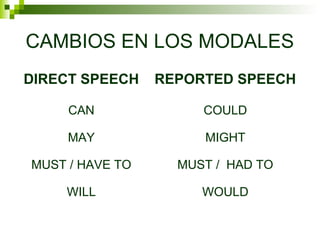
CAMBIOS EN LOS MODALES
DIRECT SPEECH REPORTED SPEECH
CAN COULD
MAY MIGHT
MUST / HAVE TO MUST / HAD TO
WILL WOULD
CAMBIOS EXPRESIONES
TEMPORALES Y DE LUGAR
DIRECT SPEECH REPORTED SPEECH
Now Then
Today That day
Tonight That night
Yesterday The previous day / the day before
Last week The previous week / the week before
A __________ ago The previous ______ / the _____ before
Tomorrow The following day / the day after / the next day
Next ___________ The following ________ / the _______ after
Here There
This
These
That
Those
Reported statements
 Al hacer una frase en afirmativa o
negativa, se han de tener en cuenta los
cambios antes mencionados y hacerlos.
 Podemos utilizar la palabra “that” para
introducir la frase en estilo indirecto. 'That'
se puede omitir:
She told him that she was happy.
She told him she was happy.
 No usamos las comillas.
 Pondremos quien dijo la frase seguido de
los verbos SAY o TELL en pasado. La
diferencia entre ellos es que después de
tell tenemos que decir la persona a quien
se lo dijo.
D.S.: Peter said, “Ann, I’m very ill.”
R.S.: Peter told Ann that he was very ill.
Reported questions
 Seguimos manteniendo los cambios que
mencionabamos al principio:
 Tiempo verbal
 Expresiones temporales y de lugar
 Pronombres personales
 En las “REPORTED QUESTIONS” ya no utilizamos
partícula interrogativa. La frase adquiere la forma de una
afirmativa:
Sujeto + verbo + complemento
Tom asked: “Are you coming to the party tonight, jane?”
Tom asked Ann if she was coming to the party that night.
Ahora tenemos que prestar atención al tipo
de pregunta que es:
1. YES/NO QUESTIONS
IF / WHETHER + SUJETO + VERBO + COMPLEMENTO
Peter asked : "Do you play football?"
Peter asked me whether (if) I played football.
2. QUESTION WITH QUESTION WORDS:
PARTÍCULA INTERROGATIVA + SUJETO + VERBO + COMPLEMENTO
Peter asked: "When do you play football?"
Peter asked me when I played football.
Reported commands
 Hay que seguir manteniendo los cambios de
expresiones de lugar y tiempo y pronombres personales
 El tiempo verbal cambia de IMPERATIVO (en D.S.) a
INFINITIVO (en R.S).
 La estructura normalmente va a ser la siguiente
tell + to (not to) + infinitive
Affirmative commands Negative commands
D.S: Father: "Do your homework!“
R.S: Father told me to do my
homework.
D.S: Teacher. "Don't talk to your mate!"
R.S: The teacher told me not to talk to
my mate.
ORDERS, REQUESTS, SUGGESTIONS
Cuando queremos cambiar a estilo indirecto una orden o petición , usamos:
TELL + somebody + infinitive
EXAMPLE:
The doctor said to me, "Stop smoking!".
The doctor told me to stop smoking.
También podemos usar:
ORDER (ordenar)
"Get out of the car!" said the policeman.
The policeman ordered him to get out of the car.
ASK (Pedir)
"Could you please be quiet," she said.
She asked me to be quiet.
WARN (advertir)
The man with the gun said to us, "Don't move!"
The man with the gun warned us not to move.
Otros verbos que utilizamos en estos casos son:
INVITE (Invitar), BEG (Suplicar), FORBID (Prohibir)
Petición de objetos: Utilizamos la formula
ask + for + object:
a. "Can I have an apple?", she asked.
She asked for an apple.
b. "Can I have the newspaper, please?"
He asked for the newspaper.
Sugerencias: normalmente utilizamos that-clause. 'That' y
'should' son opcionales en estos casos:
She said: "Why don't you get a mechanic to look at the car?"
She suggested that I should get a mechanic to look at the car.
She suggested I get a mechanic to look at the car.
Otros verbos que podemos utilizar son:
Insist
"It would be a good idea to see the dentist", said my mother.
My mother insisted that I see the dentist
Recommend
The dentist said, "I think you should use a different toothbrush".
The dentist recommended that I should use a different toothbrush.
Notes:
Suggest puede ir también seguido de gerundio:
I suggested postponing the visit to the dentist.
HOPES, INTENTIONS, PROMISES
Cuando cambiamos a estilo indirecto una intención, esperanza, o promesa
usamos un “reporting verb” adecuado a este significado, seguido that-
clause o to-infinitive:
"I'll pay you the money tomorrow."
He promised to pay me the money the next day.
He promised that he would pay me the money the next day.
Otros verbos que utilizan esta estructura son:
Hope (Tener esperanza)
"We should arrive in London before nightfall."
They hoped to arrive in London before nightfall.
They hoped they would arrive in London before nightfall.
Threaten (Amenazar)
"Give me the keys to the safe or I'll shoot you!"
He threatened to shoot me if I didn't give him the keys to the safe.
He threatened that he would shoot me if I didn't give him the keys to
the safe.
Swear (Jurar)
"I swear it! I'll be back by lunchtime."
He sweared to be back by lunchtime.
He sweared that he would be back by lunchtime.
REPORTING VERBS
 Son verbos que vamos a utilizar en estilo
indirecto a parte de SAY y TELL. Algunos ya los
hemos visto anteriormente.
 Estos verbos dan información extra de lo que
estamos hablando y la mayoría de las veces nos
sirven para hacer el cambio a estilo indirecto de
manera más libre.
• He denied doing it.
 Vamos a dividir los “reporting verbs” según el
tipo de oración que va a ir tras ellos.
Tipos de REPORTING VERBS (Algunos pueden estar en más de un
grupo)
Verbos seguidos de una condicional: IF / WHETHER + frase:
 ASK (preguntar)
 REMEMBER (recordar)
 SAY (decir)
Verbos seguidos de THAT + frase:
 ANSWER (responder)
 BOAST (alardear / presumir)
 COMPLAIN (protestar)
 DENY (negar)
 REPLY (responder)
 SAY (decir)
 SUGGEST (sugerir)
 TELL (contar)
 WARN (advertir)
Verbo seguido de THAT + frase o infinitivo:
 CLAIM (reclamar)
 PROMISE (prometer)
 THREATEN (amenazar)
Verbos seguidos de THAT+ frase conteniendo should
 ADVISE (aconsejar)
 BEG (suplicar)
 DEMAND (demandar)
 RECOMMEND (recomendar)
 SUGGEST
Verbos seguidos de complemento + infinitivo
 ADVISE
 ASK
 BEG
 INVITE (invitar)
 ORDER (ordenar)
 SHOUT (gritar)
 WARN

Reported Speech

  • 1.
  • 2.
    USO  El estiloindirecto (REPORTED SPEECH) lo utilizamos para contar lo que una persona ha dicho pero sin citar exactamente sus palabras.  EJEMPLOS:  DIRECT STYLE: Tom said: “We are going to the cinema this afternoon.”  REPORTED SPEECH: Tom said that they were going to the cinema that afternoon.
  • 3.
    CAMBIOS A REALIZAR Cuandopasamos una oración de estilo directo a indirecto tenemos que tener en cuenta una serie de cambios que tendremos que realizar: 1. Tiempos verbales 2. Expresiones temporales y de lugar 3. Pronombres, (utilizando la lógica) EXAMPLE DIRECT: Tom said: “We are going to visit Ann tomorrow” REPORTED: Tom said that they were going to visit Ann the following day
  • 4.
    CAMBIOS EN LOSTIEMPOS VERBALES DIRECT SPEECH---------------------------- REPORTED SPEECH PRESENT-------------------------------------------------------------PAST We study She said that they studied We are studying She said that they were studying PAST-----------------------------------------------------PAST PERFECT We studied She said that they had studied We were studying She said that they had been studying FUTURE--------------------------------------------------- CONDITIONAL We will study She said that they would study
  • 5.
    TIEMPOS VERBALES TENSE DIRECTSPEECH REPORTED SPEECH PRESENT SIMPLE We eat healthy food She said that they ate healthy food PRESENT CONTINUOUS We are eating healthy food She said that they were eating healthy food PRESENT PERFECT SIMPLE We have eaten healthy food She said that they had eaten healthy food PRESENT PERFECT CONTINUOUS We have been eating healthy food She said that they had been eating healthy food PAST SIMPLE We ate healthy food She said that they had eaten healthy food PAST CONTINUOUS We were eating healthy food She said that they had been eating healthy food PAST PERFECT SIMPLE We had eaten healthy food She said that they had eaten healthy food PAST PERFECT CONTINUOUS We had been eating healthy food She said that they had been eating healthy food FUTURE SIMPLE We will eat healthy food She said that they would eat healthy food
  • 6.
    CAMBIOS EN LOSMODALES DIRECT SPEECH REPORTED SPEECH CAN COULD MAY MIGHT MUST / HAVE TO MUST / HAD TO WILL WOULD
  • 7.
    CAMBIOS EXPRESIONES TEMPORALES YDE LUGAR DIRECT SPEECH REPORTED SPEECH Now Then Today That day Tonight That night Yesterday The previous day / the day before Last week The previous week / the week before A __________ ago The previous ______ / the _____ before Tomorrow The following day / the day after / the next day Next ___________ The following ________ / the _______ after Here There This These That Those
  • 8.
    Reported statements  Alhacer una frase en afirmativa o negativa, se han de tener en cuenta los cambios antes mencionados y hacerlos.  Podemos utilizar la palabra “that” para introducir la frase en estilo indirecto. 'That' se puede omitir: She told him that she was happy. She told him she was happy.  No usamos las comillas.
  • 9.
     Pondremos quiendijo la frase seguido de los verbos SAY o TELL en pasado. La diferencia entre ellos es que después de tell tenemos que decir la persona a quien se lo dijo. D.S.: Peter said, “Ann, I’m very ill.” R.S.: Peter told Ann that he was very ill.
  • 10.
    Reported questions  Seguimosmanteniendo los cambios que mencionabamos al principio:  Tiempo verbal  Expresiones temporales y de lugar  Pronombres personales  En las “REPORTED QUESTIONS” ya no utilizamos partícula interrogativa. La frase adquiere la forma de una afirmativa: Sujeto + verbo + complemento Tom asked: “Are you coming to the party tonight, jane?” Tom asked Ann if she was coming to the party that night.
  • 11.
    Ahora tenemos queprestar atención al tipo de pregunta que es: 1. YES/NO QUESTIONS IF / WHETHER + SUJETO + VERBO + COMPLEMENTO Peter asked : "Do you play football?" Peter asked me whether (if) I played football. 2. QUESTION WITH QUESTION WORDS: PARTÍCULA INTERROGATIVA + SUJETO + VERBO + COMPLEMENTO Peter asked: "When do you play football?" Peter asked me when I played football.
  • 12.
    Reported commands  Hayque seguir manteniendo los cambios de expresiones de lugar y tiempo y pronombres personales  El tiempo verbal cambia de IMPERATIVO (en D.S.) a INFINITIVO (en R.S).  La estructura normalmente va a ser la siguiente tell + to (not to) + infinitive Affirmative commands Negative commands D.S: Father: "Do your homework!“ R.S: Father told me to do my homework. D.S: Teacher. "Don't talk to your mate!" R.S: The teacher told me not to talk to my mate.
  • 13.
    ORDERS, REQUESTS, SUGGESTIONS Cuandoqueremos cambiar a estilo indirecto una orden o petición , usamos: TELL + somebody + infinitive EXAMPLE: The doctor said to me, "Stop smoking!". The doctor told me to stop smoking. También podemos usar: ORDER (ordenar) "Get out of the car!" said the policeman. The policeman ordered him to get out of the car. ASK (Pedir) "Could you please be quiet," she said. She asked me to be quiet. WARN (advertir) The man with the gun said to us, "Don't move!" The man with the gun warned us not to move. Otros verbos que utilizamos en estos casos son: INVITE (Invitar), BEG (Suplicar), FORBID (Prohibir)
  • 14.
    Petición de objetos:Utilizamos la formula ask + for + object: a. "Can I have an apple?", she asked. She asked for an apple. b. "Can I have the newspaper, please?" He asked for the newspaper.
  • 15.
    Sugerencias: normalmente utilizamosthat-clause. 'That' y 'should' son opcionales en estos casos: She said: "Why don't you get a mechanic to look at the car?" She suggested that I should get a mechanic to look at the car. She suggested I get a mechanic to look at the car. Otros verbos que podemos utilizar son: Insist "It would be a good idea to see the dentist", said my mother. My mother insisted that I see the dentist Recommend The dentist said, "I think you should use a different toothbrush". The dentist recommended that I should use a different toothbrush. Notes: Suggest puede ir también seguido de gerundio: I suggested postponing the visit to the dentist.
  • 16.
    HOPES, INTENTIONS, PROMISES Cuandocambiamos a estilo indirecto una intención, esperanza, o promesa usamos un “reporting verb” adecuado a este significado, seguido that- clause o to-infinitive: "I'll pay you the money tomorrow." He promised to pay me the money the next day. He promised that he would pay me the money the next day. Otros verbos que utilizan esta estructura son: Hope (Tener esperanza) "We should arrive in London before nightfall." They hoped to arrive in London before nightfall. They hoped they would arrive in London before nightfall. Threaten (Amenazar) "Give me the keys to the safe or I'll shoot you!" He threatened to shoot me if I didn't give him the keys to the safe. He threatened that he would shoot me if I didn't give him the keys to the safe. Swear (Jurar) "I swear it! I'll be back by lunchtime." He sweared to be back by lunchtime. He sweared that he would be back by lunchtime.
  • 17.
    REPORTING VERBS  Sonverbos que vamos a utilizar en estilo indirecto a parte de SAY y TELL. Algunos ya los hemos visto anteriormente.  Estos verbos dan información extra de lo que estamos hablando y la mayoría de las veces nos sirven para hacer el cambio a estilo indirecto de manera más libre. • He denied doing it.  Vamos a dividir los “reporting verbs” según el tipo de oración que va a ir tras ellos.
  • 18.
    Tipos de REPORTINGVERBS (Algunos pueden estar en más de un grupo) Verbos seguidos de una condicional: IF / WHETHER + frase:  ASK (preguntar)  REMEMBER (recordar)  SAY (decir) Verbos seguidos de THAT + frase:  ANSWER (responder)  BOAST (alardear / presumir)  COMPLAIN (protestar)  DENY (negar)  REPLY (responder)  SAY (decir)  SUGGEST (sugerir)  TELL (contar)  WARN (advertir)
  • 19.
    Verbo seguido deTHAT + frase o infinitivo:  CLAIM (reclamar)  PROMISE (prometer)  THREATEN (amenazar) Verbos seguidos de THAT+ frase conteniendo should  ADVISE (aconsejar)  BEG (suplicar)  DEMAND (demandar)  RECOMMEND (recomendar)  SUGGEST Verbos seguidos de complemento + infinitivo  ADVISE  ASK  BEG  INVITE (invitar)  ORDER (ordenar)  SHOUT (gritar)  WARN