
REPORTED SPEECH


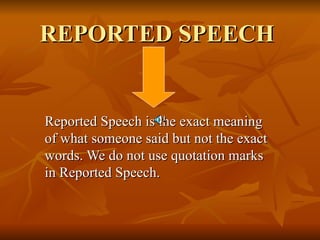
Reported Speech is the exact meaning
of what someone said but not the exact
words. We do not use quotation marks
in Reported Speech.
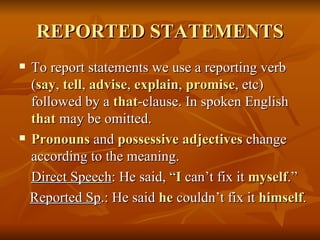
REPORTED STATEMENTS
   To report statements we use a reporting verb
    (say, tell, advise, explain, promise, etc)
    followed by a that-clause. In spoken English
    that may be omitted.
   Pronouns and possessive adjectives change
    according to the meaning.
    Direct Speech: He said, “I can’t fix it myself.”
    Reported Sp.: He said he couldn’t fix it himself.
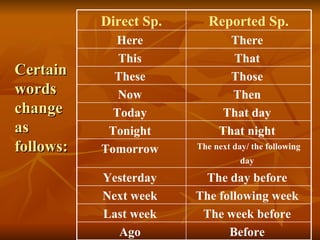
Direct Sp.      Reported Sp.
             Here              There
              This             That
Certain      These             Those
words         Now              Then
change       Today            That day
as          Tonight          That night
follows:   Tomorrow     The next day/ the following
                                   day

           Yesterday     The day before
           Next week    The following week
           Last week     The week before
             Ago              Before
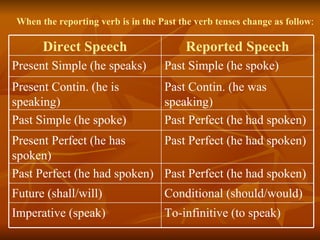
When the reporting verb is in the Past the verb tenses change as follow:

      Direct Speech                     Reported Speech
Present Simple (he speaks)         Past Simple (he spoke)
Present Contin. (he is             Past Contin. (he was
speaking)                          speaking)
Past Simple (he spoke)             Past Perfect (he had spoken)
Present Perfect (he has      Past Perfect (he had spoken)
spoken)
Past Perfect (he had spoken) Past Perfect (he had spoken)
Future (shall/will)                Conditional (should/would)
Imperative (speak)                 To-infinitive (to speak)
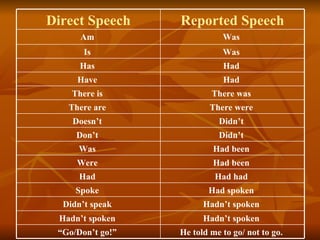
Direct Speech     Reported Speech
      Am                     Was
       Is                    Was
      Has                    Had
     Have                    Had
    There is              There was
   There are              There were
    Doesn’t                 Didn’t
     Don’t                  Didn’t
      Was                  Had been
     Were                  Had been
      Had                  Had had
     Spoke               Had spoken
  Didn’t speak          Hadn’t spoken
 Hadn’t spoken          Hadn’t spoken
 “Go/Don’t go!”   He told me to go/ not to go.
Modal
                    verbs
    Direct Speech           Reported Speech
Can                    Could
May                    Might
Might                  Might
Could                  Could
Would                  Would
Should                 Should
Ought to               Ought to
Daren’t                Daren’t
Must                   Must/ Had to
Needn’t                Needn’t/ didn’t have to
   There are no changes in verb tenses when the
    reporting verb is in the Present, Future or
    Present Perfect or when the sentences expresses
    something which is always true.
       D. S.: She’ll say, “I can do it”.
             “The earth is round”, said the teacher.
       R.S.: She’ll say (that) she can do it.
             The teacher said (that) the earth is
             round.
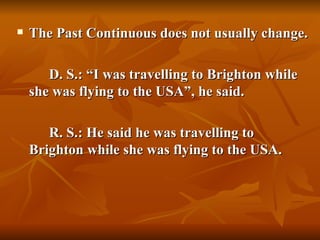
   The Past Continuous does not usually change.

       D. S.: “I was travelling to Brighton while
    she was flying to the USA”, he said.

       R. S.: He said he was travelling to
    Brighton while she was flying to the USA.
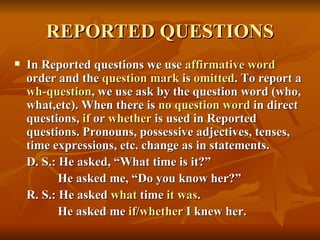
REPORTED QUESTIONS
   In Reported questions we use affirmative word
    order and the question mark is omitted. To report a
    wh-question, we use ask by the question word (who,
    what,etc). When there is no question word in direct
    questions, if or whether is used in Reported
    questions. Pronouns, possessive adjectives, tenses,
    time expressions, etc. change as in statements.
    D. S.: He asked, “What time is it?”
           He asked me, “Do you know her?”
    R. S.: He asked what time it was.
           He asked me if/whether I knew her.
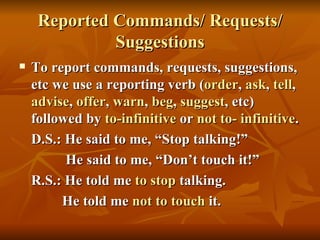
Reported Commands/ Requests/
              Suggestions
   To report commands, requests, suggestions,
    etc we use a reporting verb (order, ask, tell,
    advise, offer, warn, beg, suggest, etc)
    followed by to-infinitive or not to- infinitive.
    D.S.: He said to me, “Stop talking!”
          He said to me, “Don’t touch it!”
    R.S.: He told me to stop talking.
         He told me not to touch it.
Reported Speech

Reported Speech

  • 1.
    REPORTED SPEECH Reported Speechis the exact meaning of what someone said but not the exact words. We do not use quotation marks in Reported Speech.
  • 2.
    REPORTED STATEMENTS  To report statements we use a reporting verb (say, tell, advise, explain, promise, etc) followed by a that-clause. In spoken English that may be omitted.  Pronouns and possessive adjectives change according to the meaning. Direct Speech: He said, “I can’t fix it myself.” Reported Sp.: He said he couldn’t fix it himself.
  • 3.
    Direct Sp. Reported Sp. Here There This That Certain These Those words Now Then change Today That day as Tonight That night follows: Tomorrow The next day/ the following day Yesterday The day before Next week The following week Last week The week before Ago Before
  • 4.
    When the reportingverb is in the Past the verb tenses change as follow: Direct Speech Reported Speech Present Simple (he speaks) Past Simple (he spoke) Present Contin. (he is Past Contin. (he was speaking) speaking) Past Simple (he spoke) Past Perfect (he had spoken) Present Perfect (he has Past Perfect (he had spoken) spoken) Past Perfect (he had spoken) Past Perfect (he had spoken) Future (shall/will) Conditional (should/would) Imperative (speak) To-infinitive (to speak)
  • 5.
    Direct Speech Reported Speech Am Was Is Was Has Had Have Had There is There was There are There were Doesn’t Didn’t Don’t Didn’t Was Had been Were Had been Had Had had Spoke Had spoken Didn’t speak Hadn’t spoken Hadn’t spoken Hadn’t spoken “Go/Don’t go!” He told me to go/ not to go.
  • 6.
    Modal verbs Direct Speech Reported Speech Can Could May Might Might Might Could Could Would Would Should Should Ought to Ought to Daren’t Daren’t Must Must/ Had to Needn’t Needn’t/ didn’t have to
  • 7.
    There are no changes in verb tenses when the reporting verb is in the Present, Future or Present Perfect or when the sentences expresses something which is always true. D. S.: She’ll say, “I can do it”. “The earth is round”, said the teacher. R.S.: She’ll say (that) she can do it. The teacher said (that) the earth is round.
  • 8.
    The Past Continuous does not usually change. D. S.: “I was travelling to Brighton while she was flying to the USA”, he said. R. S.: He said he was travelling to Brighton while she was flying to the USA.
  • 9.
    REPORTED QUESTIONS  In Reported questions we use affirmative word order and the question mark is omitted. To report a wh-question, we use ask by the question word (who, what,etc). When there is no question word in direct questions, if or whether is used in Reported questions. Pronouns, possessive adjectives, tenses, time expressions, etc. change as in statements. D. S.: He asked, “What time is it?” He asked me, “Do you know her?” R. S.: He asked what time it was. He asked me if/whether I knew her.
  • 10.
    Reported Commands/ Requests/ Suggestions  To report commands, requests, suggestions, etc we use a reporting verb (order, ask, tell, advise, offer, warn, beg, suggest, etc) followed by to-infinitive or not to- infinitive. D.S.: He said to me, “Stop talking!” He said to me, “Don’t touch it!” R.S.: He told me to stop talking. He told me not to touch it.