Reported Speech
    Indirect Speech


Miss Macarena Arévalo A
Reported Speech
Definition

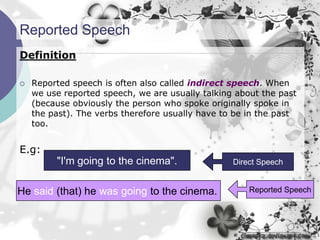
   Reported speech is often also called indirect speech. When
    we use reported speech, we are usually talking about the past
    (because obviously the person who spoke originally spoke in
    the past). The verbs therefore usually have to be in the past
    too.


E.g:
         "I'm going to the cinema".               Direct Speech


He said (that) he was going to the cinema.            Reported Speech
Changing basic tenses
Statements

   When we want to report what other person has said, we have
    to change the tenses, moving them backwards:

              DIRECT SPEECH                     REPORTED SPEECH
Present simple: I'm a teacher.      Past simple: He said he was a teacher
                                    Past continuous:
Present continuous:
                                    He said he was having lunch with his
I'm having lunch with my parents.
                                    parents.
Present perfect simple:             Past perfect simple:
I've been to France three times.    He said he had been to France three times.
Present perfect continuous:         Past perfect continuous:
I've been working very hard.        He said he had been working very hard.
Changing basic tenses
Statements

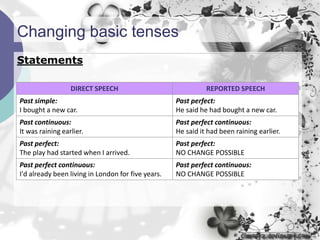
                  DIRECT SPEECH                               REPORTED SPEECH
Past simple:                                        Past perfect:
I bought a new car.                                 He said he had bought a new car.
Past continuous:                                    Past perfect continuous:
It was raining earlier.                             He said it had been raining earlier.
Past perfect:                                       Past perfect:
The play had started when I arrived.                NO CHANGE POSSIBLE
Past perfect continuous:                            Past perfect continuous:
I'd already been living in London for five years.   NO CHANGE POSSIBLE
LET’S CHECK…
Exercises:

1.   The train leaves at 05:32 => She said
     that_____________ at 05:32.
2.   We want to go to Disneyland => The children cried
     they______________ to Disneyland.
3.   John and William never write to us => Mr and Mrs Litten
     complained that John and William________________.
4.   It's too late to catch the train => He said that
     it______________ the train.
Changing Modal Verbs
Sentences with modals

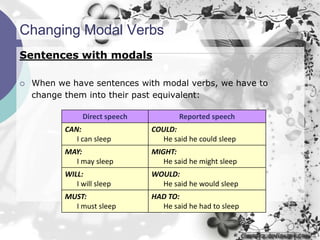
   When we have sentences with modal verbs, we have to
    change them into their past equivalent:

                Direct speech           Reported speech
           CAN:                 COULD:
              I can sleep         He said he could sleep
           MAY:                 MIGHT:
             I may sleep           He said he might sleep
           WILL:                WOULD:
              I will sleep        He said he would sleep
           MUST:                HAD TO:
             I must sleep         He said he had to sleep
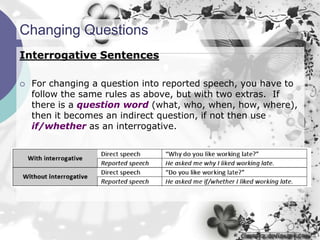
Changing Questions
Interrogative Sentences

   For changing a question into reported speech, you have to
    follow the same rules as above, but with two extras. If
    there is a question word (what, who, when, how, where),
    then it becomes an indirect question, if not then use
    if/whether as an interrogative.

Nm2 reported speech extended

  • 1.
    Reported Speech Indirect Speech Miss Macarena Arévalo A
  • 2.
    Reported Speech Definition  Reported speech is often also called indirect speech. When we use reported speech, we are usually talking about the past (because obviously the person who spoke originally spoke in the past). The verbs therefore usually have to be in the past too. E.g: "I'm going to the cinema". Direct Speech He said (that) he was going to the cinema. Reported Speech
  • 3.
    Changing basic tenses Statements  When we want to report what other person has said, we have to change the tenses, moving them backwards: DIRECT SPEECH REPORTED SPEECH Present simple: I'm a teacher. Past simple: He said he was a teacher Past continuous: Present continuous: He said he was having lunch with his I'm having lunch with my parents. parents. Present perfect simple: Past perfect simple: I've been to France three times. He said he had been to France three times. Present perfect continuous: Past perfect continuous: I've been working very hard. He said he had been working very hard.
  • 4.
    Changing basic tenses Statements DIRECT SPEECH REPORTED SPEECH Past simple: Past perfect: I bought a new car. He said he had bought a new car. Past continuous: Past perfect continuous: It was raining earlier. He said it had been raining earlier. Past perfect: Past perfect: The play had started when I arrived. NO CHANGE POSSIBLE Past perfect continuous: Past perfect continuous: I'd already been living in London for five years. NO CHANGE POSSIBLE
  • 5.
  • 6.
    Exercises: 1. The train leaves at 05:32 => She said that_____________ at 05:32. 2. We want to go to Disneyland => The children cried they______________ to Disneyland. 3. John and William never write to us => Mr and Mrs Litten complained that John and William________________. 4. It's too late to catch the train => He said that it______________ the train.
  • 7.
    Changing Modal Verbs Sentenceswith modals  When we have sentences with modal verbs, we have to change them into their past equivalent: Direct speech Reported speech CAN: COULD: I can sleep He said he could sleep MAY: MIGHT: I may sleep He said he might sleep WILL: WOULD: I will sleep He said he would sleep MUST: HAD TO: I must sleep He said he had to sleep
  • 8.
    Changing Questions Interrogative Sentences  For changing a question into reported speech, you have to follow the same rules as above, but with two extras. If there is a question word (what, who, when, how, where), then it becomes an indirect question, if not then use if/whether as an interrogative.