











Member’s
Nandan Shah
Yash Rawani
Ayushi Jain
Mohammed Ali
Dhaga
Apeksha Mehta
Rohan Bhatkar
Mohammed
Driver
Mayur Sancheti
Whatisareport?
Areport, bydefinition, isa “statement
describingwhathas happened”or
“describingastateof affairs”.
Reportsmeansastatement or
descriptionof whathas beensaid,
done,etc.
What does it contain?
It contains facts, figures information,
analysis, options, suggestions,
recommendations, drafts, charts,
pictures, statistical tables etc. specially
compiled for a particular purpose.
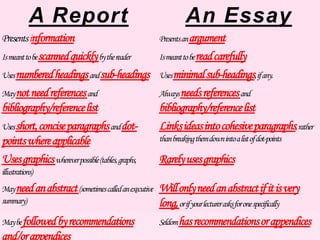
A Report An Essay
Presentsinformation Presentsanargument
Ismeanttobescannedquicklybythereader Ismeanttobereadcarefully
Usesnumberedheadingsandsub-headings Usesminimalsub-headings,ifany.
Maynotneedreferencesand
bibliography/referencelist
Alwaysneedsreferencesand
bibliography/referencelist
Usesshort,conciseparagraphsanddot-
pointswhereapplicable
Linksideasintocohesiveparagraphs,rather
thanbreakingthemdownintoalistofdot-points
Usesgraphicswhereverpossible(tables,graphs,
illustrations)
Rarelyusesgraphics
Mayneedanabstract(sometimescalledanexecutive
summary)
Willonlyneedanabstractifitisvery
long,orifyourlecturerasksforonespecifically
Maybefollowedbyrecommendations
and/orappendices
Seldomhasrecommendationsorappendices
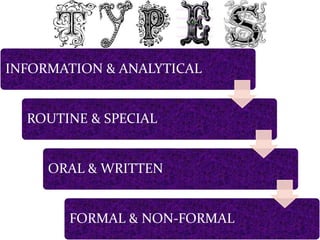
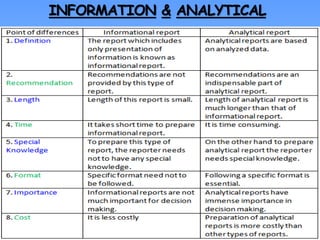
INFORMATION & ANALYTICAL
ROUTINE & SPECIAL
ORAL & WRITTEN
FORMAL & NON-FORMAL
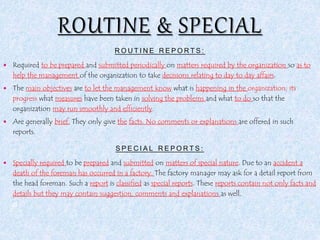
ROUTINE REPORTS:
 Required to be prepared and submitted periodically on matters required by the organization so as to
help the management of the organization to take decisions relating to day to day affairs.
 The main objectives are to let the management know what is happening in the organization, its
progress what measures have been taken in solving the problems and what to do so that the
organization may run smoothly and efficiently.
 Are generally brief. They only give the facts. No comments or explanations are offered in such
reports.
SPECIAL REPORTS:
 Specially required to be prepared and submitted on matters of special nature. Due to an accident a
death of the foreman has occurred in a factory. The factory manager may ask for a detail report from
the head foreman. Such a report is classified as special reports. These reports contain not only facts and
details but they may contain suggestion, comments and explanations as well.
d
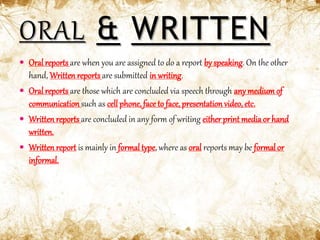
 Oral reports are when you are assigned to do a report by speaking. On the other
hand, Written reports are submitted in writing.
 Oral reports are those which are concluded via speech through anymedium of
communication such as cell phone, face to face, presentation video, etc.
 Writtenreports are concluded in any form of writing either print mediaor hand
written.
 Writtenreport is mainly in formaltype, where as oral reports may be formal or
informal.
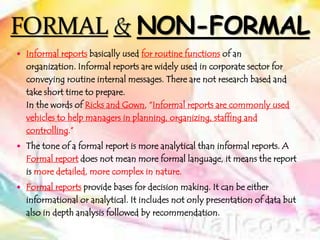
 Informal reports basically used for routine functions of an
organization. Informal reports are widely used in corporate sector for
conveying routine internal messages. There are not research based and
take short time to prepare.
In the words of Ricks and Gown, “Informal reports are commonly used
vehicles to help managers in planning, organizing, staffing and
controlling.”
 The tone of a formal report is more analytical than informal reports. A
Formal report does not mean more formal language, it means the report
is more detailed, more complex in nature.
 Formal reports provide bases for decision making. It can be either
informational or analytical. It includes not only presentation of data but
also in depth analysis followed by recommendation.
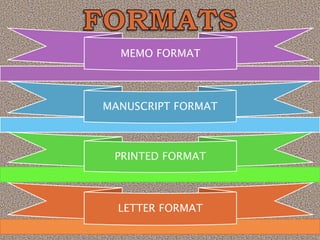
MEMO FORMAT
MANUSCRIPT FORMAT
PRINTED FORMAT
LETTER FORMAT
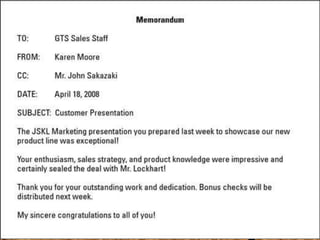
Memo is a document typically
used for communication with a
communication with a company.
Memo can be as formal like
business letter and it is used to
present a report.
Generally memo is sent to co-
worker and colleagues.
In memo we don’t have to include
formal salutation and closing
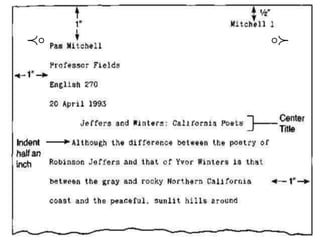
 Manuscriptformatting depends greatly on thetype of work that is being
written, as well as the individual publisher, editor orproducer.
 Thereare some guidelines in writing a MANUSCRIPT
 Oneinch margins
 Double spaced text
 A single, clear, 12-point typeface
 No extra space between paragraphs
 An indented first line for eachparagraph
 Information identifying the authorand title ofthe manuscripton every
page
po of
Mainly used when you go for a
medical test, the report which you
receive is in PRINTED FORMAT
You cannot change your words or
your sentence as once it is printed
you may have to re-write again.
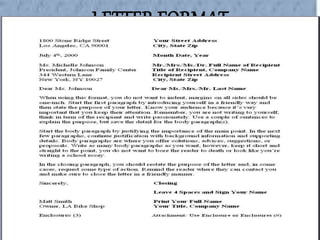
 While writing, margins should be 1 inched from all sides.
 Start the letter by introducing yourself in a friendly manner.
 State the purpose of your letter.
 Always keep the attention of your audience as they are the readers in
this case.
 Explain the purpose of your letter in a sentence or 2 as you have to
save your points for the body.
1.TITLE
6.CONCLUSION
3.CONTENT
2.SUMMARY
7.REFERENCE
S
4.INTRODUCTIO
N
5.BODY
8.RECOMMENDATION
S
Must include the title of the
report.
It should contain the title and the
author's name the report
reference number, date, its
classification
(i.e. confidential, etc).
Most companies have well
designed title pages available
as a template
These have the advantage of
producing a company
image.
www.hindustantimes.com
SUMMARY
 The summary though is the last part of the text to be written, it is
perhaps the most difficult.
 It gives a general picture of the report for those who want to be
remindedof what they have already read, and also for those who will
never see-or want to see- the total report.
 Many companies have long circulation list for summaries, but supply
the full report to only those whose status demands it.
 Thus summary saves time and money.
www.hindustantimes.com
 This is a list of the headings of the report.
 Depending on the complexity and length of the report,
you could list tables, figures and appendices
separately.
 Make sure the correct page numbers are shown
opposite the contents.
 Up-to-date word processing packages can generate a
table of contents for you.
www.hindustantimes.com
 States the objectives of the report and
comments on the way the topic of the report
is to be treated.
 Leads straight into the report itself.
 Give enough background information to
provide a context for the report.
 State the purpose of the report.
 Clarify key terms and indicate the scope of
the report (i.e. what the report will
cover).
www.hindustantimes.com
 The content of the body dependson the purpose of the report, and whether it is a report of
primary or secondary research.
 A report of primary research (based on your own observations and experiments) would
include:
 Method(summarises what you did and why). Use the past tense.
 Findings or results(describes what you discovered, observed, etc, in your observations and
experiments). Use the past tense.
 Discussion(discusses and explains your findings and relates them to previous research).
Use the present tense to make generalisations.
 Analysis/discussion of the sources you are reporting.
www.hindustantimes.com
REFERENCES &
RECOMMENDATIONS
REFERENCES- are the source information
of data that is included in report.
RECOMMENDATIONS- are suggestions for
future action. They must be logically derived
from the body of your report.
www.hindustantimes.com
CONCLUSION
A short, logical summing up of the themes
developed in the main text.
The conclusion should clearly related to the
objectives of your report.
No surprises please! (that is, don’t include
new information here.)
www.hindustantimes.com
 Reports communicate information which has
been compiled as a result of research and
analysis of data and of issues. Reports can
cover a wide range of topics , but usually
focus on transmitting information with a clear
purpose, to a specific audience .
 Good reports are documents that are accurate,
objective and complete also be well-written,
clearly structured and expressed in a way that
holds the reader's attention and meets their
expectations.
 Often reports are structured in a way that
reflects the information finding process and
the writing up of the findings.
 This shows what the report includes and excludes. For
example: Think about a periscope on a submarine.
It comes out of the water and provides the viewer
with a limited view of the landscape.
 Scope defines what you’re going to talk about in the
report, what your report will address and a brief
summary of the key components of the report. If there is
a major issue that a report is not covering, then it’s a
good idea to mention that it won’t be covering it, along
with an explanation as to why.
 The scope section will typically only be a paragraph or
two in length.
 For most technical writers, audience analysis is the
most important step in planning a target
document.
 In order for a writer's final product to be fully
successful, the piece must be aimed towards the
intended audience, its knowledge, its opinions, its
needs, and its wants.
 These instructions will help you analyze your audience
and develop a strategy to target your writing to your
audience.
GATHERING THE INFORMATION
• Information gathering can be used for a
variety of different reasons; It makes
writer aware of more diverse sources,
opinions and approaches which can only
enhance quality of the report.
• Effective information gathering can:
1. Utilize your time more efficiently and
effectively develop critical thinking
through the use of shifting/sorting
techniques.
2. It broaden our outlook and inform our
subject understanding through the
exploration of more diverse sources.
ANALYSING & ORGANISING
THE INFORMATION
• After thinking through what
information, it is important to
know, and understand how to
find it.
• This comes to the task of
analyzing the results of your
research or consultations and
organizing it.
WRITING THE 1ST DRAFT
• In professional contexts, the readers might
be managers, clients, project team
member.
• The answer will affect the content and
technical level, and is a major
consideration in the level of detail required
in the introduction
THE FINAL DRAFT
• After all of the coding is done it is finally time to write the thesis,
dissertation, academic journal article, or intra-organizational
report.
• The writing phase of research is more efficient and productive
because of the hard work that you put into the collection,
organization, and coding of your data.
• Specific report formats vary widely, but there is a common
structure in most academic publications.
• Most universities, journals, corporations, and government
agencies provide very specific publication guidelines. In all cases
it is easier to follow editorial style guidelines if you use the style-
oriented tools of Word...
RE-VISING, RE-VIEWING
& EDITTING
• The report should now be nearly complete
with an introduction, main text in sections,
conclusions, properly, formatted, references
and any appendices.
• Now you must add the page numbers,
contents and title pages and write the
summary
TYPES OF REPORT
• They were of 4 Types
1. Information & Analytical.
2. Routine & Special.
3. Oral & Written.
4. Formal & Non-Formal.
FORMATS
• They were 4 Formats too.
1. Memo Format.
2. Manuscript Format.
3. Printed Format.
4. Letter Format.
STRUCTURES
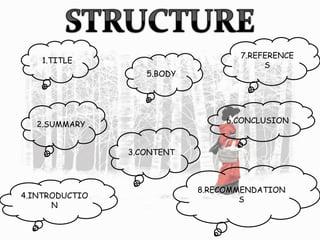
• There were 8 Structures
1. 1.TITLE
2. 2.SUMMARY
3. 3.CONTENT
4. 4.INTRODUCTION
5. 5.BODY
6. 7.REFERENCES
7. 6.CONCLUSION
8. 8.RECOMMENDATIONS
STRATEGIES
• 8 Strategies should be kept in mind while writing
a report.
1. Analyzing the report & purpose.
2. Determination of the scope of report.
3. The need of audience analysis.
4. Gathering the Information
5. Analyzing & Organizing a report.
6. Writing the 1st Draft
7. The Final Draft
8. Revising, Re-viewing & Editing.
1 2 3
Report writing

Report writing

  • 2.
    Member’s Nandan Shah Yash Rawani AyushiJain Mohammed Ali Dhaga Apeksha Mehta Rohan Bhatkar Mohammed Driver Mayur Sancheti
  • 3.
    Whatisareport? Areport, bydefinition, isa“statement describingwhathas happened”or “describingastateof affairs”. Reportsmeansastatement or descriptionof whathas beensaid, done,etc.
  • 4.
    What does itcontain? It contains facts, figures information, analysis, options, suggestions, recommendations, drafts, charts, pictures, statistical tables etc. specially compiled for a particular purpose.
  • 5.
    A Report AnEssay Presentsinformation Presentsanargument Ismeanttobescannedquicklybythereader Ismeanttobereadcarefully Usesnumberedheadingsandsub-headings Usesminimalsub-headings,ifany. Maynotneedreferencesand bibliography/referencelist Alwaysneedsreferencesand bibliography/referencelist Usesshort,conciseparagraphsanddot- pointswhereapplicable Linksideasintocohesiveparagraphs,rather thanbreakingthemdownintoalistofdot-points Usesgraphicswhereverpossible(tables,graphs, illustrations) Rarelyusesgraphics Mayneedanabstract(sometimescalledanexecutive summary) Willonlyneedanabstractifitisvery long,orifyourlecturerasksforonespecifically Maybefollowedbyrecommendations and/orappendices Seldomhasrecommendationsorappendices
  • 7.
    INFORMATION & ANALYTICAL ROUTINE& SPECIAL ORAL & WRITTEN FORMAL & NON-FORMAL
  • 9.
    ROUTINE REPORTS:  Requiredto be prepared and submitted periodically on matters required by the organization so as to help the management of the organization to take decisions relating to day to day affairs.  The main objectives are to let the management know what is happening in the organization, its progress what measures have been taken in solving the problems and what to do so that the organization may run smoothly and efficiently.  Are generally brief. They only give the facts. No comments or explanations are offered in such reports. SPECIAL REPORTS:  Specially required to be prepared and submitted on matters of special nature. Due to an accident a death of the foreman has occurred in a factory. The factory manager may ask for a detail report from the head foreman. Such a report is classified as special reports. These reports contain not only facts and details but they may contain suggestion, comments and explanations as well. d
  • 10.
     Oral reportsare when you are assigned to do a report by speaking. On the other hand, Written reports are submitted in writing.  Oral reports are those which are concluded via speech through anymedium of communication such as cell phone, face to face, presentation video, etc.  Writtenreports are concluded in any form of writing either print mediaor hand written.  Writtenreport is mainly in formaltype, where as oral reports may be formal or informal.
  • 11.
     Informal reportsbasically used for routine functions of an organization. Informal reports are widely used in corporate sector for conveying routine internal messages. There are not research based and take short time to prepare. In the words of Ricks and Gown, “Informal reports are commonly used vehicles to help managers in planning, organizing, staffing and controlling.”  The tone of a formal report is more analytical than informal reports. A Formal report does not mean more formal language, it means the report is more detailed, more complex in nature.  Formal reports provide bases for decision making. It can be either informational or analytical. It includes not only presentation of data but also in depth analysis followed by recommendation.
  • 12.
  • 13.
    Memo is adocument typically used for communication with a communication with a company. Memo can be as formal like business letter and it is used to present a report. Generally memo is sent to co- worker and colleagues. In memo we don’t have to include formal salutation and closing
  • 14.
     Manuscriptformatting dependsgreatly on thetype of work that is being written, as well as the individual publisher, editor orproducer.  Thereare some guidelines in writing a MANUSCRIPT  Oneinch margins  Double spaced text  A single, clear, 12-point typeface  No extra space between paragraphs  An indented first line for eachparagraph  Information identifying the authorand title ofthe manuscripton every page po of
  • 15.
    Mainly used whenyou go for a medical test, the report which you receive is in PRINTED FORMAT You cannot change your words or your sentence as once it is printed you may have to re-write again.
  • 16.
     While writing,margins should be 1 inched from all sides.  Start the letter by introducing yourself in a friendly manner.  State the purpose of your letter.  Always keep the attention of your audience as they are the readers in this case.  Explain the purpose of your letter in a sentence or 2 as you have to save your points for the body.
  • 17.
  • 18.
    Must include thetitle of the report. It should contain the title and the author's name the report reference number, date, its classification (i.e. confidential, etc). Most companies have well designed title pages available as a template These have the advantage of producing a company image.
  • 19.
  • 20.
    SUMMARY  The summarythough is the last part of the text to be written, it is perhaps the most difficult.  It gives a general picture of the report for those who want to be remindedof what they have already read, and also for those who will never see-or want to see- the total report.  Many companies have long circulation list for summaries, but supply the full report to only those whose status demands it.  Thus summary saves time and money.
  • 21.
  • 22.
     This isa list of the headings of the report.  Depending on the complexity and length of the report, you could list tables, figures and appendices separately.  Make sure the correct page numbers are shown opposite the contents.  Up-to-date word processing packages can generate a table of contents for you.
  • 23.
  • 24.
     States theobjectives of the report and comments on the way the topic of the report is to be treated.  Leads straight into the report itself.  Give enough background information to provide a context for the report.  State the purpose of the report.  Clarify key terms and indicate the scope of the report (i.e. what the report will cover).
  • 25.
  • 26.
     The contentof the body dependson the purpose of the report, and whether it is a report of primary or secondary research.  A report of primary research (based on your own observations and experiments) would include:  Method(summarises what you did and why). Use the past tense.  Findings or results(describes what you discovered, observed, etc, in your observations and experiments). Use the past tense.  Discussion(discusses and explains your findings and relates them to previous research). Use the present tense to make generalisations.  Analysis/discussion of the sources you are reporting.
  • 27.
  • 28.
    REFERENCES & RECOMMENDATIONS REFERENCES- arethe source information of data that is included in report. RECOMMENDATIONS- are suggestions for future action. They must be logically derived from the body of your report.
  • 29.
  • 30.
    CONCLUSION A short, logicalsumming up of the themes developed in the main text. The conclusion should clearly related to the objectives of your report. No surprises please! (that is, don’t include new information here.)
  • 31.
  • 33.
     Reports communicateinformation which has been compiled as a result of research and analysis of data and of issues. Reports can cover a wide range of topics , but usually focus on transmitting information with a clear purpose, to a specific audience .  Good reports are documents that are accurate, objective and complete also be well-written, clearly structured and expressed in a way that holds the reader's attention and meets their expectations.  Often reports are structured in a way that reflects the information finding process and the writing up of the findings.
  • 34.
     This showswhat the report includes and excludes. For example: Think about a periscope on a submarine. It comes out of the water and provides the viewer with a limited view of the landscape.  Scope defines what you’re going to talk about in the report, what your report will address and a brief summary of the key components of the report. If there is a major issue that a report is not covering, then it’s a good idea to mention that it won’t be covering it, along with an explanation as to why.  The scope section will typically only be a paragraph or two in length.
  • 35.
     For mosttechnical writers, audience analysis is the most important step in planning a target document.  In order for a writer's final product to be fully successful, the piece must be aimed towards the intended audience, its knowledge, its opinions, its needs, and its wants.  These instructions will help you analyze your audience and develop a strategy to target your writing to your audience.
  • 36.
    GATHERING THE INFORMATION •Information gathering can be used for a variety of different reasons; It makes writer aware of more diverse sources, opinions and approaches which can only enhance quality of the report. • Effective information gathering can: 1. Utilize your time more efficiently and effectively develop critical thinking through the use of shifting/sorting techniques. 2. It broaden our outlook and inform our subject understanding through the exploration of more diverse sources.
  • 37.
    ANALYSING & ORGANISING THEINFORMATION • After thinking through what information, it is important to know, and understand how to find it. • This comes to the task of analyzing the results of your research or consultations and organizing it.
  • 38.
    WRITING THE 1STDRAFT • In professional contexts, the readers might be managers, clients, project team member. • The answer will affect the content and technical level, and is a major consideration in the level of detail required in the introduction
  • 39.
    THE FINAL DRAFT •After all of the coding is done it is finally time to write the thesis, dissertation, academic journal article, or intra-organizational report. • The writing phase of research is more efficient and productive because of the hard work that you put into the collection, organization, and coding of your data. • Specific report formats vary widely, but there is a common structure in most academic publications. • Most universities, journals, corporations, and government agencies provide very specific publication guidelines. In all cases it is easier to follow editorial style guidelines if you use the style- oriented tools of Word...
  • 40.
    RE-VISING, RE-VIEWING & EDITTING •The report should now be nearly complete with an introduction, main text in sections, conclusions, properly, formatted, references and any appendices. • Now you must add the page numbers, contents and title pages and write the summary
  • 42.
    TYPES OF REPORT •They were of 4 Types 1. Information & Analytical. 2. Routine & Special. 3. Oral & Written. 4. Formal & Non-Formal.
  • 43.
    FORMATS • They were4 Formats too. 1. Memo Format. 2. Manuscript Format. 3. Printed Format. 4. Letter Format.
  • 44.
    STRUCTURES • There were8 Structures 1. 1.TITLE 2. 2.SUMMARY 3. 3.CONTENT 4. 4.INTRODUCTION 5. 5.BODY 6. 7.REFERENCES 7. 6.CONCLUSION 8. 8.RECOMMENDATIONS
  • 45.
    STRATEGIES • 8 Strategiesshould be kept in mind while writing a report. 1. Analyzing the report & purpose. 2. Determination of the scope of report. 3. The need of audience analysis. 4. Gathering the Information 5. Analyzing & Organizing a report. 6. Writing the 1st Draft 7. The Final Draft 8. Revising, Re-viewing & Editing. 1 2 3