DEFINITION
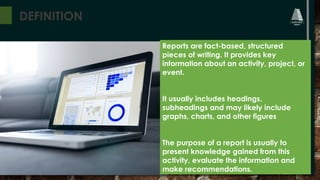
Reports are fact-based,structured
pieces of writing. It provides key
information about an activity, project, or
event.
It usually includes headings,
subheadings and may likely include
graphs, charts, and other figures
The purpose of a report is usually to
present knowledge gained from this
activity, evaluate the information and
make recommendations.
3.
WHY IS REPORTINGIMPORTANT?
BENEFITS
1. A report provides a navigational system to steer the team in the
right direction
2. It ensures consistent monitoring – you need to work with intention
and awareness
3. It gives indications of how your team is performing on a constant
basis
4. Reporting keeps the goals simple and clear
4.
WHAT TYPE OFREPORT ARE YOU WRITING?
TYPES OF
REPORT
1. Project Report e.g. Status reports (daily, weekly, monthly, quarterly)
2. Technical/Research Report e.g. Investigation report, Scientific Journals
3. Sales and Marketing Report
4. Laboratory Report e.g. Scientific report
5. Annual Report e.g. Company’s annua report
5.
PREPARE
REPORT OUTLINE
1. Whoare your audience? – for style and language
2. What is it about? (determine the core information and title of your report)
3. Why is it needed? (justify the purpose)
4. When do you need it? (set aside enough time)
5. Where will it be published ? (the distribution channels)
6. Have you got enough information? (resources and materials)
7. How will you gather data to support your report?
6.
ORGANISE
•Organise your contentinto separate sections
•Give your report sections appropriate headers
•Introduce graphic solutions to support your presentation e.g.
Tables, Diagrams, Illustrations and Infographics
THE PRINCIPLES
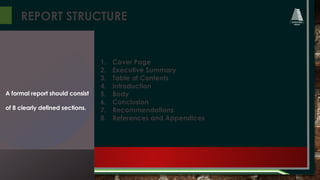
REPORT STRUCTURE
1. CoverPage
2. Executive Summary
3. Table of Contents
4. Introduction
5. Body
6. Conclusion
7. Recommendations
8. References and Appendices
A formal report should consist
of 8 clearly defined sections.
9.
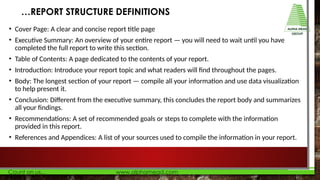
• Cover Page:A clear and concise report title page
• Executive Summary: An overview of your entire report — you will need to wait until you have
completed the full report to write this section.
• Table of Contents: A page dedicated to the contents of your report.
• Introduction: Introduce your report topic and what readers will find throughout the pages.
• Body: The longest section of your report — compile all your information and use data visualization
to help present it.
• Conclusion: Different from the executive summary, this concludes the report body and summarizes
all your findings.
• Recommendations: A set of recommended goals or steps to complete with the information
provided in this report.
• References and Appendices: A list of your sources used to compile the information in your report.
…REPORT STRUCTURE DEFINITIONS
10.
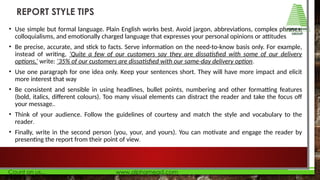
• Use simplebut formal language. Plain English works best. Avoid jargon, abbreviations, complex phrases,
colloquialisms, and emotionally charged language that expresses your personal opinions or attitudes
• Be precise, accurate, and stick to facts. Serve information on the need-to-know basis only. For example,
instead of writing, ‘Quite a few of our customers say they are dissatisfied with some of our delivery
options,’ write: ‘35% of our customers are dissatisfied with our same-day delivery option.
• Use one paragraph for one idea only. Keep your sentences short. They will have more impact and elicit
more interest that way
• Be consistent and sensible in using headlines, bullet points, numbering and other formatting features
(bold, italics, different colours). Too many visual elements can distract the reader and take the focus off
your message..
• Think of your audience. Follow the guidelines of courtesy and match the style and vocabulary to the
reader.
• Finally, write in the second person (you, your, and yours). You can motivate and engage the reader by
presenting the report from their point of view.
REPORT STYLE TIPS
12.
• Leave yourreport and come back to it later
• Proofread the whole report or have it proofread by someone else to avoid grammatical,
orthographic or punctuation errors
• A clean and correct report will demonstrate your professionalism, commitment to the
business and respect for the readers.
DO NOT SEND UNTIL YOU DO THESE…
13.
PRESENTATION OUTLINE
MSWORD MASTERY: HOW TO’s
Paragraph Formatting
Starting a Bulletted List
Changing Page Margins
Spelling and Grammar
Inserting Page Numbers
Cut and Copying
Font Formatting
Word Templates
Section Breaks