
GFR,Plasma Load,Tubular
Load,Transport Maximum,Renal
Threshold,Concept of Plasma
Clearence,Osmolar Clearence &Free
Water Clearence ,CCR,eGFR,ACR
DR.TASNIM ARA JHILKY
MD Part II
Phase A
DEPARTMENT OF BIOCHEMISTRY
SIR SALIMULLAH MEDICAL COLLEGE
MIDFORD,DHAKA
GFR
• It is the amount of glomerular filtrate
produced by all functioning nephrons of both
kidneys per minute.
• It is about 125ml/min or 180L/day in adult
male
• In female 10% less.
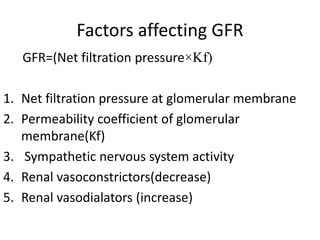
Factors affecting GFR
GFR=(Net filtration pressure×Kf)
1. Net filtration pressure at glomerular membrane
2. Permeability coefficient of glomerular
membrane(Kf)
3. Sympathetic nervous system activity
4. Renal vasoconstrictors(decrease)
5. Renal vasodialators (increase)
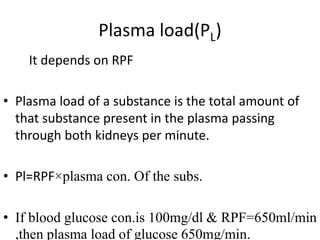
Plasma load(PL)
It depends on RPF
• Plasma load of a substance is the total amount of
that substance present in the plasma passing
through both kidneys per minute.
• Pl=RPF×plasma con. Of the subs.
• If blood glucose con.is 100mg/dl & RPF=650ml/min
,then plasma load of glucose 650mg/min.
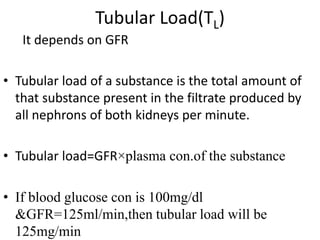
Tubular Load(TL)
It depends on GFR
• Tubular load of a substance is the total amount of
that substance present in the filtrate produced by
all nephrons of both kidneys per minute.
• Tubular load=GFR×plasma con.of the substance
• If blood glucose con is 100mg/dl
&GFR=125ml/min,then tubular load will be
125mg/min
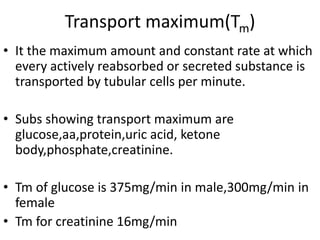
Transport maximum(Tm)
• It the maximum amount and constant rate at which
every actively reabsorbed or secreted substance is
transported by tubular cells per minute.
• Subs showing transport maximum are
glucose,aa,protein,uric acid, ketone
body,phosphate,creatinine.
• Tm of glucose is 375mg/min in male,300mg/min in
female
• Tm for creatinine 16mg/min
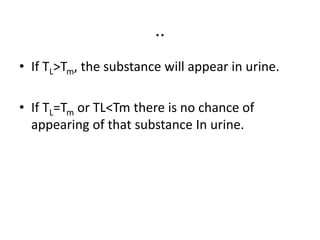
..
• If TL>Tm, the substance will appear in urine.
• If TL=Tm or TL<Tm there is no chance of
appearing of that substance In urine.
Renal threshold
• It the plasma concentration of actively reabsorbed
substance at or below which substance will not appear
in urine ,but above which substance will appear in
urine.
• It is 180mg% for glucose.
• Above the threshold value ,the TL of the subs excceds
its Tm ,so the subs fails to be completely reabsorbed
and appears in urine.
• Below the threshold value,TL expected to be well below
its Tm.so subs completely reabsorbed & does not
appear in urine.
Con………..
• Tm of glucose 375mg/min for male &300mg/min
,so to produce glycosuria TL of glucose should be
more than these respectively.
• Against the TL of glucose 300mg/min in female
&375mg/min in male their predicted renal
threshold of glucose need to be 240% in female
&same shuold be 300mg% in male .
….
• Practically renal threshold for glucose is180%
• Glycosuria occurs at plasma con of 180mg% when the
TL of glucose is only 225mg/min(less than Tmax)
• This phenomenon of glycosuria in spite of smaller TL
compared to Tmg at the renal threshold of glucose
180mg% is known as sply
Non uniformity of Tmg among the nephrons
Nephrons with low Tmg usually spill glucose in
urine at a lower plasma con than the predicted value of
240mg% or 300mg%.
Plasma clearance
• Plasma clearance of a substance is the virtual volume of
plasma that contains the amount of that substance
excreted through urine per minute.
• It is virtual volume of plasma that is cleared of that
substance by renal excretion per minute
• C=UV/P
C=Plasma clearance of the subs(ml/min)
U=Urinary concentration of the subs.(mg/ml)
V=Urinary flow rate(ml/min)
P=Plasma con of the subs(mg/ml)
.
• Plasma clearance of a subs becomes less than GFR if
the subs is partially reabsorbed(urea)
• It becomes more than GFR if the subs partially
secreted.
• Plasma clearance is zero if completely
reabsorbed(glucose)
• Plasma clearance of creatinine =70-140ml/min
• Urea clearance 60-70 ml/min
• Glucose clearance 0 ml/min
Importance of plasma clearence
• It acts as a marker of renal function.
• It is used for measurement of GFR & RPF.
• It is used as a guide to determine the
effective dose of drugs which are cleared by
kidney
• In glomerular impairment the renal clearance
of creatinine &urea decreases.
Osmolar Clearence
1. It is the virtual of plasma which contains all the
osmotically active solutes excreted through urine per
minute.
2. Cosm=(Uosm×V)/Posm
Cosm=osmolar clearance(ml/min)
Uosm=Urinary osmolarity(mosm/L)
V=Urinary flow rate (ml/min)
Posm=plasma osmolarity(mosm/l)
Cosm=(900×1.0)÷300=3ml/min
It indicates that the amount of solutes excreted by an
individual through urine in each minute in fact lies with 3
ml of plasma within blood vessel.
Free water clearence
• It is the volume of solute free water excreted or
retained per minute during formation and excretion of
urine.
• CH2O=V-Cosm
Cosm=Osmolar clearance(ml/min)
V=Urinary flow rate(ml/min)
CH2O=Free water clearance(ml/min)
• In a normal individual V=I ml/min,Cosm=3ml/min.so
free water clearance=1-3=-2
• It is usually negative,because urine is much more
concentrated than plasma.
….
• In hypertonic urine-(urinary osmolarity>300mosm)
free water clearance negative,because here urinary
solutes are excreted with less water volume then their
osmolar clearance.
• Hypotonic urine-(urinary osmolarity<300mosm/L)
free water clearance becomes positive.
• Isotonic urine-(urinary osmolarity=300mosm)free
water clearance becomes zero.
….
Concept of free water clearance is used to assess
the
• Volume of free water excretion during hypotonic
urine formation.
• Volume of free water retention during hypertonic
urine formation.
• Renal concentrating &diluting power
Measurement of GFR by plasma clearance
of inulin.
• Any substance which is freely filtered from plasma
into the filtrate,the filtrate con.will be equal to its
plasma con. In circulation
• the subs.neither reabsorbed nor secreted,not
metabolized or produced in kidney,passing through
tubular system totally appears in urine.
• so the amount of that subs present in filtrate will
be equal to its amount in urine.
infact calculate the plasma clearance of that
substance which will represent the GFR
• GFR=UV/P
• Infused intravenously at a constant rate.
• Not endogenously produced within the body
• Others sub. are mannitol,sorbitol.
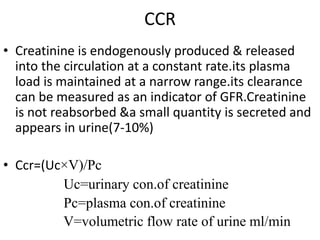
CCR
• Creatinine is endogenously produced & released
into the circulation at a constant rate.its plasma
load is maintained at a narrow range.its clearance
can be measured as an indicator of GFR.Creatinine
is not reabsorbed &a small quantity is secreted and
appears in urine(7-10%)
• Ccr=(Uc×V)/Pc
Uc=urinary con.of creatinine
Pc=plasma con.of creatinine
V=volumetric flow rate of urine ml/min
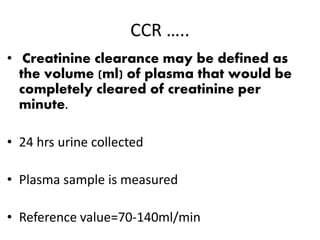
CCR …..
• Creatinine clearance may be defined as
the volume (ml) of plasma that would be
completely cleared of creatinine per
minute.
• 24 hrs urine collected
• Plasma sample is measured
• Reference value=70-140ml/min
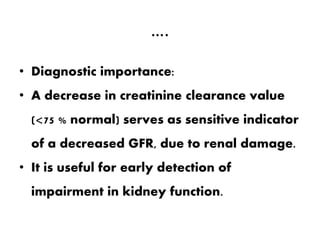
….
• Diagnostic importance:
• A decrease in creatinine clearance value
(<75 % normal) serves as sensitive indicator
of a decreased GFR, due to renal damage.
• It is useful for early detection of
impairment in kidney function.
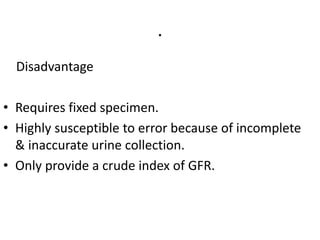
.
Disadvantage
• Requires fixed specimen.
• Highly susceptible to error because of incomplete
& inaccurate urine collection.
• Only provide a crude index of GFR.
• ADVANTAGE OF CREATININE CLEARANCE;
– A)It is a normal metabolite of the body
– B)It does not require I.V. administration
– C)Estimation of creatinine is simple
– D)In early stages it has got advantage over
S.Creatinine
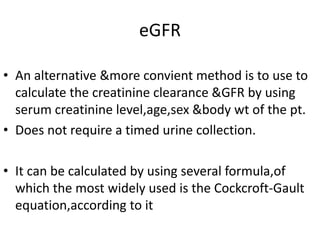
eGFR
• An alternative &more convient method is to use to
calculate the creatinine clearance &GFR by using
serum creatinine level,age,sex &body wt of the pt.
• Does not require a timed urine collection.
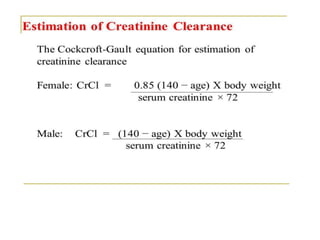
• It can be calculated by using several formula,of
which the most widely used is the Cockcroft-Gault
equation,according to it
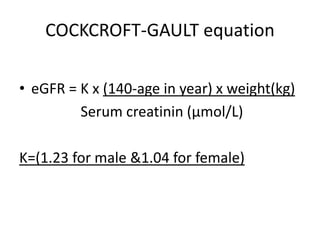
COCKCROFT-GAULT equation
• eGFR = K x (140-age in year) x weight(kg)
Serum creatinin (µmol/L)
K=(1.23 for male &1.04 for female)
….
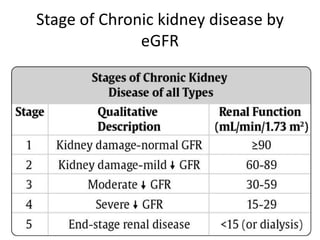
Stage of Chronic kidney disease by
eGFR
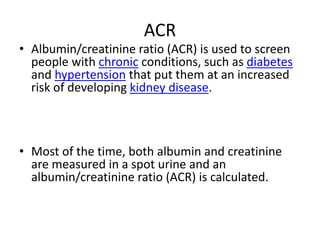
ACR
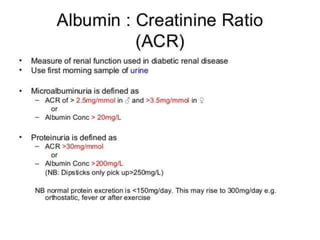
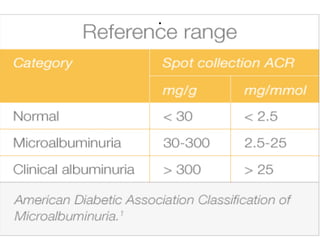
• Albumin/creatinine ratio (ACR) is used to screen
people with chronic conditions, such as diabetes
and hypertension that put them at an increased
risk of developing kidney disease.
• Most of the time, both albumin and creatinine
are measured in a spot urine and an
albumin/creatinine ratio (ACR) is calculated.
.
.
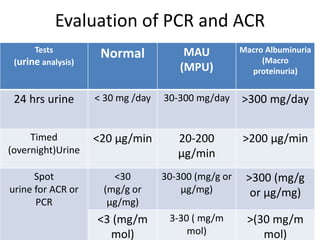
Evaluation of PCR and ACR
Tests
(urine analysis)
Normal MAU
(MPU)
Macro Albuminuria
(Macro
proteinuria)
24 hrs urine < 30 mg /day 30-300 mg/day >300 mg/day
Timed
(overnight)Urine
<20 µg/min 20-200
µg/min
>200 µg/min
Spot
urine for ACR or
PCR
<30
(mg/g or
µg/mg)
30-300 (mg/g or
µg/mg)
>300 (mg/g
or µg/mg)
<3 (mg/m
mol)
3-30 ( mg/m
mol)
>(30 mg/m
mol)
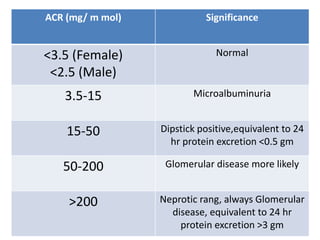
Continued..ACR (mg/ m mol) Significance
<3.5 (Female)
<2.5 (Male)
Normal
3.5-15 Microalbuminuria
15-50 Dipstick positive,equivalent to 24
hr protein excretion <0.5 gm
50-200 Glomerular disease more likely
>200 Neprotic rang, always Glomerular
disease, equivalent to 24 hr
protein excretion >3 gm
.
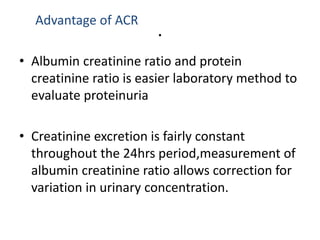
Advantage of ACR
• Albumin creatinine ratio and protein
creatinine ratio is easier laboratory method to
evaluate proteinuria
• Creatinine excretion is fairly constant
throughout the 24hrs period,measurement of
albumin creatinine ratio allows correction for
variation in urinary concentration.
Cont…
35

GFR ,plasma load,clearence,ACR,CCR,eGFR by dr.Tasnim

  • 1.
    GFR,Plasma Load,Tubular Load,Transport Maximum,Renal Threshold,Conceptof Plasma Clearence,Osmolar Clearence &Free Water Clearence ,CCR,eGFR,ACR DR.TASNIM ARA JHILKY MD Part II Phase A DEPARTMENT OF BIOCHEMISTRY SIR SALIMULLAH MEDICAL COLLEGE MIDFORD,DHAKA
  • 2.
    GFR • It isthe amount of glomerular filtrate produced by all functioning nephrons of both kidneys per minute. • It is about 125ml/min or 180L/day in adult male • In female 10% less.
  • 3.
    Factors affecting GFR GFR=(Netfiltration pressure×Kf) 1. Net filtration pressure at glomerular membrane 2. Permeability coefficient of glomerular membrane(Kf) 3. Sympathetic nervous system activity 4. Renal vasoconstrictors(decrease) 5. Renal vasodialators (increase)
  • 4.
    Plasma load(PL) It dependson RPF • Plasma load of a substance is the total amount of that substance present in the plasma passing through both kidneys per minute. • Pl=RPF×plasma con. Of the subs. • If blood glucose con.is 100mg/dl & RPF=650ml/min ,then plasma load of glucose 650mg/min.
  • 5.
    Tubular Load(TL) It dependson GFR • Tubular load of a substance is the total amount of that substance present in the filtrate produced by all nephrons of both kidneys per minute. • Tubular load=GFR×plasma con.of the substance • If blood glucose con is 100mg/dl &GFR=125ml/min,then tubular load will be 125mg/min
  • 6.
    Transport maximum(Tm) • Itthe maximum amount and constant rate at which every actively reabsorbed or secreted substance is transported by tubular cells per minute. • Subs showing transport maximum are glucose,aa,protein,uric acid, ketone body,phosphate,creatinine. • Tm of glucose is 375mg/min in male,300mg/min in female • Tm for creatinine 16mg/min
  • 7.
    .. • If TL>Tm,the substance will appear in urine. • If TL=Tm or TL<Tm there is no chance of appearing of that substance In urine.
  • 8.
    Renal threshold • Itthe plasma concentration of actively reabsorbed substance at or below which substance will not appear in urine ,but above which substance will appear in urine. • It is 180mg% for glucose. • Above the threshold value ,the TL of the subs excceds its Tm ,so the subs fails to be completely reabsorbed and appears in urine. • Below the threshold value,TL expected to be well below its Tm.so subs completely reabsorbed & does not appear in urine.
  • 9.
    Con……….. • Tm ofglucose 375mg/min for male &300mg/min ,so to produce glycosuria TL of glucose should be more than these respectively. • Against the TL of glucose 300mg/min in female &375mg/min in male their predicted renal threshold of glucose need to be 240% in female &same shuold be 300mg% in male .
  • 10.
    …. • Practically renalthreshold for glucose is180% • Glycosuria occurs at plasma con of 180mg% when the TL of glucose is only 225mg/min(less than Tmax) • This phenomenon of glycosuria in spite of smaller TL compared to Tmg at the renal threshold of glucose 180mg% is known as sply Non uniformity of Tmg among the nephrons Nephrons with low Tmg usually spill glucose in urine at a lower plasma con than the predicted value of 240mg% or 300mg%.
  • 11.
    Plasma clearance • Plasmaclearance of a substance is the virtual volume of plasma that contains the amount of that substance excreted through urine per minute. • It is virtual volume of plasma that is cleared of that substance by renal excretion per minute • C=UV/P C=Plasma clearance of the subs(ml/min) U=Urinary concentration of the subs.(mg/ml) V=Urinary flow rate(ml/min) P=Plasma con of the subs(mg/ml)
  • 12.
    . • Plasma clearanceof a subs becomes less than GFR if the subs is partially reabsorbed(urea) • It becomes more than GFR if the subs partially secreted. • Plasma clearance is zero if completely reabsorbed(glucose) • Plasma clearance of creatinine =70-140ml/min • Urea clearance 60-70 ml/min • Glucose clearance 0 ml/min
  • 13.
    Importance of plasmaclearence • It acts as a marker of renal function. • It is used for measurement of GFR & RPF. • It is used as a guide to determine the effective dose of drugs which are cleared by kidney • In glomerular impairment the renal clearance of creatinine &urea decreases.
  • 14.
    Osmolar Clearence 1. Itis the virtual of plasma which contains all the osmotically active solutes excreted through urine per minute. 2. Cosm=(Uosm×V)/Posm Cosm=osmolar clearance(ml/min) Uosm=Urinary osmolarity(mosm/L) V=Urinary flow rate (ml/min) Posm=plasma osmolarity(mosm/l) Cosm=(900×1.0)÷300=3ml/min It indicates that the amount of solutes excreted by an individual through urine in each minute in fact lies with 3 ml of plasma within blood vessel.
  • 15.
    Free water clearence •It is the volume of solute free water excreted or retained per minute during formation and excretion of urine. • CH2O=V-Cosm Cosm=Osmolar clearance(ml/min) V=Urinary flow rate(ml/min) CH2O=Free water clearance(ml/min) • In a normal individual V=I ml/min,Cosm=3ml/min.so free water clearance=1-3=-2 • It is usually negative,because urine is much more concentrated than plasma.
  • 16.
    …. • In hypertonicurine-(urinary osmolarity>300mosm) free water clearance negative,because here urinary solutes are excreted with less water volume then their osmolar clearance. • Hypotonic urine-(urinary osmolarity<300mosm/L) free water clearance becomes positive. • Isotonic urine-(urinary osmolarity=300mosm)free water clearance becomes zero.
  • 17.
    …. Concept of freewater clearance is used to assess the • Volume of free water excretion during hypotonic urine formation. • Volume of free water retention during hypertonic urine formation. • Renal concentrating &diluting power
  • 18.
    Measurement of GFRby plasma clearance of inulin. • Any substance which is freely filtered from plasma into the filtrate,the filtrate con.will be equal to its plasma con. In circulation • the subs.neither reabsorbed nor secreted,not metabolized or produced in kidney,passing through tubular system totally appears in urine.
  • 19.
    • so theamount of that subs present in filtrate will be equal to its amount in urine. infact calculate the plasma clearance of that substance which will represent the GFR • GFR=UV/P • Infused intravenously at a constant rate. • Not endogenously produced within the body • Others sub. are mannitol,sorbitol.
  • 20.
    CCR • Creatinine isendogenously produced & released into the circulation at a constant rate.its plasma load is maintained at a narrow range.its clearance can be measured as an indicator of GFR.Creatinine is not reabsorbed &a small quantity is secreted and appears in urine(7-10%) • Ccr=(Uc×V)/Pc Uc=urinary con.of creatinine Pc=plasma con.of creatinine V=volumetric flow rate of urine ml/min
  • 21.
    CCR ….. • Creatinineclearance may be defined as the volume (ml) of plasma that would be completely cleared of creatinine per minute. • 24 hrs urine collected • Plasma sample is measured • Reference value=70-140ml/min
  • 22.
    …. • Diagnostic importance: •A decrease in creatinine clearance value (<75 % normal) serves as sensitive indicator of a decreased GFR, due to renal damage. • It is useful for early detection of impairment in kidney function.
  • 23.
    . Disadvantage • Requires fixedspecimen. • Highly susceptible to error because of incomplete & inaccurate urine collection. • Only provide a crude index of GFR.
  • 24.
    • ADVANTAGE OFCREATININE CLEARANCE; – A)It is a normal metabolite of the body – B)It does not require I.V. administration – C)Estimation of creatinine is simple – D)In early stages it has got advantage over S.Creatinine
  • 25.
    eGFR • An alternative&more convient method is to use to calculate the creatinine clearance &GFR by using serum creatinine level,age,sex &body wt of the pt. • Does not require a timed urine collection. • It can be calculated by using several formula,of which the most widely used is the Cockcroft-Gault equation,according to it
  • 26.
    COCKCROFT-GAULT equation • eGFR= K x (140-age in year) x weight(kg) Serum creatinin (µmol/L) K=(1.23 for male &1.04 for female)
  • 27.
  • 28.
    Stage of Chronickidney disease by eGFR
  • 29.
    ACR • Albumin/creatinine ratio(ACR) is used to screen people with chronic conditions, such as diabetes and hypertension that put them at an increased risk of developing kidney disease. • Most of the time, both albumin and creatinine are measured in a spot urine and an albumin/creatinine ratio (ACR) is calculated.
  • 30.
  • 31.
  • 32.
    Evaluation of PCRand ACR Tests (urine analysis) Normal MAU (MPU) Macro Albuminuria (Macro proteinuria) 24 hrs urine < 30 mg /day 30-300 mg/day >300 mg/day Timed (overnight)Urine <20 µg/min 20-200 µg/min >200 µg/min Spot urine for ACR or PCR <30 (mg/g or µg/mg) 30-300 (mg/g or µg/mg) >300 (mg/g or µg/mg) <3 (mg/m mol) 3-30 ( mg/m mol) >(30 mg/m mol)
  • 33.
    Continued..ACR (mg/ mmol) Significance <3.5 (Female) <2.5 (Male) Normal 3.5-15 Microalbuminuria 15-50 Dipstick positive,equivalent to 24 hr protein excretion <0.5 gm 50-200 Glomerular disease more likely >200 Neprotic rang, always Glomerular disease, equivalent to 24 hr protein excretion >3 gm
  • 34.
    . Advantage of ACR •Albumin creatinine ratio and protein creatinine ratio is easier laboratory method to evaluate proteinuria • Creatinine excretion is fairly constant throughout the 24hrs period,measurement of albumin creatinine ratio allows correction for variation in urinary concentration.
  • 35.