Renal Failure
Types Acute  Chronic
Acute renal failure Sudden onset with oliguria/anuria Rapid rise in BUN and S Creatinine
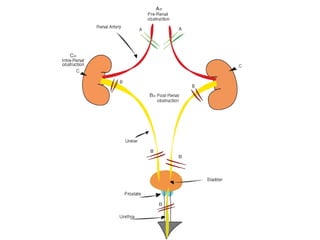
RENAL DISEASE – CLINICAL FEATURES Azotaemia = BUN  ,  Creatinine  - biochemical abnormality Pre renal - due to renal hypoperfusion  ( shock, haemorrhage, CCF). No parenchymal renal disease. Renal  – due to renal parenchymal disease. Post renal  – due to obstruction to urine outflow below kidney. Uraemia = azotemia + S/S of renal failure
 
Types Pre-renal Intra-renal Post-renal
 
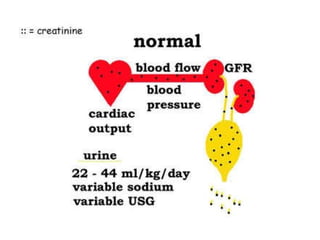
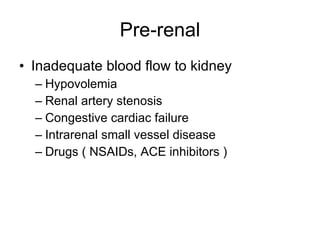
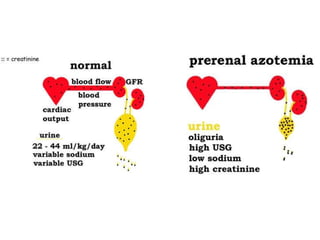
Pre-renal Inadequate blood flow to kidney Hypovolemia Renal artery stenosis Congestive cardiac failure Intrarenal small vessel disease Drugs ( NSAIDs, ACE inhibitors )
 
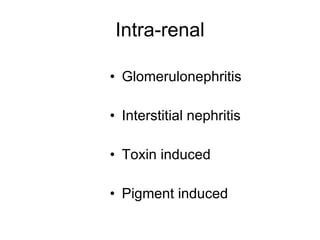
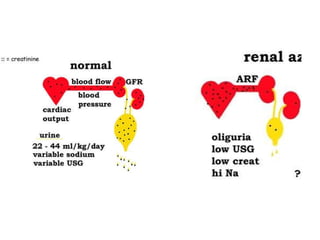
Intra-renal Glomerulonephritis Interstitial nephritis Toxin induced Pigment induced
 
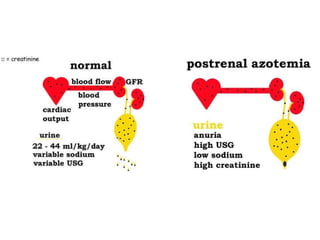
Post-renal Intra – renal obstruction Extra – renal obstruction
 
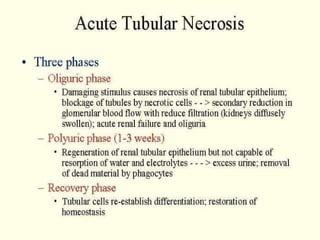
Pathogenesis ARF leads to acute tubular necrosis Hypoxic injury
 
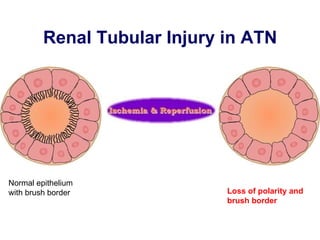
Renal Tubular Injury in ATN Loss of polarity and brush border   Normal epithelium with brush border
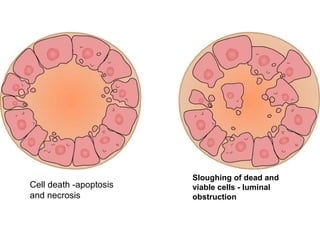
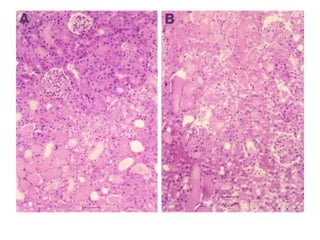
Cell death -apoptosis and necrosis  Sloughing of dead and viable cells - luminal obstruction
 
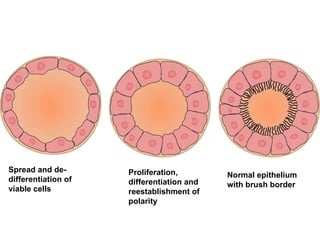
Spread and de-differentiation of viable cells   Proliferation, differentiation and reestablishment of polarity Normal epithelium with brush border
Urinary abnormalities ATN – Granular, epithelial casts, urine osmolality < 350 mOsm/L
Other abnormalities Hyperkalemia Azotemia Metabolic acidosis Hyponatremia and hypervolemia
Prevention and treatment Supportive care Fluid and sodium restriction Treat the hyperkalemia, acidosis Dialysis
Dialysis Increased intravascular volume leading to CHF, Pulmonary edema, intractable hypertension Non-responsive hyperkalemia Symptomatic uremia – lethargy, neurologic changes, seizures
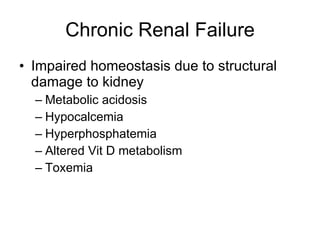
Chronic Renal Failure Impaired homeostasis due to structural damage to kidney Metabolic acidosis Hypocalcemia Hyperphosphatemia Altered Vit D metabolism Toxemia
 
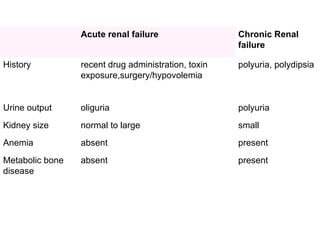
  present absent Metabolic bone disease present absent Anemia small normal to large Kidney size polyuria oliguria Urine output polyuria, polydipsia recent drug administration, toxin exposure,surgery/hypovolemia  History Chronic Renal failure Acute renal failure
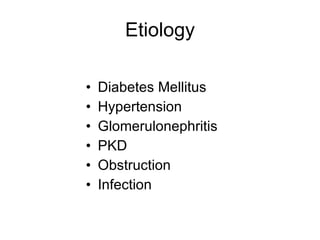
Etiology Diabetes Mellitus Hypertension Glomerulonephritis PKD Obstruction Infection
Stages Decreased renal reserve Renal insufficiency  Renal failure Uremia
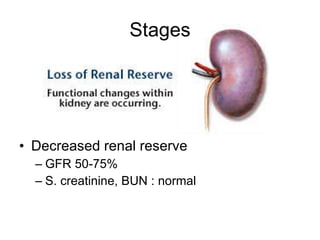
Stages Decreased renal reserve  GFR 50-75% S. creatinine, BUN : normal
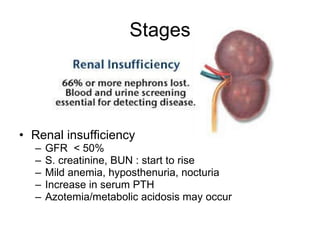
Stages Renal insufficiency  GFR  < 50% S. creatinine, BUN : start to rise Mild anemia, hyposthenuria, nocturia Increase in serum PTH Azotemia/metabolic acidosis may occur
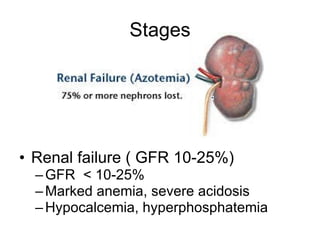
Stages Renal failure ( GFR 10-25%) GFR  < 10-25% Marked anemia, severe acidosis Hypocalcemia, hyperphosphatemia                                                                                                 
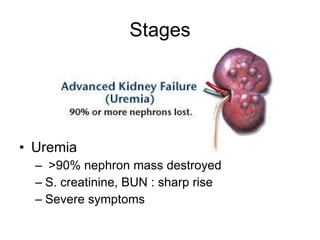
Stages Uremia >90% nephron mass destroyed S. creatinine, BUN : sharp rise Severe symptoms
Pathogenesis Intact nephron hypothesis Trade off hypothesis Glomerular hyperfiltration hypothesis
Intact nephron hypothesis GFR is reduced, number of functional nephrons is reduced,  but amount of solutes excreted remains same  When >75% nephron mass is destroyed – BUN and S. creatinine begin to rise
Trade off hypothesis Increased blood conc. of some solutes stimulate secretion of other factors Retention of phosphate – release of PTH – increased Ca levels & reduced phosphate, reduced bicarbonate absorption – acidosis ,osteomalacia, calcification
Glomerular hyperfiltration hypothesis With progressive loss of some nephrons, hyperfiltration occurs in the remaining – leads to fibrosis and scarring Any added stress precipitates Uremia
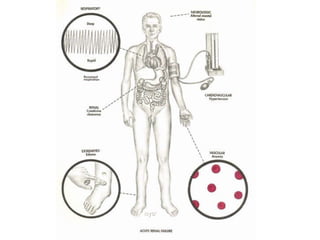
Alterations of metabolism and function Disorders of Urine Disorders of Water and Sodium balance Disorders of Potassium balance Metabolic Acidosis Renal Azotemia Renal Hypertension Calcium, Phosphate and bone metabolism Renal anemia and bleeding tendency
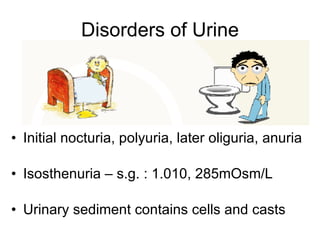
Disorders of Urine Initial nocturia, polyuria, later oliguria, anuria Isosthenuria – s.g. : 1.010, 285mOsm/L Urinary sediment contains cells and casts
Disorders of Water and Sodium balance Continued ingestion of salt – CHF, Hypertension, edema Excess water ingestion – Hyponatremia, hypervolemia, weight gain ECF depletion - shock
Disorders of Potassium balance Hyperkalemia if GFR < 5% by potassium sparing diuretics and in Diabetes mellitus(hyporeninemic hypoaldosteronism) ->reduced angiotensin II & impairs aldosterone secretion.
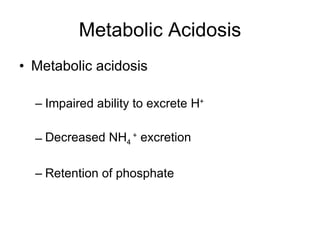
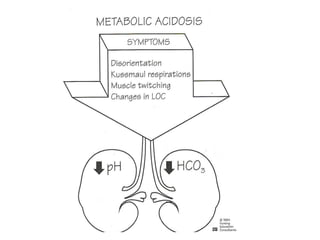
Metabolic Acidosis Metabolic acidosis Impaired ability to excrete H + Decreased NH 4  +  excretion Retention of phosphate
 
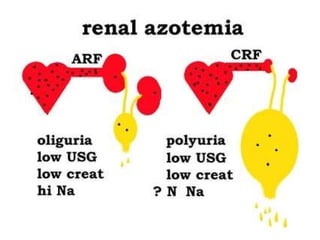
Renal Azotemia Increase of non-protein-nitrogen Urea, creatinine, phenols, amines, urates, guanidines
Renal Hypertension Fluid and Na overload(usual cause) Hyper-reninemia(less often) by failing kidney in response to falling renal perfusion.
Calcium, Phosphate and bone metabolism Diminished absorption of calcium from the gut Overproduction of parathormone Disordered Vit D metabolism Chronic metabolic acidosis Hypophospatemia
Renal anemia and bleeding tendency Lack of erythropoietin Bone marrow suppression Bone marrow fibrosis due to PTH Aluminum toxicity Dialysis related blood loss Coagulation defects – mainly platelet related
 
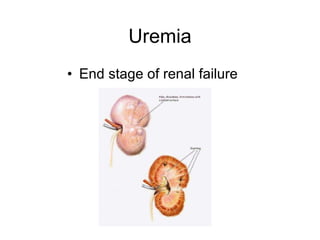
Uremia End stage of renal failure
Etiology & Pathogenesis Urea & other small m.w. molecules Middle molecules Polypeptide hormones
Urea & other small m.w. molecules When Blood urea > 300mg/dL – anorexia, weakness, headache, vomiting and bleeding Phenol, cresol, catechol, hydroquinone Methylguanidine Polyamines – putrescine, cadaverine, spermidine
Middle molecules Mol wt – 300 to 5000 Greater morbidity In vitro – neurotoxicity, inhibits hemopoiesis, lymphoblast transformation, glucose utilization, fibroblast proliferation, leukocyte phagocytic activity and platelet aggregation
Polypeptide hormones Insulin, Glucagon, PTH, gastrin, calcitonin Trade off hypothesis
Alterations of metabolism and function Neuromuscular Cardiovascular and pulmonary Hematological Gastrointestinal Endocrine and metabolic Dermatologic Immunologic
Neuromuscular CNS – mild insomnia to seizures, coma PNS – restless legs syndrome, foot drop Aluminum toxicity, disequilibrium syndrome
Cardiovascular and pulmonary CHF, Pulmonary edema  Uremic pericarditis Arrhythmias Accelerated atherosclerosis
Hematological Lack of erythropoietin Bone marrow suppression Bone marrow fibrosis due to PTH Aluminum toxicity Dialysis related blood loss Coagulation defects – mainly platelet related
Gastro intestinal Nausea, vomiting When GFR<10%, anorexia Uremic colitis, peptic ulcer Uremic gastroenteritis
Endocrine and metabolic Low estrogen in women – amenorrhoea, infertility Low testosterone in men – impotence, oligospermia, germ cell dysplasia Increased half life of insulin
Dermatologic Pallor due to anemia Gray discoloration due to hemochromatosis Ecchymosis & hematomas Pruritis & excoriations Uremic frost
Immunologic Immune suppression
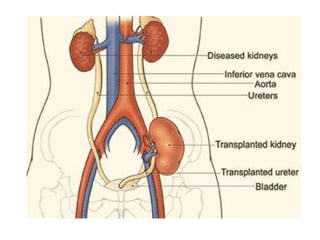
Prevention & treatment Conservative Dialysis  Peritoneal / hemodialysis Renal transplantation
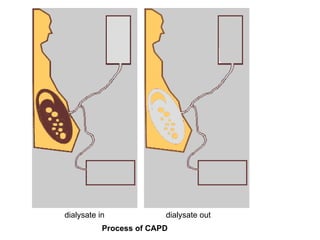
dialysate out  dialysate in  Process of CAPD 


Renal failure

  • 1.
  • 2.
    Types Acute Chronic
  • 3.
    Acute renal failureSudden onset with oliguria/anuria Rapid rise in BUN and S Creatinine
  • 4.
    RENAL DISEASE –CLINICAL FEATURES Azotaemia = BUN , Creatinine - biochemical abnormality Pre renal - due to renal hypoperfusion ( shock, haemorrhage, CCF). No parenchymal renal disease. Renal – due to renal parenchymal disease. Post renal – due to obstruction to urine outflow below kidney. Uraemia = azotemia + S/S of renal failure
  • 5.
  • 6.
  • 7.
  • 8.
    Pre-renal Inadequate bloodflow to kidney Hypovolemia Renal artery stenosis Congestive cardiac failure Intrarenal small vessel disease Drugs ( NSAIDs, ACE inhibitors )
  • 9.
  • 10.
    Intra-renal Glomerulonephritis Interstitialnephritis Toxin induced Pigment induced
  • 11.
  • 12.
    Post-renal Intra –renal obstruction Extra – renal obstruction
  • 13.
  • 14.
    Pathogenesis ARF leadsto acute tubular necrosis Hypoxic injury
  • 15.
  • 16.
    Renal Tubular Injuryin ATN Loss of polarity and brush border Normal epithelium with brush border
  • 17.
    Cell death -apoptosisand necrosis Sloughing of dead and viable cells - luminal obstruction
  • 18.
  • 19.
    Spread and de-differentiationof viable cells Proliferation, differentiation and reestablishment of polarity Normal epithelium with brush border
  • 20.
    Urinary abnormalities ATN– Granular, epithelial casts, urine osmolality < 350 mOsm/L
  • 21.
    Other abnormalities HyperkalemiaAzotemia Metabolic acidosis Hyponatremia and hypervolemia
  • 22.
    Prevention and treatmentSupportive care Fluid and sodium restriction Treat the hyperkalemia, acidosis Dialysis
  • 23.
    Dialysis Increased intravascularvolume leading to CHF, Pulmonary edema, intractable hypertension Non-responsive hyperkalemia Symptomatic uremia – lethargy, neurologic changes, seizures
  • 24.
    Chronic Renal FailureImpaired homeostasis due to structural damage to kidney Metabolic acidosis Hypocalcemia Hyperphosphatemia Altered Vit D metabolism Toxemia
  • 25.
  • 26.
      present absentMetabolic bone disease present absent Anemia small normal to large Kidney size polyuria oliguria Urine output polyuria, polydipsia recent drug administration, toxin exposure,surgery/hypovolemia History Chronic Renal failure Acute renal failure
  • 27.
    Etiology Diabetes MellitusHypertension Glomerulonephritis PKD Obstruction Infection
  • 28.
    Stages Decreased renalreserve Renal insufficiency Renal failure Uremia
  • 29.
    Stages Decreased renalreserve GFR 50-75% S. creatinine, BUN : normal
  • 30.
    Stages Renal insufficiency GFR < 50% S. creatinine, BUN : start to rise Mild anemia, hyposthenuria, nocturia Increase in serum PTH Azotemia/metabolic acidosis may occur
  • 31.
    Stages Renal failure( GFR 10-25%) GFR < 10-25% Marked anemia, severe acidosis Hypocalcemia, hyperphosphatemia                                                                                                 
  • 32.
    Stages Uremia >90%nephron mass destroyed S. creatinine, BUN : sharp rise Severe symptoms
  • 33.
    Pathogenesis Intact nephronhypothesis Trade off hypothesis Glomerular hyperfiltration hypothesis
  • 34.
    Intact nephron hypothesisGFR is reduced, number of functional nephrons is reduced, but amount of solutes excreted remains same When >75% nephron mass is destroyed – BUN and S. creatinine begin to rise
  • 35.
    Trade off hypothesisIncreased blood conc. of some solutes stimulate secretion of other factors Retention of phosphate – release of PTH – increased Ca levels & reduced phosphate, reduced bicarbonate absorption – acidosis ,osteomalacia, calcification
  • 36.
    Glomerular hyperfiltration hypothesisWith progressive loss of some nephrons, hyperfiltration occurs in the remaining – leads to fibrosis and scarring Any added stress precipitates Uremia
  • 37.
    Alterations of metabolismand function Disorders of Urine Disorders of Water and Sodium balance Disorders of Potassium balance Metabolic Acidosis Renal Azotemia Renal Hypertension Calcium, Phosphate and bone metabolism Renal anemia and bleeding tendency
  • 38.
    Disorders of UrineInitial nocturia, polyuria, later oliguria, anuria Isosthenuria – s.g. : 1.010, 285mOsm/L Urinary sediment contains cells and casts
  • 39.
    Disorders of Waterand Sodium balance Continued ingestion of salt – CHF, Hypertension, edema Excess water ingestion – Hyponatremia, hypervolemia, weight gain ECF depletion - shock
  • 40.
    Disorders of Potassiumbalance Hyperkalemia if GFR < 5% by potassium sparing diuretics and in Diabetes mellitus(hyporeninemic hypoaldosteronism) ->reduced angiotensin II & impairs aldosterone secretion.
  • 41.
    Metabolic Acidosis Metabolicacidosis Impaired ability to excrete H + Decreased NH 4 + excretion Retention of phosphate
  • 42.
  • 43.
    Renal Azotemia Increaseof non-protein-nitrogen Urea, creatinine, phenols, amines, urates, guanidines
  • 44.
    Renal Hypertension Fluidand Na overload(usual cause) Hyper-reninemia(less often) by failing kidney in response to falling renal perfusion.
  • 45.
    Calcium, Phosphate andbone metabolism Diminished absorption of calcium from the gut Overproduction of parathormone Disordered Vit D metabolism Chronic metabolic acidosis Hypophospatemia
  • 46.
    Renal anemia andbleeding tendency Lack of erythropoietin Bone marrow suppression Bone marrow fibrosis due to PTH Aluminum toxicity Dialysis related blood loss Coagulation defects – mainly platelet related
  • 47.
  • 48.
    Uremia End stageof renal failure
  • 49.
    Etiology & PathogenesisUrea & other small m.w. molecules Middle molecules Polypeptide hormones
  • 50.
    Urea & othersmall m.w. molecules When Blood urea > 300mg/dL – anorexia, weakness, headache, vomiting and bleeding Phenol, cresol, catechol, hydroquinone Methylguanidine Polyamines – putrescine, cadaverine, spermidine
  • 51.
    Middle molecules Molwt – 300 to 5000 Greater morbidity In vitro – neurotoxicity, inhibits hemopoiesis, lymphoblast transformation, glucose utilization, fibroblast proliferation, leukocyte phagocytic activity and platelet aggregation
  • 52.
    Polypeptide hormones Insulin,Glucagon, PTH, gastrin, calcitonin Trade off hypothesis
  • 53.
    Alterations of metabolismand function Neuromuscular Cardiovascular and pulmonary Hematological Gastrointestinal Endocrine and metabolic Dermatologic Immunologic
  • 54.
    Neuromuscular CNS –mild insomnia to seizures, coma PNS – restless legs syndrome, foot drop Aluminum toxicity, disequilibrium syndrome
  • 55.
    Cardiovascular and pulmonaryCHF, Pulmonary edema Uremic pericarditis Arrhythmias Accelerated atherosclerosis
  • 56.
    Hematological Lack oferythropoietin Bone marrow suppression Bone marrow fibrosis due to PTH Aluminum toxicity Dialysis related blood loss Coagulation defects – mainly platelet related
  • 57.
    Gastro intestinal Nausea,vomiting When GFR<10%, anorexia Uremic colitis, peptic ulcer Uremic gastroenteritis
  • 58.
    Endocrine and metabolicLow estrogen in women – amenorrhoea, infertility Low testosterone in men – impotence, oligospermia, germ cell dysplasia Increased half life of insulin
  • 59.
    Dermatologic Pallor dueto anemia Gray discoloration due to hemochromatosis Ecchymosis & hematomas Pruritis & excoriations Uremic frost
  • 60.
  • 61.
    Prevention & treatmentConservative Dialysis Peritoneal / hemodialysis Renal transplantation
  • 62.
    dialysate out dialysate in Process of CAPD 
  • 63.
  • 64.