Presented By: Interns
Dr Jeevan Shrestha
Dr Sanjeev Shrestha
Dr Manish Maharjan
Date: 14th September 2017
RENAL CELL CARCINOMA
 I have no conflict of interest or disclosure in
relation to this presentation.
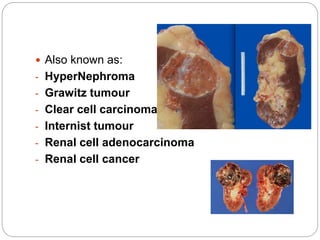
 Also known as:
- HyperNephroma
- Grawitz tumour
- Clear cell carcinoma
- Internist tumour
- Renal cell adenocarcinoma
- Renal cell cancer
 First described by Konig in 1826
 In 1883, Grawitz, noted the fatty content of
cancer cells similar to that of adrenal cells.
 3% of adult malignancies
 90-95% of neoplasms arising from the kidney
 2 % - 4% increase in incidence per year
Adenocarcinoma arising from renal tubular cells.
- Most common site: Proximal Renal Tubules
- Common in males(M:F= 1.6:1)
- More common in 5th -7th decade of life.
- Median age at diagnosis from 2002 to 2006 was 64 years
- Median age of death was 70 years
- This non capsulated tumour is very vascular.
- 30% presents with metastatic disease.
- 10th leading cause of cancer deaths in males in the
United States
Phenotypic and Molecular Characteristic :
 Site of Origin
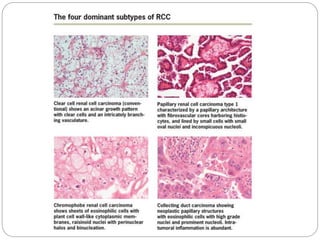
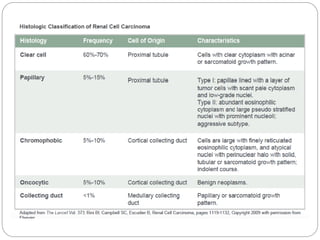
 Proximal Nephron: 1. Clear cell carcinoma(75%)
- VHL mutation
- Hypermethylation
- LOH 3p25
2. Papillary Carcinoma(15%)
-HPRC(type 1) :
Met protooncogene mutation
-HLRCC(type 2):
Fumarate Hydratase mutation
-7q3 Trisomy
 Distal Nephron:
- Oncocytoma
- Chromophobe Carcinoma
- Collecting duct carcinoma
- Undifferentiated carcinoma(<2%)
Risk Factors:
- Tobacco Smoking(24-30% cases)
2 fold increase risk for RCC
- Obesity , HTN
- Cystic Kidney disease patient after long term dialysis
- Hormonal : Diethylistillbestrol
- Occupational: Leather tanning, shoe workers,asbestos
 Genetic:
- Von Hippel-Lindau (VHL) syndrome [ 3p25] :
Bilateral
- Hereditary papillary renal carcinoma (HPRC)
- Familial renal oncocytoma (FRO) associated
with Birt-Hogg-Dube syndrome (BHDS)
- Hereditary renal carcinoma (HRC)
- Analgesic(Phenacetin)
- Family History Positive : 2.5 x greater risk
- Dietary: High fat/ Protein
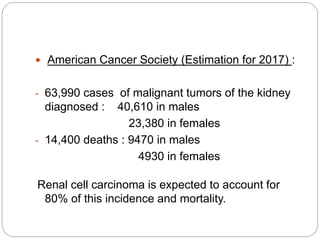
 American Cancer Society (Estimation for 2017) :
- 63,990 cases of malignant tumors of the kidney
diagnosed : 40,610 in males
23,380 in females
- 14,400 deaths : 9470 in males
4930 in females
Renal cell carcinoma is expected to account for
80% of this incidence and mortality.
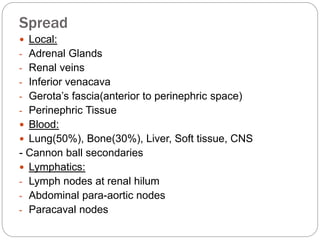
Spread
 Local:
- Adrenal Glands
- Renal veins
- Inferior venacava
- Gerota’s fascia(anterior to perinephric space)
- Perinephric Tissue
 Blood:
 Lung(50%), Bone(30%), Liver, Soft tissue, CNS
- Cannon ball secondaries
 Lymphatics:
- Lymph nodes at renal hilum
- Abdominal para-aortic nodes
- Paracaval nodes
Case:
 55 year male
 c/o: Swelling in left loin x 9 months
Pain in the left loin x 6 months
Passage of blood in urine x 6 months
- Swelling in the left loin gradually increasing in size
associated with dull aching continuous pain
- Passage of blood in urine, dark red in color,often with
clots, intermittent at interval of 10-15 days and lasts for
about 2-3 days.
- Swelling in left side of scrotum is also present for 2
months.
- Examination: General examinatin normal except
patient is anemic
 Systemic examination:
 Inspection: Normal contour of abdomen with no
scar, distension, engorged vein, or any visible
peristalsis
 Palpation:
- Left kidney is palpable extending from left lumbar to
left hypochondrium.
- Medial, lateral and lower margin is palpable with
irregular surgace, non tender, firm,moving slightly
with respiration.
- Liver and spleen arenot palpable
 Percussion: Dullness in renal angle
 Ausculation: BS +
 Local examination of external genitalia: Normal
except mild degree of varicocele on left side.
Clinical Presentaion
 Most are asymptomatic(25%-35%) until development of metastasis
 Incidental
Classical triad(10%cases):
- HEMATURIA(40%)
- LOIN PAIN(40%)
- PALPABLE MASS IN THE FLANK OR ABDOMEN(25%)
Metastasis:
Persisent Cough, Bone pain, Cervical lymphadenopathy, Weight loss, fever,
Malaise
Obstruction of Inferior venacava:
Bilateral lower extremity edema
Right sided varicocele
Left sided varicocele(2% males):
-due to compression of testicular vein
-Irreducible
Constitutional symptoms: Fever/sweating/Malaise/Weight
Paraneoplastic syndrome
 Polycythemia(Erythropoietin)
 Hypercalcemia(Parathyroid hormone related peptide)
 Hypertension(Renin)
 Hepatic dysfunction
 Feminisation
 Masculinisation
 Cushing Syndrome(ACTH)
 Eosinophilia
 Leukemoid reaction
 Amyloidosis
 Stauffer syndrome : Non metastatic reversible liver
dysfunction which gets corrected after nephrectomy.
Diagnostic tests
 History and physical examination
 Laboratory: CBC,ESR, Serum Calcium,LDH, Renal profile, LFT
 Urine microscopy: Look for RBC
 RADIOLOGICAL:
 USG abdomen: To know size, extension, lymph node involvement,
spread, status of renal veins and inferior venacava
 Intravenous pyelography: Lack of sensitivity and specificity
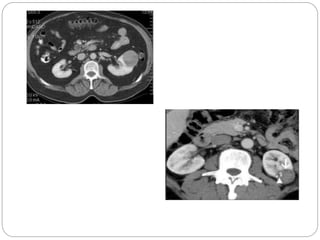
 Thin slice renal CT scan with and without IV contrast is the best
test for diagnosing renal masses.
-Detects early lesion,function,spread, venous status, lymph node
status, tumour extension.
-CECT : Helps to find out function of opposite kidney.
- Any renal mass that enhances with IV administration of contrast on
CT by more than 15 HU should be considered an RCC until
proved otherwise(Hartman et al, 2004)
 Chest Xray: May show calcified cannon ball
secondaries
 MRI:
-Diagnostic to assess the tumour thrombus in IVC.
- To evaluate collecting system
 Renal angiogram: To see vasularity
 Pharmacoangiogram(Inject noradrenaline along with
dye while doing angiogram)
- Tumour blush can be visualised.
- As tumour vessels are autonomous they willnot
constrict.
 Bone scan: To see secondaries
 Inferior venacavogram
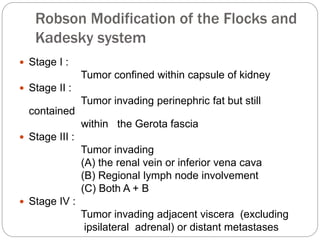
Robson Modification of the Flocks and
Kadesky system
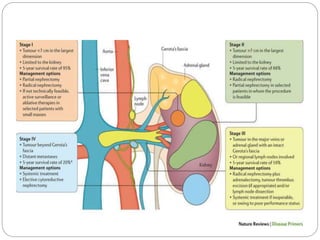
 Stage I :
Tumor confined within capsule of kidney
 Stage II :
Tumor invading perinephric fat but still
contained
within the Gerota fascia
 Stage III :
Tumor invading
(A) the renal vein or inferior vena cava
(B) Regional lymph node involvement
(C) Both A + B
 Stage IV :
Tumor invading adjacent viscera (excluding
ipsilateral adrenal) or distant metastases
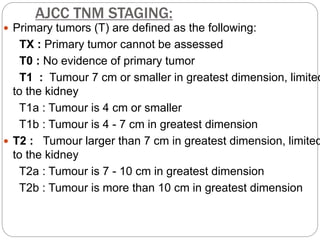
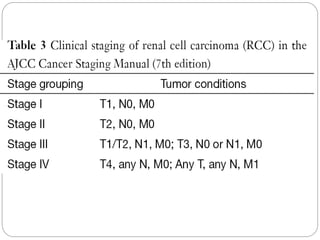
AJCC TNM STAGING:
 Primary tumors (T) are defined as the following:
TX : Primary tumor cannot be assessed
T0 : No evidence of primary tumor
T1 : Tumour 7 cm or smaller in greatest dimension, limited
to the kidney
T1a : Tumour is 4 cm or smaller
T1b : Tumour is 4 - 7 cm in greatest dimension
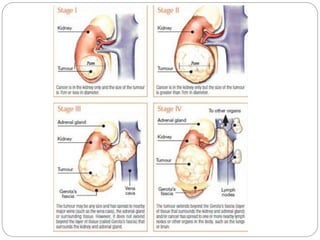
 T2 : Tumour larger than 7 cm in greatest dimension, limited
to the kidney
T2a : Tumour is 7 - 10 cm in greatest dimension
T2b : Tumour is more than 10 cm in greatest dimension
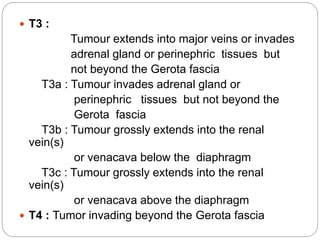
 T3 :
Tumour extends into major veins or invades
adrenal gland or perinephric tissues but
not beyond the Gerota fascia
T3a : Tumour invades adrenal gland or
perinephric tissues but not beyond the
Gerota fascia
T3b : Tumour grossly extends into the renal
vein(s)
or venacava below the diaphragm
T3c : Tumour grossly extends into the renal
vein(s)
or venacava above the diaphragm
 T4 : Tumor invading beyond the Gerota fascia
 Regional lymph node (N) classification is not
affected by laterality and is defined as follows:
 NX – Regional lymph nodes cannot be assessed
 N0 – No regional lymph node metastasis
 N1 – Metastasis in regional lymph node(s)
 Distant metastasis (M) is defined as the following:
 M0 – No distant metastasis
 M1 – Distant metastasis
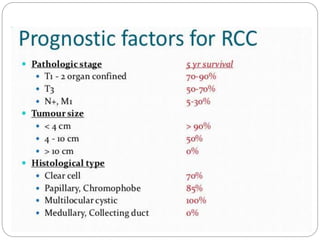
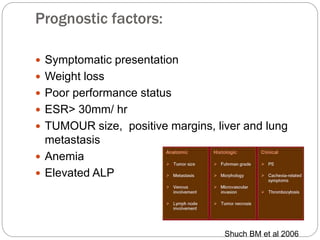
Prognostic factors:
 Symptomatic presentation
 Weight loss
 Poor performance status
 ESR> 30mm/ hr
 TUMOUR size, positive margins, liver and lung
metastasis
 Anemia
 Elevated ALP
Shuch BM et al 2006
Treatment
 Surgery is the treatment of choice
 Partial Nephrectomy
 Radical Nephrectomy
 Chemotherapy (RCC is mostly chemoresistant)
 Angioinfarction
 Immunotherapy
 Adjuvant: Tyrosine kinase Inhibitors(TKI’s)
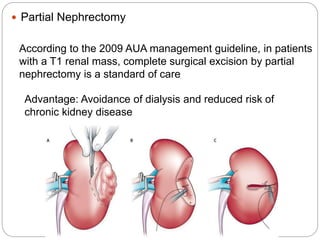
 Partial Nephrectomy
According to the 2009 AUA management guideline, in patients
with a T1 renal mass, complete surgical excision by partial
nephrectomy is a standard of care
Advantage: Avoidance of dialysis and reduced risk of
chronic kidney disease
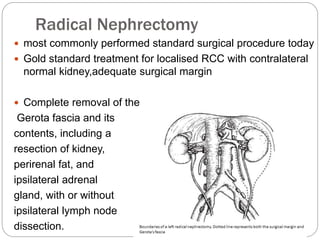
Radical Nephrectomy
 most commonly performed standard surgical procedure today
 Gold standard treatment for localised RCC with contralateral
normal kidney,adequate surgical margin
 Complete removal of the
Gerota fascia and its
contents, including a
resection of kidney,
perirenal fat, and
ipsilateral adrenal
gland, with or without
ipsilateral lymph node
dissection.
Molecular-Targeted Agents
 Sunitinib
 Bevacizumab in combination with interferon
 Pazopanib
 Temsirolimus
 Everolimus
 Lenvatinib in combination with everolimus
 Nivolumab
 Cabozantinib
 Sorafenib
 Axitinib
Sunitinib
- Multikinase inhibitor
- Receptor inhibited:
- Vascular endothelial growth factor receptors 1,2,
and 3 (VEGFR 1-3), Platelet-derived growth
factor receptor alpha (PDGFR-alpha), and
PDGFR-beta
- Recommended dose for advanced renal cell
carcinoma is one 50 mg oral dose taken once
daily, with or without food, on a schedule of 4
weeks on treatment, followed by 2 weeks off
treatment
Chemotherapy
 Floxuridine (5-fluoro 2'-deoxyuridine [FUDR])
 5-fluorouracil (5-FU)
 Vinblastine
 paclitaxel (Taxol)
 carboplatin
 ifosfamide
 gemcitabine
 anthracycline (doxorubicin)
 RCC is refractory to most chemotherapeutic agents
because of multidrug resistance mediated by p-
glycoprotein
Experimental Therapeutic Approaches
 Immunomodulatory drugs (eg, lenalidomide)
 Vaccines
 Nonmyeloablative allogeneic peripheral blood
stem-cell transplantation
 Megestrol and antiestrogens
Radiation Therapy
 primary therapy for palliation(Painful osseous lesion
or brain metastasis)
 RCC is radioresistant tumor
 radiation treatment of brain metastasis improves
quality of life, local control, and overall survival
duration.
 Symptomatic relied in 64-84% patients
 Renal Artery Embolization:
 Ethanol and gelatin sponge pledgets has been found
effective for palliative treatment
 retrospective study in 8 patients with stage IV disease
found that ethanol ablation controlled hematuria and
flank pain
Thank you

Renal cell carcinoma

  • 1.
    Presented By: Interns DrJeevan Shrestha Dr Sanjeev Shrestha Dr Manish Maharjan Date: 14th September 2017 RENAL CELL CARCINOMA
  • 2.
     I haveno conflict of interest or disclosure in relation to this presentation.
  • 3.
     Also knownas: - HyperNephroma - Grawitz tumour - Clear cell carcinoma - Internist tumour - Renal cell adenocarcinoma - Renal cell cancer
  • 4.
     First describedby Konig in 1826  In 1883, Grawitz, noted the fatty content of cancer cells similar to that of adrenal cells.  3% of adult malignancies  90-95% of neoplasms arising from the kidney  2 % - 4% increase in incidence per year
  • 5.
    Adenocarcinoma arising fromrenal tubular cells. - Most common site: Proximal Renal Tubules - Common in males(M:F= 1.6:1) - More common in 5th -7th decade of life. - Median age at diagnosis from 2002 to 2006 was 64 years - Median age of death was 70 years - This non capsulated tumour is very vascular. - 30% presents with metastatic disease. - 10th leading cause of cancer deaths in males in the United States
  • 6.
    Phenotypic and MolecularCharacteristic :  Site of Origin  Proximal Nephron: 1. Clear cell carcinoma(75%) - VHL mutation - Hypermethylation - LOH 3p25 2. Papillary Carcinoma(15%) -HPRC(type 1) : Met protooncogene mutation -HLRCC(type 2): Fumarate Hydratase mutation -7q3 Trisomy  Distal Nephron: - Oncocytoma - Chromophobe Carcinoma - Collecting duct carcinoma - Undifferentiated carcinoma(<2%)
  • 9.
    Risk Factors: - TobaccoSmoking(24-30% cases) 2 fold increase risk for RCC - Obesity , HTN - Cystic Kidney disease patient after long term dialysis - Hormonal : Diethylistillbestrol - Occupational: Leather tanning, shoe workers,asbestos  Genetic: - Von Hippel-Lindau (VHL) syndrome [ 3p25] : Bilateral - Hereditary papillary renal carcinoma (HPRC) - Familial renal oncocytoma (FRO) associated with Birt-Hogg-Dube syndrome (BHDS) - Hereditary renal carcinoma (HRC) - Analgesic(Phenacetin) - Family History Positive : 2.5 x greater risk - Dietary: High fat/ Protein
  • 11.
     American CancerSociety (Estimation for 2017) : - 63,990 cases of malignant tumors of the kidney diagnosed : 40,610 in males 23,380 in females - 14,400 deaths : 9470 in males 4930 in females Renal cell carcinoma is expected to account for 80% of this incidence and mortality.
  • 12.
    Spread  Local: - AdrenalGlands - Renal veins - Inferior venacava - Gerota’s fascia(anterior to perinephric space) - Perinephric Tissue  Blood:  Lung(50%), Bone(30%), Liver, Soft tissue, CNS - Cannon ball secondaries  Lymphatics: - Lymph nodes at renal hilum - Abdominal para-aortic nodes - Paracaval nodes
  • 13.
    Case:  55 yearmale  c/o: Swelling in left loin x 9 months Pain in the left loin x 6 months Passage of blood in urine x 6 months - Swelling in the left loin gradually increasing in size associated with dull aching continuous pain - Passage of blood in urine, dark red in color,often with clots, intermittent at interval of 10-15 days and lasts for about 2-3 days. - Swelling in left side of scrotum is also present for 2 months. - Examination: General examinatin normal except patient is anemic
  • 14.
     Systemic examination: Inspection: Normal contour of abdomen with no scar, distension, engorged vein, or any visible peristalsis  Palpation: - Left kidney is palpable extending from left lumbar to left hypochondrium. - Medial, lateral and lower margin is palpable with irregular surgace, non tender, firm,moving slightly with respiration. - Liver and spleen arenot palpable  Percussion: Dullness in renal angle  Ausculation: BS +  Local examination of external genitalia: Normal except mild degree of varicocele on left side.
  • 15.
    Clinical Presentaion  Mostare asymptomatic(25%-35%) until development of metastasis  Incidental Classical triad(10%cases): - HEMATURIA(40%) - LOIN PAIN(40%) - PALPABLE MASS IN THE FLANK OR ABDOMEN(25%) Metastasis: Persisent Cough, Bone pain, Cervical lymphadenopathy, Weight loss, fever, Malaise Obstruction of Inferior venacava: Bilateral lower extremity edema Right sided varicocele Left sided varicocele(2% males): -due to compression of testicular vein -Irreducible Constitutional symptoms: Fever/sweating/Malaise/Weight
  • 16.
    Paraneoplastic syndrome  Polycythemia(Erythropoietin) Hypercalcemia(Parathyroid hormone related peptide)  Hypertension(Renin)  Hepatic dysfunction  Feminisation  Masculinisation  Cushing Syndrome(ACTH)  Eosinophilia  Leukemoid reaction  Amyloidosis  Stauffer syndrome : Non metastatic reversible liver dysfunction which gets corrected after nephrectomy.
  • 17.
    Diagnostic tests  Historyand physical examination  Laboratory: CBC,ESR, Serum Calcium,LDH, Renal profile, LFT  Urine microscopy: Look for RBC  RADIOLOGICAL:  USG abdomen: To know size, extension, lymph node involvement, spread, status of renal veins and inferior venacava  Intravenous pyelography: Lack of sensitivity and specificity  Thin slice renal CT scan with and without IV contrast is the best test for diagnosing renal masses. -Detects early lesion,function,spread, venous status, lymph node status, tumour extension. -CECT : Helps to find out function of opposite kidney. - Any renal mass that enhances with IV administration of contrast on CT by more than 15 HU should be considered an RCC until proved otherwise(Hartman et al, 2004)
  • 18.
     Chest Xray:May show calcified cannon ball secondaries  MRI: -Diagnostic to assess the tumour thrombus in IVC. - To evaluate collecting system  Renal angiogram: To see vasularity  Pharmacoangiogram(Inject noradrenaline along with dye while doing angiogram) - Tumour blush can be visualised. - As tumour vessels are autonomous they willnot constrict.  Bone scan: To see secondaries  Inferior venacavogram
  • 20.
    Robson Modification ofthe Flocks and Kadesky system  Stage I : Tumor confined within capsule of kidney  Stage II : Tumor invading perinephric fat but still contained within the Gerota fascia  Stage III : Tumor invading (A) the renal vein or inferior vena cava (B) Regional lymph node involvement (C) Both A + B  Stage IV : Tumor invading adjacent viscera (excluding ipsilateral adrenal) or distant metastases
  • 22.
    AJCC TNM STAGING: Primary tumors (T) are defined as the following: TX : Primary tumor cannot be assessed T0 : No evidence of primary tumor T1 : Tumour 7 cm or smaller in greatest dimension, limited to the kidney T1a : Tumour is 4 cm or smaller T1b : Tumour is 4 - 7 cm in greatest dimension  T2 : Tumour larger than 7 cm in greatest dimension, limited to the kidney T2a : Tumour is 7 - 10 cm in greatest dimension T2b : Tumour is more than 10 cm in greatest dimension
  • 23.
     T3 : Tumourextends into major veins or invades adrenal gland or perinephric tissues but not beyond the Gerota fascia T3a : Tumour invades adrenal gland or perinephric tissues but not beyond the Gerota fascia T3b : Tumour grossly extends into the renal vein(s) or venacava below the diaphragm T3c : Tumour grossly extends into the renal vein(s) or venacava above the diaphragm  T4 : Tumor invading beyond the Gerota fascia
  • 24.
     Regional lymphnode (N) classification is not affected by laterality and is defined as follows:  NX – Regional lymph nodes cannot be assessed  N0 – No regional lymph node metastasis  N1 – Metastasis in regional lymph node(s)  Distant metastasis (M) is defined as the following:  M0 – No distant metastasis  M1 – Distant metastasis
  • 28.
    Prognostic factors:  Symptomaticpresentation  Weight loss  Poor performance status  ESR> 30mm/ hr  TUMOUR size, positive margins, liver and lung metastasis  Anemia  Elevated ALP Shuch BM et al 2006
  • 29.
    Treatment  Surgery isthe treatment of choice  Partial Nephrectomy  Radical Nephrectomy  Chemotherapy (RCC is mostly chemoresistant)  Angioinfarction  Immunotherapy  Adjuvant: Tyrosine kinase Inhibitors(TKI’s)
  • 30.
     Partial Nephrectomy Accordingto the 2009 AUA management guideline, in patients with a T1 renal mass, complete surgical excision by partial nephrectomy is a standard of care Advantage: Avoidance of dialysis and reduced risk of chronic kidney disease
  • 31.
    Radical Nephrectomy  mostcommonly performed standard surgical procedure today  Gold standard treatment for localised RCC with contralateral normal kidney,adequate surgical margin  Complete removal of the Gerota fascia and its contents, including a resection of kidney, perirenal fat, and ipsilateral adrenal gland, with or without ipsilateral lymph node dissection.
  • 32.
    Molecular-Targeted Agents  Sunitinib Bevacizumab in combination with interferon  Pazopanib  Temsirolimus  Everolimus  Lenvatinib in combination with everolimus  Nivolumab  Cabozantinib  Sorafenib  Axitinib
  • 34.
    Sunitinib - Multikinase inhibitor -Receptor inhibited: - Vascular endothelial growth factor receptors 1,2, and 3 (VEGFR 1-3), Platelet-derived growth factor receptor alpha (PDGFR-alpha), and PDGFR-beta - Recommended dose for advanced renal cell carcinoma is one 50 mg oral dose taken once daily, with or without food, on a schedule of 4 weeks on treatment, followed by 2 weeks off treatment
  • 35.
    Chemotherapy  Floxuridine (5-fluoro2'-deoxyuridine [FUDR])  5-fluorouracil (5-FU)  Vinblastine  paclitaxel (Taxol)  carboplatin  ifosfamide  gemcitabine  anthracycline (doxorubicin)  RCC is refractory to most chemotherapeutic agents because of multidrug resistance mediated by p- glycoprotein
  • 36.
    Experimental Therapeutic Approaches Immunomodulatory drugs (eg, lenalidomide)  Vaccines  Nonmyeloablative allogeneic peripheral blood stem-cell transplantation  Megestrol and antiestrogens
  • 37.
    Radiation Therapy  primarytherapy for palliation(Painful osseous lesion or brain metastasis)  RCC is radioresistant tumor  radiation treatment of brain metastasis improves quality of life, local control, and overall survival duration.  Symptomatic relied in 64-84% patients  Renal Artery Embolization:  Ethanol and gelatin sponge pledgets has been found effective for palliative treatment  retrospective study in 8 patients with stage IV disease found that ethanol ablation controlled hematuria and flank pain
  • 38.