JJ615-MECHANICAL COMPONENTS &
MAINTENANCE
CHAPTER 1 :

MAINTENANCE PRINCIPLE &PROCEDURES
SHATIS KUMAR A/L KALIMUTHU
AHMAD SUHAIB ANSARI BIN BAHIKI
JIVINDERRAN A/L PRABAGARAN
NOR ASYIKIN BINTI ABDULLAH
NUR MAIZATUL FAZIRA BNTI MOHD AZAHA
PARANITHARAN A/L BRAPAKARAN

15DKM11F1087
15DKM11F1094
15DKM11F1095
15DKM11F1096
15DKM11F1097
15DKM11F1099
Maintenance
• In general, Maintenance means to
hold, keep, sustain or preserve
• Maintenance is an activity involved in keeping
something in good working order, and actions
performed to keep systems functioning or in
service.
Principle Of Maintenance
• To achieve product quality and customer
satisfaction through adjusted and serviced
equipment
• Maximize useful life of equipment
• Keep equipment safe and prevent safety
hazards
• Minimize frequency and severity of
interruptions
Objectives
• Must be consistent with the goals of
production (cost, quality, delivery, safety)
• Must be comprehensive and include specific
responsibilities
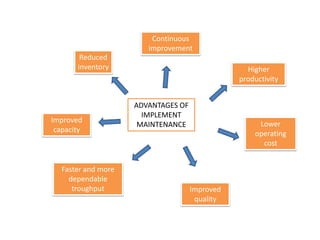
Continuous
improvement
Reduced
inventory

Improved
capacity

Faster and more
dependable
troughput

Higher
productivity
ADVANTAGES OF
IMPLEMENT
MAINTENANCE

Lower
operating
cost

Improved
quality
• Reduced inventory
-Reducing stores and buffer stock.
• Continuous improvement
-Is on going effort to improve product
services or process.
• Higher productivity
-Is high ratio of output to input of
production.
• Improved capacity
-Improve the capacity of product.
• Improved quality
-Achieve a step change in quality through
contracting out the service with the new
service level agreement.
• Lower operating cost
-Expenses which are related to the
operation of a organization in a lower
cost.
TYPE OF COST MAINTENANCE
COST
MAINTENANCE
UNPLANNED
MAINTENANCE
EMERGENCY @
BREAKDOWN
MAINTENANCE
OPPORTUNITIE
MAINTENANCE
CORRECTIVE
MAINTENANCE

PLANNED
MAINTENANCE
CORRECTIVE
MAINTENANCE
PREDECTIVE
MAINTENANCE

ROUTINE
MAINTENANCE
DESIGN OUT
MAINTENANCE

PERVENTIVE
MAINTENANCE
CONDITION
BASE
MAINTENANCE

SCHEDULE
MAINTENANCE
VARIOUS TYPE OF COST
MAINTENANCE AND RELATED
• Emergency @ breakdown maintenance
It means that people waits until equipment fails
and repair it.
• Periodic maintenance
It means periodically inspecting, servicing and
cleaning equipment and replacing parts to prevent
sudden failure and process problems.
• Corrective maintenance
It improves equipment and its components so that
preventive maintenance can be carried out reliably.
VARIOUS TYPE OF COST
MAINTENANCE AND RELATED
• Routine maintenance
-It is a daily maintenance ( cleaning, inspection, oiling
and re-tightening ),
• Preventive maintenance
-It design to retain the healthy condition of
equipment and prevent failure
• Predictive maintenance
-It is a method in which the service life of important
part is predicted based on inspection or diagnosis, in
order to use the parts to the limit of their service life.
WORKPLACE SAFETY
Benefits Of Clean and Working
Environment
• Reduced Accidents
– reduce accidents that can result in employees
injuring their backs, legs, shoulders or other body
parts because of broken equipment, and also wet
areas where people can slip.

• Air Quality
– Employees will literally breathe easier in safe
workplaces free from chemical pollution,
asbestos, dust, cigarette smoke or other allergens.
• Reduced stress
– Unsafe workplaces may cause unhealthy stress
levels among employees fearful of threats from
co-workers, dramatic altercations with
management or persistent problems related to
parking lot theft and other challenges.
Personal Protective Equipment (PPE)
• Personal protective equipment (PPE) refers to
protective clothing, helmets, goggles, or other
garments or equipment designed to protect
the wearer's body from injury.The hazards
addressed by protective equipment include
physical, electrical, heat, chemicals,
biohazards, and airborne particulate matter.
Examples
Gloves
Hearing
protection

Protective
clothing
Safety
helemt

respirator
Goggles
Safety
boots
Important Of Personal Protective
Equipment
• To reduce employee exposure to hazards
when engineering and administrative controls
are not feasible or effective in reducing these
exposures to acceptable level.PPE is needed
when there are hazards present.PPE has the
serious limitation that it does not eliminate
the hazard at source and may result in
employees being exposed to the hazard if the
equipment fails.
Lockout and Tagout
• Lockout/Tagout refers to the procedures
established for Control of Hazardous Energy as
described by the Occupational Safety and
Health Administration (OSHA) under Federal
Registry 29 CFR1910.147.
• Lockout/Tagout ensures employee safety
during inspection, maintenance, or service of
equipment by controlling all energy flow to
and from the equipment.
• To achieve system lockout, all energy sources
are turned off or disconnected, and stored
energy is released, restrained, or dissipated. A
lock or lockout device applied to each energy
source prevents accidental startup.
• Tag out is a labelling process that is always
used when lockout is required.The process of
tagging out a system involves attaching or
using an indicator.
Lock out/tag out sign

Tag out label

Lock out
Lock out/tag out program
• Lockout/Tagout specification includes the
following:
–
–
–
–
–

Plant or company-wide safety policies.
Machine-specific lockout procedures.
Lock and key and tag control.
Program review and certification.
Outside contractor rules and regulations.

• All companies whose employees service or
maintain equipment with potentially hazardous
energy sources must have an OSHA-compliant
Lockout/Tagout program.
Purpose of lock out/tag out
• A lockout/tag out program will help prevent:
– Contact with a hazard while performing tasks that
require the removal, by-passing, or deactivation of
safe guarding devices.
– The unintended release of hazardous energy
(stored energy).
– The unintended start-up or motion of machinery,
equipment or processes.
When lock out/tag out is required?
• Lockout/Tagout is required whenever
employees are exposed to hazardous energy
• It is also a procedures that are required
whenever you must remove or bypass a
machine guard or other safety device, and
place any part of your body where you could
be caught by moving machinery.
Hazardous materials
• Hazardous materials or Hazmat, are solids,
gases, and liquids that can hard people,
animals property, and the environment.
Throughout the U.S.hazardous materials are
moved by marine vessels, air, rail, and truck.
• During the servicing and maintenance of
machines and equipment, the unexpected
startup or release of stored energy could
cause injury to employees.
Hazardous Energy
Electrical

mechanical

hydraulic

Hazardous
energy

pnuematic

chemical

thermal
Hazardous materials sign
Organizations that given safety at
Hazardous materials
• The Occupational Safety and Health Act (OSH
Act) gives OSHA authority to promulgate the
hazardous materials regulations.
• EPA Hazoardous materials organization has
primary responsibility for regulating the
transport of hazardous materials across all
modes except pipelines
Hand Tools
Chisel
• Remove unwanted timber
or to carve it out

Clamps
• to create inward pressure to
secure objects or materials
together to prevent
movement or separation.
Hammer
• To deliver an impact or
force such as pounding or
striking to an object.

Hand saw
• used to cut materials with
its blade.
Screwdrivers
• Screwdrivers are used for
driving screws into
materials or for securing or
loosening parts on
machinery.

Planer
• A planer is used to shape or
thin out a piece of timber
by removing small amounts
of wood.
Wrench
• It s used to for
gripping, fastening,rotating
,loosing or turning
bolts,nuts and screw.

Pliers
• These are used to hold
objects firmly for bending
or physical compression.
Power Tools
Circular saw
• Circular saws are similar to
jigsaws only the blade is
round and much larger
which means it is better for
straight cuts.

Drill
• Used for drilling holes or
inserting and removing
screws from a material.
Jigsaw
• used for cutting curves
much like a coping saw as it
uses a similar sized blade
only it cuts much quicker.

Electric Planer
• Electric planers are the
same as hand planers only
they work automatically
which makes planning much
faster and easier.
Router
• create curved edges and
mill out timber making
them very useful.

Belt sander
• creates scratches if it is used
against the woods grain but
it removes more material.
Air Compressor
• An air compressor is a
device that converts power
(usually from an electric
motor, a diesel engine or a
gasoline engine)

4″ Angle Grinder
• also known as a side
grinder or disc grinder, is a
handheld power tool used
for cutting,grinding
and polishing.
Important of inspecting a hand tools &
power tools
• The purpose of the inspection is to ensure a
well-functioning tools
• Identify tools that are not broken
• Keep the tool to be used does not pose a high
risk

mechanical components & maintenance

  • 1.
    JJ615-MECHANICAL COMPONENTS & MAINTENANCE CHAPTER1 : MAINTENANCE PRINCIPLE &PROCEDURES SHATIS KUMAR A/L KALIMUTHU AHMAD SUHAIB ANSARI BIN BAHIKI JIVINDERRAN A/L PRABAGARAN NOR ASYIKIN BINTI ABDULLAH NUR MAIZATUL FAZIRA BNTI MOHD AZAHA PARANITHARAN A/L BRAPAKARAN 15DKM11F1087 15DKM11F1094 15DKM11F1095 15DKM11F1096 15DKM11F1097 15DKM11F1099
  • 2.
    Maintenance • In general,Maintenance means to hold, keep, sustain or preserve • Maintenance is an activity involved in keeping something in good working order, and actions performed to keep systems functioning or in service.
  • 3.
    Principle Of Maintenance •To achieve product quality and customer satisfaction through adjusted and serviced equipment • Maximize useful life of equipment • Keep equipment safe and prevent safety hazards • Minimize frequency and severity of interruptions
  • 4.
    Objectives • Must beconsistent with the goals of production (cost, quality, delivery, safety) • Must be comprehensive and include specific responsibilities
  • 5.
  • 6.
    • Reduced inventory -Reducingstores and buffer stock. • Continuous improvement -Is on going effort to improve product services or process. • Higher productivity -Is high ratio of output to input of production.
  • 7.
    • Improved capacity -Improvethe capacity of product. • Improved quality -Achieve a step change in quality through contracting out the service with the new service level agreement. • Lower operating cost -Expenses which are related to the operation of a organization in a lower cost.
  • 8.
    TYPE OF COSTMAINTENANCE COST MAINTENANCE UNPLANNED MAINTENANCE EMERGENCY @ BREAKDOWN MAINTENANCE OPPORTUNITIE MAINTENANCE CORRECTIVE MAINTENANCE PLANNED MAINTENANCE CORRECTIVE MAINTENANCE PREDECTIVE MAINTENANCE ROUTINE MAINTENANCE DESIGN OUT MAINTENANCE PERVENTIVE MAINTENANCE CONDITION BASE MAINTENANCE SCHEDULE MAINTENANCE
  • 9.
    VARIOUS TYPE OFCOST MAINTENANCE AND RELATED • Emergency @ breakdown maintenance It means that people waits until equipment fails and repair it. • Periodic maintenance It means periodically inspecting, servicing and cleaning equipment and replacing parts to prevent sudden failure and process problems. • Corrective maintenance It improves equipment and its components so that preventive maintenance can be carried out reliably.
  • 10.
    VARIOUS TYPE OFCOST MAINTENANCE AND RELATED • Routine maintenance -It is a daily maintenance ( cleaning, inspection, oiling and re-tightening ), • Preventive maintenance -It design to retain the healthy condition of equipment and prevent failure • Predictive maintenance -It is a method in which the service life of important part is predicted based on inspection or diagnosis, in order to use the parts to the limit of their service life.
  • 11.
  • 12.
    Benefits Of Cleanand Working Environment • Reduced Accidents – reduce accidents that can result in employees injuring their backs, legs, shoulders or other body parts because of broken equipment, and also wet areas where people can slip. • Air Quality – Employees will literally breathe easier in safe workplaces free from chemical pollution, asbestos, dust, cigarette smoke or other allergens.
  • 13.
    • Reduced stress –Unsafe workplaces may cause unhealthy stress levels among employees fearful of threats from co-workers, dramatic altercations with management or persistent problems related to parking lot theft and other challenges.
  • 14.
    Personal Protective Equipment(PPE) • Personal protective equipment (PPE) refers to protective clothing, helmets, goggles, or other garments or equipment designed to protect the wearer's body from injury.The hazards addressed by protective equipment include physical, electrical, heat, chemicals, biohazards, and airborne particulate matter.
  • 15.
  • 16.
    Important Of PersonalProtective Equipment • To reduce employee exposure to hazards when engineering and administrative controls are not feasible or effective in reducing these exposures to acceptable level.PPE is needed when there are hazards present.PPE has the serious limitation that it does not eliminate the hazard at source and may result in employees being exposed to the hazard if the equipment fails.
  • 17.
    Lockout and Tagout •Lockout/Tagout refers to the procedures established for Control of Hazardous Energy as described by the Occupational Safety and Health Administration (OSHA) under Federal Registry 29 CFR1910.147. • Lockout/Tagout ensures employee safety during inspection, maintenance, or service of equipment by controlling all energy flow to and from the equipment.
  • 18.
    • To achievesystem lockout, all energy sources are turned off or disconnected, and stored energy is released, restrained, or dissipated. A lock or lockout device applied to each energy source prevents accidental startup. • Tag out is a labelling process that is always used when lockout is required.The process of tagging out a system involves attaching or using an indicator.
  • 19.
    Lock out/tag outsign Tag out label Lock out
  • 20.
    Lock out/tag outprogram • Lockout/Tagout specification includes the following: – – – – – Plant or company-wide safety policies. Machine-specific lockout procedures. Lock and key and tag control. Program review and certification. Outside contractor rules and regulations. • All companies whose employees service or maintain equipment with potentially hazardous energy sources must have an OSHA-compliant Lockout/Tagout program.
  • 21.
    Purpose of lockout/tag out • A lockout/tag out program will help prevent: – Contact with a hazard while performing tasks that require the removal, by-passing, or deactivation of safe guarding devices. – The unintended release of hazardous energy (stored energy). – The unintended start-up or motion of machinery, equipment or processes.
  • 22.
    When lock out/tagout is required? • Lockout/Tagout is required whenever employees are exposed to hazardous energy • It is also a procedures that are required whenever you must remove or bypass a machine guard or other safety device, and place any part of your body where you could be caught by moving machinery.
  • 23.
    Hazardous materials • Hazardousmaterials or Hazmat, are solids, gases, and liquids that can hard people, animals property, and the environment. Throughout the U.S.hazardous materials are moved by marine vessels, air, rail, and truck. • During the servicing and maintenance of machines and equipment, the unexpected startup or release of stored energy could cause injury to employees.
  • 24.
  • 25.
  • 26.
    Organizations that givensafety at Hazardous materials • The Occupational Safety and Health Act (OSH Act) gives OSHA authority to promulgate the hazardous materials regulations. • EPA Hazoardous materials organization has primary responsibility for regulating the transport of hazardous materials across all modes except pipelines
  • 27.
    Hand Tools Chisel • Removeunwanted timber or to carve it out Clamps • to create inward pressure to secure objects or materials together to prevent movement or separation.
  • 28.
    Hammer • To deliveran impact or force such as pounding or striking to an object. Hand saw • used to cut materials with its blade.
  • 29.
    Screwdrivers • Screwdrivers areused for driving screws into materials or for securing or loosening parts on machinery. Planer • A planer is used to shape or thin out a piece of timber by removing small amounts of wood.
  • 30.
    Wrench • It sused to for gripping, fastening,rotating ,loosing or turning bolts,nuts and screw. Pliers • These are used to hold objects firmly for bending or physical compression.
  • 31.
    Power Tools Circular saw •Circular saws are similar to jigsaws only the blade is round and much larger which means it is better for straight cuts. Drill • Used for drilling holes or inserting and removing screws from a material.
  • 32.
    Jigsaw • used forcutting curves much like a coping saw as it uses a similar sized blade only it cuts much quicker. Electric Planer • Electric planers are the same as hand planers only they work automatically which makes planning much faster and easier.
  • 33.
    Router • create curvededges and mill out timber making them very useful. Belt sander • creates scratches if it is used against the woods grain but it removes more material.
  • 34.
    Air Compressor • Anair compressor is a device that converts power (usually from an electric motor, a diesel engine or a gasoline engine) 4″ Angle Grinder • also known as a side grinder or disc grinder, is a handheld power tool used for cutting,grinding and polishing.
  • 35.
    Important of inspectinga hand tools & power tools • The purpose of the inspection is to ensure a well-functioning tools • Identify tools that are not broken • Keep the tool to be used does not pose a high risk